Posted on

Nevada Site Visits – Day 1 – Silver One Resources

Silver One Resources

Does successful investing within the junior resource sector start with choosing the right metal?

I’ve said it many times, I believe speculating in the direction of a metal price is essentially impossible to do with any consistency, and shouldn’t be the reason for investing in a junior resource company.

This statement is more controversial than I had imagined and has been challenged many times over the last 3 or 4 months.

Let’s use the gold price as an example. The narrative surrounding higher gold prices can take many forms, but for most people, a higher future gold price is driven by the instability of the global financial system, which has been propped up by quantitative easing and low interest rates throughout the world.

I have no issue with that argument.
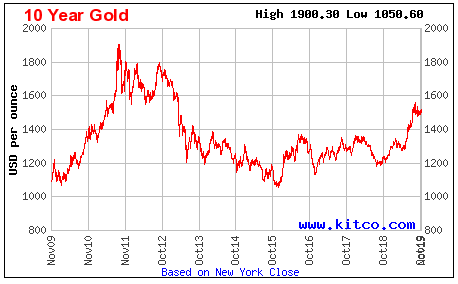
However, from 2011 to 2015, the gold price was almost cut in half and, as we all know as junior resource sector investors, besides the 8 month blip in 2016, the juniors, on a whole, have been in a bear market since 2012.

So why the precipitous fall from grace?

  • Must have been the miraculous repair of the global financial system.

Not a chance. In my opinion, the global financial system has only worsened over the last 8 years. Countries are more in debt than ever and interest rates continue to be near record lows.

  • So, it must be gold supply manipulation by the world’s central banks.

Maybe, but honestly, I find it very hard to accept any thesis on gold supply and demand considering that, essentially, all the gold ever mined still exists.

  • US$1900/oz was too high, the market over valued the amount of risk in the global market.

I’m not sure I have heard anyone use that argument to explain the fall in the gold price, but I think that there is some sensibility to it. Personally, though, given where we are today, I think we will see the gold price break US$2000/oz.

When? Great question! I have no idea and there-in lies one of the main issues with metal price speculation.

In reality, given a long enough timeframe, you can be right about the direction of the metal price, however, given the time value of money, are you actually right?

My point with this example is to show that while the popular narrative and the fundamentals of a metal appear to be pointing to a rising metal price, global markets are complex and hard to predict.

Thus, it’s my opinion that especially for the average investor, there’s very little value in trying to guess or follow someone who believes that they can predict the direction of a metal price.

If you’re bullish on the metal, buy the metal – it doesn’t come with the risk associated with the miners, who can lose you money due to a variety of factors that include exploration failure, poor metallurgy or political strife.

Successful investing in junior resource companies is predicated on 3 main criteria: Invest in the best people, protect your downside risk, and be a deep thinker – see through the popular narrative.
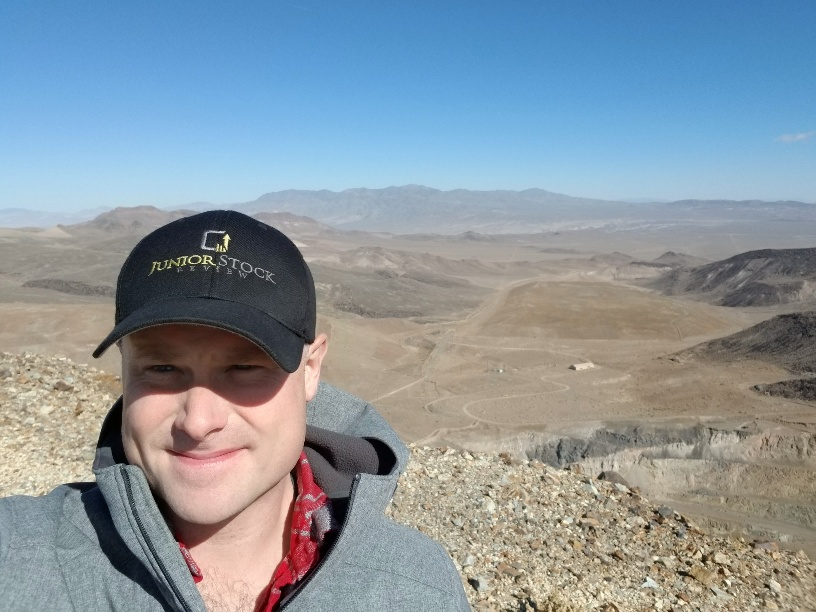
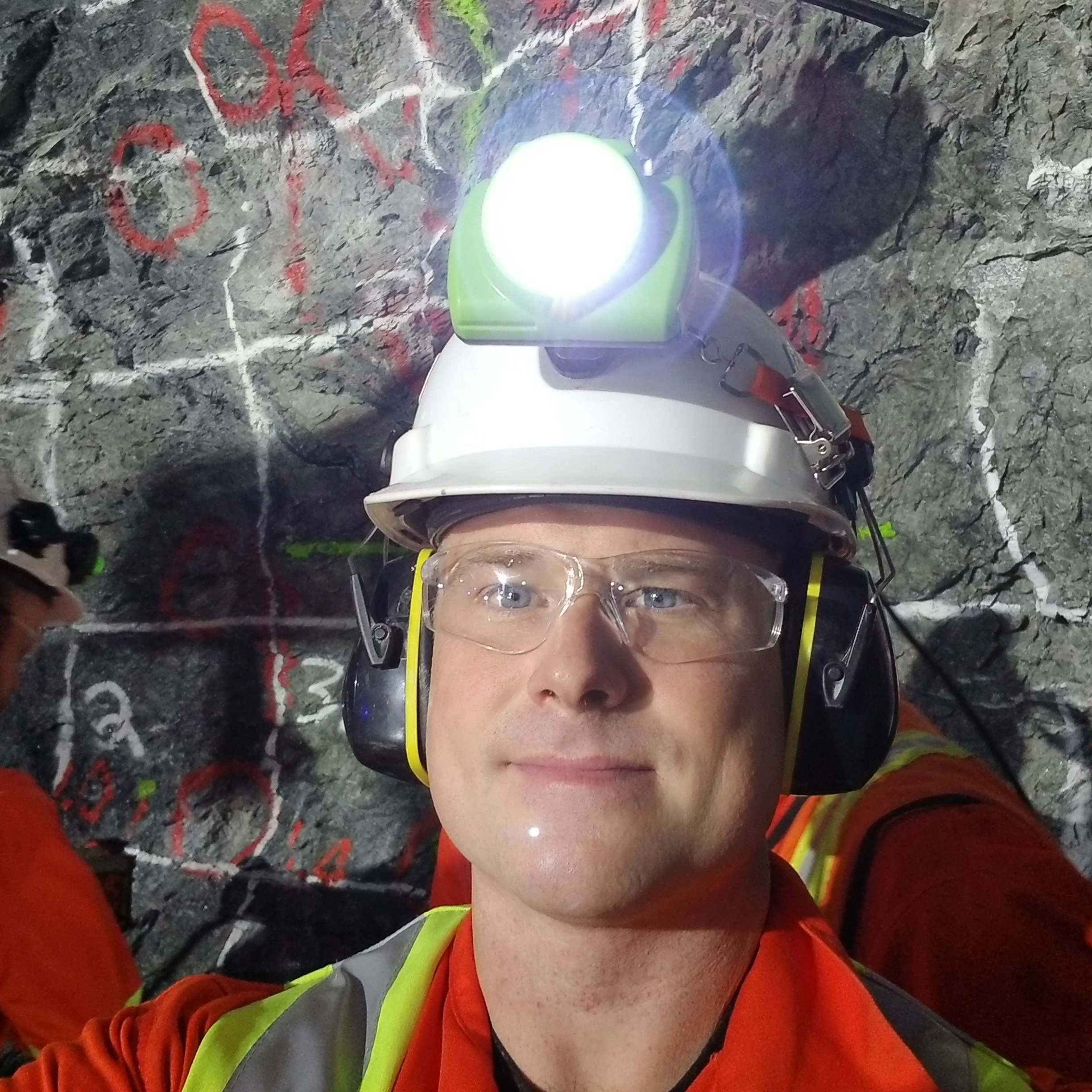
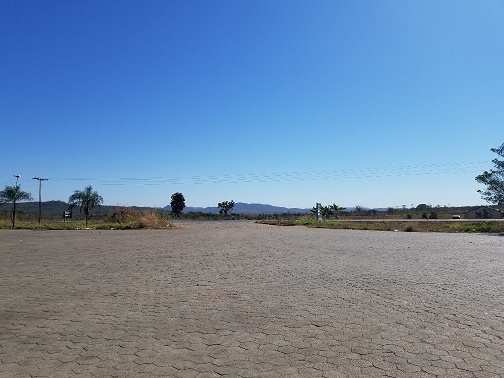
Interstate and Entrance to the project is directly behind me

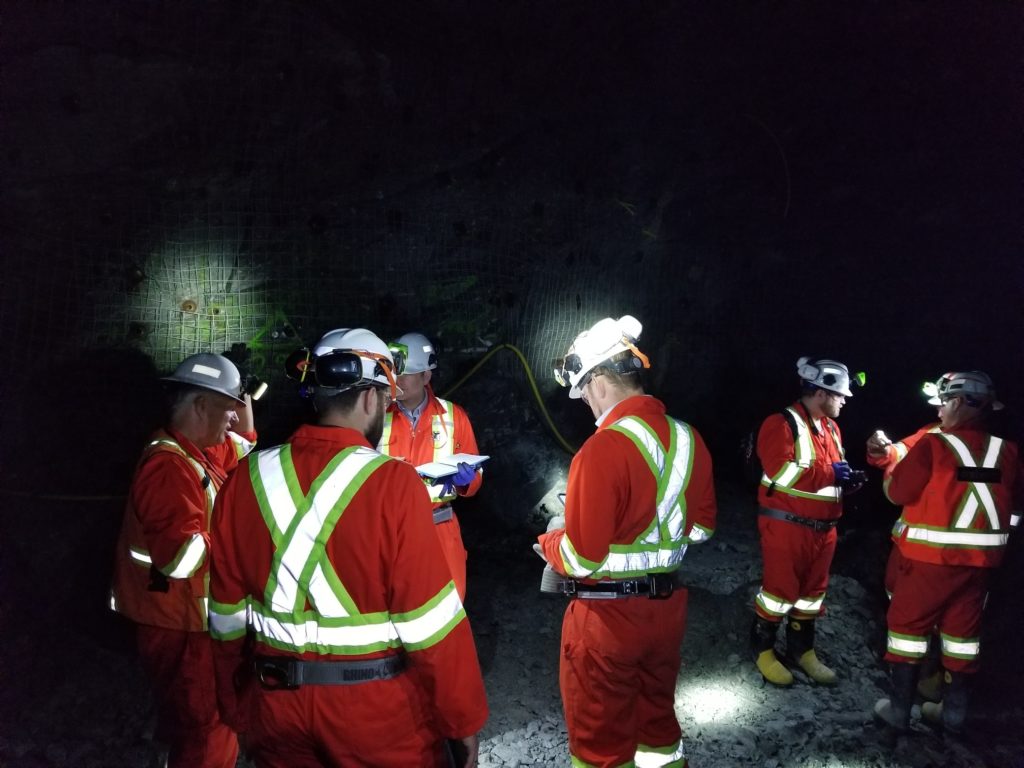
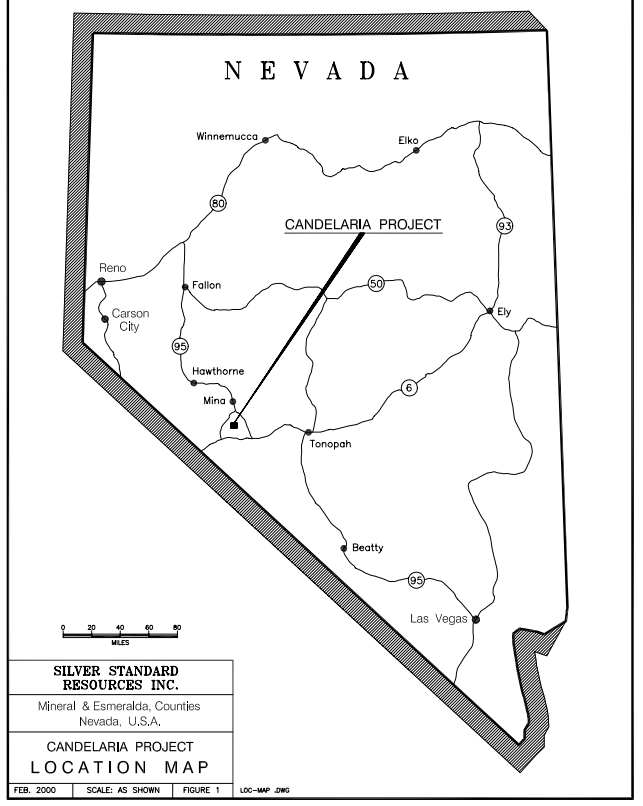
Today, I have for you the details from Day 1 of my Nevada Site Visit Tour, where I had the chance to visit Silver One Resource’s flagship Candelaria Project, which is located in the northwestern portion of Nevada, near Hawthorne.

Let’s take a closer look.

Reno, Nevada

On October 28,th I caught the 6:20am flight out of Toronto to Denver and hopped on a connecting flight which brought me to Reno, Nevada before noon Pacific time.

Unless you’re travelling to Las Vegas, in my experience, Nevada is always multiple flights from the east coast. It’s even worse if you’re flying into Elko, Nevada, which is located in the northeastern portion of the state – it’s been a marathon 3 flights the last 3 times I’ve taken the trip.

Flights aside, I really enjoy this part of the United States. The air is fresh and clear and once you leave the cities and begin to travel into the smaller towns, it’s like going back in time from a number of perspectives.

After landing in Reno, we made the 3ish hour drive south to Hawthorne, where we spent the night. The next morning, it was a short drive to Candelaria and a good review of what Silver One is planning at its flagship asset.
Source: Technical Report

Hawthorne sits directly south of Walker Lake and, interestingly, is home to the world’s largest ammunition depot. The depot covers 147,000 acres and has over 600,000 square feet of storage space within 2,427 bunkers.

Unfortunately, I don’t have a picture to share. You will have to trust me when I say that it’s an amazing sight to see and really confusing if you don’t know what you’re looking at.

Besides being home to the world’s largest ammo depot, Hawthorne is home to 3,000 people.
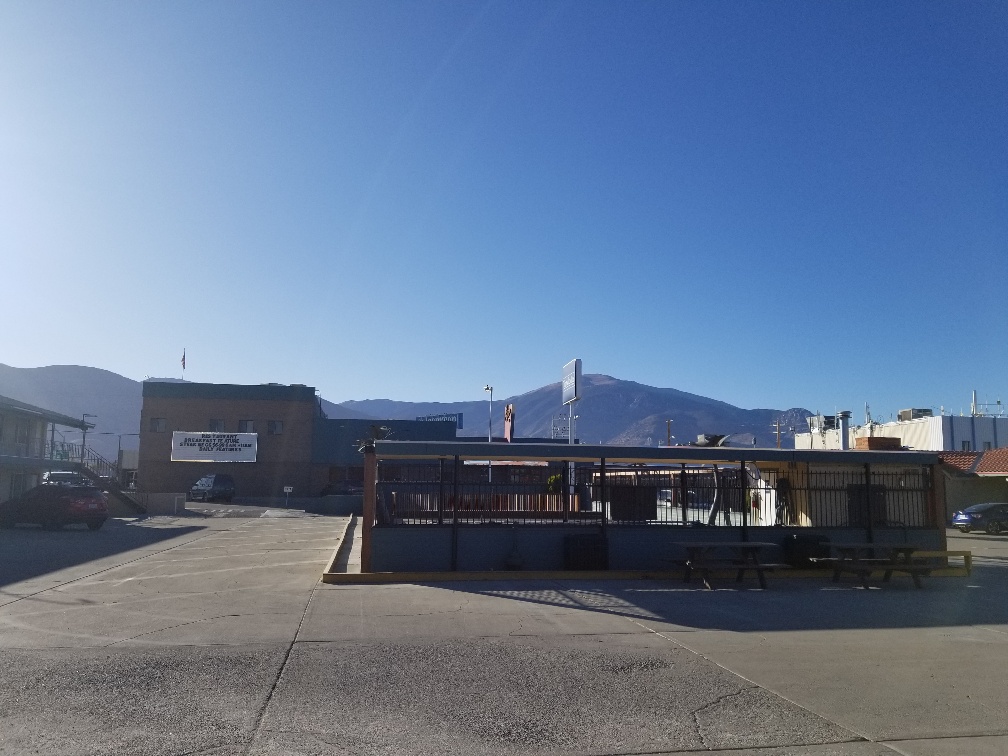
View outside the door of my room at the Travel Lodge in Hawthrone, Nevada

At our hotel, at least half of the guests looked to be with the mining industry in some shape or form. The other half were older couples, whom I’m sure were using Hawthorne’s Travel Lodge as a stopover on their way to Las Vegas.

Silver One Resources (SVE:TSXV)

MCAP – $44.79 million (at the time of writing)

Shares – 149.3 million

FD – 187.1 million

Strategic Shareholders – Eric Sprott 10.8%, SSR Mining 6%, Insiders 5.5%, First Mining Gold 3.4%

NOTE: Silver One closed a $4.976 million financing at a share price of $0.125 and a 3 year – ½ warrant at $0.20 on July 11, 2019. The PP shares will be free trading very soon and there’s a chance that some buyers may sell their shares and hold the warrants moving forward – FYI.

Candelaria Project
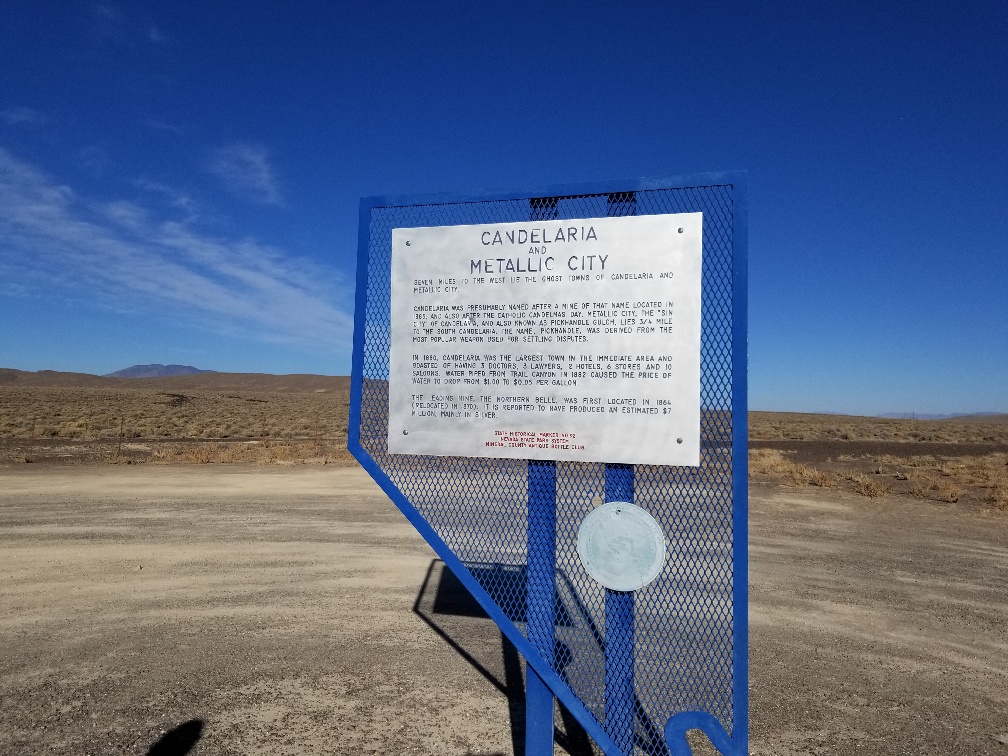
NOTE: Silver One has 1 remaining $1 million option payment on Candelaria, which is due in January 2020 to Silver Standard.  Additionally, under the option agreement, Silver One must assume a $2 million reclamation bond relating to the historic heap leach pads at Candelaria. Instead of coinciding with the last option payment, this will be deferred until January 2023.

Being a past producing mine site, the Candelaria project has great infrastructure. It begins with close proximity to the interstate and a paved road right up to the main gates of the project.

Turning off the interstate, power lines follow you up and into Candelaria, with the sub-station sitting right next to a steel building. This is where Silver One is currently holding samples and other exploration equipment.

Additionally, Candelaria has access to water via wells that produce 500 to 600 gpm, I’m told, and sit in the southern portion of the property.

NOTE: From 1980 to 1999, the Candelaria mine produced 47 million ounces of silver before being closed due to low silver prices.

Historical Resource

The Candelaria project has no 43-101 compliant resources on any of its heap leach pads or deposits – Northern Belle, Mount Diablo, Lucky Hill Mine or Georgine Pit.

Thus, the historical resource table which I have included for your reference should be taken with a grain of salt.
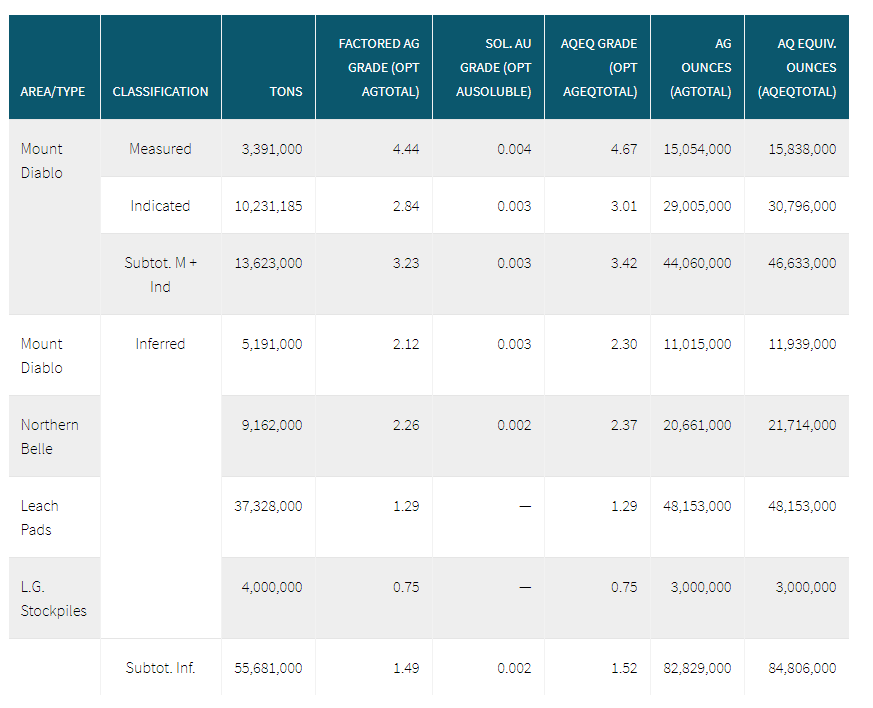
HISTORICAL RESOURCE – NOT 43-101 Compliant

Silver One’s CEO, Greg Crowe, who led much of the discussion during the site visit, mentioned that an updated resource was a priority for the company moving forward.

In fact, most of the drilling this fall will be used to produce a 43-101 compliant resource.

Metallurgy

In terms of priorities, next to setting a base number for Candelaria’s resource estimate, the company will also focus a lot of attention on the project’s metallurgy.

As it stands right now, roughly 30% of Candelaria’s silver is non-recoverable through coarse grinding and cyanide leaching.

Preliminary mineralogical testing suggests that most of this non-recoverable silver is held within jarosite.

Having 30% of your resource non -recoverable is significant and, thus, is why it’s a priority for Silver One to improve.

NOTE: Initial metallurgical results show that 56% of the silver on the heap leach pads is cyanide soluble, leaving 44% in the non-recoverable category.

In my view, the metallurgical work represents biggest opportunity for the company. How or where else can they add that many payable ounces within a year for what is a fraction of the cost and risk of drilling.

Crowe explained that they are focused on finding the optimal milling (grinding) size needed to liberate the silver from the jarosite.

Of course, the amount of milling has to be balanced with the economics of the whole process. It’s one thing to liberate all the silver out of the jarosite, but if you need $50 silver to do it, is it worth it?

It will be very interesting to watch for these results, and much like the resource estimate, see what silver price is needed for this to be economic.

Drill Targets

Next to the Candelaria’s priority work, the resource estimate and metallurgical testing, there are some interesting exploration drill targets across the entire property.
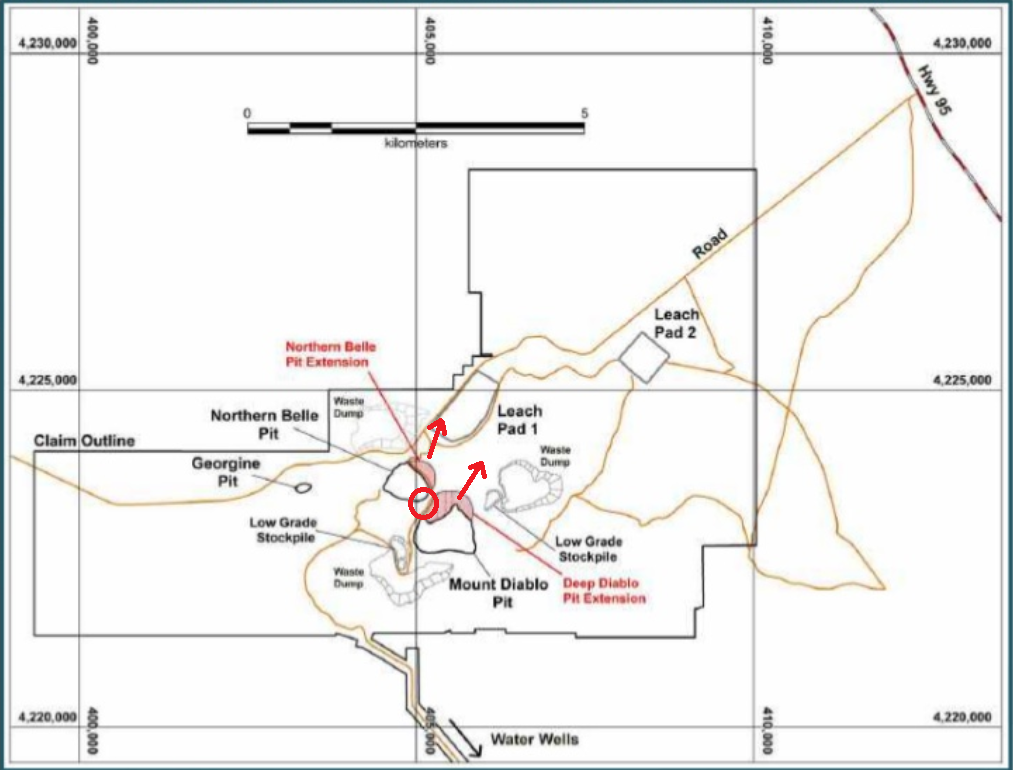
I will draw your attention to the image above, which gives us a top view of the project.

The Northern Belle and Mount Diablo pits are labelled and sit on either side of the red circle.
Northern Belle Pit

The first 2 targets are the most obvious. Silver One will be drill for down dip extensions, which I have represented using red arrows, on both pits.

Second, both deposits will be drilled for lateral extensions, specifically in between the 2 pits to see if they connect. Represented as the area within the red circle.
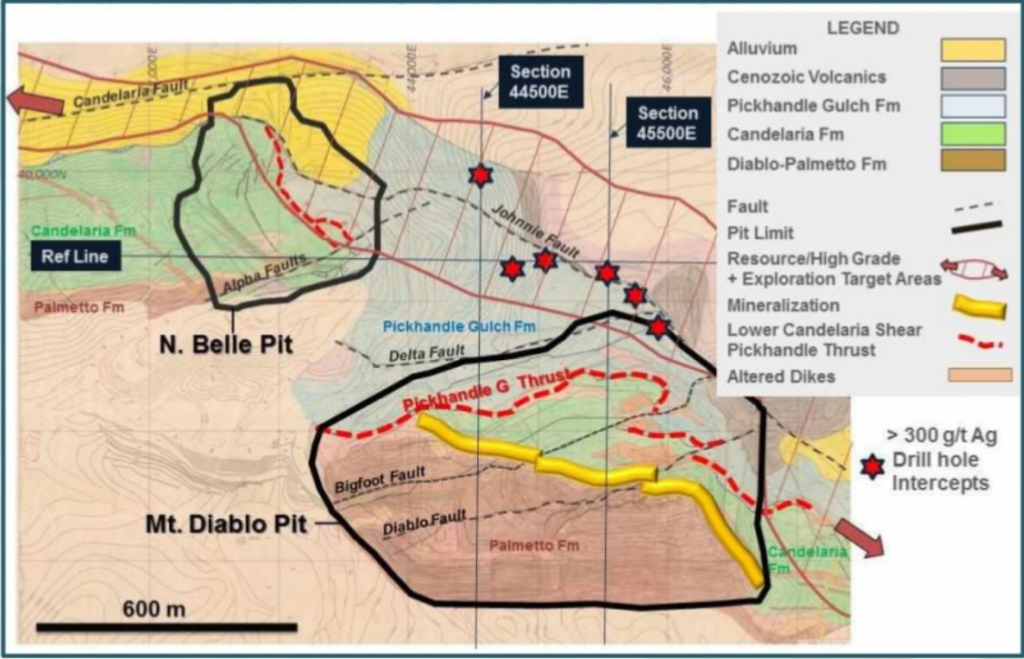
Historic Silver Standard Drilling

Historically, Silver Standard did hit silver mineralization in a number of holes in between the 2 pits, represented as stars in the image above.

Georgine Pit

Now let’s take a look at the more abstract exploration targets at Candelaria.
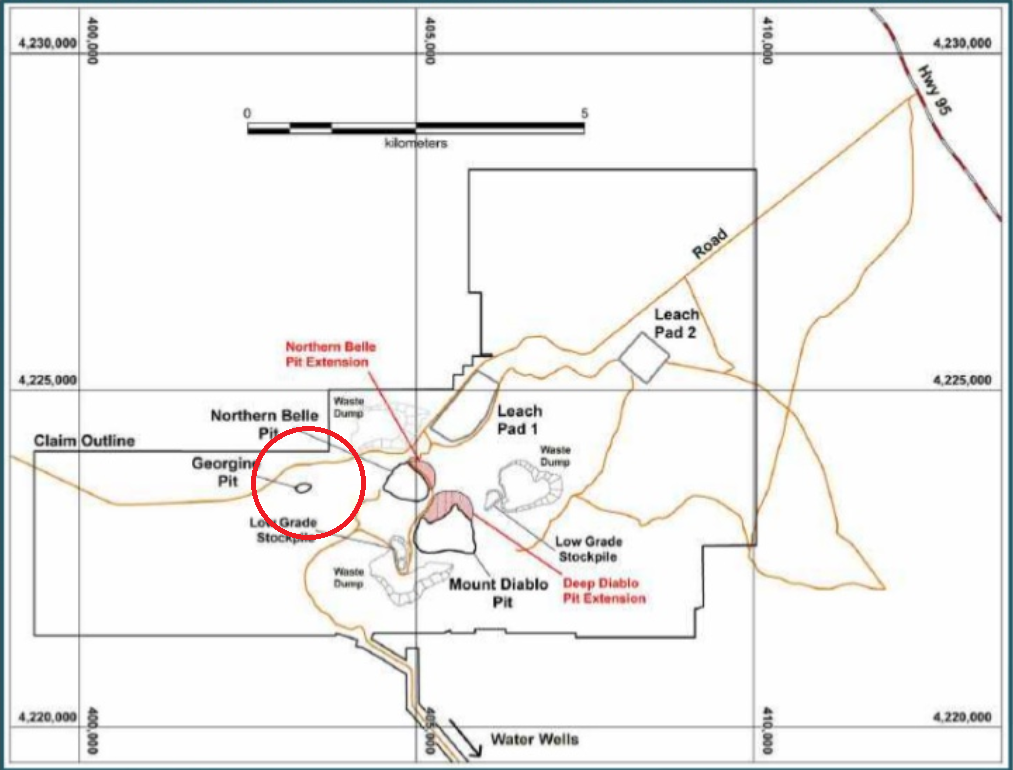
In the image above, I have circled the next most prospective area within Candelaria.

This region of the property is interesting as it either represents a parallel or off-set mineralized structure to that which hosts Northern Belle and Diablo.

Currently, there are 2 known past producing pits in this area – Georgine and the Lucky Mine. Both are small, but when mixed with the magnetic anomaly the company has identified, could represent a much bigger system.

I couldn’t find a picture, but Crowe mentioned that the magnetic anomaly lies just north of the Georgine pit. Given this, they subsequently staked more ground along the north claim boundary you see in the image above. The new claim block represents an area of approximately 8 square kilometres.

Another interesting note on this area is the grab samples they have found. Crowe showed us one of the high grade copper, low grade gold samples they found in the immediate area surrounding Georgine.
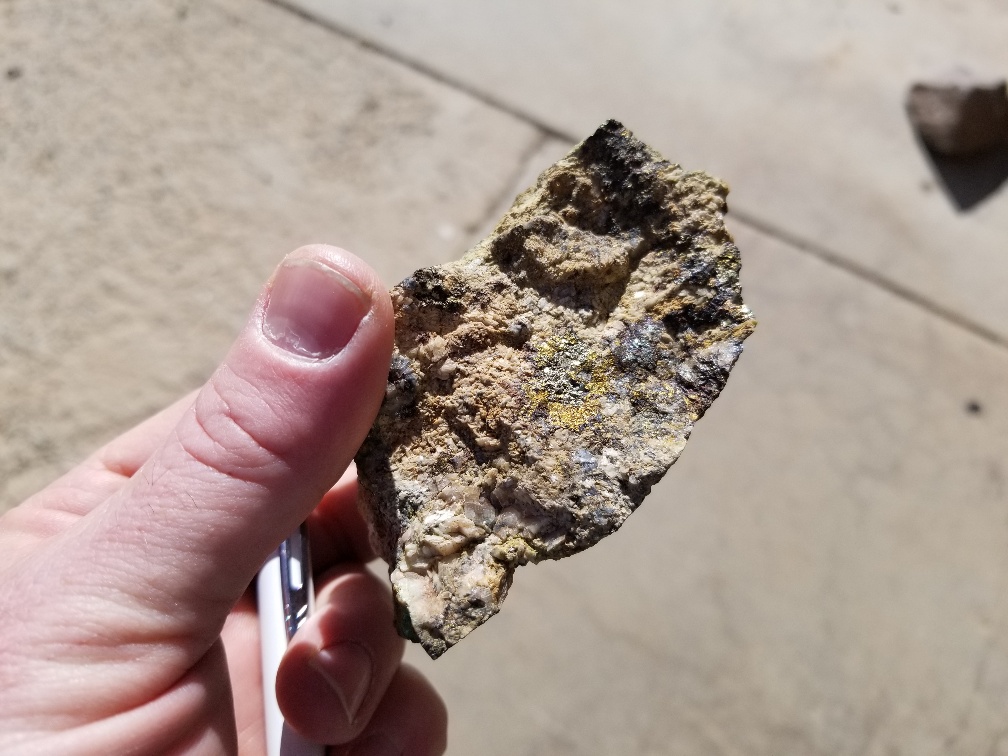
Sample found near Georgine Pit

Crowe speculated about the possibility of there being an Iron Oxide Copper Gold (IOCG) deposit in this area.

They plan to follow up the grab sample with an IP survey, which could shed some light on any concentrations of sulphide mineralization in the area.

Concluding Remarks

It was a good site visit to Silver One’s Candelaria project, I believe I have a good understanding of where the company is and where they are headed.

I look forward to seeing the initial drill results from the company, which I am sure we will see before the end of the year. Additionally, more geophysical work on the new claim block and area surrounding Georgine pit should be really revealing to what may be there.

I, however, am not a buyer of Silver One Resources at this point; as there are a number of questions I have yet to answer.

First, will there be an onslaught of selling as this summer’s private placement shares become free trading?

Second, the metallurgical work is a HUGE part of this story and, really, I think, will be the main factor in classifying it as a good or great project.

Silver One has been added to my watchlist, as I eagerly await drill and preliminary met work results.

Don’t want to miss a new investment idea, interview or financial product review? Become a Junior Stock Review VIP now – it’s FREE!

Until next time,

Brian Leni  P.Eng

Founder – Junior Stock Review

Disclaimer: The following is not an investment recommendation, it is an investment idea. I am not a certified investment professional, nor do I know you and your individual investment needs. Please perform your own due diligence to decide whether this is a company and sector that is best suited for your personal investment criteria. I have NO business relationship with any of the companies discussed in this article, however, Silver One Resources did pay for my site visit expenses. I do NOT own shares in Silver One Resources.


Posted on

O3 Mining – The 3rd Iteration of the Osisko Mining Group

“The desire for more, the fear of missing out, the tendency to compare against others, the influence of the crowd and the dream of the sure thing-these factors are near-universal. Thus they have a profound collective impact on most investors and most markets. The result is mistakes, and those mistakes are frequent, wide-spread and recurring. “ ~ The Most Important Thing Illuminated pg.97

Success in the junior resource sector is predicated on a few key things.

First and foremost, it’s vital to invest your money with the right people. The wrong people have the capability of destroying any semblance of value in a good project.

Second, you need to protect your downside risk as it pertains to a company’s share price versus its intrinsic value.

Finally, you need to be a deep thinker and see through the narrative of the herd. This point is as much about brains as it is about courage – it’s rare to have both.

Today, in mid-October, at the highest precious metals prices we have seen in 6 years, the junior resource sector is, for the most part, selling off.

It begs the question, why?

Is it profit-taking? Maybe for a few of the best names, but for the most part, I think many companies haven’t seen much of an uptick in their share price, even with the spike in metal prices over the last 3 months.

Is it premature tax-loss selling? I don’t think that’s totally out of the question.

Is it the narrative surrounding a large correction in precious metals prices, which has caused many to anticipate the fall in prices and sell?

Social media is a powerful tool, it wouldn’t surprise me if those calling for a correction are influencing a percentage of investors. There’s comfort in following the herd.

Or, is it a lack of confidence in high precious metals prices in the future?  I think that makes a lot of sense.

Human behaviour suggests that most people project their immediate past into the future. I can, therefore, see a high percentage of investors expecting to see the gold price fall, which ultimately would lead to them incurring losses on the companies within their portfolio.

In the end, it’s probably the confluence of all of these points and many more which have caused there to be more sellers than buyers, at this point.

For me, I see it as an opportunity to add to my positions in companies already in my portfolio or buy tranches in new companies in which I have been waiting for weakness.

Today, I have some thoughts on a company that I believe has all of the right ingredients for success and, in my opinion, is selling at a discount to their intrinsic value.

The company is O3 Mining, the 3rd iteration from the Osisko mining group.

Let’s take a look!

O3 Mining (OIII:TSXV)

MCAP – $107.2 million (at the time of writing)

Shares – 46,174,125

Cash – $32.0 million (approximately)

Strategic Shareholders – Osisko Mining 54.1%, Insiders 3.7%

The Genesis of O3 Mining

Earlier this year, Osisko Mining entered into a definitive agreement with Chantrell Ventures Corp (CV-H:TSXV), which saw Osisko’s non-core assets transferred to Chantrell, resulting in the Reverse Take-Over (RTO) of Chantrell by Osisko Mining.

The company was renamed O3 Mining, its shares were consolidated 40:1, it raised $18.6 million at $3.88 per share with a full warrant at $4.46, and the 3rd iteration of the Osisko team was born.

NOTE: For those who don’t know, the founders of Osisko Mining  consists of John Burzynski, Robert Wares, Sean Roosen. Jose Vizquerra Benavides became part of the leadership team in 2011.

O3 Mining is led by CEO, Jose Vizquerra-Benavides, who is a geologist by trade. Vizquerra-Benavides is a native of Peru and comes from a long line of miners, as his grandfather is the founder of Buenaventura, a major mining producer company in Peru listed on the NYSE.

Vizquerra-Benavides began his career in the sector with Buenaventura, but eventually moved to Canada where he worked as a production and exploration geologist at the Red Lake gold mine.

From here, Vizquerra-Benavides joined the Osisko team where he has held a number of different roles or positions, such as Executive Vice President of Strategic Development & Director at Osisko Mining, and President & CEO of Oban Mining Corp.

While he is arguably the least known of the Osisko leadership team, I think that will soon change because, in my opinion, it’s obvious to me that Vizquerra-Benavides has the right pedigree to be successful in his new role as CEO of O3 Mining.

Quebec and Ontario

I’m not going to go into any detail about the jurisdictions, because unless you have been living under a rock or are new to resource sector investing, you will know that Quebec and Ontario are two of the best jurisdictions for mining investment attractiveness in the world.

The Fraser Institute continually has both jurisdictions rated in their top 20 places to explore, develop and mine worldwide.

Acquisitions

With the formation of the new company and Vizquerra-Benavides appointed as CEO, O3 didn’t waste any time adding to their already impressive land position within the Abitibi Greenstone Belt.

First was the acquisition of the Quebec subsidiary of Chalice Gold Mines Limited (details of the deal can be found here).  A company with projects along the Cadillac Break.

NOTE: Chalice Gold Mines was acquired for $12.0 million in O3 stock.

Next, in another all shares deal, Alexandria Minerals was acquired (details of the deal can be found here). Clearly, given where O3 has focused their attention in their first drill program, Alexandria’s projects located in the Val d’Or region were particularly appealing.

NOTE: Alexandria Minerals had issued and outstanding 529,790,966 shares. O3 acquired Alexandria for $0.07 a share or 0.018041 for each O3 share, therefore, the purchase price was roughly $37.1 million.

Finally, in another all shares deal, O3 acquired Harricana River Mining Corporation, whose Harricana Mine Project is located in the Val d’Or area of the Cadillac Break (details of the deal can be found here).

NOTE: Harricana was acquired for 773,196 shares in O3 with a stock price of $2.59 in the announcement date – August 23, 2019. Therefore, the value of the transaction is $2.0 million.

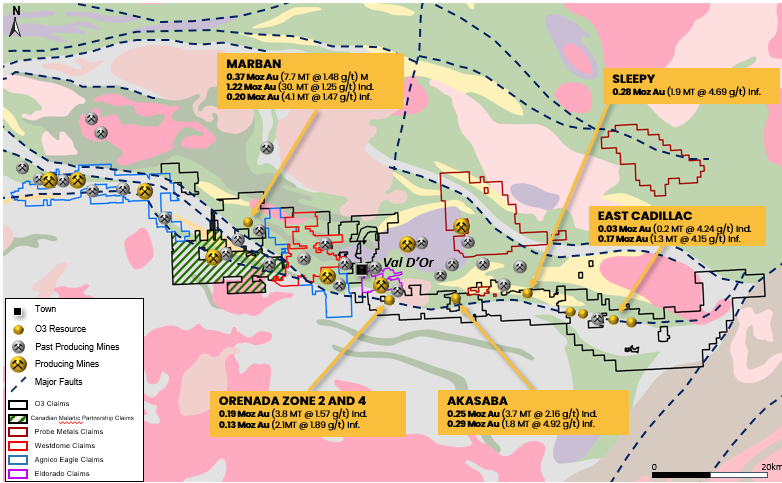
Figure 1: Val d’OR Consolidation – Post Acquisitions

Source: O3 Mining Inc.

Value of O3

In my opinion, protecting your downside risk is an integral part of consistently making profit from your investments within the junior resource sector.

Let’s do a quick calculation of O3’s underlying value:

  • The total market value of O3’s acquisition is $51.1 million. Breakdown:  Chalice Gold Mines – $12 million, Alexandria Minerals – $37.1 million, and Harricana River- $2 million.
  • The RTO value of Osisko Mining’s non-core assets, which includes the advanced Marban project, was $99.9 million.
  • O3 has raised a total of $37.78 million over the last 10 months: RTO financing – $10 million, Bought Deal financing (March 27th, 2019) – $17.7 million, Charitable Flow-Through financing (September 26th, 2019) – $10.08 million

Therefore, if you add up the value of O3’s acquisitions, Osisko’s non-core project portfolio and their cash (which will be lower than the total amount that they raised), the underlying value of O3 Mining is roughly $200 million or almost twice the current MCAP.

NOTE: No value is assigned to the exploration potential.

In my opinion, while the share price can undoubtedly move lower, I like the downside protection which O3 presents at its current price.

Drill Targets

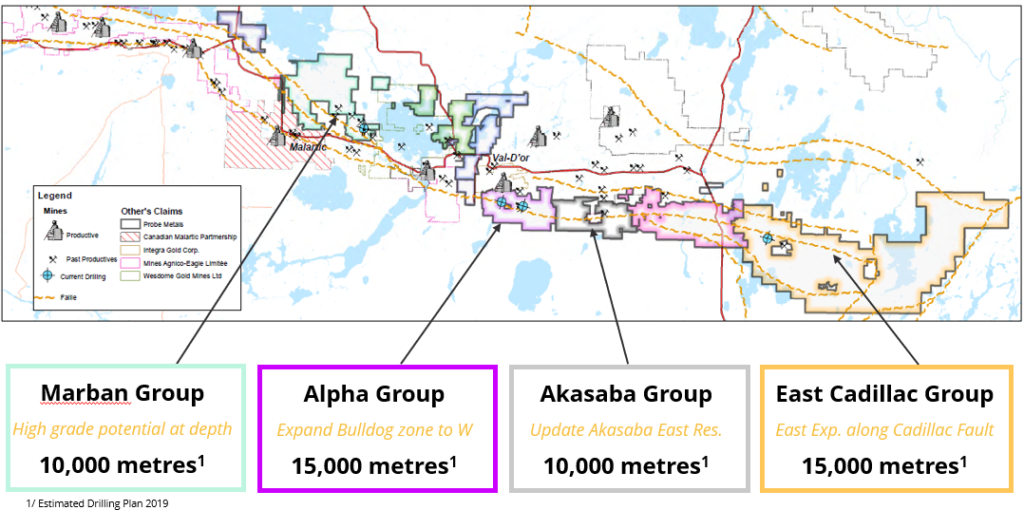
With the acquisitions in place, O3 is continuing to march forward with a 50,000m drill program on 4 main target areas within their Val d’Or region properties.

Figure 2: Aggressive Osisko Style Exploration

Source: O3 Mining Inc.

The drill program is being funded by a $10.08 million charitable flow-through private placement which closed on September 26th.

For those who don’t know about charitable flow-through shares, they’re typically issued at an even higher multiple above the market share price value than regular flow-through shares.

The ability to raise cash through charitable flow is a tremendous advantage compared to a regular hard dollar private placement, as it reduces the amount of dilution by the raise, while also giving the buyer an even higher tax reduction for participating.

Marban Group

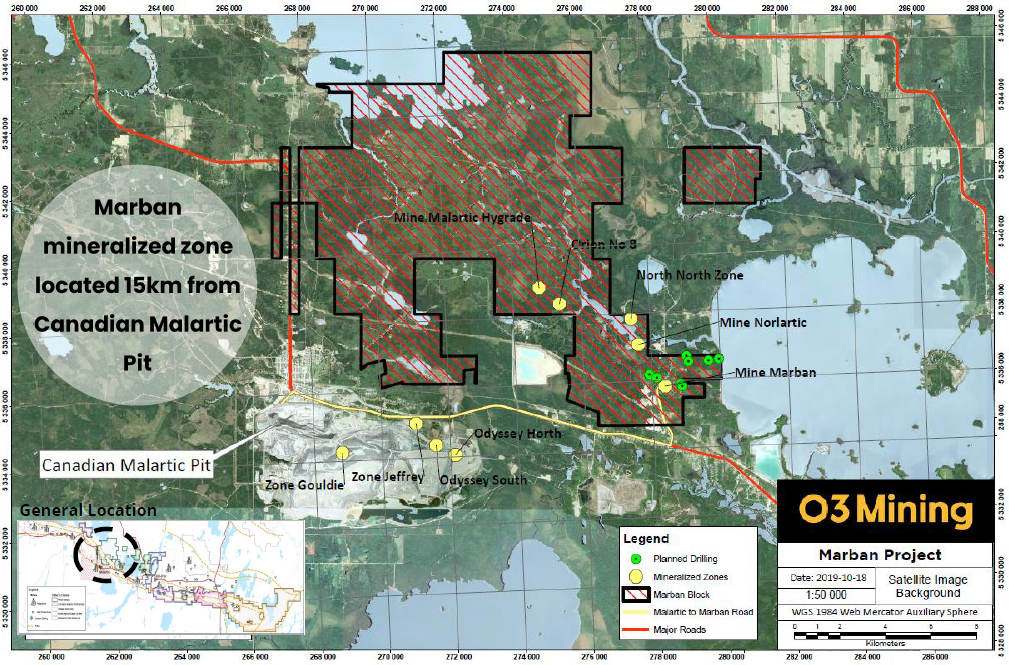
The Marban Group consists of the Marban and Harricana projects. The Marban project is located near the town of Malartic, Quebec, which sits roughly 30 km west of Val d’Or.

It’s one of the non-core assets which was spun out from Osisko Mining in the RTO with Chantrell Ventures. Marban was originally acquired by Osisko (Oban Mining at the time) from Niogold in 2016 when the 2 companies merged.

Marban has a 43-101 in-pit measured and indicated resource of 37 Mt at 1.24 g/t for 1.48 Moz of gold and an in-pit inferred resource of 3.6 Mt at 1.15 g/t for 0.13 Moz of gold.

In my conversation with Vizquerra-Benavides, O3 is planning to drill 8 holes there, which will be targeting high-grade gold below the existing resource – which means below 400m.

For those who aren’t familiar with Abitibi shear zone gold deposits, they can be deep, high grade and steeply dipping.

Therefore, exploration below 400m for high-grade gold mineralization is a legit prospect and one that I am very interested to see tested.

Figure 3: Marban Project

Source: O3 Mining Inc.

Additionally, as mentioned earlier, Marban is located in close proximity to the town of Malartic, which also means it’s in close proximity to the Canadian Malartic Open Pit Gold Mine owned by Agnico Eagle and Yamana Gold.

It is speculation, but I believe it’s valid to think that Marban becomes an attractive acquisition target for the Canadian Malartic Mine moving forward, as its reserves dwindle and precious metal prices remain strong.

Alpha Group

The Bulldog zone was discovered by Alexandria Minerals in late 2018.

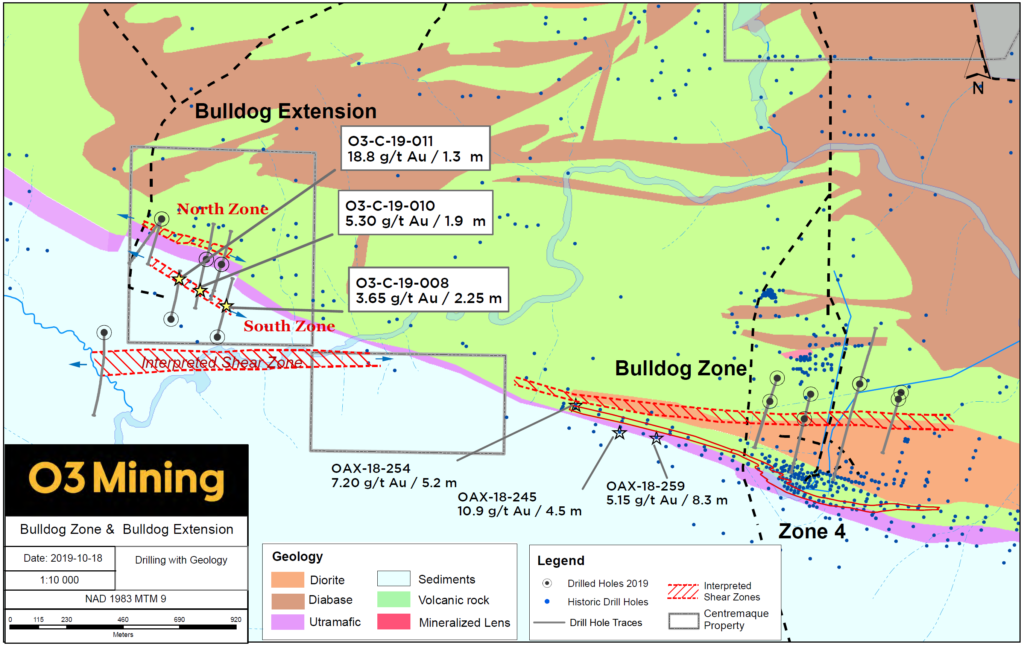
Reviewing the results in the December 11th, 2018 news release, the Bulldog zone is east-west trending and has been confirmed over 500m with a thickness ranging from 20 to 40 metres.

There were 8 initial holes drilled on the Bulldog target in 2018 and they returned some great results, which were highlighted by:

  • Drill hole OAX-18-245 intersected 10.50 m @ 6.20 grams per tonne (g/t) Gold (Au) including 4.50 m @ 10.87 g/t Au.
  • Drill hole OAX-18-254 intersected 10.50 m @ 4.25 g/t Au including 5.20 m @ 7.20 g/t Au.
  • Drill hole OAX-18-259 intersected 8.30 m @ 5.15 g/t Au and 3.00 m @ 6.92 g/t Au.

With regards to drilling at Bulldog, Vizquerra-Benavides mentioned the phrase, “drill for structure, drift for gold”. Meaning, first and foremost, they want to establish or understand the structures that are controlling the gold mineralization.

Early this week, O3 announced results that confirm the extension of the Bulldog mineralized structure located 1,500 metres to the east and importantly, demonstrate the potential for gold-bearing structures in the Pontiac sediments.

The Bulldog gold-bearing mineralized structure discovered in December 2018, demonstrates good continuity in gold grades over several metres and is over 500 metres in strike length.

  • Drill hole O3-C-19-011 intersected 18.8 g/t Au over 1.3 metres
  • Drill hole O3-C-19-010 intersected 5.30 g/t Au over 1.9 metres
  • Drill hole O3-C-19-008 intersected 3.65 g/t Au over 2.25 metres


Figure 4: Alpha Group – Bulldog Zone

Source: O3 Mining Inc.

O3 will continue with its 15,000m drill program in the Alpha Group, systematically drilling every 80 meters across the known zone, with the intent of establishing an inferred resource.

Akasaba Group

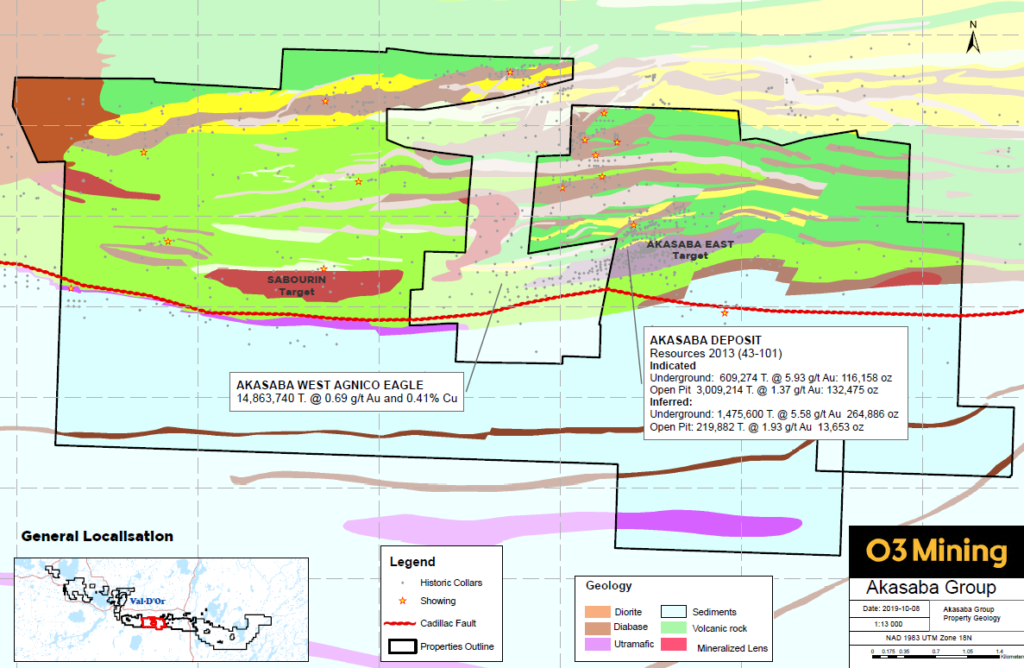
Akasaba sits east of the Bulldog Zone and, of course, on the east side of Akasaba West, which is an open-pit development project owned by Agnico Eagle. Akasaba West has an inferred resource of 14.8 Mt at 0.69 g/t for 332,074 oz of gold and 0.41% for 61.2 Mkg of copper.

O3 will perform a 10,000m drill program in the Akasaba Group to confirm and expand resources in the Akasaba east target.

Figure 5: Akasaba Group

Source: O3 Mining Inc.

East Cadillac Group

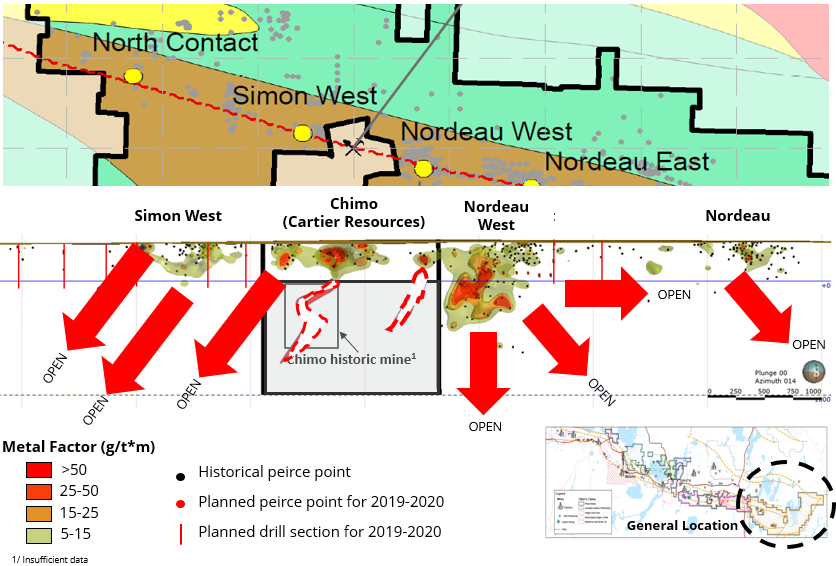
The Nordeau West target in the O3’s East Cadillac Group, which was acquired in the acquisition of Quebec portion of Chalice Gold Mines, sits to the east of Val d’Or and of O3’s other 3 drill target areas.

Nordeau West has a JORC indicated resource estimate of 225,000 tonnes at 4.17 g/t for 30,200oz of gold and an inferred resource of 1.112 Mt at 4.09 g/t for 146,300 oz of gold.

Figure 6: East Cadillac Group

Source: O3 Mining Inc.

As you can see in the image above, O3 now controls essentially all of the land which surrounds the historic Chimo Mine, which is owned by another junior gold company – Cartier Resources (ECR:TSXV).

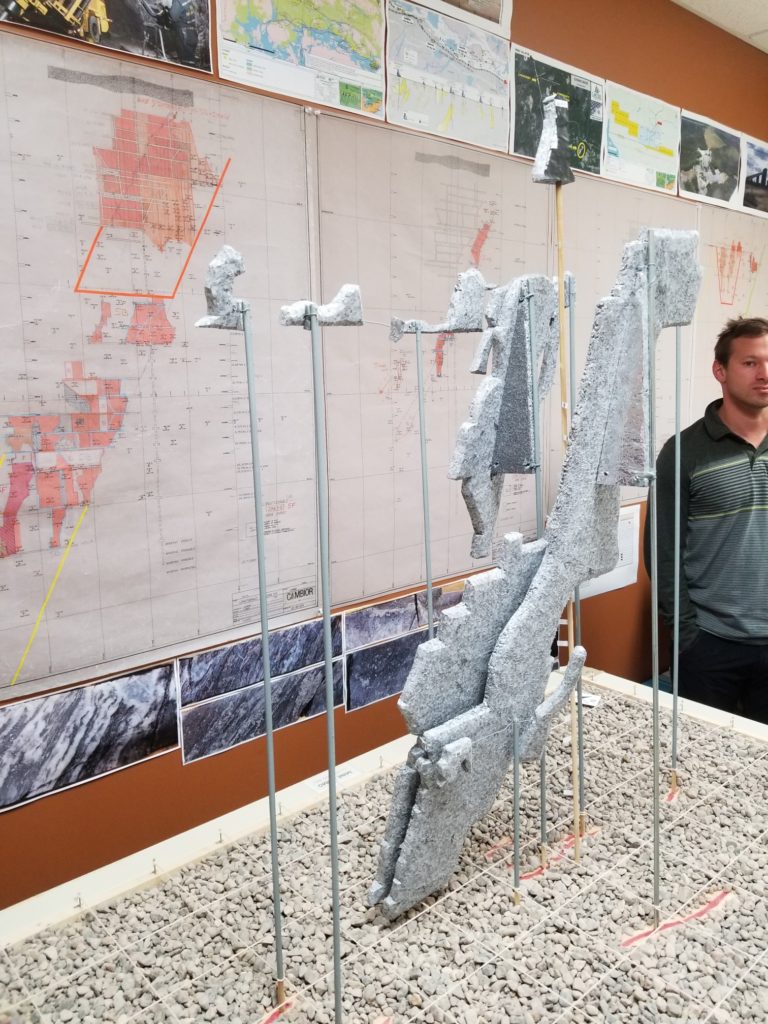
If you take the time to review the 3D resource model which is available on VRIFY’s website or in the video on Cartier’s website, you will get a good idea of the deposit and how it relates to the prospects on O3’s property.

Given the existing resource on the Nordeau West target and where O3 will be targeting their drilling, there’s a good chance that gold mineralization, possibly high grade, will be discovered.

Concluding Remarks

As I mentioned in the intro, success in the junior resource sector, I believe, is predicated on 3 main factors.

First, invest in the best people.

  • O3 Mining is the 3rd iteration of the Osisko Mining Group and is led directly by its CEO, Jose Vizquerra-Benavides. The Osisko team has made it a habit of being successful in an industry that is fraught with failure.
  • Not only have they done it at the peak of the market – bringing the Canadian Malartic Gold Mine into production in 2011, but they have also raised over $400 million dollars to develop the soon-to-be-feasibility-study-level Windfall project over the course of one of the worst bear markets in history.

Second, protect your downside risk.

  • O3 is currently selling for roughly half of its intrinsic value, providing the investor with good downside risk.

And, finally, take a contrarian view of the market and/or the company.

  • Most of the junior resource sector is selling off, including O3 Mining, which has seen its share price reach a low below $2.30 a share, over the last month or two.
  • “Be fearful when others are greedy and greedy when others are fearful” ~ Warren Buffet

There is risk in any investment, especially when it comes to mineral exploration, but by sticking to the highest quality issuers, I believe, you give yourself the best opportunity for profit!

I own shares in O3 Mining and will continue to buy on weakness in the weeks ahead.

Don’t want to miss a new investment idea, interview or financial product review? Become a Junior Stock Review VIP now – it’s FREE!

Until next time,

Brian Leni  P.Eng

Founder – Junior Stock Review

Disclaimer: The following is not an investment recommendation, it is an investment idea. I am not a certified investment professional, nor do I know you and your individual investment needs. Please perform your own due diligence to decide whether this is a company and sector that is best suited for your personal investment criteria. I have NO business relationship with any of the companies discussed in this article. I do own shares O3 Mining and Cartier Resources.
Posted on

A Look at Nickel & Why It’s The Best Performing Metal of 2019

nickel price chart

The majority of resource sector investors are currently focused on precious metals, which I think is justified. Whether it be a trade war, the issuing of 30 year bonds with a negative yield, or the lowering of interests rates, clearly, there are issues with the global financial system that need to be rectified.

Precious metals, therefore, are acting like any insurance policy; their price is rising along with the increase in risk.

With that said, nickel has actually been the best performing metal of 2019 to date. Its price has risen more than 50% in the last 2 months and, today, sits at around US$8 per pound – a level not seen since 2014.

I have become well acquainted with the nickel market over the last few years and am really not surprised by the sudden price move; to me, it was inevitable. There are a number of factors that could drive the nickel price even higher in the future, the export ban in Indonesia being just one of them.

Today, I have for you an interview with someone who lives the nickel market every day, Martin Turenne, CEO of FPX Nickel Corp.

In our conversation, we touch on the history and strategy behind the Indonesian export ban, the various nickel end products in the market, global nickel inventories, the affect of the environmental policy moving forward and, finally, an update on FPX Nickel, which has recently released some fantastic news with regards to the Baptiste Deposit’s metallurgy.

Enjoy!

Brian: Many of the headlines surrounding this recent surge in the nickel price have concentrated on the Indonesian export ban and for good reason. In 2014, Indonesia introduced the first export ban and within 6 months the nickel price spiked above US$9 per pound. Now, 5 years later and the same scenario appears to be playing out.

Firstly, could you give us some historical background on why Indonesia instituted a nickel export ban in 2014?

Martin: Indonesian mines produce about 25% of the world’s nickel mine supply, but the country has traditionally been lacking in domestic refining capacity – for a long time, they were simply shipping low-value, unprocessed ore to refineries in China. Indonesians have a long history of resource nationalism, and the export ban in 2014 was implemented to force companies to build smelters in Indonesia so that the country could enjoy more of the economic benefits of producing refined nickel  — to generate economic activity from capital investment and job creation. The ban was at least partly successful in achieving that goal – Indonesia is now a major producer of refined nickel.

Brian: Secondly, why are they having to ban exports again? Did the 2014 ban not produce the results they had intended?

Martin: After implementing the ore export ban in 2014, the Indonesian government partially relaxed the ban in 2017 to allow for the export of some ore by those companies which had committed to building smelters in-country. The buildout of those smelters was moderately successful, but it wasn’t happening as quickly as the Indonesian government would like it to. So, the re-implementation of a full ban is driven in part by the Indonesian government’s desire to force companies to act more swiftly in building out those smelters.

Brian: Background context is important, but really, what matters to investors is the impact of the export ban.

What is the impact of the export ban on the global market supply?

Martin:

There has been some good analysis come out in the past few days from BMO and Wood Mackenzie which concludes that the export ban will result in a 5-10% reduction in nickel supply for the next 2-4 years, versus their previous supply assumptions. The nickel market has already been in a long-term structural shortage since 2016, so this additional supply disruption is a major event. This could lead to the nickel price being sustainably higher for the next few years.

Brian: Examining the nickel price chart, while initially, instituting the nickel export ban in 2014 spiked the price, the impact seems to have dramatically declined in the second half of the year, bringing the price back to where it started at the end of 2014.

Today’s market looks much different than it did in 2014 – for a number of reasons. The first thing that comes to my mind is global nickel inventories, which are nearly half the levels in 2014.

For example, looking at the LME nickel warehouse levels, it shows that current inventory is sitting at roughly 150,000 tonnes. 

An important question rarely asked, possibly out of ignorance, is what type of nickel makes up the Global inventories?

Martin: LME inventory is comprised entirely of Class 1 nickel products, typically briquettes, pellets and cathode – to qualify as a Class 1, the nickel product must contain 99.8% nickel, so basically pure nickel.

Brian: Okay, this brings us to a common misconception, that nickel sulphide mines produce class 1 nickel, which is incorrect.   

So it begs the question, who does feed the Class 1 nickel market?

Martin:

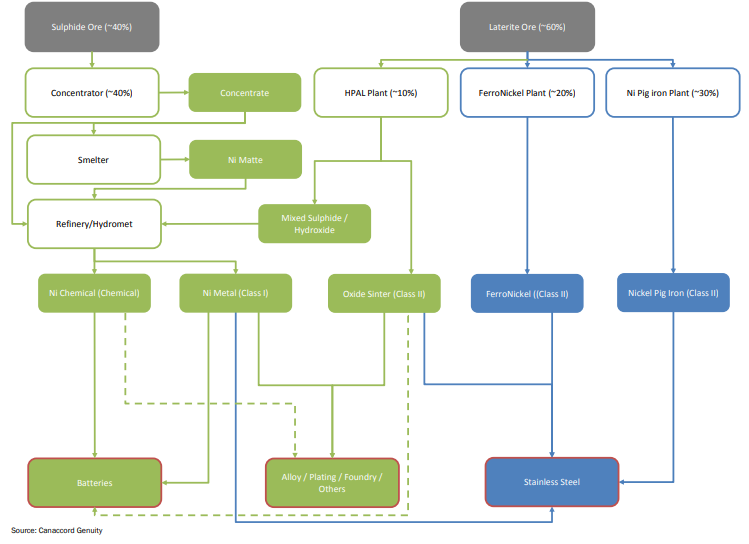
As I’ve said, Class 1 nickel is basically a pure nickel product. Class 2 nickel products have less nickel content, but they contain significant amounts of iron, which makes them highly sought after by stainless steel producers.

Class 1 nickel comes from both sulphide and laterite nickel mines. For both sulphide and laterite ore, there are several refining and processing steps required to convert the ore into a concentrate or slurry and then ultimately into Class 1 nickel – oftentimes, it’s the refiners and smelters who enjoy better margins than the actual miners themselves. That’s part of the reason that the nickel industry tends to be vertically integrated – if you’re a miner having to sell your product to a third party smelter, you are at the mercy of smelter payment terms.

Brian: Can you give us a break down of the most common end products produced by mining operations and how they fit into the global nickel market supply?

Martin: The nickel produced at most mine sites is not Class 1 nickel – sulphide miners typically produce nickel concentrate with about 15% nickel content, and laterite miners mostly produce Class 2 nickel in the form of ferronickel or nickel pig iron (NPI) with a nickel content ranging between 10% and 30%. Nickel sulphide concentrates are typically sold for a relatively low value (70-75% of the LME nickel price) to smelters, who then smelt and refine the nickel toward the ultimate production of a Class 1 nickel product. Ferronickel and NPI, on the other hand, bypass the smelting process and are sold directly to stainless steel producers for relatively high value (95-100% of the LME nickel price) due to the value of the iron contained in those products.

Source: Canaccord Genuity

Brian: Keeping with the nickel supply side discussion, recently it was reported that there was a waste spill from the Chinese owned Ramu nickel mine in Papua New Guinea. The red discharge spilled from the mine was found clouding the waters of Basamuk Bay.

Personally, I only see the environment becoming a bigger issue in the future, as it’s become a hot politically driven subject.

Do you think more stringent environmental regulations will affect nickel supply in the future? If so, please explain.

Martin: In the last year alone, we’ve seen environmental and social issues lead to the closure or the threatened closure of mines in Papua New Guinea, Myanmar, Guatemala and Brazil – and that’s to say nothing of the ongoing environmental inspections in the Philippines, which is one of the largest producers of nickel globally. Well over 60% of nickel mine supply comes from emerging economies with lower environmental and social licence standards than say, Canada or Australia. As environmental and social concerns become more prominent in those emerging countries, that will ultimately lead to either the closure of certain nickel mines, or to increased operating costs for miners having to comply with higher standards. Over time, this will lead to an increase in the nickel cost curve, and therefore in the nickel price.

Brian: We have discussed all supply side issues within this interview on the current nickel market, which, in terms of gauging how strong the nickel market could be, it’s supply driven bull markets that are the strongest.

None of us have crystal balls, but in your opinion, is it realistic to think that we will see nickel prices higher than US$7.50 over the next 12 months?

Martin: Before the recent announcement regarding the Indonesian export ban, the long-term consensus nickel price forecast was $7.50/lb. The implementation of the export ban has accelerated the spot price move upward. We would expect to see more volatility in the nickel price over the next 12 months, but the updated forecasts from BMO and Goldman Sachs are already projecting an $8 to $9 price in that timeframe.

Brian: A few weeks ago, FPX released the results of their metallurgical optimization program which began late last fall. In my opinion, the results look great and should give the company a relatively unique end product which can bypass the smelter and be sold directly to the end user.

Firstly, can you give us an overview of the results? Secondly, can you speak to the possible benefits of being able to bypass the smelter?

Martin: The new metallurgical results mark a huge breakthrough for FPX. First, we are seeing recoveries in the range of 83-94%, which is a big improvement over the 82% recovery in the 2013 PEA – this will lead to an increase in projected nickel production and lower the unit cost of production. Second, we are now producing a separate iron ore by-product for the first time in the project’s history; depending on the market for our iron concentrate, this new product stream could have a positive impact on project economics. Third, the nickel concentrate we are now producing grades 63-65% versus the 13.5% concentrate in the previous PEA. Producing this high-grade concentrate means we will likely get paid a lot more for the product, something in the range of 90-95% of the LME nickel price, compared to the 75% payability assumption in the previous PEA. That’s because this high-grade concentrate is very low in penalty elements like sulphur and phosphorus, which means it will by-pass smelters and can be directly fed to stainless steel producers. By cutting out the smelter middle man, we can yield the types of payables achieved by similar products like ferronickel and NPI.

Brian: The metallurgical results certainly didn’t go unnoticed, as FPX’s recent private placement was oversubscribed. Now, with the influx of cash and the work completed over the last few years, I assume we may be headed for an update to the 2013 PEA in 2020.

What is the plan for 2020? Will we see an update to the 2013 PEA? Do the plans for 2020 require there to be sustained high nickel prices?

Martin:On closing our current private placement, we will have over $2 million in the treasury and will be fully funded to execute on more metallurgical test work, particularly leach testing of the nickel concentrates to understand if we can produce nickel in a form suitable for the EV battery market. Beyond that, and assuming the nickel price settles above the $7.00/lb level, we will be well positioned to deliver an updated PEA, with exact timing still to be confirmed.

Concluding Remarks

There is much to be gleaned from Turenne’s answers in the interview. In my opinion, many of the topics that we discussed are often over looked or misunderstood by investors. With this new or clarified knowledge of the nickel market dynamics, I think nickel investors are in a much better position to make informed investment decisions.

With that said, in my opinion, you should never buy a junior resource company because you are bullish on the price of the metal. Remember, junior resource companies are businesses that revolve around the people and their ability to execute on a plan which reflects the company’s overall vision.

If management can’t execute, nickel deposits don’t get discovered or developed and, therefore, no matter where the nickel price goes, you are most likely going to lose money.

I’m bullish on the future of nickel and, at the moment, am only invested in one junior nickel company – FPX Nickel Corp. (FPX:TSXV).

For those interested in knowing more about the nickel sector and why I believe FPX presents great risk to reward potential, check out these links:

2019 VRIC Presentation – Nickel: A Short and Long-Term Outlook

Nickel Laterite’s Integral Role in the Coming Nickel Boom

KE Report – Taking Note of the Run in Nickel

Don’t want to miss a new investment idea, interview or financial product review? Become a Junior Stock Review VIP now – it’s FREE!

Until next time,

Brian Leni  P.Eng

Founder – Junior Stock Review

Disclaimer: The following is not an investment recommendation, it is an investment idea. I am not a certified investment professional, nor do I know you and your individual investment needs. Please perform your own due diligence to decide whether this is a company and sector that is best suited for your personal investment criteria. I have NO business relationship with FPX Nickel Corp., however, I do own shares.

Posted on

Quebec Site Tour Visit Day 2 – Cartier Resources

Cartier Resources

Day 2 began at Cartier Resources’ offices in Val d’Or.  Interestingly, Cartier’s office walls are filled with field work photos, Chimo mine blueprints, deposit layouts, historical Val d’Or mining statistics and a whole host of other interesting pictures.

Personally, I thought this was a nice touch for visitors as it gives a good perspective on what the company has and is doing to move the company forward – a picture is worth a thousand words.

Cartier Resources (ECR:TSXV)

MCAP – $30.1 million (at the time of writing)

Shares – 177.1 million

Cash – roughly $6 million

CEO – Phillippe Cloutier is a geologist by trade with over 25 years of experience in mining exploration and development.

Cartier’s Business Plan

Cartier made it clear that using funds efficiently is their top priority; they started their presentation by outlining how they go about their exploration work with an added focus on how they planned their drill programs on the past producing Chimo mine property.

The talk was led by VP Dr. Gaetan Lavalliere, who is a professional geologist with over 25 years of experience in the mining industry. 

Cartier organizes their geological data to formulate a prioritized list of targets. By doing this, they are always focused on the targets that have the highest probability of returning good results for each dollar spent.

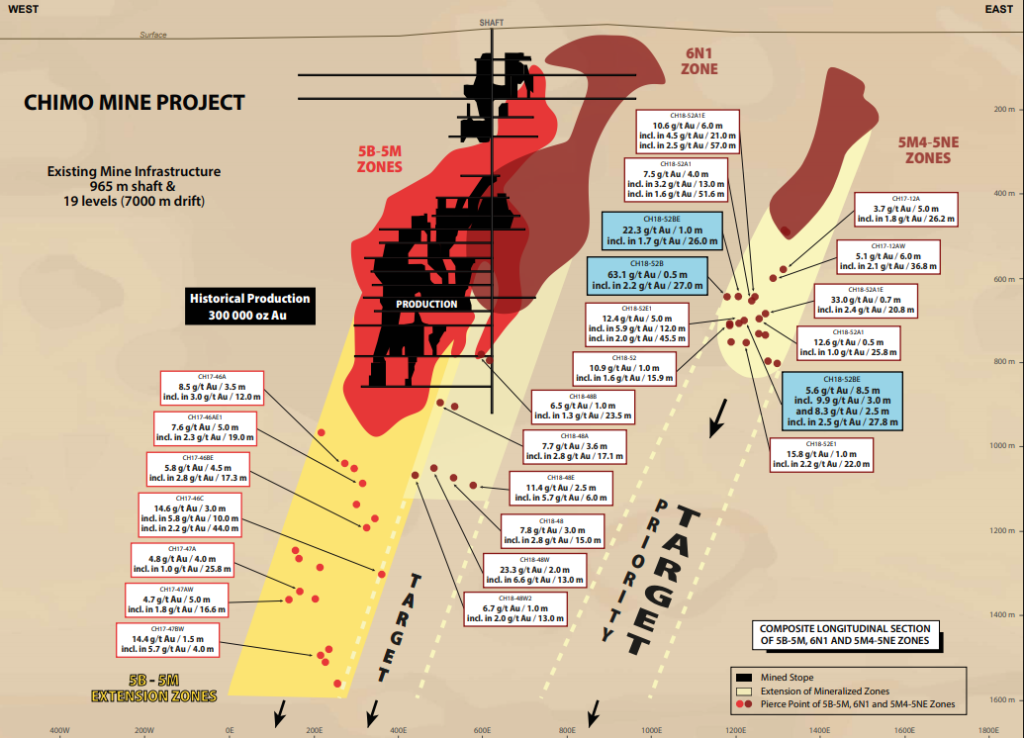
With regards to Chimo, the team was focused on 3 high priority targets from the deposit’s 24 zones.

It should come as no surprise that these zone extensions are mostly at depth, which fits the Abitibi shear zone related gold deposit model. Each of the companies that we visited on our trip were focused on targeting high grade gold mineralization at depth.

I believe Osisko’s ‘Discovery 1’ hole could prove to be a major catalyst for all the other companies with gold projects along the Abitibi, to follow suit and explore deeper…much deeper.

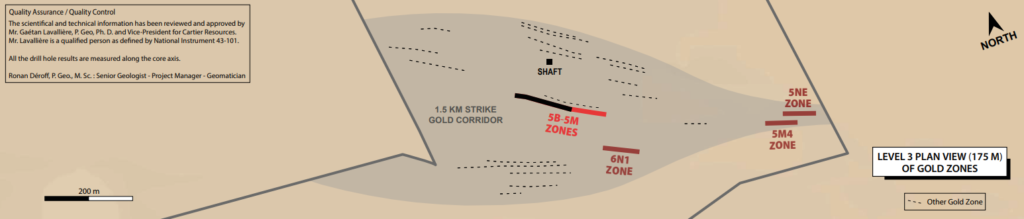
Cartier’s zone extension drilling, in my opinion, has been a success with some very good grades and widths. Reviewing the images above, which were provided by Cartier, you can clearly see how the drilling was systematically planned to delineate the gold mineralization.

If I were to have a criticism of Cartier, it would be that they don’t have any 43-101 technical reports supporting what they have done at Chimo. To explain that further, I fully subscribe to the fact that any senior company interested in Chimo will disregard any technical report Cartier possessed in favour of conducting their own due diligence.

Moreover, most sophisticated investors in the sector can review the drill results and historical mine data and construct an economic model for the revitalized mine and have an idea of its potential value.

The problem, at the moment, is the company says they are targeting the retail market, who, by and large, don’t have the necessary skills to calculate the value of Chimo. Instead, they are depending on someone else’s opinion to gauge its potential value.

NOTE: On a high level, to model Chimo effectively, you would need to have a grip on two important points; the resource size and grade and cost of dewatering the flooded shaft and underground workings. With realistic values for these 2 points, you could model the project using the costs and tax structures from other economic studies or mines in the general Val d’Or area.

In open discussion with CEO Cloutier, this point hasn’t been overlooked by the management team. They are now, however, in a position that requires them to conserve money and await a buyer for Chimo. The conservation of cash allows Cartier to weather any storm that may be headed their way when it comes to negotiation for Chimo.

Takeover Candidates

Who would be a likely candidate to purchase Chimo?

That’s a great question and one that’s key to Cartier’s investment proposition.

First and foremost, the obvious candidate is O3 Mining, which, over the last month or so, has bought up a ton of land around Chimo, through their purchases of Chalice Gold Mines and Alexandria Minerals.

O3 Mining is a new company formed by the Osisko Mining team, whose track record supports an aggressive approach to all aspects of mining company development.

In my opinion, if O3 were interested in Chimo, it wouldn’t be for the short-term production capability, it would be because they see the potential for a much larger system in the area, Chimo just being one of the key pieces.

Additionally, I have heard Agnico Eagle’s name come up as a potential suitor for the purchase of Chimo.  I’m less inclined to believe they are a better candidate than O3 to make the purchase, because Chimo, at this point, is much smaller in both resource size and land position than would typically entice a major’s attention.

While O3 and Agnico are arguably the top takeover candidates, it could be a much smaller producer with underground experience that is willing to take on this small short-term production capability story, but they will have to be well financed to make it happen.

Time will tell.

Concluding Remarks

Personally, I do see the value in owning Cartier, even without having modelled Chimo. They are cashed up, have a good management team, and have a bunch of other high potential projects that are just waiting in the wings as far as exploration goes.

Without a doubt, there will be a buyer for Chimo, it’s just a matter of price and when it will happen.

A potential investor must realize that a deal may not be imminent and understand that Cartier will be in hibernation mode until a deal can be made. Depending on your investment outlook and level of patience, this could be a deal breaker.

Don’t want to miss a new investment idea, interview or financial product review? Become a Junior Stock Review VIP now – it’s FREE!

Until next time,

Brian Leni  P.Eng

Founder – Junior Stock Review

Disclaimer: The following is not an investment recommendation, it is an investment idea. I am not a certified investment professional, nor do I know you and your individual investment needs. Please perform your own due diligence to decide whether this is a company and sector that is best suited for your personal investment criteria. I have NO business relationship with Cartier Resources, nor do I currently own any shares.  However, all of my expenses for the site visit were paid for.

Posted on

AbraPlata Resources – An Undervalued, Well-financed Silver Company with a Portfolio of JV Ready Projects

AbraPlata Resources

In the first half of 2019, most of the questions I received from readers involved the gold price and where I thought it was headed. Now, 8 months later and with the gold price surpassing US$1500/oz, the focus of the questions has shifted to the other precious metal – silver.

Silver is often referred to as gold on steroids, as historically it has outperformed gold both to the upside and downside depending on the direction of the market.  Today, the silver price has eclipsed US$18.50/oz and, at this rate, may even surpass US$20/oz by the end of 2019.

The factors driving the silver price are closely related to those driving gold, mainly the FED lowering interest rates, the talk of further QE, negative interest in Europe, the turmoil surrounding the U.S. and China trade war, and the ever-increasing list of financial calamities around the world.

Additionally, silver has a component of industrial use, which I think is the added driver of its volatility.

The rising silver price has brought with it a large amount of speculative cash which is flowing into many of the junior silver companies. Reviewing my watch list, many of these companies are up by huge amounts, mostly for no reason other than they offer perceived leverage to the silver price.

It’s the classic buying of junior resource companies because of a bullish outlook for a metal. This mentality in the junior resource sector, while it may bring short-term gains, will ultimately lose money for investors over the long term.

Junior resource companies are speculations on management’s ability to execute on a well thought out plan, which aligns with their overall vision for the company. If people can’t execute, it doesn’t matter where the metal price goes, the metal will either not be discovered or developed into a mine – period.

Today, I have for you a company which is led by good management, has roughly $3 million in cash, a high potential flagship asset – Diablillos – which has an existing M&I resource with around 140 Moz of silver equivalent, a portfolio of Chilean projects ready for JV, and a great plan to bring value to shareholders.

This company is the newly proposed AbraPlata Resources, which is expected to announce a definitive agreement regarding a merger with Aethon Minerals very soon.

Let’s take a closer look.

Merger – Aethon Minerals and AbraPlata Resources

Earlier this year, Aethon announced that they had struck a deal which would give them the exclusive right to perform technical due diligence, over a 5 month period, on AbraPlata Resource’s Diablillos silver-gold project in Argentina.

For this exclusive right, Aethon paid AbraPlata US$50,000 and agreed to spend at least US$150,000 on expenditures in connection with a metallurgical testing program and other related test work.  At the end of the 5 month period, Aethon could then acquire a 50% or greater interest in the project.

Five months later, Aethon and AbraPlata announced that they had agreed in principle to a merger of the two companies, creating a new junior with a great flagship asset in Diablillos, a portfolio of JV ready projects in Chile, and around $3 million in cash.

Additionally, I think it’s important to point out that the merger signals that the money Aethon spent on testing the deposit’s metallurgy must have returned good results or this merger wouldn’t be happening. A HUGE plus for both sets of shareholders, because it’s one thing to own a deposit, but without the economic ability to liberate and concentrate the mineral, it’s worthless!

NOTE: In accordance with the merger agreement, AbraPlata will issue 3.75 shares for every share of Aethon. At the time of writing, there is an arbitrage opportunity in owning Aethon shares, which are selling at a discount to the deal.

I fully expect to see the announcement of a definitive agreement in the coming days, and would expect the transaction to close before the end of the year. 

Aethon Minerals (AET:TSXV)

MCAP – $6.3 million (at the time of writing)

Share Price – $0.23

Shares – 27.6 million

FD – 46.3 million

AbraPlata Resources (ABRA:TSXV)

MCAP – $6.7 million (at the time of writing)

Share Price – $0.075

Shares – 96.7 million

FD – 131.5 million

People

In early 2018, Altius Minerals spun out a portfolio of its Chilean projects into Aethon Minerals. For those who don’t know, Altius is focused on the mining and resource sector through prospect generation, and the creation and acquisition of royalties and investments.

Over the course of my investing career, I have learned that to make money consistently, it’s of the utmost importance to identify and invest in the best people. I believe it’s a given that Altius has a keen interest in the success of the newly formed AbraPlata Resources and, therefore, with the appointment of Aethon’s interim CEO as its leader, John Miniotis, I believe it speaks volumes about his abilities and future in the mining business.

AbraPlata will be Miniotis’ first crack at being a CEO, but he certainly isn’t a newbie to the industry, as he has over 14 years of experience, previously working at AuRico Metals, Lundin Mining and Barrick Gold, as well as roles in equity research with BMO Capital Markets and Wellington West Capital Markets.

Miniotis is technically supported by Chief Geologist, David O’Connor, who is currently based out of Chile. O’Connor is a veteran of the industry with over 40 years of experience, founding or co-founding 5 publically listed companies, discovering the El Espino deposit in Chile, leading early exploration for Western Mining Corp. at the Olympic Dam deposit, and Chief geologist of Peko-Wallsend in Australia.

Additionally, with the merger of the two companies, a new Board of Directors will be announced. Right now, we know that current AbraPlata interim CEO and Director, Rob Bruggeman, will become the Chairman and the remaining seats will be broken down as follows: two directors nominated by AbraPlata, two directors nominated by Aethon, one director by SSR Mining and one director nominated by Altius Minerals.

This should prove to be very good for the new company, as this should ensure that there will be good representation on the board with people who have creditable mining experience in Argentina and, most importantly, in-depth knowledge of their flagship Diablillos Silver-Gold Project.

With the support of Altius and the financial backing of Sprott Asset Management, who is also a major shareholder, the newly formed AbraPlata has all it needs to be a success in the future.

Diablillos Silver-Gold Project

  • 2018 PEA: After-tax NPV@7.5% – US$212 million, After-tax IRR of 30.2% at US1300/oz gold and US$20/oz silver.
    • 6,000 tpd open pit mining operation, producing 9.8 Moz AgEq per year
    • Open pit estimated initial CAPEX US$293 million, includes US$91 of pre-stripping cost
  • 2017 Historical Resource – 140 Moz @ 161 g/t Ag Eq or 1.7 Moz @ 2.0 g/t  Au Eq at spot prices
  • Aethon successfully completed, pre-merger, extensive testing of the Oculto deposit’s metallurgy, ensuring that the PEA results are representative of the entire deposit, not just a specific zone.
  • SSR Mining is the original vendor of the project and supports the transaction and has agreed to delay property payments of US$5 million and US$7 million by four years (see March 1st press release). I expect further detail of the payments to SSR to be given at the time of the announcement of the definitive agreement regarding the merger.

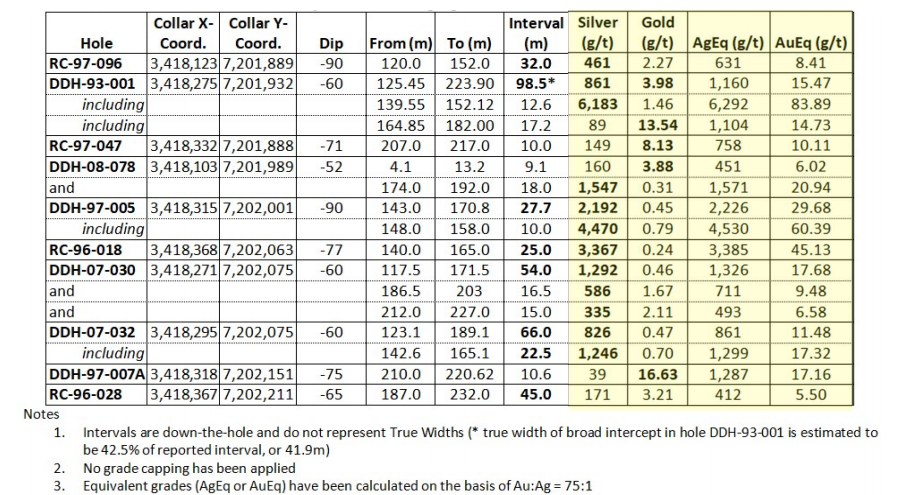
Last week, I discussed the potential of the Oculto deposit expansion with Miniotis and O’Connor. O’Connor highlighted some of the high grade core associated with breccias zones, where high grades have been intercepted over broad widths in historical drilling.

Interestingly, reviewing some of the historical results, you can see that these intercepts have some really good high grade hits.  A few of the highlights are: 98.5m of 861 g/t silver and 3.98 g/t gold, 27.7m of 2,192 g/t silver and 0.45 g/t gold and 54m of 2,292 g/t silver and 0.46 g/t gold.

This is especially great because, in our discussion, Miniotis brought up the possibility of changing the mine plan from open pit to an underground operation, which has the potential to dramatically drop the initial CAPEX cost needed to bring Diablillos to production.

Upon completion of the merger, priority number one for AbraPlata will be to establish continuity between these intercepts, at a drill spacing where they can be added to an updated resource calculation. Miniotis expects the drill program will cost roughly $1 million, making it easily affordable with their cash position.

The second priority will be to explore some of the satellite breccia deposits, which sit within 1 to 2 km of Oculto and could be potentially mined in a future production scenario.

In my opinion, there’s a clear path to improving the NPV of Diablillos in a big way and, most advantageous, is investors really don’t have to wait that long to get an idea of how much better the project economics will be.

Chilean Project Portfolio

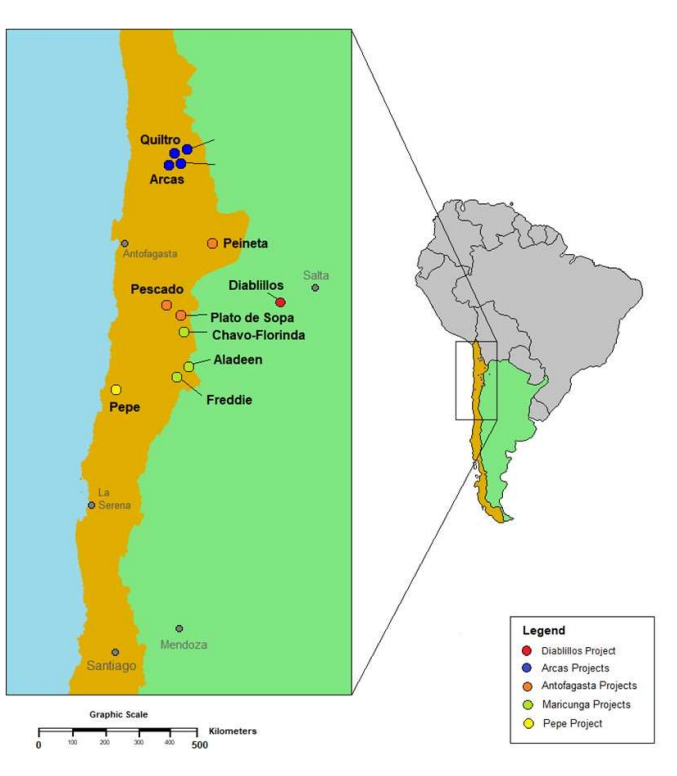
The newly formed AbraPlata will own 100% of a large prospective land package, totalling over 100,000 ha in northern Chile. The land package includes the Arcas Copper-Gold Project, Maricunga Gold Project and the Peineta Gold-Silver Project, which all sit in close proximity to some of the most prospective ground in South America.

Each project is ready for JV with a partner and I fully expect to hear news of a new partnership before the end of the year.  The prospect generator model is great way to mitigate risk in the mining industry, and for a company like AbraPlata, who has a focus on their flagship Diablillos, any JV partnership is like icing on the cake, as the partner is on the hook for the exploration funding.

Currently, this aspect of the company has been overlooked by the market, but I expect that to change quickly in the weeks ahead.

Chile and Argentina

Jurisdictional risk is everywhere; no matter where you look, there’s always a chance that your money will be lost due to some country or region’s political calamity.

In saying this, I do think that certain countries come with a higher probability of an investor realizing a loss in their investment due to their chaotic state.

The newly formed AbraPlata Resources has projects in Chile and Argentina, two countries which, besides sharing a border, are very different in terms of their perceived mining investment risk profile. Currently, Chile is considered one of the best places for mining investment; the Fraser Institute which ranks countries in terms of their mining investment attractiveness gave Chile a score of 84.90, placing it 6th in the world.

Given this, I don’t think that we have to go into much detail about the merits of Chile and why I believe it’s as good as it comes in terms of mining jurisdictions.

While Chile ranks very high, Argentina on the other hand has been riddled with issues over the last 20 years, from 2001’s $100 billion sovereign debt default, to the controversial two term presidency of Christine Fernandez de Kirchner from 2007 to 2015.

Here’s a brief summary of some of the most contested issues during her reign:

  • Heavy government spending in social programs by both Nestor Kirchner (President 2003 to 2007) and his wife, Christine (President 2007 to 2015).
  • In 2012, Argentina’s congress nationalized Repsol’s (a Spanish oil company) portion in the national energy company, YPF. Kirchner defended the move by stating, “it failed to boost oil and natural gas production needed to keep up with local demand” (Reuters).
  • Nationalized private pension funds, known as “Las Administradoras de Fondos de Jubilaciones y Pensiones (AFJP)” (Wiki).
  • Kirchner fostered relationships with China, Venezuela and Iran.
  • Nisman Allegations – Kirchner and Argentine Foreign Minister, Hector Timerman, were allegedly involved in a plot to cover up Iran’s role in the 1994 bombing of the Amia Jewish Community Centre, in which 85 people were killed. Alberto Nisman, who was investigating this bombing, made the allegations against Kirchner and Timerman.  Days after the allegations, Nisman was found dead in his apartment.
  • Raised taxes on exports, which the government later overturned, due to mass protests.

Mauricio Macri defeated Kirchner in Argentina’s 2016 Presidential election and was widely regarded as the man to turn Argentina’s economy around. While he didn’t stir up as much controversy as Kirchner, he has had his own issues trying to turn around Argentina’s economy.

Today, Argentina sits with higher levels of poverty than four years ago, a Peso which has dramatically devalued against the US dollar, and now an upcoming election which could see the return of Kirchner, albeit in a Vice President’s role to Presidential candidate, Alberto Fernandez, who just recently won the primary election, called PASO (Primarias Abietas Simultaneas y Obligatorias).

PASO allows parties that receive at least 1.5% of the vote to participate in the general election on October 27th, 2019.

Fernandez hasn’t won yet, but the results of the PASO election put a lot of doubt on Macri retaining the presidency. The possibility of Kirchner having any political influence given what happened during her past terms as President is a great glimpse into the culture of Argentina.

I have said it before, cultures take hundreds of years to change and, while they may appear to be better in the short term, rarely is it ever sustainable, as the society’s true colours will always show.

So what does this mean in terms of investment in Argentina?

First and foremost, no doubt there’s risk associated with this potential change in government leadership, as left-leaning political ideology has a long history of being bad for a country’s economics.

Given Kirchner’s history, I’m sure many investors may be concerned with the possibility of the government nationalizing the Diablillos Project. However, I think that there is very little chance of that happening at this point, because of where the project is in its development.

Bottom line, Diablillos is at least a couple of years away from this becoming a mine and, by that time, we should have a better idea of how much of a threat the Argentine government might be.

Salta Province

One other note; all of the discussion, thus far, has centred around the politics at the federal level, however, it’s arguably more important to focus on how mining is viewed within the specific Argentine province with which the project is located, as there’s a lot of variation among them.

Diablillos is located in the Salta province, which is in the northwest portion of the country. Salta has a long history with mining, with a variety of metals being mined across the province. The most famous, because of the battery metal craze, may be Salta’s lithium brine mines, which are a part of the world-famous lithium triangle.

Thus, Salta is known for being supportive of mining and have provided a framework in which permitting applications are expeditiously vetted.

Further, amongst the political turmoil at the federal level, senior mining companies such as First Quantum have continued to put money into Salta. In 2014, they acquired the Taca Taca Project for roughly $500 million; not a small amount of money.

Finally, with all things considered and you contrast the political risks against the upside potential in the newly formed AbraPlata,  I think the political risk associated with Argentina is acceptable.

Concluding Remarks

AbraPlata Resources presents an attractive investment proposition as demonstrated by its MCAP; the investor has a high potential for success versus the risk associated with the company.

Here’s a summary of AbraPlata’s upside potential:

  • Good management – supported by Altius Minerals, SSR Mining and Sprott Asset Management
  • MCAP is currently valued at roughly 10% of 2018 PEA on Diablillos
    • After-tax NPV@7.5% of US$212 million, After-tax IRR of 30.2% at US1300/oz gold and US$20/oz silver
    • Indicated Resource – 80.9 Moz @ 93.1 g/t silver and 732 koz @0.84 g/t gold
    • Potential to improve NPV through resource expansion at depth and along strike
    • Potential to drastically reduce initial CAPEX by changing the mine plan to an underground operation
  • No value given to its Chilean Project Portfolio – Arcas Copper-Gold Project, Maricunga Gold Project and Peineta Gold-Silver Project – All are JV-ready opportunities.
    • The prospect generator business model has the JV partners fund the exploration of the projects – drastically reducing the risk associated with exploration.
    • If you consider that many prospect generators, albeit with JV partners in place, have, in many cases, MCAPs of CAD$30 million alone, AbraPlata’s current value proposition is very good.
  • Roughly $3 million in cash

No investment is without risk, including an investment in AbraPlata. Given the upside potential that I see in the company, however, especially in a rising precious metals environment, I believe AbraPlata is in for a dramatic market re-rating once the merger is complete.

I’m an owner and will continue to be a buyer of AbraPlata on weakness in the weeks ahead, as they set forth on what should be an exciting fall of exploration at Diablillos.

Don’t want to miss a new investment idea, interview or financial product review? Become a Junior Stock Review VIP now – it’s FREE!

Until next time,

Brian Leni  P.Eng

Founder – Junior Stock Review

Disclaimer: The following is not an investment recommendation, it is an investment idea. I am not a certified investment professional, nor do I know you and your individual investment needs. Please perform your own due diligence to decide whether this is a company and sector that is best suited for your personal investment criteria. I have NO business relationship with any of the companies discussed in this article – Altius Minerals, Aethon Minerals, AbraPlata Resources. I do own shares in Altius Minerals and Aethon Minerals.
Posted on

Quebec Site Visit Tour Day 1 -Osisko Mining

Brian Leni

Gold continues to march its way upward, breaking US$1,500 /oz and setting all-time highs in numerous other currencies, including the Canadian and Australian dollars.  While this is music to the ears of the gold producing companies around the globe, the rest of the world is bracing for turmoil.

Tensions in Asia have hit new highs with the protests in Hong Kong appearing to escalate. Hong Kong’s airport has been shut down, and the Hong Kong people have taken to the streets waving the American flag and singing its anthem; a sight I wouldn’t have believed had I not seen the video clips.

China is not only fighting to maintain its control over Hong Kong, but continues to fight the Americans over trade. In my opinion, the longer this goes on, the worse it is for the global economy, as China remains an integral piece of the financial puzzle.

To add further complexity to the global marketplace, the U.S. Federal Reserve cut interest rates by 0.25%, signalling weakness in the U.S. economy. The currency wars continue, as they inch closer to fiats intrinsic value of 0.

While I can’t predict the ebb and flow of any commodity, I think it’s safe to say that the world is, unfortunately, ready for higher gold prices and, with it, we are most likely to see some type of climactic event which will trigger a reset for the global economy.

Now that seems like a gloomy outlook, but on the bright side, while that scenario may be inevitable, it doesn’t mean it’s imminent. Secondly, as an investor, I think you have to ask yourself, ‘how can I profit from a world which is in financial turmoil?’

First off, I should rephrase my question, as it most likely isn’t a case of how to profit, but more how to maintain what you have, given the circumstances.
Buying physical precious metals is definitely prudent and, given the attention high gold prices bring to the precious metals companies, investment in the best junior resource companies should prove to be very profitable.

In my opinion, equating future high metals prices with investment in junior companies is a recipe for inevitable failure, however, given that the majority of the market works this way, I expect to see irrationally high junior company valuations in the not-too-distant future.

Last week, I visited 3 junior gold companies that are all situated in close proximity to Val d’Or, Quebec. For those who aren’t familiar with this area, Val d’Or is famous for its historical gold production, as this eastern portion of the Abitibi Greenstone Belt has produced roughly 70 Moz of gold throughout its history.

All 3 companies appear to give the investor good risk to reward potential, in a gold market which is just starting to heat up.

Let’s take a closer look at the details of my trip.

Enjoy!

Day 1 – Osisko Mining’s Windfall Project

For all intents and purposes, the Osisko story starts back in 2004 with the acquisition of the Canadian Malartic site. Founders, John Burzynski, Sean Roosen and Robert Wares, used an innovative geological analysis model to analyze Quebec’s publicly available geological data (SIGEOM). The data revealed that the Canadian Malartic site had the potential for an open pit mining operation, which prompted the team to acquire the site.

Canadian Malartic Gold Mine

Seven years after acquisition, in 2011, Canadian Malartic poured its first gold bar, and 3 years after that, it was acquired in a friendly transaction by Agnico Eagle and Yamana Gold.

Today, Osisko Mining, the company run by this mine-building team, is focused on developing the Windfall Project, which is located in the Abitibi Greenstone Belt between Val d’Or and Chibougamau in Quebec.

Windfall Project

On August 6th, via helicopter, I had the chance to visit Windfall. Here’s a breakdown of what I saw while on site and a few notes on the direction of the company as they push toward the completion of 1,000,000 metres of drilling.

Osisko Mining (OSK:TSX)

MCAP – $965.7 million (at the time of writing)

Shares – 273.2 million

Cash – $300 million in cash and cash equivalents

First, that isn’t a typo, Osisko is at or quickly approaching 1 million metres of drilling on Windfall. If their 3.5 km exploration hole, aptly named ‘Discovery 1,’is successful, there may be even more to come, as the deposit potentially just got a lot bigger.

Discovery 1 Drill Rig

3.5 km is an incredibly long hole, the longest that I have ever heard of in hard rock exploration, and I believe this is a reflection of the team which is driving the development of Osisko. Burzynski, Roosen and Wares have a vision of what Windfall could be and aren’t held back by the usual difficulties of junior resource companies – I’m mainly referring to money, here.

Osisko has raised around $400 million dollars over the last 4 years through charitable flow through financing. Charitable flow through is raised at a premium to the market share price. In Osisko’s case, the last financing was done at 1.8 times the market price.

The premium is a huge advantage for the company and its shareholders because it’s less dilutive, by almost half, than if they had to raise the cash at market prices.

Discovery 1

Why plunge the roughly $1.0 million, 3.5 km hole into the ground? There are a couple of reasons, and I believe it’s important to touch on them as they speak to the speculative upside potential in the share price.

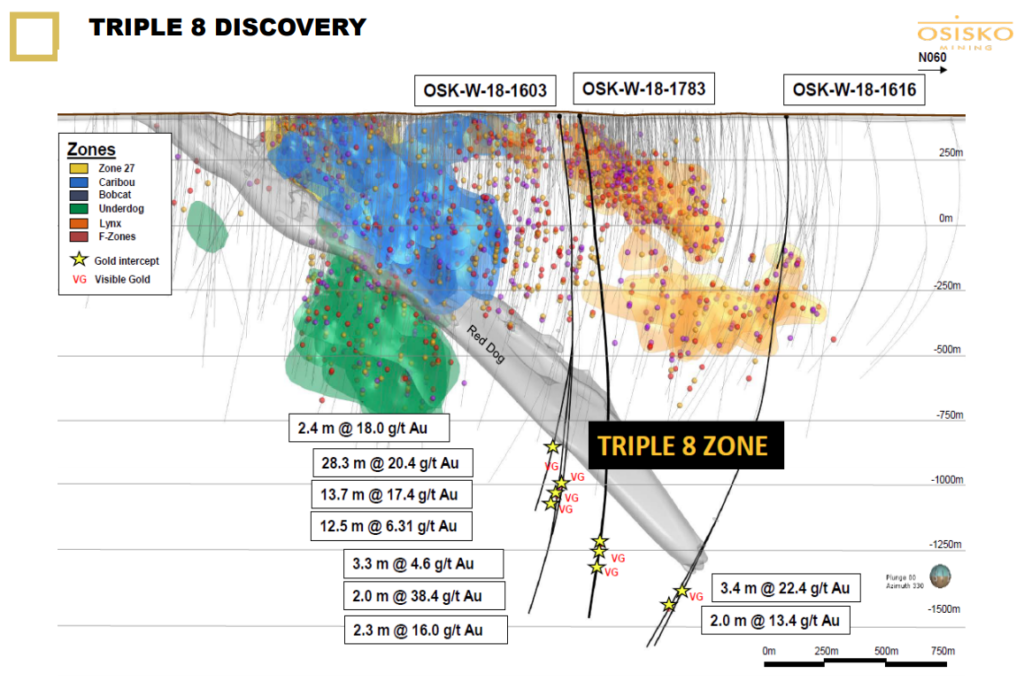
First, in exploration drilling below the known zones, that is, at depths below 750 m, they discovered the Triple 8 zone, which hit some great intervals of gold, highlighted by 28.3 m of 20.4 g/t Au, 13.7 m of 17.4 g/t Au and 12.5 m of 6.3 g/t to list just a few.

osisko triple 8 discovery
Triple 8 Zone Discovery

Along with these high-grade gold discoveries, they also encountered andesite porphyry and garnet and biotite alteration, which is associated with high heat, ergo they might be getting closer to the intrusive heat source.

Second, discovering gold mineralization at the bottom of this 3.5 km hole will play a huge role in the layout of a future mine.  Most importantly, it would dictate if and where a shaft would be sunk to most efficiently mine the deposit.

Osisko’s geological model for the deposit is supported by the Triple 8 zone discovery and has clearly given the company’s leadership a good view of the upside potential to justify the risk of coming up with nothing.

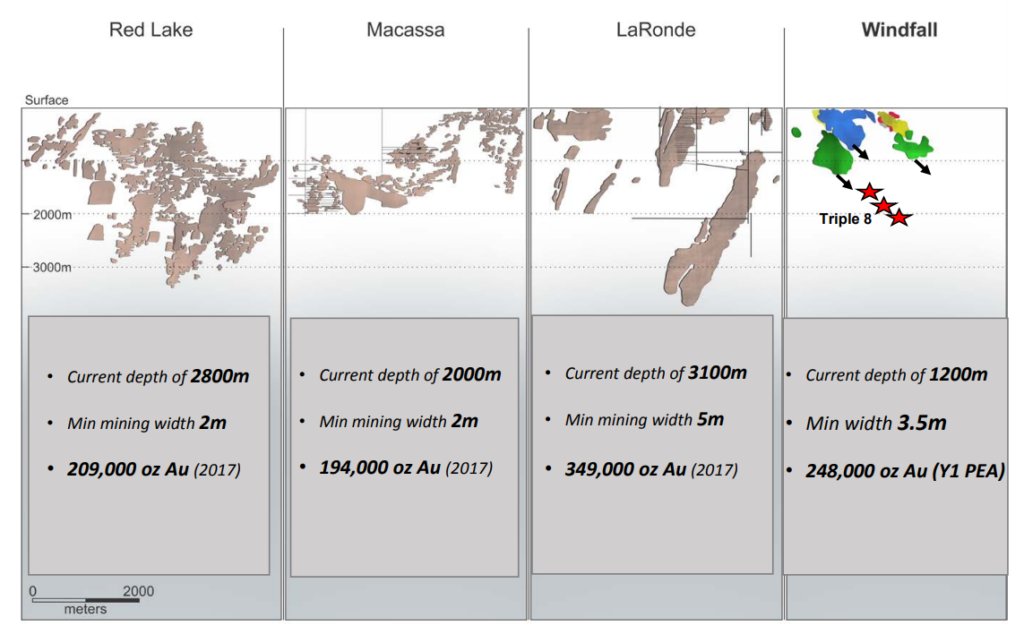
Archean mine comparison
Archean Gold Deposits

Additionally, it should be noted that there are other examples of archean gold deposits that plunge to extremes depth, none further at the moment than Agnico Eagle’s La Ronde mine, which is currently mining at 3100 m vertically below surface.

La Ronde Gold Mine
La Ronde Gold Mine

Discovery 1 has a lot of potential; it could arguably be a game changer for the Windfall Project as there is a chance that this already large gold deposit could get much bigger. In my opinion, the only risk is the roughly $1 million it cost to drill the hole, which, to a team who seemingly is a magnet for cash, doesn’t seem like as big of a risk as it would be to most junior companies.
Bottom line, at the very least, Discovery 1 should provide Osisko’s geologists with plenty of structural data on the very deepest parts of this system and, if they are so bold, will give them a good map for another shot at the prize.

Underground at Windfall

The highlight of the entire site visit tour was going underground at Windfall. It was a first for me and something that I will never forget!

Brian Leni
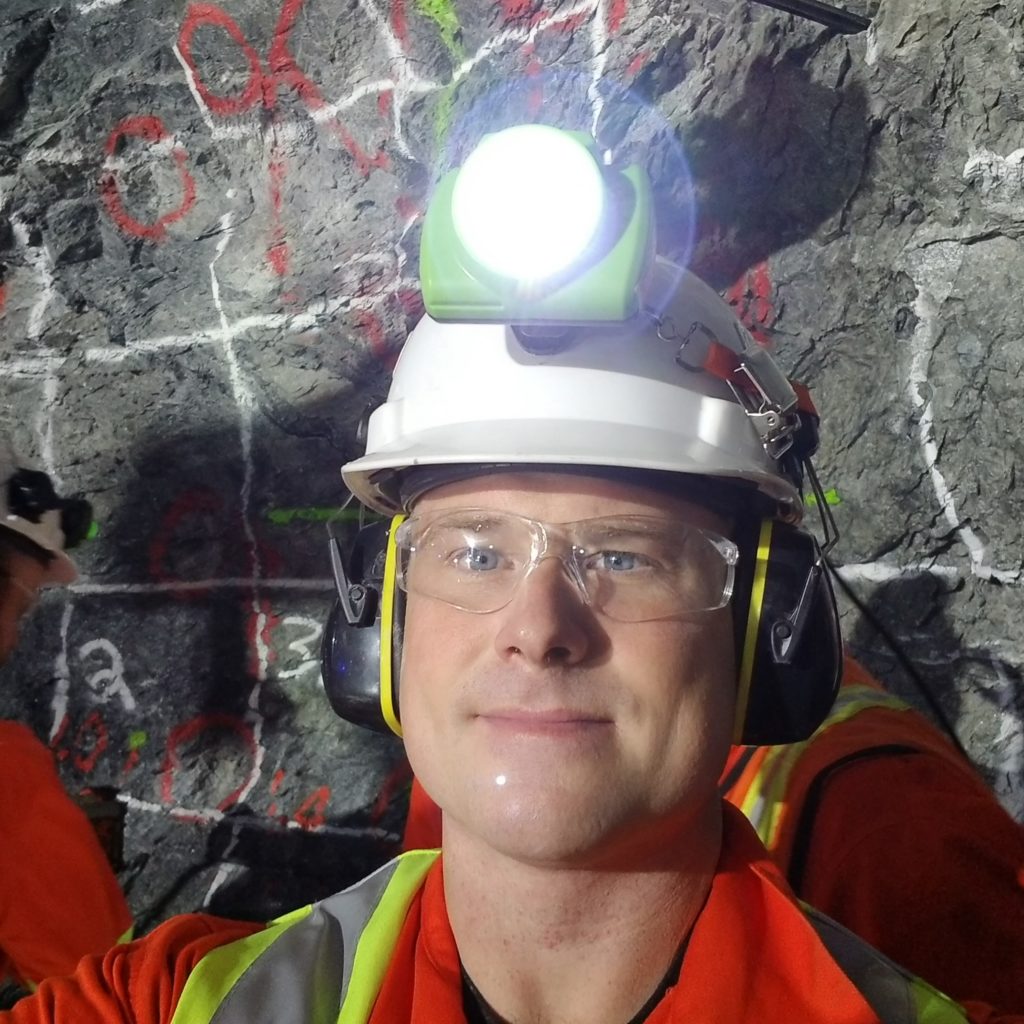
Me 300 vertical meters underground

We suited up in our PPE – steel-toe boots, safety glasses, hard hat + ear muffs + head lamp, coveralls, gloves and belt, and proceeded to load up into the truck which would bring us to a depth of 300 vertical metres.

Decline at Windfall

8 of us were in the back of the truck, making it a cozy, hot trip down the ramp, which, I might add, was much steeper than I imagined when we started the journey.

Underground core drilling

Upon exiting the vehicle, however, it was well ventilated and cool at our first stop, where they happened to be core drilling. Being underground may not be for everyone. Heck, it may not be for me in any capacity except for a 20-minute tour, but I’m really glad I had the chance to do it at least once.

Underground at Windfall

Windfall PEA Highlights

After-tax NPV@5% – C$413.2 million

After-tax IRR – 32.7%

Pre-Production CAPEX – C$392.3 million

Base case at US$1300/oz Au and US$17.00/oz Ag

A PEA on Windfall was completed last summer and released to the market. Currently, Osisko is in the process of completing a Feasibility Study (FS) on Windfall and, I believe, will show a big improvement on the NPV of the project.

One of the reasons I believe there will be an improvement is as follows:

  • Removal of the triple cap on grade, which cascades from 60 g/t, to 30 g/t, to 15 g/t on certain portions of the deposit.
    • A 5500 tonne bulk sample of Windfall’s Zone 27 returned a grade of 8.53 g/t, almost 2 g/t more than the 6.76 g/t used in 2018 PEA.
  • The Triple 8 Zone was discovered roughly 750m below the surface, extending Windfall’s known mineralization much deeper than the existing resource. As mentioned earlier, not only was high-grade gold encountered, but also mineralization, which indicates proximity to the intrusive heat source for the whole system.
    • I believe a bigger gold resource, while being much deeper, will add to the overall value of the project.

Concluding Remarks

The investment case for Osisko Mining is compelling, as I have a high degree of confidence that the management team will be successful in constructing Windfall into Quebec’s next gold mine. The only questions I have are related to how much upside potential they can create leading up to a construction decision.

As I covered in this article, there are a number of factors that I think will make Windfall more economically appealing in the months ahead, but how appealing will be answered by the drill bit leading up to the end of the year.

Don’t want to miss a new investment idea, interview or financial product review? Become a Junior Stock Review VIP now – it’s FREE!

Until next time,

Brian Leni  P.Eng

Founder – Junior Stock Review

Disclaimer: The following is not an investment recommendation, it is an investment idea. I am not a certified investment professional, nor do I know you and your individual investment needs. Please perform your own due diligence to decide whether this is a company and sector that is best suited for your personal investment criteria. I have NO business relationship with Osisko Mining, nor do I currently own any shares.  However, all of my expenses for the site visit were paid for.

Posted on

Sprott Natural Resource Symposium 2019: Lessons Learned & My Notes on Some of the Exhibitors

Sprott Natural Resource Symposium 2019

Prior to the 2019 edition of the Sprott Natural Resource Symposium, I mentioned that Rick Rule’s speech on Thursday August 1st would be worth the price of admission – he didn’t disappoint!

The speech was entitled, Lessons, Re-Learned, In a Bear Market, and for good reason, as Rule covered many of the lessons that I have found so helpful over the course of my investing career.

Here’s a look at 2 lessons that, when incorporated into your investment process, in my view, will be key to your success.

  1. The sequence of answering unanswered questions leads to high returns over time.

This lesson is the basis for share price appreciation across all sectors, but is particularly important in the junior resource sector.

So, given its importance, how does one identify a company’s unanswered questions?

The unanswered questions focus on the catalysts that will drive the share price in the future, for example, the most common unanswered questions surround drill results.

Invariably, the answering of these questions leads to more unanswered questions and, thus, the process really never ends until you get a “no” answer or you have attained an acceptable amount of profit (different for everyone).

Along with identifying the unanswered questions, it’s paramount that the investor evaluate the probability of attaining a “yes” answer to each of the questions and weigh it against the potential profit.

Evaluating the probability of success is rooted in the company’s fundamentals, aspects such as who is running the company, its share structure, its cash position, the geology of the property and the jurisdiction in which the company is operating – to name just a few. 

Examples of unanswered questions:

Question – Does the mineralization extend along strike from the existing deposit?

  • If yes, how far and at what grade?

Question – Is the mineralization amenable to standard mineral processing techniques – crushing, grinding, floatation, magnetic separation?

  • If yes, are there any deleterious elements contained in the concentrate?
    • If yes, what are smelter penalties?
  • If yes, what is the metal recovery?

Share prices are driven by catalysts, and by focusing on these quantifiable answers, an investor can not only maximize his potential profit, but also minimize the effect that emotion has on their investments.

  1. When the reason to own a stock goes away, the stock needs to go away.

Lesson #2 is closely linked with lesson #1, but is particularly important in my opinion because selling a losing position can be hard to do.

The basis of this lesson is rooted in selling a stock because of receiving a “no” answer to an unanswered question. In my experience, this is very wise advice, especially in the short term, as it most often takes time for a company to reset and recover after failure.

Additionally, I think you can parlay lesson #2 a little further.

For example, you may invest in a company for specific reasons, such as its business model, the involvement of a particular person, its focus on a particular metal, or maybe it’s an interest in a particular project.

Following the mantra of lesson #2, if any of these reasons change, it’s time to sell. For example, if a project generation company whose business model centres around using “other people’s money” to explore their properties changes to using their own money to explore, you may want to think about selling, as the risk profile of the company just changed.

In my view, these lessons are invaluable and, when practiced, easily justify the price of admission to a conference such as the Sprott Natural Resource Symposium.

With that said, it will be 2020 before you know it, and with it a chance to register for next year’s conference at a significant discount if done early. Watch for the links in the New Year.

Symposium Exhibitors

One of the many perks of attending the Symposium is its list of exhibitors, each of which has been vetted by the Sprott organization and owned in a Sprott managed equity account.

While this is definitely an advantage, it doesn’t mean that investors should freely invest in any company at the conference. No matter who recommends a company, each investor is obligated, in my view, to complete their own due diligence and determine if it’s an investment which fits their own personal criteria.

I met with 10 companies that were exhibiting at the Symposium and compiled a few notes on each of them. In no particular order:

Aethon Minerals (AET:TSXV)

MCAP – $5 million (at the time of writing)

Cash – Over $3 million

  • Altius Minerals (ALS:TSX) spin out in 2018.
  • Recently announced a merger with AbraPlata, whereby all of the issued and outstanding Aethon shares will be exchanged on the basis of 3.75 AbraPlata common shares for each Aethon share. This implies consideration of $0.248 per Aethon Based on the 10-day volume weighted average of AbraPlata shares $0.661.
  • Currently, Aethon is trading at discount to AbraPlata.
  • John Miniotis will be the new company’s President and CEO.
  • Flagship asset – the Diabillos Project has a total indicated resource of 27,100 tonnes – 80.9 million oz of silver at 93.1 g/t and 732k oz of gold at 0.84 g/t and an inferred resource of 1,100 tonnes – 1.69 million oz of silver at 48.8 g/t and 29K of gold at 0.83 g/t.
  • Diabillos Project – High grade precious metal exploration potential.
  • Large Chilean land package which is slated for future joint ventures with senior mining companies. I expect to see a JV deal before the end of the year.

Hot Chili Limited (HCH:ASX)

MCAP – $44 million (at the time of writing)

Cash – Over $1 million AUD (will need to finance for Phase 2 drilling)

  • Christian Easterday is Managing Director.
  • 2 Projects: Cortadera Copper Porphyry Project and Productora Copper Project.
  • Cortadera was optioned from a private Chilean mining group, SCM Carola, earlier this year.
    • Located 14 km from Productora Copper Project.
    • Initial 5,500 m drill program was highlighted by the discovery of a new high grade zone at Cuerpo 3, the main porphyry- CRP0013D – 750 m grading 0.6% copper and 0.2 g/t gold from 204 m depth, including 188 m grading 0.9% copper and 0.4 g/t gold.
    • Exploration potential – geochemistry and geophysics (ground mag and IP) have identified a North Target area which has never been drilled.
    • Exploration potential – Additionally, each of the 4 porphyry centres remain open at depth and laterally.
    • Phase 2 drilling to commence shortly.
    • Maiden resource on Cortadera to be released very soon.
  • Productora Copper Project
    • Total Proven and Probable Reserves (JORC) – 166.9 tonnes at 0.43% copper, 0.09 g/t gold and 138 ppm molybdenum (at metal prices – Cu $3.00 USD/lbs, Au$1200 USD/oz and Mo $14.00 USD/lbs).

Altus Strategies (ALTS:TSXV)

MCAP – $16.9 million (at the time of writing)

Cash – roughly $1 million in cash and securities

  • CEO Steven Poulton leads a team of geologists and mining engineers who have a history of success in the resource industry.
  • Altus team has a long history of success in Africa.
  • Insider Ownership – CEO Steven Poulton owns 14.2%.
  • Strategic shareholders, which includes – Exploration Capital Partners (2012 and 2014) combined 13.2%, and Euro Pacific Gold Fund 3.8%.
  • 18 projects, all located in Africa, encompassing a wide range of precious and base metals.
  • Prospect generator business model.
  • Targeting greater than $10 million USD per annum JV financed exploration expenditures.
  • 9 projects in the “Joint Venture Ready” portion of their development – precious and base metals.

Millrock Resources (MRO:TSXV)

MCAP – $8.3 million (at the time of writing)

Cash – Over $2 million in cash and securities

  • Greg Beischer is President and CEO.
  • Millrock is mainly focused on mineral exploration within the Tintina Gold Province located in Alaska, but does have additional project interests in BC and Mexico.
  • Prospect generator business model.
  • No joint venture partners at the moment, however, this is likely to change in the weeks to come.
  • Currently, the Goodpaster Project is a focus for the company, as they are targeting an extension to Northern Star’s Pogo mine.
    • Using CSAMT geophysics Millrock is targeting a deep shear zone to the west of the existing mine. Key to this program is the fact that they are using the same contractor as Northern Star did to complete the work.
    • Completion of the program will either be followed by a decision to drill or wait for a JV partner to fund the drilling of the prospective target.

Mundoro Capital Inc.

MCAP – $8.67 million (at the time of writing)

Cash – $3 million (Q1-2019)

  • Teo Dechev is President and CEO.
  • Prospect Generator business model.
  • Exclusively in Eastern Europe, mainly Serbia and Bulgaria.
  • JOGMEC JV – Currently in Phase 2 program – geophysics, with drilling to follow in Q3 2019 – JOGMEC can attain 51% of the project by spending $4 million USD in expenditures by March 2019 and purchase up to 80% of the project with the delivering of a Feasibility Study.
  • Freeport JV – Currently in Phase 1 program – Alteration mapping and geophysics, with drilling to possibly follow near the end of Q4 2019 – Freeport can attain 51% of the project by spending $5 million USD in expenditures by September 2021 and up to 75% of the project by solely funding an additional $40 million in expenditures by 2026.
  • Timok Project is up for Joint Venture, but no partner at the moment.
  • Strategic Alliance In Bulgaria with JOGMEC.
  • Large institutional holdings – 58%.

Ardea Resources (ARL:ASX)

MCAP – $59.44 AUD (at the time of writing)

Cash – $11.2 million AUD

  • Andrew Penkethman is the CEO.
  • Focused on both precious and base metals, with a primary push towards nickel-cobalt.
  • Goongarnie Nickel Cobalt Project – PFS: 2.25 Mtpa, before tax NPV of $2.4 billion and IRR of 31%, CAPEX cost $918 million USD, Pressure Acid Leach (PAL).
  • Large gold and nickel exploration land package totalling 3500 square kilometers.
  • Possibility to spin out gold focused projects and make Ardea solely a nickel company as we move into what may be a strong nickel price environment in the years ahead.

Equinox Gold (EQX:TSXV)

MCAP -$843.6 million

  • Christian Milau is CEO and Executive Director.
  • Ross Beatty is a major shareholder, owing 12% of the company.
  • Gold focused, with 3 advanced staged / mines in Brazil and California, USA.
  • Aurizona Gold Mine poured its first gold in May 2019, 2019 production guidance is set at 75 to 90,000 oz Au at a AISC of $950 to 1,025/oz.
  • Mesquite Gold Mine – in production, YTD 2019 – $70.8 million in revenue, 52K oz produced, $780/oz cost and a AISC of $907/oz. Production guidance updated to 125 to 145K oz at an AISC of $930 to 980/oz.
  • Castle Mountain – 3.6 Moz Au reserves, 16 year mine life, $763/oz avg LOM AISC – construction to begin second half of 2019.
  • Overal,l Equinox should produce 200 to 235K ounces in 2019, with a goal of attaining production over 1 million ounces per annum by 2023.

ISO Energy (ISO:TSXV)

MCAP – $49.9 million

Cash – $3 million

  • Craig Parry is the President and CEO.
  • Board of Directors is led by the Chairman Leigh Curyer, who is the CEO of NexGen Energy. NexGen owns arguably the best undeveloped uranium deposit in the world.
  • Team has the background to be successful in the Athabasca Basin.
  • NexGen owns 53.4%, Cameco owns 5.4%, Orano owns 2.0% and Institutional owns 19.2% – doesn’t leave much in the public float.
  • Summer Drill Program – Hurricane Zone – 8 holes into a 16 hole program on their Larocque East Project, which is located in the eastern portion of the Athabasca Basin. Targets are hosted in Sandstone/unconformity. Drill program is expected to cost $1.5 million, leaving them with $1.5 million going into 2020.
  • 3 other projects in their portfolio – Thorburn Lake, Radio and North Thorburn.

CanAlaska Uranium (CVV:TSXV)

MCAP – $11.24 million (at the time of writing)

Cash – roughly $1.0 million in cash and cash equivalents (April 2019).

  • Peter Dasler is President and CEO.
  • Prospect generator business model.
  • 3 main Projects: West McArthur, Cree East and NW Manitoba.
  • West McArthur is a JV with Cameco – Targeting a unconformity-basement uranium deposit.
  • Cree East has no JV partner – 9 target areas across the property, possibility of both basement and sandstone hosted uranium deposits.
  • NW Manitoba lies in close proximity to the Saskatchewan border and is similar geologically to Rabbit Lake, Collins Bay and Eagle Point Uranium mines which are within 90 km of the property.

Goviex Uranium (GXU:TSXV)

MCAP – $65.6 million (at the time of writing)

Cash – $2.8 million USD

Debt – $8.0 million USD

  • Daniel Major is the President and CEO.
  • 3 uranium projects, all located in Africa – Madaouela, Mutanga and Falea.
  • Flagship Madaouela Project is at the definitive feasibility study stage of development. The Republic of Niger has signed a definitive agreement to jointly develop the project.
  • After-tax NPV@8% – $340 million USD, IRR – 21.9% at a uranium price of $70 USD/lbs.
  • Orano (formerly Areva) operates a uranium mine in close proximity to Madaouela, which is reaching the end of its mine life.
  • “The State is to receive an additional working interest of 10% in exchange for approximately US$14.5 million of claims due by the Company to the State comprised of the final €7 million Madaouela I Mining Permit acquisition payment and settlement of previously challenged three years of area taxes (US$6.6 million) (collectively, the “Debt”) between the Company and the State related to the Madaouela Project. The Company is to receive a final, complete and unconditional release without reserves in respect of the Debt, upon the transfer the additional working Interest.” ~ News Release
  • The company is working at optimizing its metallurgy and subsequently extract value from the other base metals that are present – nickel, cobalt and molybdenum. Gravity separation and floatation techniques are being tested for their ability to concentrate the metals effectively. If successful, these advances have the potential to positively affect the project’s economics.

Don’t want to miss a new investment idea, interview or financial product review? Become a Junior Stock Review VIP now – it’s FREE!

Until next time,

Brian Leni  P.Eng

Founder – Junior Stock Review

Disclaimer: The following is not an investment recommendation, it is an investment idea. I am not a certified investment professional, nor do I know you and your individual investment needs. Please perform your own due diligence to decide whether this is a company and sector that is best suited for your personal investment criteria.  I have NO business relationship with any of the companies mentioned in this article. I am a shareholder of Aethon Minerals.

Posted on

Aftermath Book Review – Rickards’ Latest and Greatest

Aftermath

“Society does not get endlessly richer and more sophisticated. Periodically things collapse. It is not the end of the world. It is the end of an age.” ~ Rickards – The Road to Ruin – pg.297

Change is coming, I can feel it.

My sample size isn’t overly large, but in my life, I can’t remember society being as polarized between left and right as it is today. It isn’t just Canada and United States, either, it seems to be a good portion of the world.

So, why does it matter? Well, in my view, the root of where we are economically begins with the culture of the society. In this case, I’m referring to western culture or, more specifically, the derivatives of western culture which are found in Canada and the United States.

Western culture is of particular importance because its ebbs and flows, presently, have such a profound effect on the entire world. In fact, I would suggest that what I’m feeling is actually the degeneration of western culture and, in effect, the fall of the global economy as we currently know it.

For all intents and purposes, the United States represents the peak of western culture, as its rise to the world’s top power over the last 100 years has been predicated on all the ideals, mainly liberty and freedom, which allow the free thinking individual to prosper.

Instead, today we are headed on a path toward destruction. This path is one which is moving to remove the liberty and freedom of the individual and increasingly to replace it with government oversight, effectively removing an individual’s responsibility of choice.

In essence, the left and right are fighting to establish who knows best for everyone else. This will ultimately end in the failure of the western culture and, along with it, the collapse of the global economy in its current form.

Today, I have for you a review of James Rickards’ latest book, Aftermath – Seven Secrets of Wealth Preservation in the Coming Chaos. Aftermath is volume 4 in a quartet of books that included Currency Wars, The Death of Money and The Road to Ruin.

Much like the previous three, Aftermath doesn’t disappoint as it sets out a blueprint for wealth preservation in the coming chaos.

Let’s take a closer look.

Aftermath – Seven Secrets of Wealth Preservation in the Coming Chaos

Much like Currency Wars, The Death of Money and The Road to Ruin, in Aftermath Rickards uses both his experience and financial knowledge to outline his thesis for why a reset to the global monetary system is inevitable.

The chapters in Aftermath are broken down into topics, the ramifications of which could individually or collectively trigger the next global economic meltdown.

In my own words, here are the 7 topics that Rickards covers:

  • Tariffs and Trade Wars
  • Debt to GDP Ratio
  • Behaviour Economics
  • Passive Investing
  • Velocity of Money
  • Global Monetary Reset
  • Terminal Unit

Each of the topics is deserving of its own chapter, however, I particularly enjoyed the information Rickards provides on the debt to GDP ratio and behavioural economics. In my view, these 2 topics are of particular importance because I think that, ultimately, a crisis in the global economy will start with them.

Specifically, I believe quantitative easing (QE) and low interest rates are to the market as drugs are to an addict.  Therefore, pick your poison; more QE and low interest rates that will lead to an overdose, or go cold turkey, which will lead to the tremors and, most likely in this case, death. Either way, change is on the horizon.

Debt to GDP Ratio

Currently, the United States debt to GDP ratio sits at roughly 105%, a level which Rickards explains is considered by most economists to be above the point of no return. Once an economy reaches these critical levels, the growth of the economy is destroyed as any profits are directly fed into servicing the debt.

Japan is a great example of the effects of a high debt to GDP ratio, as the Japanese economy has been stagnant for multiple decades.

The obvious question then is, can’t the U.S. expand their debt to GDP ratio to the extent of Japan and still avoid a crisis? The answer is probably not; there would be a crisis of confidence before it reached the levels of the Japanese economy.

“The U.S. debt to GDP ratio is approaching the point at which it cannot expand much farther without inducing a crisis of confidence” ~ Aftermath

Firstly, while Japan’s debt is much larger than its GDP, the saving grace for the Japanese, in my opinion, is the fact that the Japanese people are its largest holders of its debt. Because of this, I believe there is a level of protection that the U.S., for example, doesn’t have.

Second, while the U.S. does appear, superficially, to have room to grow its debt to GDP ratio, the potential lack of confidence in the U.S.’s ability to service that debt begins to heighten. Unlike the Japanese, a good portion of the U.S. debt is held overseas and, thus, presents a major hurdle to further expansion.

Dwindling confidence will snowball and surely cause a major economic crisis. America’s debt to GDP ratio is in risky territory. In the chapter, ‘Putting out the Fire with Gasoline,’ Rickards walks you through the history and risks associated with debt to GDP rations and, most importantly, provides a tip for protecting your wealth against this major risk.

Human Behaviour

“Are humans risk adverse slugs or overconfident pretenders? The answer is both, depending on past circumstances and current conditions at the point of decision. This behaviour contradiction, one of many, illustrates why it is so difficult to make sense of human behaviour in markets” ~ Aftermath

We all have cognitive bias that affects the decisions we make. More specifically to the basis of this book review, it is the bias-laden investment decisions that many of us make that pose a major risk to the economy.

In the investment world, there is a tendency to follow the herd into buying the most popular stocks – for example, the FANG stocks (Facebook, Apple, Netflix and Google) or using the most popular investment techniques, such as passive or index investing. While the herd mentality can sometimes provide short-term profits, over the long haul, it typically ends in losses.

Currently, we sit at a very risky juncture in the stock market, where it sits at all time highs. All time highs mixed with the hyper-synchronicity investments is extremely dangerous for both the individual investor and the market as a whole.

If or when losses begin to mount, it will have a contagion effect on the market and, undoubtedly, lead to what could be major losses.

There is so much more to this topic which Rickards covers in the book – I won’t spoil it. Understanding this one chapter in the book could make all the difference in preserving your wealth.

Concluding Remarks

While it is easy to get caught up in the ‘when,’ as in when will the crisis occur, it really is a waste of time. No one can predict when complex events such as a global monetary reset will take place. In my opinion, it’s important to continue to live life as you normally would, but with some added financial prudence.

In my view, Aftermath is a MUST read for everyone, not just for those who are focused or interested in the global economy.  The benefits of understanding the ramifications of what has happened in the global economy over the last 10 years is integral for understanding where we may be headed.

In Aftermath, Rickards lays out the groundwork needed to protect your wealth in the future, no matter what’s around the corner.

While it may not be imminent, it does appear to be inevitable that a global monetary reset is on the horizon. Read Aftermath, The Road to Ruin, The Death of Money and Currency Wars – you won’t regret it!

Don’t want to miss a new investment idea, interview or financial product review? Become a Junior Stock Review VIP now – it’s FREE!

Until next time,

Brian Leni  P.Eng

Founder – Junior Stock Review

Disclaimer: The following is not an investment recommendation, it is an investment idea. I am not a certified investment professional, nor do I know you and your individual investment needs.

Posted on

Amarillo Gold – Developing Brazil’s Next Gold Mine

Amarillo Gold Corp

I’m constantly searching the junior resource sector for companies whose share price is trading for less than their value. In January of this year, I became an investor in Amarillo Gold, a junior company which I believe is trading for far less than their value.

A couple of weeks ago, I had the chance to travel to Brazil and see Amarillo’s flagship Mara Rosa Project, which is located in the northwest portion of the State of Goias.

Rafael Silveira, Myself, Frank Baker

The site visit was highly beneficial because it confirmed for me why I’m invested in Amarillo and why I believe it will be Brazil’s next gold mine. My reasons are as follows:

  • The Amarillo management team is well suited to moving Mara Rosa to and through construction, as their pedigree reveals a history of developing projects in Brazil. From the CEO to the team located in Brazil, each member has been in the mining industry a long time and has a specific skill set which is applicable to the development of Mara Rosa.
  • The Mara Rosa Project is advanced with an updated Pre-Feasbility Study (PFS) completed in the fall of 2018. The PFS revealed an after-tax NPV@5% of $US 244.3 million at $US 1300/oz gold, which means, at the time of writing, with a MCAP of less than $30 million CAD, the company is currently trading at less than 10% of its PFS after-tax value.
  • Expansion of the resource – There is a realistic probability of expansion of the Posse Deposit resource at depth and to the northeast. Examining soil sampling, geophysics and historical drilling, the northeast portion of the property looks particularly interesting to me, given its size. Drilling isn’t a priority at the moment for the company, but could spell more upside potential in the future.
  • While a controversial figure, Jair Bolsonaro will bring about a positive economic change to Brazil. This is already evident with the pension reform bill which is moving through the Brazilian government’s approval process, as I write. Ultimately, I believe Amarillo’s current price to value proposition is well worth the risk.
  • The town of Mara Rosa and its people, from what I could tell, view the construction of the mine positively and look forward to the jobs that it will bring. There are many active and former mines in the northern region of the State of Goias, making it a great spot for development.
  • Takeover Candidate – while I believe Amarillo is currently a takeover candidate, I believe that upon the completion of the Definitive Feasibility Study (DFS) it becomes much more appealing to senior or mid-tier mining companies, as the DFS will bring more confidence and validation to the economics of the project.

Amarillo isn’t without risk; I believe there is at least one hurdle which the company must overcome in order to be fairly valued by the market. That hurdle is the metallurgy of the Posse Deposit, which has been a major focus for the company since they purchased the deposit from Western Mining in 2003.

While the mineralization is complex, I believe the company is on track for proving up and optimizing the metallurgical process that is needed to economically extract the gold from the Posse deposit ore.

In my opinion, Amarillo Gold is trading for less than its value. I was a buyer at 20 cents and believe a re-rating in the share price is just around the corner.

Without further ado, a look at why I am a buyer of Amarillo Gold.

Enjoy!

Amarillo Gold

MCAP – $28.8 million (at the time of writing)

Shares – 140.8 million

FD – 185.6 million

Cash – $3.0 million (as of June 30, 2019)

Insider Ownership – 10%

Institutional Ownership – 60%

Bolsonaro’s Affect on Brazil

In the fall of 2018, I wrote an article on Brazil and why I’m optimistic about its future. My thesis was primarily based on, at the time, presidential candidate Jair Bolsonaro winning the election and taking control of the country.

For those who are unaware, Bolsonaro was victorious and is now the President of Brazil.

So now, roughly 9 months later and with the basis of my thesis fulfilled, what do I think about Brazil and its future, now having spent close to a week there? Am I still optimistic?

Determining the answer to this question has been much harder than I would have guessed prior to my trip. I believe Bolsonaro will have a positive effect on Brazil’s economy, because he is seemingly dedicated to minimizing the amount of corruption in the government and to appointing leadership within it based on merit, not to fulfill a favour or bribe. This will have very positive effects.

During my trip, I actively engaged as many Brazilians (who spoke English) as I could to learn about their views of Brazil, mainly where it is as a country and where it’s headed under the leadership of Bolsonaro.

Interestingly, much like Trump in America, Bolsonaro has a polarizing affect on people; they either love him or they hate him. Even some of the Brazilians who said they voted for him, hate him. I found this particularly interesting and wanted to know why.

 Most often, I was told that there wasn’t anyone else to vote for and, bottom line, government corruption has to be reduced for Brazil to be successful.

Of the younger generation, let’s say under 30, I met only one person who thought that Bolsonaro was good for the country. The rest hated him and said that he is going to destroy it as he takes away some of the services and “privileges” that many of the Brazilian people have come to rely upon.

Further, the same younger generation yearns for former President and now convicted criminal, Lula Da Silva, who is currently in jail for his involvement (while President) with Operation Car Wash. In my opinion, this is truly bizarre, but goes to show you that people only see what they want to see.

There is much more to this discussion, but I will leave it here because it’s out of the prevue of this article. My conclusion on Brazil is this; I believe Bolsonaro will have a positive effect economically on Brazil, which, ultimately, should make it a more desirable place to do business during his reign.

What I have seen, however, only strengthens my thought that it takes multiple generations or hundreds of years to change a culture and, therefore, while Bolsonaro will have an impact during his term, it will be minimal and short lived, as I do expect to see a return to a left-leaning government in the future.

With this said, in my opinion, investing within a “risky” jurisdiction is always a matter of a risk adjusted price to value comparison. Meaning, am I getting enough upside potential to warrant investment?

Additionally, remember that there is risk in every jurisdiction, even the ones that are widely thought to be tier 1 locations for mining investment. I will quote Rick Rule, CEO of Sprott U.S. Holdings, who recently said to me,

“Mostly the controllable aspect of political risk is price and probability…I would argue with you right now that the People’s Republic of British Columbia, which is regarded as a superb place for politics, is extraordinarily risky. The BC provincial legislature is a joint venture between the Socialists and the Greens. Not exactly mining’s best friend… Yes, Brazil has a long standing history of formal corruption. I would ask you what the difference between a campaign contribution and a bribe is.” ~

Therefore, with regards to Amarillo Gold, in my opinion, there’s enough upside potential to warrant investment in the company, as it’s currently trading at less than 10% of its updated PFS after-tax NPV of $US 244.3 million.

Amarillo’s Leadership

Amarillo is led by CEO, Mike Mutchler, who is a mining engineer by trade. Mutchler’s experience in the sector relates well to the needs of Amarillo, as he is an experienced mine builder. Most recently, Mutchler was COO of Largo Resources, which built a vanadium mine in Brazil.

Although he hasn’t been a CEO, his skill set and education, in my opinion, should be the perfect recipe for what Amarillo needs to be successful in completing their FS on the Mara Rosa Project and, most importantly, making it Brazil’s next gold mine.

Next, we have Roland Uloth, who is Amarillo’s Executive Chairman. Uloth has extensive experience within the business world, with the last 20 years focused on the mining sector. Notably, Uloth has been a key executive with both River Gold Mines and Wesdome.

Additionally, I think it should be noted that Uloth has been a major buyer of Amarillo stock on the open market, as the SEDI insider buying report is littered with his purchases. According to SEDI, Uloth currently owns over 6 million shares, excluding warrants.

Finally, and arguably the most important member of the Amarillo team at this juncture, is Arao Portugal, who was just officially named Amarillo’s Country Manager. Country Manager isn’t a common position within a junior mining company, but makes complete sense in this case.

Portugal brings a unique set of skills and experience to Amarillo, which I believe are vital to the overall success of the company as they look to attain their final 2 permits – the Installation License (IL) and the Operation License (OL).

There are a few more important players on the Amarillo team: Frank Baker – Metallurgist and Project Manager, Luis Carlos F. Da Silva – Geology Manager, Alexandre Elisel and Rafael Silveira – Geologists.

Mara Rosa Project

The Mara Rosa Project encompasses roughly 60,000 ha and sits just a few minutes’ drive from the centre of the town of Mara Rosa, which is located in the northern portion of the State of Goias.  This region of the State is very familiar with mining, as there are a number of former and currently operating mines in the region.

Most notably is Lundin’s Chapada copper-gold Mine, AngloGold Ashanti and Kinross’ Serra Grande Gold Mine, and Anglo American’s Barro Alto nickel mine, to name just a few. The point is, with these mines being within 100 km, the people of Mara Rosa and the surrounding area are very familiar with mining and the benefits that come with it.

Amarillo’s Main Office and Core Shack – Located in Mara Rosa

As well, given the amount of mining in this portion of the State, infrastructure is good; in particular, power is readily accessible with a sub-station within 4 km of the Mara Rosa Project. The hydro power in this area is supplied by the 450 MW Serra Mesa Hydro Electric dam.

Pre-Feasibility Study Economics

In September of 2018, Amarillo released an updated PFS on Mara Rosa and revealed some very robust economics.

Contractor Mine Scenario

Gold Price Assumption – $US 1300 per ounce

After-tax Net Present Value (NPV) at a 5% discount – $US 244.3 million

After-tax Internal Rate of Return (IRR) – 50.8%

CAPEX – $US 122.9 million

AISC – $US 655 per ounce

Reserves (Proven and Probable) – 1.087 Moz of gold

Resources (Measured and Indicated) – 1.3 Moz of gold

Satellite Image of Mara Rosa Project

In my opinion, the Mara Rosa Project has great economics, with good downside risk protection in terms of the gold price. Robust economics at the PFS stage of development is a really good sign, as there is a higher degree of confidence that the Project can deal with issues that may arise given the rigorous analysis which is yielded by the DFS.

Site Visit – July 2019

My trip to Mara Rosa, Brazil from Toronto was very straightforward. I flew overnight from Toronto to Sao Paulo, which is approximately a 10.5 hour flight. To note, Sao Paulo’s Guarulhos International Airport has seen some great upgrades since I was last in Brazil in 2011. I’m guessing that the 2016 Rio Olympics brought about  this overhaul.

Next, I had a short 2 hour flight from Sao Paulo to Brazil’s capital, Brasilia. Interestingly, after doing a 17.5 hour flight from San Francisco to Singapore in April of this year, I found these flights to be easy!

Brasilia Airport – Domestic Terminal

From Brasilia, a company representative picked me up at the airport and we headed northwest to the town of Mara Rosa, which is roughly a 4.5 hour drive. The drive between Brasilia and Mara Rosa is pretty good considering the amount of heavy truck traffic those roads appear to receive.

Rest Stop Along the Road Between Brasilia and Mara Rosa

Along with the multiple 2 lane highways that head north out of Brasilia, there is also a railway which runs right beside the Mara Rosa Project. Rail is a great way to reduce the amount of truck traffic, however, it sounds like this railway isn’t used to its full extent, which is too bad as it would save the roads and, ultimately, make them safer for commuters.

2011 View from Sugar Loaf Mountain – Rio de Janeiro

My previous trip to Brazil was spent in and around Rio de Janeiro, which is much different than what I encountered in the capital region. Rio is a very mountainous and lush environment, which clearly gets an optimal amount of sun and rain, as it is a veritable jungle surrounding you as you drive into Rio.

Future Mine Site in the Distance

By comparison, the Federal District of Brasilia and the Northern portion of the State of Goias is much different. In terms of topography, it is much flatter, drier and open, with farmers’ fields lining the highways. The region, however, does have a rainy season where the rain fall is very heavy, which allows for the endless farmers’ fields and well-established jungle-like vegetation.

Northeast Corner of the Posse Deposit

NOTE: The area surrounding the town of Mara Rosa is known for its production of turmeric spice. While walking the property, one of the geologists pointed out some turmeric bulbs lying on the ground. There are fields of these plants, their bulbs are harvested, dried and ground into a powder, which is then packaged and sold in grocery stores. Farming is the major industry in this part of Brazil and is what currently drives (economically) towns such as Mara Rosa.

Expansion of the Posse Deposit

As per the 2018 updated PFS, the Posse deposit has 1,087 koz of proven and probable gold reserves at an average grade of 1.42 g/t. While this is great, more ounces would be even better and, given what I saw onsite and reviewing historical exploration data with the geological team, there’s reasonable probability that the Posse Deposit could be extended at depth and to the northeast.

Reviewing some of the past geophysics on the deposit, you can clearly see that the anomaly, of approximately twice the size of the existing deposit, extends out to the northeast. The focus of previous drilling campaigns has been on the main deposit, however, there is historical drilling data on a few holes that have been drilled along the northeast extension.

As you can see in the image above, there hasn’t been much step out drilling, but what has been done has returned some decent hits. I believe it will be well worth the time and money to see if it’s something of significance.

One other note, while an extension to the northeast of Posse would be great, under the current Preliminary License (LP), the seasonal creek that cuts perpendicularly across the strike of the northeast extension would prevent Amarillo from expanding their current pit to include the new discovery.

However, the company does have the option to apply for modifications to their existing LP, which, if they choose to, could include the temporary re-routing of the creek so that this northeast area is available for mining.

Seasonal Creek in the northeast of the property

Tailings Dam

The tragic failure of Vale’s tailings dam in the neighbouring State of Minas Gervais resulted in the death of 300 people. Talking to many mining engineers, the design of the dam that failed has long been known to have some major weaknesses and, thus, in my mind, was preventable.

Moving forward, similarly designed tailings dams can be upgraded to prevent this from occurring again in the future. It sounds like the Brazilian government, however, is going a step further and will announce the banning of all tailings dams in future construction, regardless of the design.

In my opinion, this is a knee-jerk reaction to an issue which is solved through proper engineering and, most of all, the diligence of the companies that operate these mines and tailings facilities. Banning the construction of this integral part of a mine is crazy.

In saying this, there are alternatives to the traditional tailings facilities and, with this in mind, Amarillo’s leadership has decided to proactively pursue one of these alternatives given the potential direction of the Brazilian Government.

Reviewing the location of Tailings Mat Storage

So how does this new approach affect Amarillo’s mine plan and economics? That’s a great question. First off, the company is pursuing a horizontal filtration technology which is proven to reduce the moisture content of the tailings. The end product of the process yields what the company reps were describing as tailings mats.

These tailings mats are still required to be stored in a lined storage facility, meaning the basis of construction for the original tailings dam will still be used to dry stack the mats. The company reps tell me that this change in process shouldn’t cause any issue with their already issued preliminary license (LP).

In all, the cost for the filtration system is roughly $US 10 million in CAPEX dollars and is estimated to require another $US 1 per tonne in operating cost per year over the course of the life of the mine. I haven’t added this new cost to my discounted cash flow model yet, but given the economics of the project, I’m guessing this won’t be a huge issue.


Archeology Testing

Standard practice in Brazil is to conduct archeological studies on the properties that are moving toward construction. This process requires a certain amount of area on a property to be studied for historical significance.

During my visit, a team of archeologists was on site performing the study. For someone who finds these studies really interesting, it was great to have the opportunity to see part of the process in person.

At the dig site I visited, they had just discovered some remnants of bowls and an area which had  been used for fires at some point. In the image below, to the right of the teal pan, the bowl artifacts have been outlined in small white pins. These artifacts will be removed from site and stored in a museum.

While the archeological study is not over, it is expected to have minimal to no impact on the Mara Rosa Project construction plans, which is good to hear.

Metallurgy

As I mentioned in my intro, the metallurgy of the Posse Deposit is most likely the largest hurdle to the success of Amarillo moving forward. I am, however, personally very encouraged by what I see in the testing the company has performed to date, and believe that the metallurgical testing performed for the FS will turn the tide, in terms of how the market views the risk associated with the economic extraction of the gold.

There’s much to cover with regards to the metallurgical processing of the Posse Deposit mineralization, so I’m going to cover this in a separate Part 2 of this article.

Concluding Remarks

Currently, Amarillo Gold is selling at a fraction of its updated PFS NPV, which, I believe, gives an investor plenty of upside potential given the risk associated with the company.  Amarillo’s focus is completion of their DFS, which will pave the way for the remaining permits and, ultimately, the construction of Brazil’s next gold mine.

Stay tuned for Part 2 of my Amarillo Gold Site Visit article, where I will cover the Posse Deposit’s metallurgy and why I believe the company is on the right track to put this risk behind them.

Don’t want to miss a new investment idea, interview or financial product review? Become a Junior Stock Review VIP now – it’s FREE!

Until next time,

Brian Leni  P.Eng

Founder – Junior Stock Review

Disclaimer: The following is not an investment recommendation, it is an investment idea. I am not a certified investment professional, nor do I know you and your individual investment needs. Please perform your own due diligence to decide whether this is a company and sector that is best suited for your personal investment criteria. Currently, I do own Amarillo Gold Corporation stock.

All Amarillo Gold Corporation analytics were taken from their website and press release. Junior Stock Review has NO business relationship with Amarillo Gold Corporation. Amarillo Gold Corporation did pay for travel expenses for the site visit.

Posted on

A Conversation with Rick Rule, CEO of Sprott U.S. Holdings

Becoming a competent investor requires the constant willingness to learn and the pushing aside of what you think you know. Over the course of my personal investing career, there have been a handful of people who have greatly influenced the way I invest my money in the market. Rick Rule, without a doubt, has had the largest impact to date.

In a few weeks, July 30th to August 3rd, the annual Sprott Natural Resource Symposium will take place in Vancouver, British Columbia, Canada. Rule will be giving a speech at 8 am on August 1st entitled, Lessons, Re-Learned, In a Bear Market.

In my opinion, this single speech is worth the price of admission, never mind the whole host of other headline speakers, such as Doug Casey, James Rickards and Grant Williams to name just a few.

Today, I have for you a conversation with Rick Rule. In our conversation, we covered a number of topics, but most importantly, Rule explains why it’s vital for an investor to be self-aware and, secondly, frames the mindset which is needed to invest in “risky” jurisdictions.

Additionally, at the end of the interview, Rule gives you, the reader, a great offer that I hope you will take him up on!

See you at the Symposium.

Enjoy

Brian: Access to cash is to the junior resource companies like air is to human beings; an absolute necessity.

For many, Toronto, Canada represents the Mecca of junior mining finance. However, it appears this may be rapidly changing, as the bear market in resources is not only affecting investor profits, but also the banks and institutions which have, for many years, been the suppliers of cash to junior resource sector.

I have a two-part question; First, in your opinion, do you agree that Toronto’s role as the center of the junior mining finance world is diminishing? Secondly, if so, do you foresee any repercussions for this seemingly major change?

 Rick: I think to an extent, Toronto’s role may be declining, it’s really a consequence of the increase in participation in other parts of the world. I’m thinking particularly of the Pacific Basin, Hong Kong, Shanghai, and of course, Sydney. Toronto still punches, Toronto and by extension Vancouver, still punch well above their weight on a global scene, meaning that they still originate more capital for mining that is consumed inside Canada. It’s worthy to note the centers of excellence occur in both cities that make important contributions to the service sectors in those cities. My suspicion is that as the mining market turns from cyclical lows that the importance of Toronto and Vancouver, that is the importance of Canada, as a mining finance center, will continue.

Brian: Over the last month or so, the gold price has been strong, surpassing the US$1400 /oz mark, a price we haven’t seen since 2013.  While a rising gold price will undoubtedly draw more eyes to the sector, which is positive, I can’t help but think that there are some drawbacks to a world with a rising gold price.

How do you view a world with rising gold prices?

Rick: Gold traditionally has functioned as insurance, which means it does well when confidence decreases. The circumstance that would see a very high gold price would almost certainly be a poor outcome for most aspects of your life and your portfolio. The truth is that gold does well in response to things like war or economic unrest.

So the circumstance that would see gold at levels that some forecasters have talked about, $5,000 US and now $6,000 US, and now $7,000 US an ounce, would not be pleasant for the rest of your portfolio. That said, I think a prudent investor always allocates for circumstances that would be problematic. And gold, for thousands of years, has operated in that part of people’s portfolio.

BrianAre market sentiment and fundamentals like the chicken and the egg? Meaning, does it make a difference which one comes first to alter the tide from a bear to bull market?

Rick: I believe it does. I believe in mining, well, I believe in all economic activities that bull markets are the authors of bear markets and vice versa. People’s expectation of the future is set by their experience in the immediate past, and it’s my belief that markets overshoot in both directions. I believe the next bull market in mining will be a consequence of people’s anticipation of success being so low that the challenge for the industry would be to get under the bar rather than over the bar.

In other words, the industry needs to beat people’s expectations for a while. People’s expectations are now so low that beating those expectations will, in fact, be easy. The fundamentals must change relative to value before expectations change. And, mercifully, the mining industry is in the midst, the beginning, of a renaissance I believe that will cause it to do exactly that.

Brian: Over the last year or so, I have found great value in studying my losses and trying to find similarities in my mode of failure.  Not surprisingly, there is a commonality in my failure mode and it is directly linked to my own bias tendencies.

Self awareness is important in all aspects of life, but hard for some to attain. I heard a wise man once say,

“you may not know who you are, but I bet you can tell me who you aren’t.”

This really resonated with me because the more I think about it, the more this backwards type of thinking makes sense.

As an investor, how important is it to be self-aware?

Rick: I think that’s probably the most important question I’ve been asked all month. And I would suggest to you that there are many paths to investment success, but they all begin with who you are. I have learned myself that most of my worst investment wounds were in fact self-inflicted. And while I look at the range of risks in the market, interest rates, governments, dishonest promoters, the biggest risk that I face is conveniently located to the right of my left ear and to the left of my right ear. That is my own biases.

We talked a bit in the prior question about the earliest bias. We all believe ourselves to be rational fact seekers, taking information from all sources, and organizing that information logically and making rational conclusions. That’s not what happens. We, in fact, select information that makes us comfortable with our existing prejudices and biases. And the truth is that we have short memories. Our experience in the recent and the immediate past shapes our expectation for the future much more than our experience going back two decades or three decades, which is, in fact, more valuable.

I think if anybody takes away anything from this interview it is being self honest, attempting to be self honest, pardon me, checking your biases, and continuing to invest in your own education is the best guarantee that you can have of investment success.

Brian: In my opinion, political risk within a jurisdiction is rooted within the culture of the society in which it inhabits. Therefore, understanding the culture of the society is integral for gauging the risk of a prospective investment.

Being bullish on one of the world’s riskiest jurisdictions is usually correlated with some major change within the given country’s politics. However, I’m not sure if the change that is expected is ever really real, as most countries seemingly never escape the handle of ‘risky.’

Is it possible to have or expect real change in risky jurisdictions?

Rick: I think you need to define a risky jurisdiction. The truth is that mining is a location specific and capital intensive business, so it is particularly prone to political risk. It’s also a small business, which means that it never enjoys the political power necessary to defend itself. Mostly, the controllable aspect of political risk is price and probability. People who look like you and I, and I’m venturing into dangerous territory here, politically risky it can go, tend to believe that money that is stolen from us by white people in English, according to the rule of law, is less gone than money that’s stolen from us in ways that we understand less well.

So, I believe a lot of political risk is expectation and the price that one assumes for the risk. My biggest economic experience with political risk occurred 30 years ago in a wayward jurisdiction known as the People’s Republic of California where net present value in excess of about $700 million was taken by shareholders by the capricious California legislature. And people tell me that Congo is risky.

I would argue with you right now that the People’s Republic of British Columbia, which is regarded as a superb place for politics, is extraordinarily risky. The BC provincial legislature is a joint venture between the Socialists and the Greens. Not exactly mining’s best friend. The wealth grabs that the BC legislature in Vancouver City Council have made frankly protectionist racist taxes on foreign investors are, I think, a harbinger in the future. So, when people talk about cultures and political risk, people need to discriminate I think based on their understanding of the culture that they operate in and the culture that they are familiar with. Yes, Brazil has a long standing history of formal corruption. I would ask you what the difference between a campaign contribution and a bribe is.

Brian: Having attended many resource sector focused investment conferences over the years, it’s clear, to me at least, that the majority of investors in the sector are in their, so-to-speak, ‘golden years.’ The younger generations, mainly the millennials, on mass, are virtually absent with their attention seemingly more focused on cannabis and crypto. The question that comes to my mind is, why? Is it a matter of relatability?

In your opinion, why has the resource sector failed to attract the millennial generation’s investment dollars, thus far?

Rick: I think that the younger generation is extremely narrative oriented, and the resource narrative hasn’t played out for a long time. My own generation, we’re definitely past our sell by date. Certainly in the ’60s, we were attracted to much more mainstream investment activities until our paradigms were changed by the decade of the ’70s, which saw natural resources explode in price, and that price justified the narrative to us.

My suspicion is that sometime in the next 10 years we are going to have another upward move in resource prices, in particular precious metals prices, and I think the precious metals narrative. Appealing to people’s greed and fear will have an extremely profound impact on millennials. Interestingly, I have found in the last 18 months that the inbound interest that Sprott has received around the world is now about evenly divided between younger people and older people, and is interestingly now 40% female. A circumstance which I have never seen before.

So, while the situation that you describe still prevails today, I would suggest to you that it’s changing very, very rapidly. The industry is attracting interest from around the world rather than just from developed countries. It is attracting increasing interest from younger people, and for the first time in my career, attracting substantial interest from younger females.


Brian: Conferences are a great way to expand your knowledge of the sector and to speak to the people who are running the companies in which you’re speculating. Learn who these people are – you’re trusting them with your money.  

For those looking for a conference to attend, I highly suggest that you attend the Sprott Natural Resource Symposium from July 30th to August 2nd in Vancouver.  In my opinion, it’s by far the best conference in the business and worth every penny.

In your opinion, what’s the value proposition of the Sprott Natural Resource Symposium?

Rick: I think we have several value propositions. The first is that the sort of keynote headline speakers, the generalists, who go to the narrative that we were just discussing, our top, top, top line. Danielle Dimartino Booth, sort of a new voice on the scene, but a profoundly bright individual. She will be joined on the main podium by Nomi Prins, another person who just came to prominence in the last decade. Of course, Jim Rickards will be back, and Doug Casey will be back.

But keeping the macro theme company. Importantly at this conference there will be five or six presenters who have built multi-billion-dollar natural resource companies from standing starts. People who can talk about how you generate billions of dollars of wealth in the resource business, and how their experience building companies has shaped how they invest and how it can help the way you invest.

Importantly, at this conference, our attendees have told us that the exhibitors, the public companies who come to tout their wares, are more than advertisers. The attendees say that the exhibitors are content, too. So in our conference, which is different than other conferences, in order to be allowed to exhibit a public company it must be owned in a Sprott managed equity account. That doesn’t sadly guarantee that everything we invest in goes up in price. But the truth is that you will have a curated list of exhibitors, which are all owned in Sprott managed accounts, and by Sprott principles.

So, I think the combination of an absolutely great top line group of commentators and newsletter editors, with combined circulations over a million people, a high quality group of industry people who have made billions of dollars for their investors, and a curated group of exhibitors combine to make this, I think, the finest high net worth retail natural resource conference on the planet.

Brian: That’s great. I’m really looking forward to it. Thank you very much for your time today.

Rick: Always a pleasure, Brian. If I may, I would like to offer your readers an inducement to get to know Sprott. For any of your listeners who care, I am willing to personally rank their speculative resource portfolio.

If they would email me the names and symbols in text, not as an attachment, in an email to RRule@sprottglobal.com, I will rank their holdings and send them back by return email.

Absolutely no obligation on their part. This is something that we do to get to know people. So if that is of interest, I invite your listeners to email me personally.


Brian: That’s a great offer. Thank you very much, Rick.

Rick: Always a pleasure. Thank you. I look forward to seeing you in Vancouver.

Don’t want to miss a new investment idea, interview or financial product review? Become a Junior Stock Review VIP now – it’s FREE!

Until next time,

Brian Leni  P.Eng

Founder – Junior Stock Review

Disclaimer: The following is not an investment recommendation, it is an investment idea. I am not a certified investment professional, nor do I know you and your individual investment needs. Please perform your own due diligence to decide whether this is a company and sector that is best suited for your personal investment criteria.