Posted on

Northern Empire – The Sterling Gold Project Site Visit

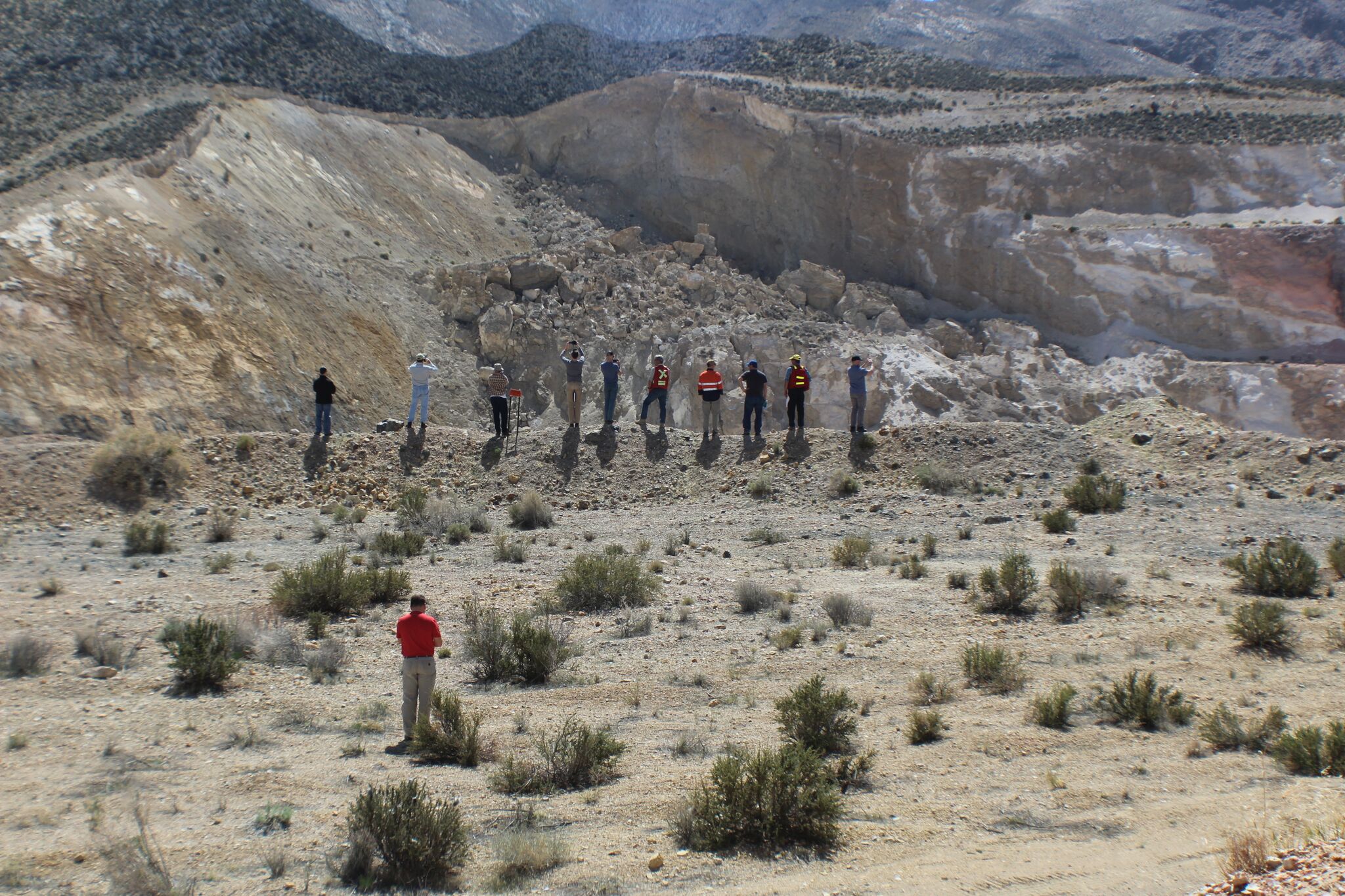
Northern Empire's secret pass pit

On April 6th, I had the opportunity to visit Northern Empire’s Sterling Gold Project, located north-west of Las Vegas, Nevada.  My visit was great and really gave me a good perspective of the Sterling Gold Project’s scale and its potential for further resource expansion.

In particular, the Crown Block stood out as having great exploration potential, as not only is this area a focus for Northern Empire, but also has drawn a lot of attention from Corvus Gold, whose Mother Lode Open Pit is completely surrounded by Northern Empire.

In all, I left the site visit very optimistic that Northern Empire’s 2018 drill program should shed a lot of light onto the Sterling Gold Project’s potential and am eagerly awaiting news flow!


Las Vegas

After landing in Vegas, I hopped in an Uber to get to my hotel. As this was my first visit to the area, I was mesmerized by the bright lights, massive celebrity advertisements and sheer size of the Las Vegas Strip.

View from the bridge connecting the Bellagio and Ballys

View from the bridge connecting the Bellagio and Ballys

Las Vegas truly is the center of the universe when it comes to marketing, because the corporations that reside here clearly understand human behaviour and how to manipulate it. Everything about the strip is designed to put a smile on your face while simultaneously extracting the maximum amount of money from your wallet.

Along the strip, a Starbuck’s tall Americano is $5.50 USD, a tall can (493ml) of domestic beer $10.00 USD, and a ‘big gulp’ slushy with rum or tequila will run you $30 USD. These prices remind me of those typically reserved for sporting events or concerts, which may be a good comparison for the confines of the Vegas Strip.

A view of New York New York from my hotel parking lot

A view of New York New York from my hotel parking lot

While my comments here may seem negative to some, they aren’t meant to be. I have a high regard for the marketing expertise that has created this ‘wonderland.’

View of the Bellagio

View of the Bellagio

Bottom-line, even if you aren’t a gambler, Las Vegas is a place that everyone should visit at some point in their lives. It truly is unique in terms of what it has to offer.


Sterling Gold Project

The day of the site visit started early, as we met in the lobby of the hotel at about 6:30 am. I, however, hadn’t adjusted to the 3 hour time change and was up some time before. One thing about starting your day at 4 am in Vegas is that you aren’t alone. That said, I’m sure most of the people I encountered at that time of the morning had yet to go to bed!

From our hotel, it was about a 2 hour drive up the I95 to the Sterling Gold Project. Given the size of our group, we split up into 3 vehicles. In the SUV with me was Executive Chairman, Doug Hurst, and The National Investor newsletter Editor/Publisher, Chris Temple. Both men are very experienced in the mining and investment worlds and shared several, great anecdotal stories about their experiences and lessons they’ve learned from the sector.

Drones and Area 51

Roughly half way to our destination, we drove past a U.S. Air Force base which, famously or infamously, is the site of at least a portion of the U.S. drone fleet.
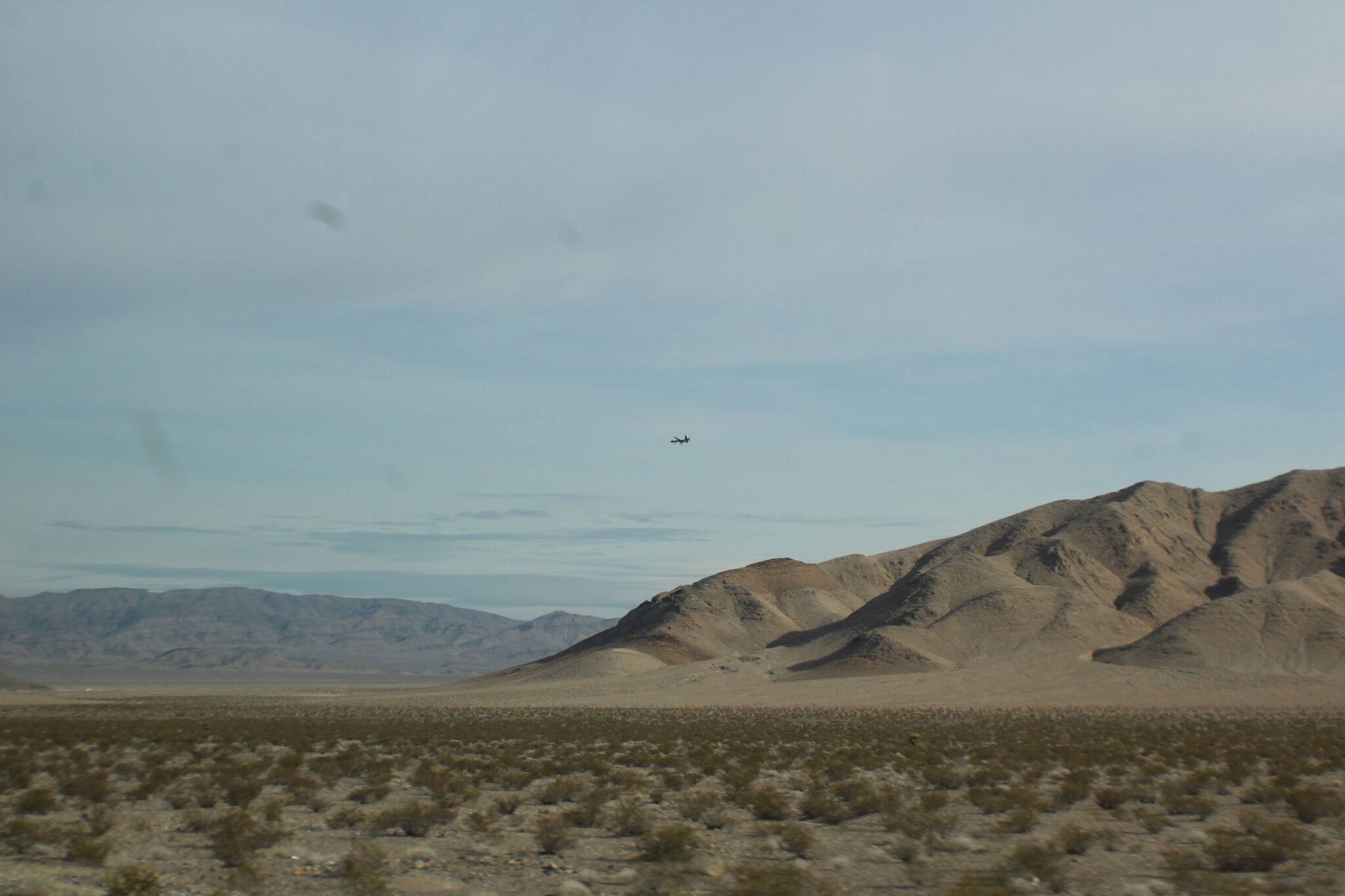
drone

A drone flying in the Sterling Gold Project Vicinity

One of the most intriguing, yet mysterious, sites along the way was Area 51. Of course, you can’t actually see Area 51, but many of the businesses along the highway have names inspired by this mysterious U.S. Air Force base. I’m by no means an expert on the lore surrounding Area 51, but after spending the day at the Sterling Gold Project, you very quickly become aware of a U.S. military presence.
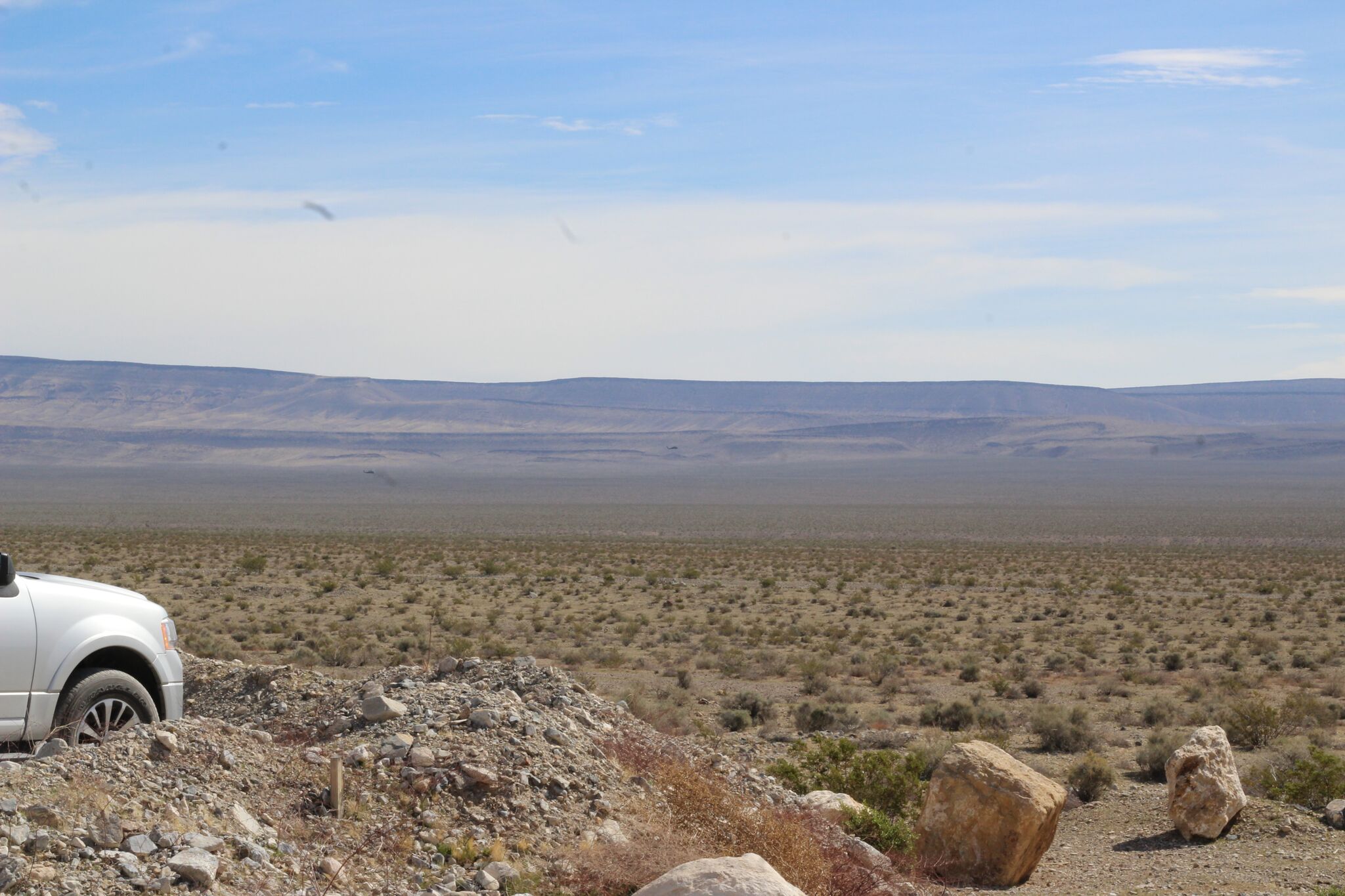
helicopter

2 (small) Helicopters in the distance


Walker Lane Trend

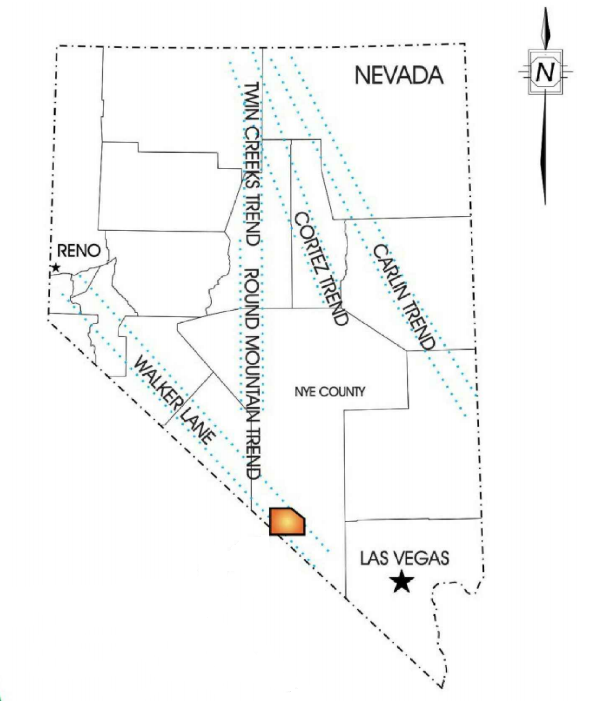
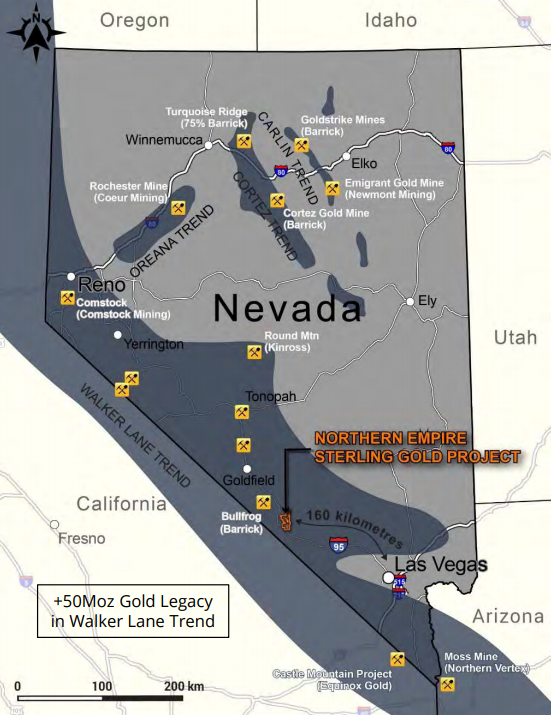
The Walker Lane Trend extends north-west from Las Vegas to Reno, running parallel to the Nevada and California state borders. While not as famous as the Carlin or Battle Mountain-Eureka Trends in the northern portion of the state, the Walker Lane Trend has a very rich gold mining history.
Walker Lane Trend


It’s estimated that 50 million ounces of gold have been discovered within the Walker Lane Trend, with the Comstock Lode Mine located near Reno being, arguably, the most famous.  Additionally, the Round Mountain and Bullfrog Mines are other examples of gold producing mines within the trend.

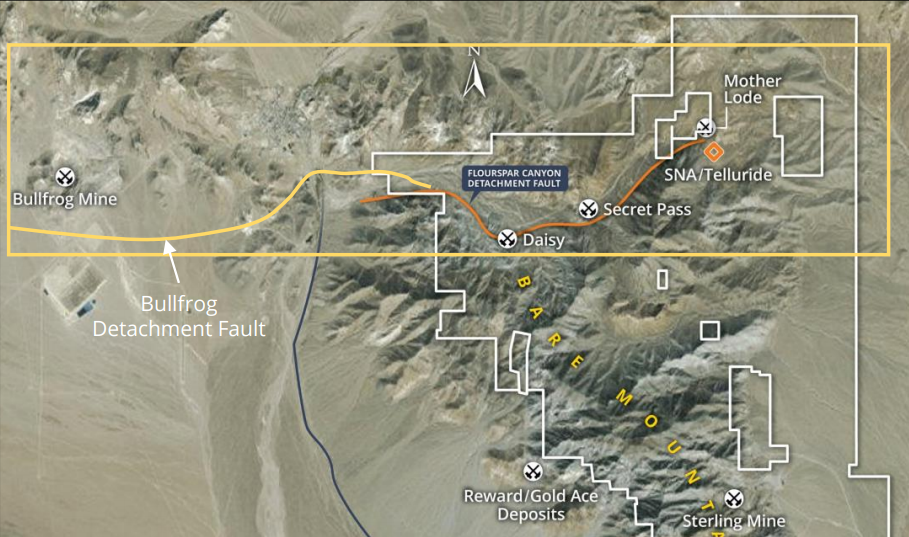
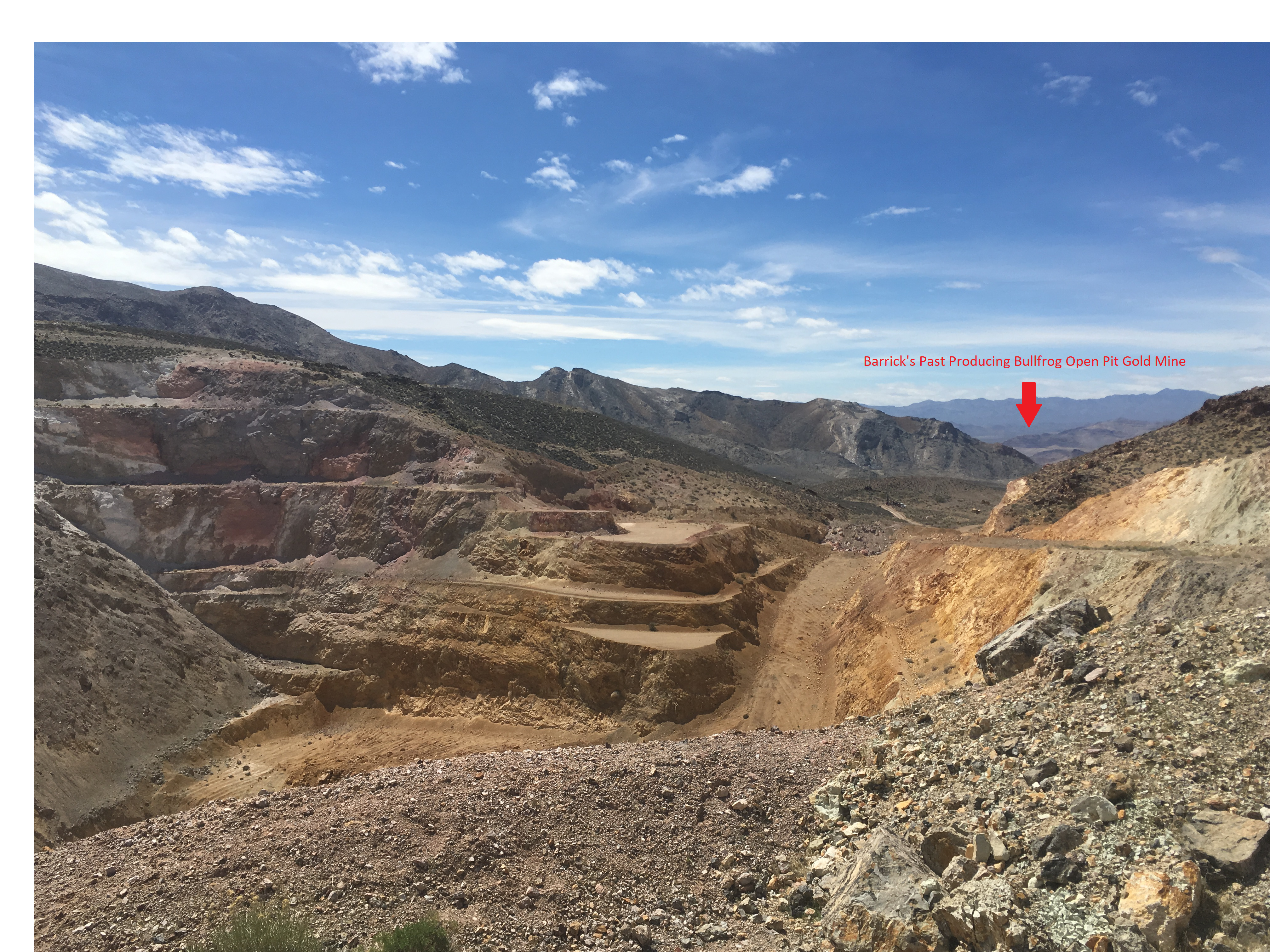
Interestingly, Barrick’s past producing 2.3 million ounce Bullfrog Open Pit Gold Mine can be seen from Northern Empire’s Crown Block. I was able to snap a photo, while standing at the top of the Secret Pass Open Pit – see below.
View from Northern Empire's Secret Pass Open Pit

View from the Secret Pass Open Pit – Barrick’s Bullfrog Mine
 

Crown Block - detachment fault

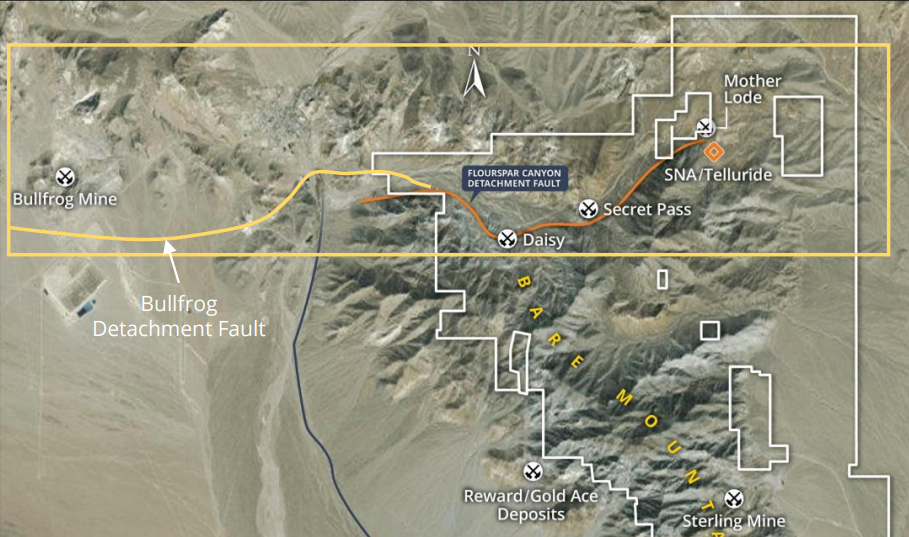
Satellite Image of the Crown Block

As you can see in the satellite image above, the Bullfrog Detachment Fault and the Fluorspar Canyon Detachment Fault run in a similar east-west fashion, and lay host to the past producing open pit mines. Also, the Faults divide the tertiary volcanic rocks in the north and the sedimentary rocks in the south.


Sterling Mine

The site visit began at Northern Empire’s permitted Sterling Mine, which is in the southern region of the property. After completing our site safety orientation and collecting our PPE, we hit the road, making our first stop at the heap leach pads.
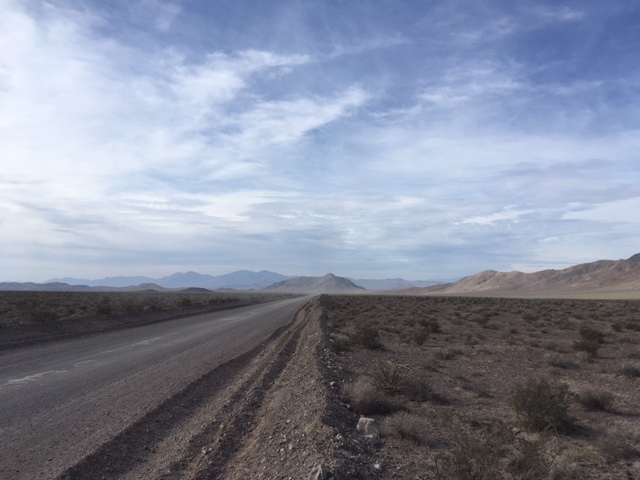
Sterling’s Main Entrance Road, Looking Away from the Sterling Mine

Sterling’s Main Entrance Road, Looking away from the Sterling Mine
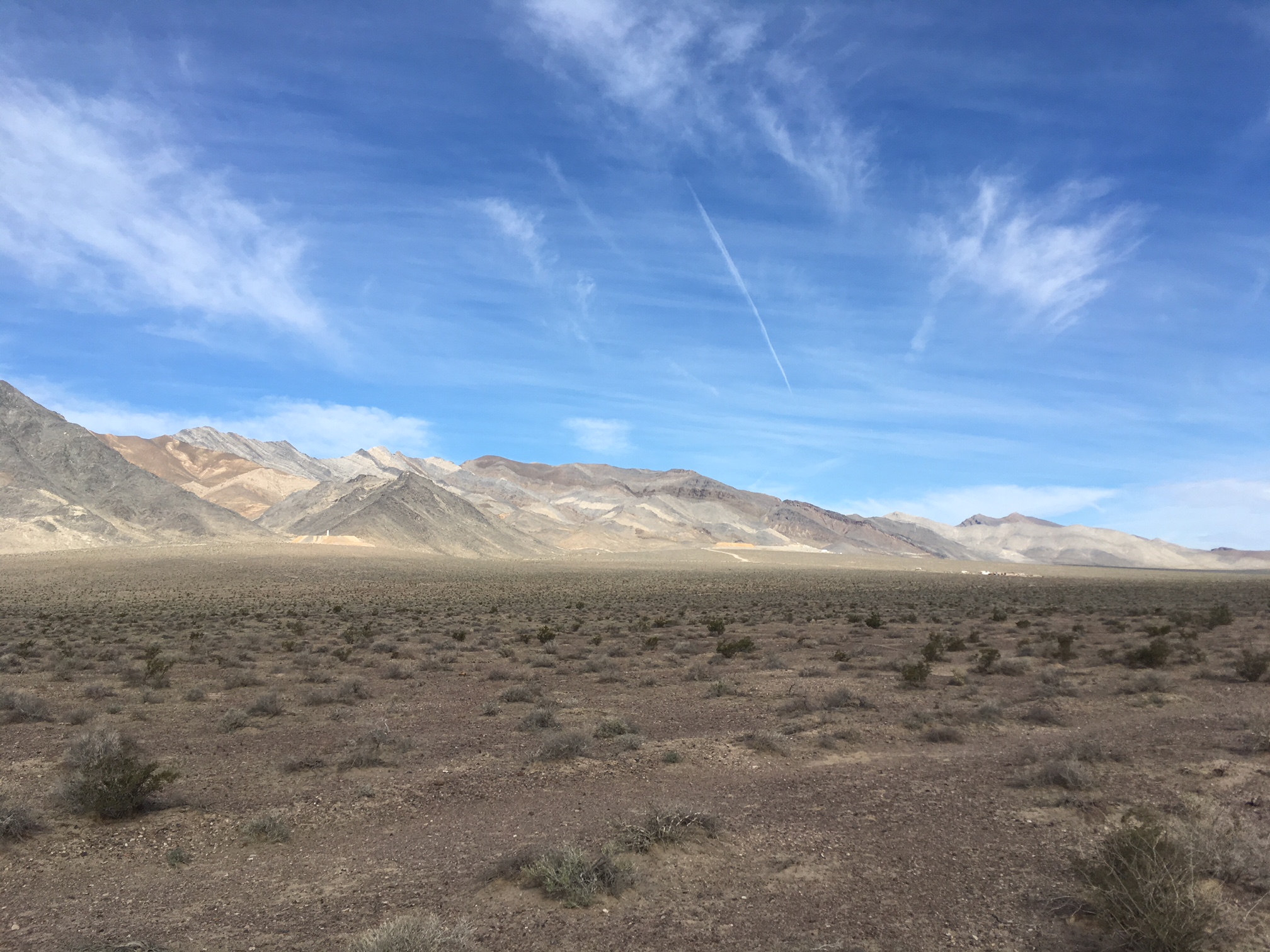
Sterling’s Main Entrance Road, Looking at the Sterling Mine

Sterling’s Main Entrance Road, Looking at the Sterling Mine

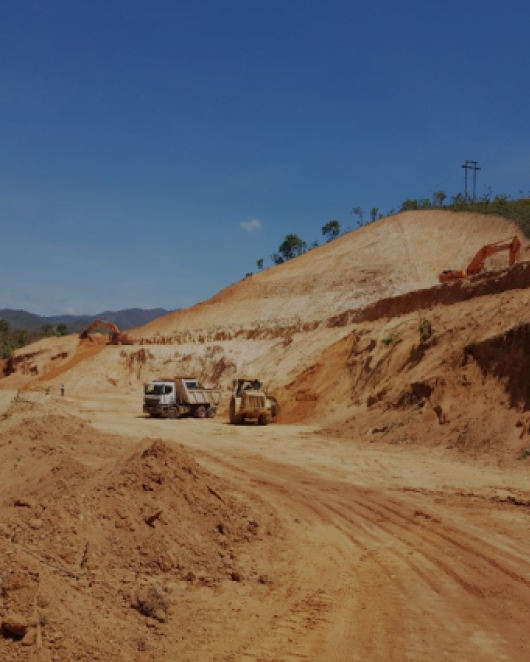
Currently, there’s one active leach pad; at the time of our visit, it was being turned over by the bulldozer featured in the photo below. The ore is mixed on the pad to help oxygenate the pile and break up any fluid channels that formed over the last cycle. Ultimately, this leads to higher recoveries in the processing plant. These are simple smart things that the Company does to improve efficiency show the respect that they treat shareholder capital. Also to note, the existing facilities and processing plant appear to be in great shape, which is a real plus when it comes time to begin production.
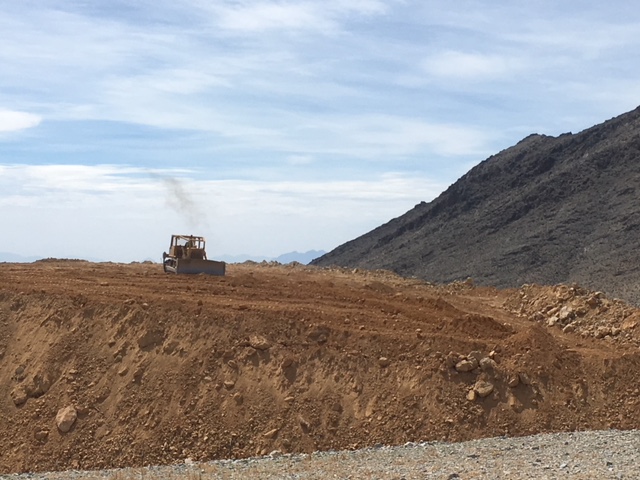
Active Leach Pad

Active Leach Pad


We then moved into the Sterling Mine open pit area, more specifically up onto the Water Tank Hill, which gives a great vantage point for viewing all three open pits.
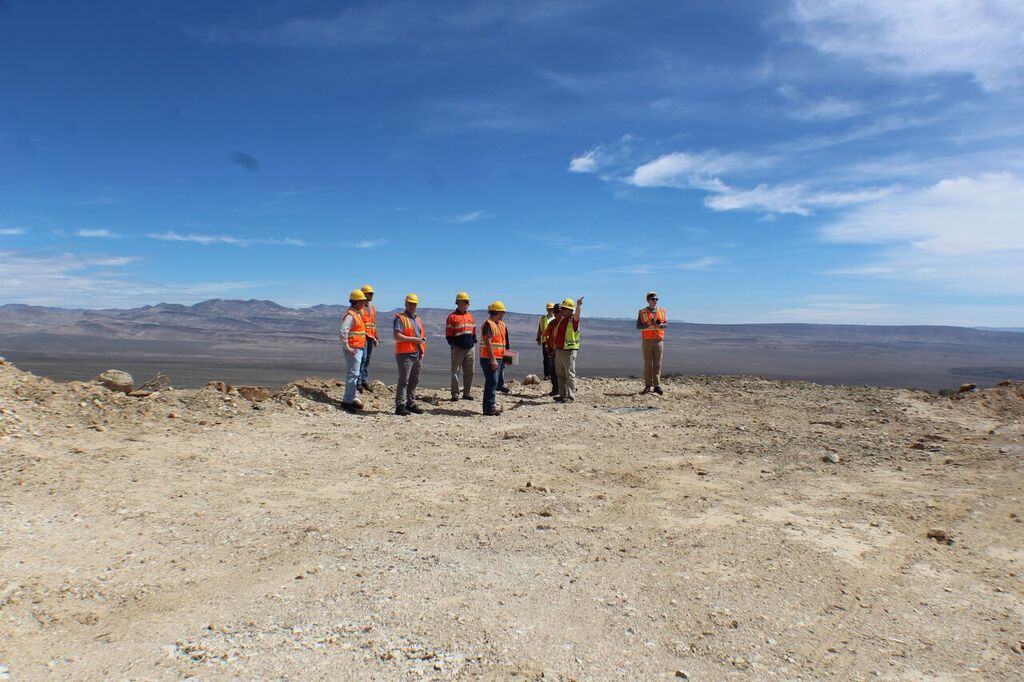
CEO Mike Allen

Northern Empire CEO, Mike Allen, on Top of Water Tank Hill


While standing on Water Tank Hill, CEO, Mike Allen, took the opportunity to explain how they will attempt to expand the Sterling Mine resource. As explained in my introductory article, the company will follow up on recent high-grade drill holes that sit on the pit shell edge, as seen in the satellite photo below.
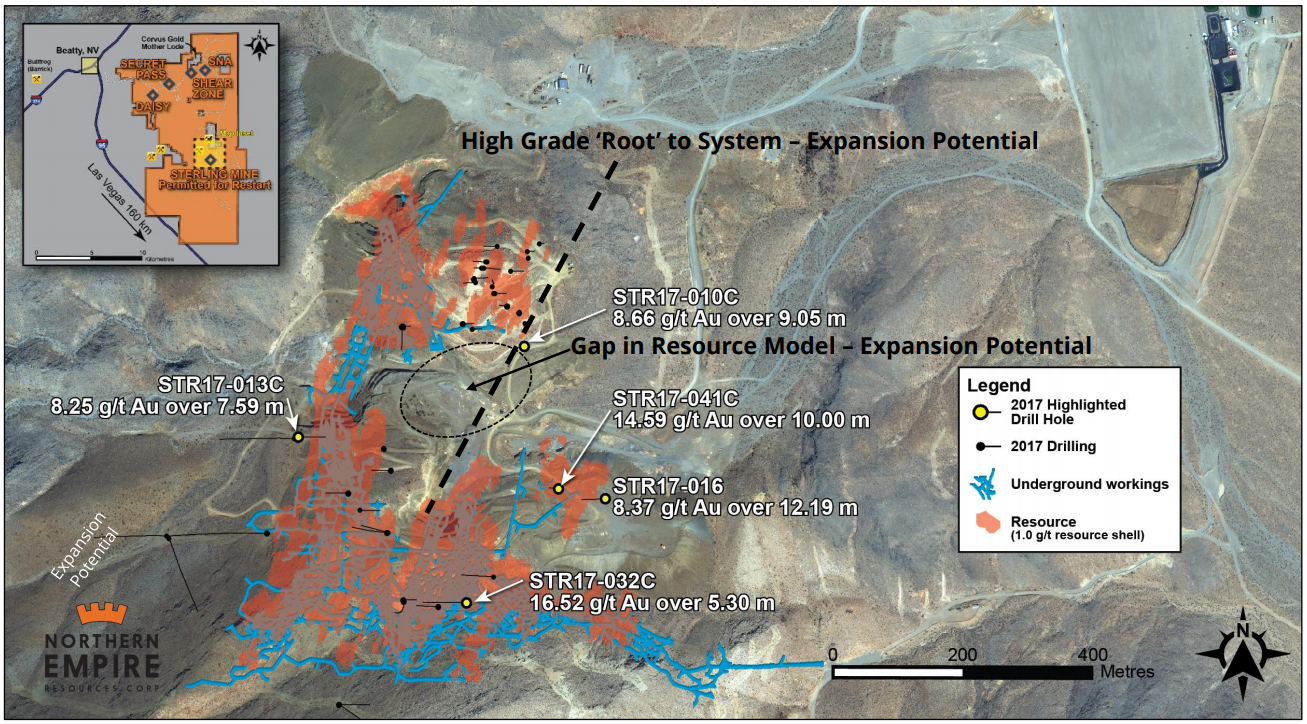
Sterling Mine aerial photo


Sterling Gold Project Mineralization – Core Shack
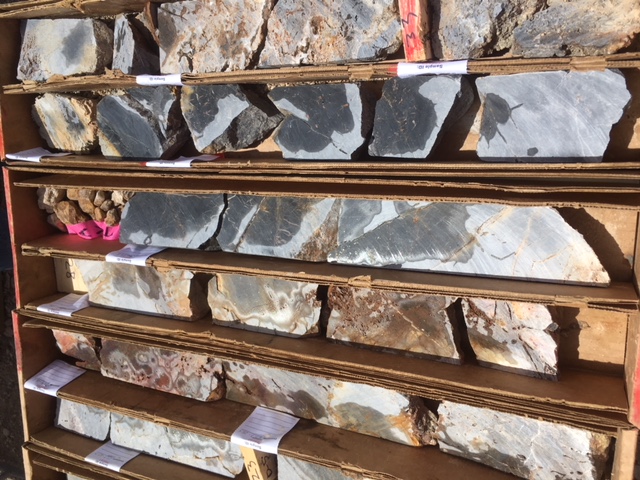
Core box

Next, we headed back to the main offices for lunch and a look at the core shack. As with all Carlin-Style gold, the core doesn’t possess any eye-catching visible flakes or nuggets, but instead it is the orange oxidized material (the more broken up the better) which should catch your eye, as it is gold bearing. The samples, however, were still very interesting as the fluorite and calcite mineralization found on the property can be seen in the core samples. In the photo below, for instance, the purple mineral is fluorite.
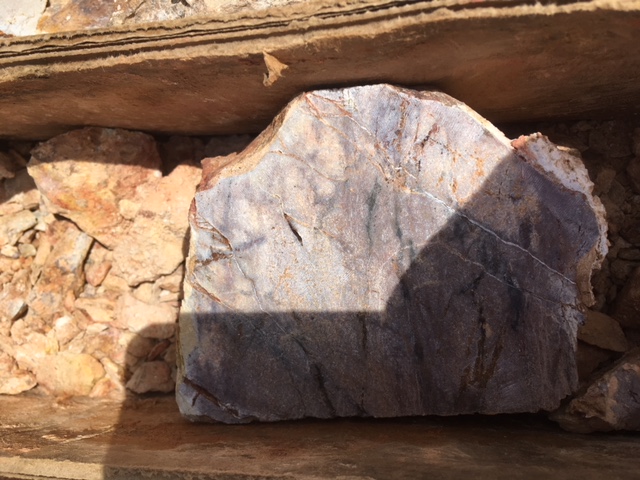
core sample with florite

Core Sample with Purple Mineral Fluorite


In fact, the Sterling property boundaries not only surround Corvus Gold’s Mother Lode Project, but also historic fluorite and mercury mines, which can be seen in the property map below.  Interestingly, it was mentioned during the visit that the fluorite mine was hampered by gold contamination, what a wonderful issue to have!
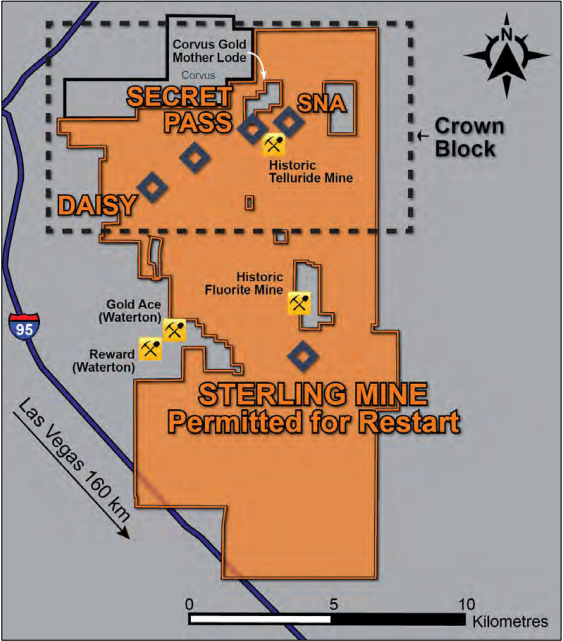
Sterling Gold Project - All mines

Sterling Gold Project


Sterling Mine Site Manager Chuck Stevens , who worked previously in the Sterling underground mine, showed me a few excellent calcite samples in his office and, additionally, pointed out the massive calcite sample sitting outside the geologist’s office trailer. Also, Executive Chairman, Doug Hurst, pointed out a couple of cinder cones which lie just east of the property; another example of the geological diversity of the property and its surrounding area. The immediate area around Northern Empire’s Sterling Project features fluorite, decorative rock, precious metals and marble mines demonstrating both the endowment of the area, the impact of mining on the local economy, and the ability to permit both large and small mines effectively.
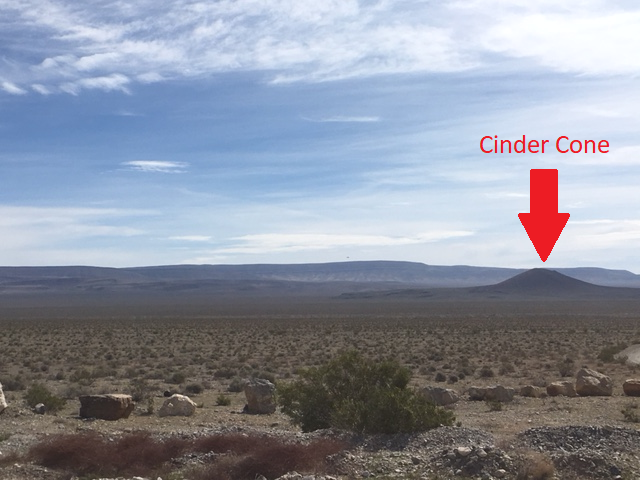
Cinder Cone Edited

NOTE: A Cinder Cone is formed by volcanic eruptions of mafic / intermediate lavas, which collect to build a cone around a volcanic vent. On the east side of I95, on your way up to the Sterling Gold Project from Las Vegas, a cinder cone is currently being mined for decorative stone used in landscaping.


The Crown Block
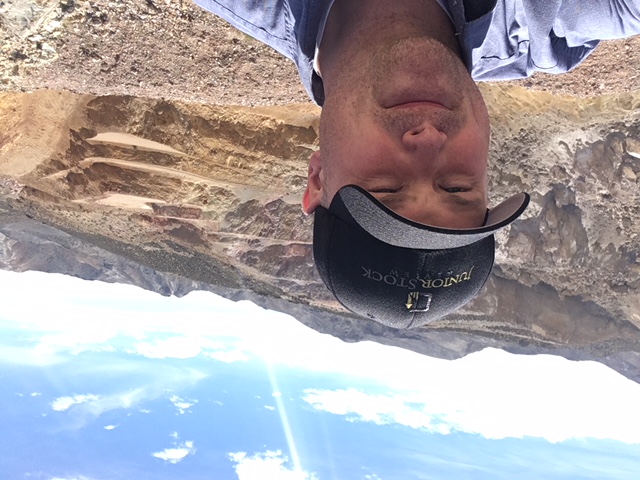
Brian Leni

Yours truly with the Secret Pass Open Pit in the background

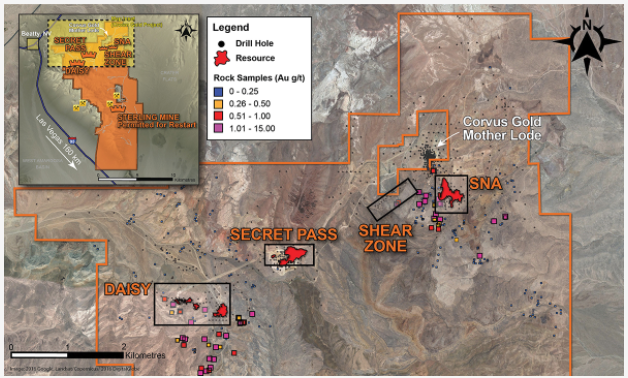
Heading back out onto the I95, we then headed north toward the town of Beatty, to the Crown Block.  As you will remember from my introductory article, the Crown Block is made up of 4 main targets: Daisy, Secret Pass, Shear Zone and SNA, all of which are located along the Fluorspar Canyon Detachment Fault.
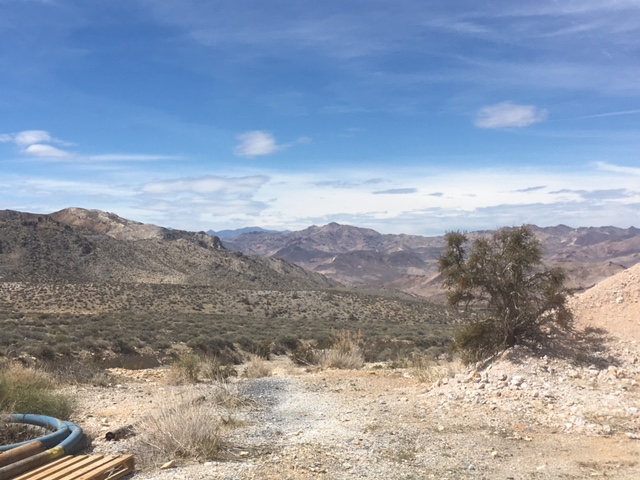
Daisy

Our first two stops were at Daisy and Secret Pass deposits, where Senior Geologist, Ron Kieckbusch, and Exploration Manager, Rich Histed, discussed the geology of the area, the work they completed in 2017, and where they were headed in 2018.

Geology of Crown Block

South of the fluorspar detachment fault, mapping has defined an asymmetric fold-thrust belt in the sediment package, with a northwest vergence and northeast plunge likely of Mississippian age (327-290 Ma).

It’s my understanding that the folding of the sediment package generated perpendicular faults, which were later made larger during a caldera collapse. For those who aren’t familiar, a caldera is a large volcanic crater, which can be formed by either an explosive volcanic eruption or the collapse of surface rock into an empty magma chamber. The now larger faults become easier conduits for fluid flow, thus explaining the mineralizing event.


Geological Mapping and Geochemical Sampling

Currently, 30% of the 141 square-kilometer property package has been geologically mapped and geochemically sampled, with the Crown Block being the primary focus. Mapping and sampling is a very efficient and cheap way of acquiring drill targets. In total, 580 rock chip samples have been taken, returning grades within a range of undetectable to a high of 13.85 g/t gold, and 34 samples returned greater than a 1.0 g/t gold.
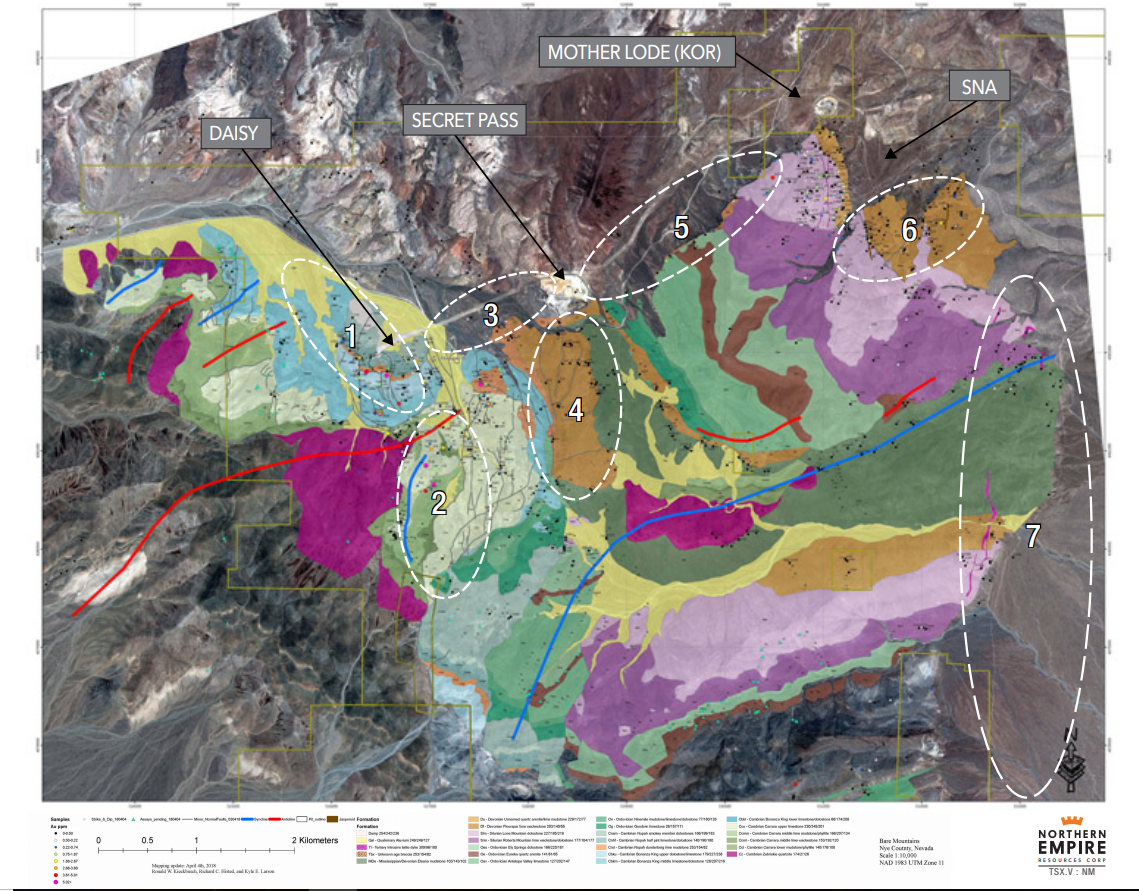
Crown Block new targets

As stated, the mapping and sampling within the Crown Block has identified new exploration targets, which were noted in the April 25th news release and can be found in the image above.

  1. Road Zone – located north of the Daisy Deposit and features several up-dip surface samples of greater than 1.0 g/t gold, which indicates potential for shallow mineralization.
  2. Gold Ace Fault – located south and up-dip of the Daisy Deposit and features a large undrilled area of high-grade surface samples, including a high of 13.85 g/t gold.
  3. Crowell Extension – located east of the Daisy Deposit and features reported gold grades of up to 7.0 g/t from the historic Crowell fluorite mine. The Crowell Extension target has a strike length of roughly 800 meters.
  4. Radio Tower – Anomalous surface geochemistry to the south of the Secret Pass pit indicate a possible target at depth.
  5. Secret Pass East – As the name suggests, this target lays on the under-explored eastern portion of the large Secret Pass Deposit. Surface sampling has returned up to 5.0 g/t gold and represents a potential strike length of roughly 1200 meters.
  6. Ronko Jasperoids – Located south of the SNA, undrilled Jasperoids returned sample values of up to 2.0 g/t at surface. Jasperoids are excellent host rocks for mineralization and represent a strike length of roughly 500 meters.
  7. Range Front Fault Zone – Range front fault systems have, historically, laid host to many of the largest Carlin-Style gold deposits in Nevada. The range front fault, which runs along the eastern portion of the land package, is sizeable and untested, which has the potential to host a large deposit. Historic sampling returned values upwards of 5.0 g/t gold at surface on secondary structures. It should be noted that range front structures host 3 deposits on the eastern side of the Bare Mountain Range; Motherlode, SNA and the 144 Zone.

In my opinion, there is a TON of potential here, as Northern Empire begins to expand and fill the gaps between these historic deposits. As seen in the image above, it looks like one big shallow gold system, with good grade. In the gold mining world, it doesn’t get much better!

With the identification of these high prospective targets, Northern Empire is expanding their current drill program to 18,000 meters and have already begun the permitting process for a larger 50,000 meter program, which will focus on expanding the Crown Block resource and testing these new regional targets.


Exploration Drill Results – Daisy and Secret Pass

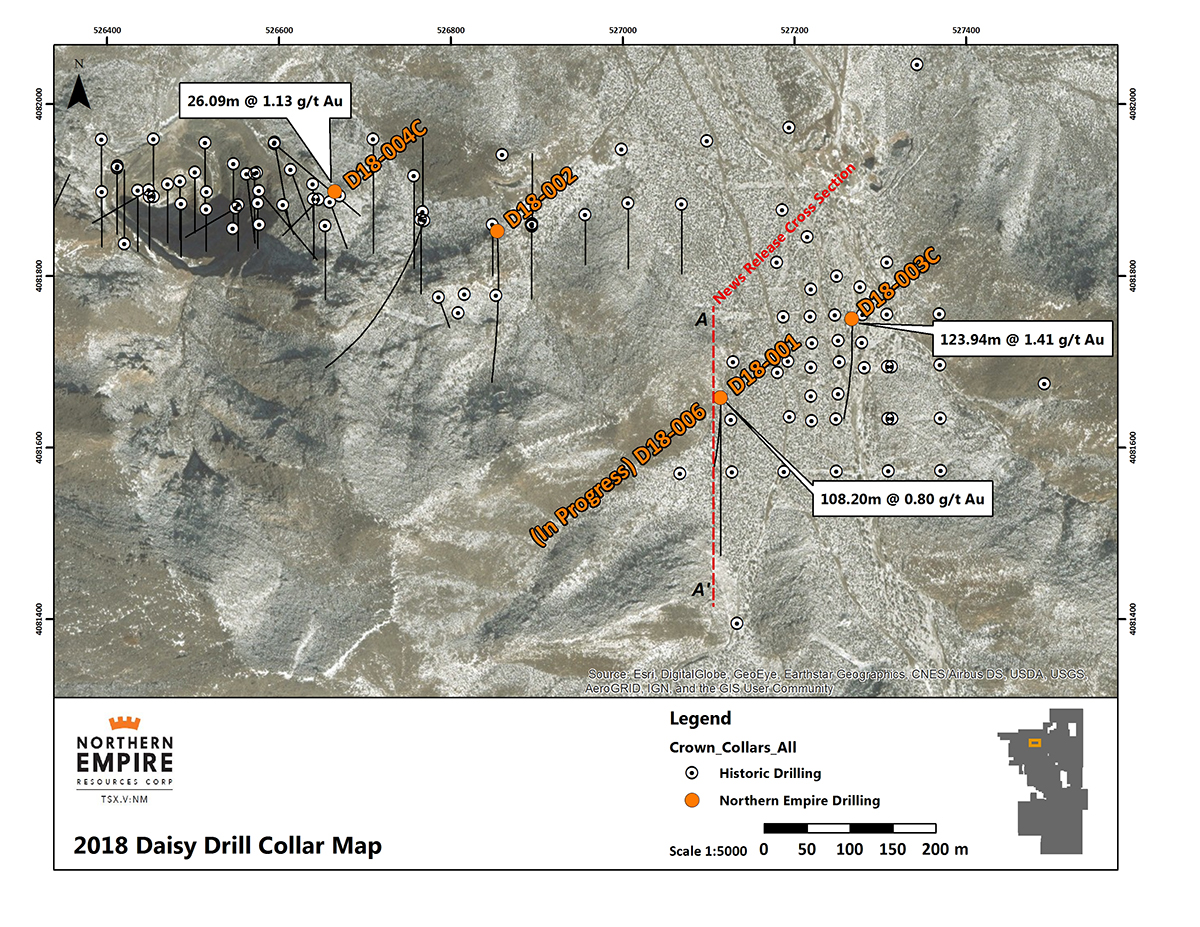
Step-out drill results from the Daisy and Secret Pass, released May 2nd, not only returned good grades and widths, but confirm that both deposits are open for expansion. The results are highlighted by,

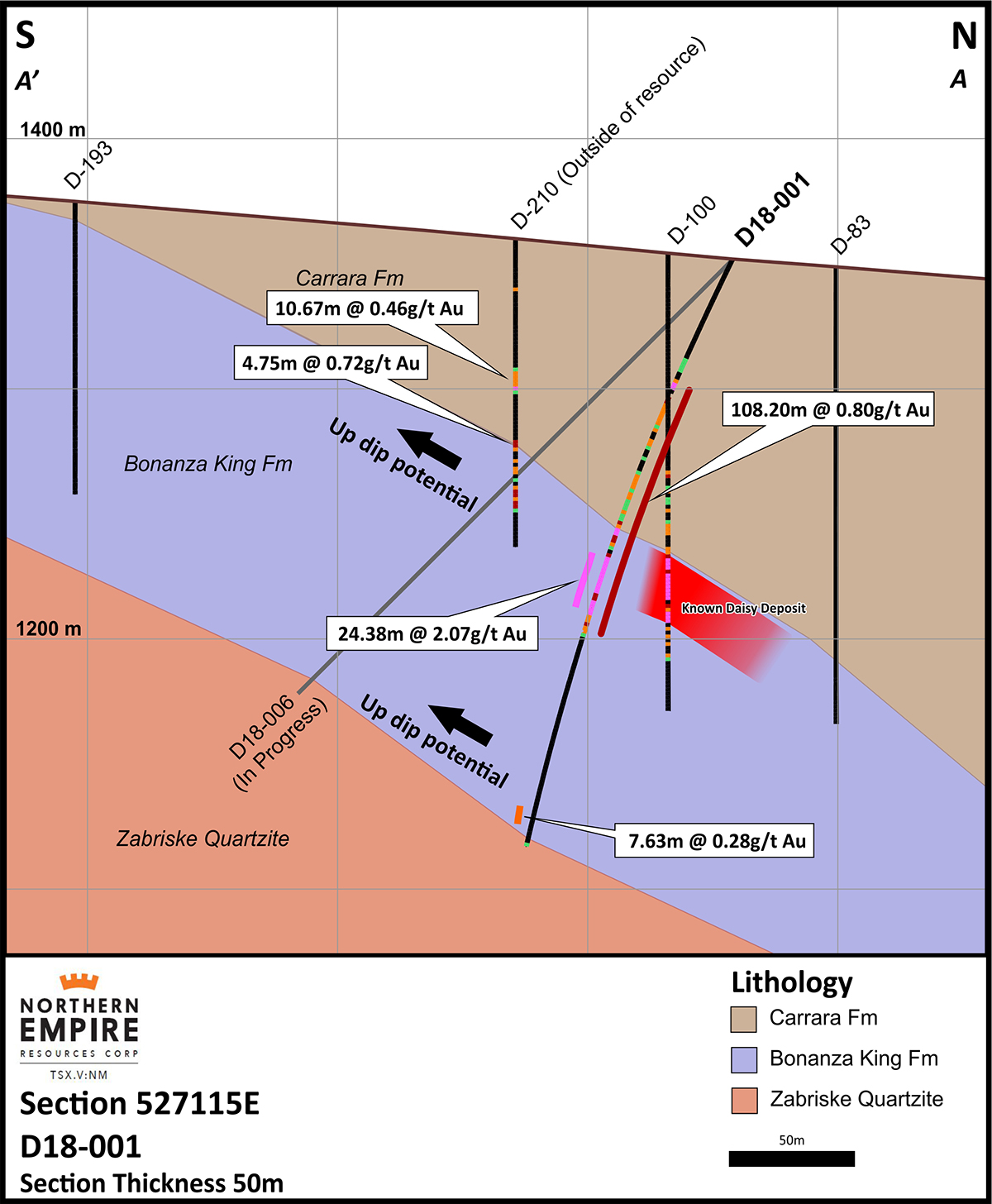
  • Daisy Deposit –D18-001 step-out hole returned 108.2 meters grading 0.80 g/t gold.
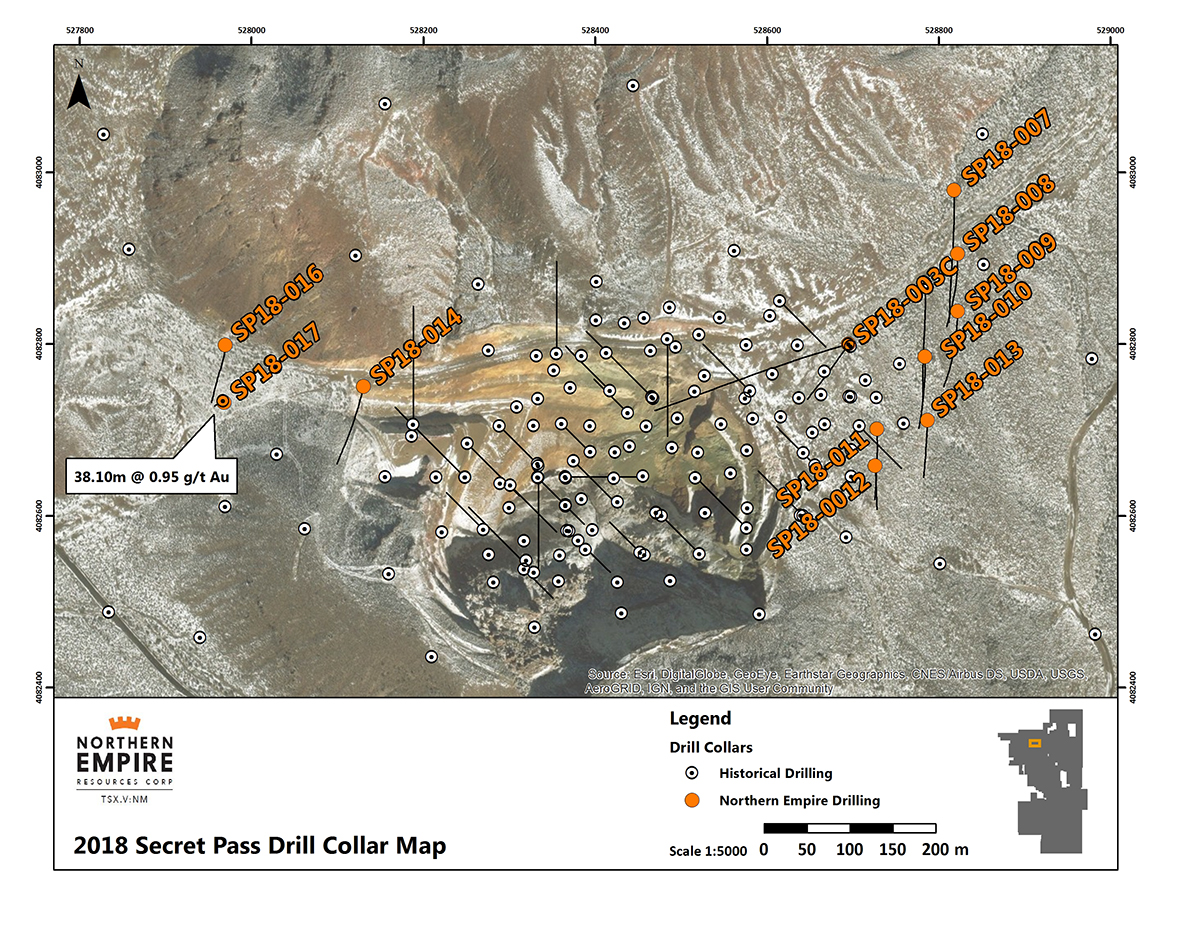
  • Secret Pass Deposit – SP18-017 step-out hole returned 38.1 meters grading 0.95 g/t gold.


Daisy Drilling
Daisy Drilling

The highlighted D18-001 step-out hole encountered mineralization 53.35 meters down the hole, which was shallower than expected. Additionally, mineralization was encountered at the base of the Cararra formation, which suggests that there is a possibility for further mineralization to be discovered lower in the stratigraphic sequence.  In all, the drill results confirm that the Daisy Deposit remains open up-dip for further expansion. Please see the news release for complete details.
Daisy_SP_NR_18-05-01

Secret Pass Drilling

18-05-01_SecretPassDDH_NR

The highlighted SP18-017 drill hole stepped out 200m west from the known Secret Pass Deposit and 196.9 meters deep encountered mineralization grading 0.95 g/t gold over 38.1 meters. To note, this hole was terminated before losing mineralization. Northern Empire states within the news release that they intend on re-drilling the hole to better understand the full extent of what has been discovered.  This step-out is a great result as it confirms that the Secret Pass Deposit mineralization is open to the west.


Corvus Gold

The last stop of the day was at the SNA Deposit, in the north-east corner of the property. As we approached the SNA Deposit, we first drove past Corvus Gold’s Mother Lode Open Pit, which is completely encompassed by Northern Empire’s Crown Block.
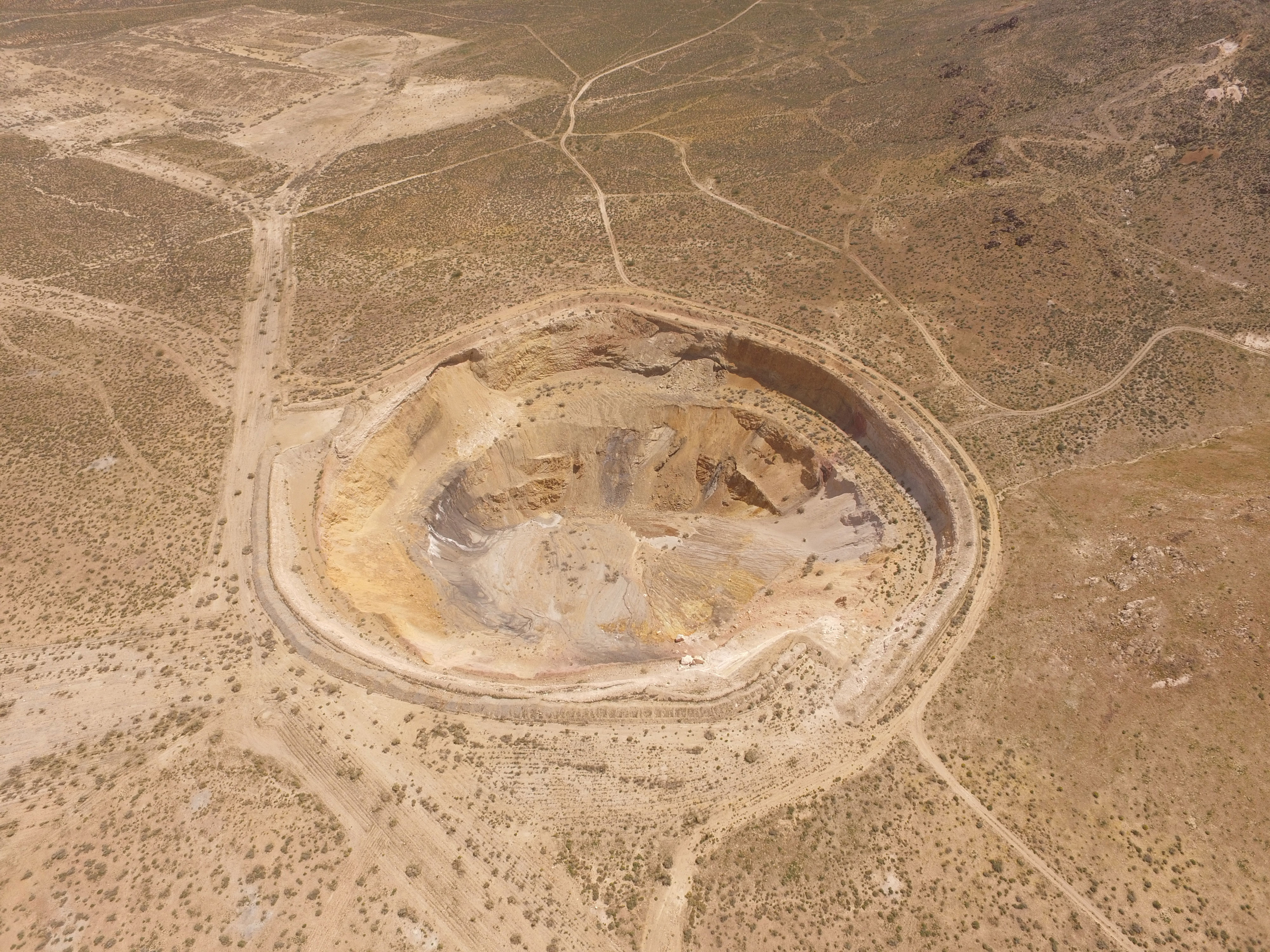
Mother Lode Open Pit

Corvus Gold’s Mother Lode Open Pit

For those who are not familiar, the Mother Lode Deposit has been a major focus for Corvus over the last year, with 10,000m of drilling in 2017 and another 13,000m of drilling planned for the first half of 2018. For those that may not be familiar, Corvus has a MCAP around $300 million, which is largely based on the drilling success at Mother Lode.  I find this interesting as a Northern Empire shareholder, because I’m intrigued by the amount of drilling that’s occurring around the existing open pit and, specifically, how that mineralization may extend out toward, or connecting to, the SNA Deposit.

Examining the satellite image below, you can see the concentration of Corvus drill holes not only in the vicinity of the open pit but, more importantly, along the claim boundary.
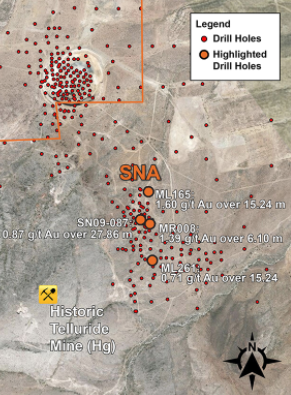
SNA Mother Lode

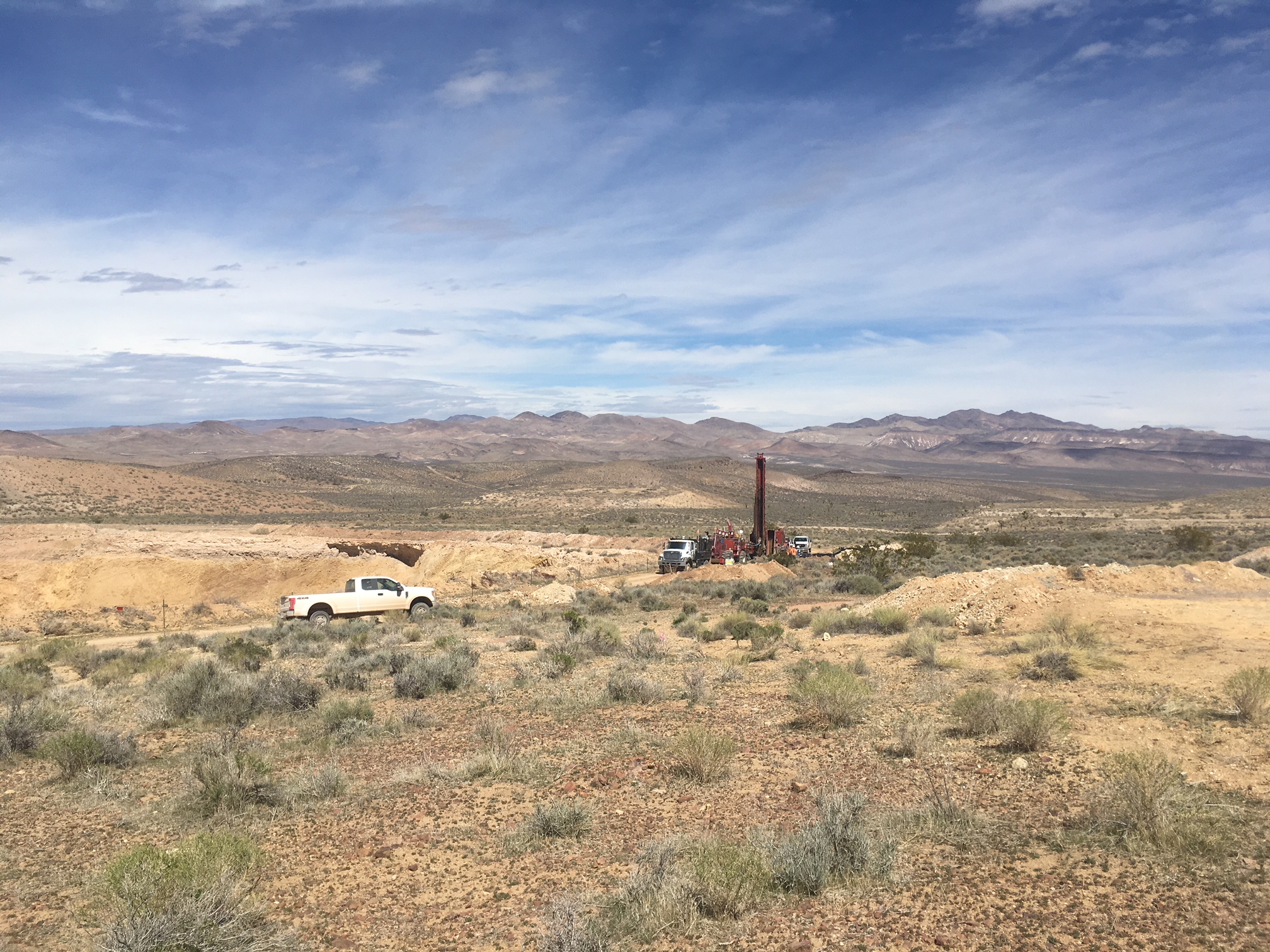
This is a fairly obvious observation, one that didn’t get past Northern Empire management; while viewing the SNA Deposit during our visit, drilling was taking place along the Corvus claim boundary.  In news released April 17th, Northern Empire confirmed that the Mother Lode mineralization does extend south towards the SNA deposit and have drilled significant gold grades from structures which cut favourable host rock for Carlin-type gold mineralization beneath the historic Telluride Mercury Mine.
Northern Empire Drilling beside Mother Lode Open Pit

Northern Empire Drilling beside Mother Lode Open Pit


Concluding Remarks

As I’ve said in the past, site visits are an excellent way for you to bring your due diligence to the next level, and nothing beats seeing the property and interacting with the people in person. My visit to the Sterling Gold Project was no different, as it gave me a better view of the upside potential of the property and the type of people managing the company.

Just to recap, here’s a list of what I see as the strengths for Northern Empire:

  • Good management team with extensive experience exploring and developing gold projects in Nevada.
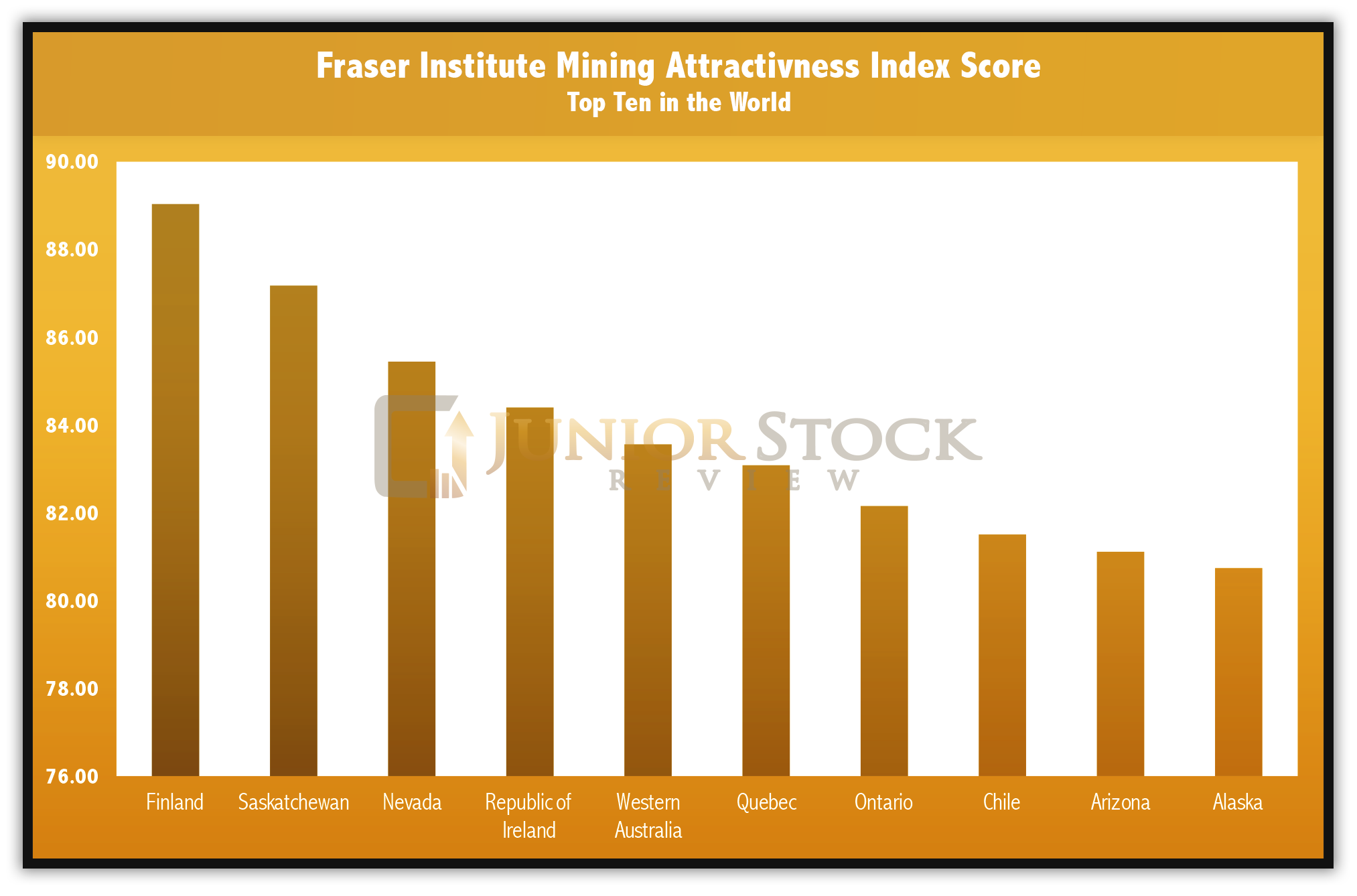
  • The Fraser Institute ranks Nevada 3rd in the world for Mining Investment Attractiveness.
  • Northern Empire is in possession of all the necessary production permits to restart the Sterling Mine.
  • The Sterling Mine potential production scenario should be low-cost, as the Carlin Style gold mineralization will be mined from an open pit and is amenable to heap-leaching.
  • Exploration Potential – The Crown Block, especially, holds a lot of resource expansion potential as it appears all of the existing deposits have the potential to be larger; potentially, one large, shallow and good grade gold system.
    • 18,000 meter drill program underway and a larger 50,000 meter drill program on the horizon as it is currently being permitted!
  • Existing inferred global resource of 985,000 ounces of gold at 1.29 g/t.
  • CASH – $16 million!!


I believe there’s a lot of upside potential for Northern Empire if they’re able to execute their plan of expanding the resource at both the Sterling Mine and the Crown Block. I look forward to good news flow over the coming months as this story really begins to come together on the back of their 18,000m drill program.


Don’t want to miss a new investment idea, interview or financial product review? Become a Junior Stock Review VIP now – it’s FREE!


Until next time,


Brian Leni  P.Eng

Founder – Junior Stock Review


Disclaimer: The following is not an investment recommendation, it is an investment idea. I am not a certified investment professional, nor do I know you and your individual investment needs. Please perform your own due diligence to decide whether this is a company and sector that is best suited for your personal investment criteria. I do own shares in Northern Empire Resources. All Northern Empire Resources’ analytics were taken from their website and press release. Northern Empire Resources is a Sponsor of Junior Stock Review.
 

Posted on

Anaconda Mining – An Update on Goldboro and Thoughts on the Proposed Maritime Resources Takeover

Anaconda Mining Inc--Anaconda Mining Intersects Multiple Wide- H

As an investor, I believe it’s very important for the leader of a company to have a vision for where the company is headed and how they will get there. While the formation and expression of a vision is important, the execution of the actions that lead to the realization of that vision is even more important – it’s where the reasoning for your investment is rooted.

Anaconda Mining’s CEO, Dustin Angelo, is a great example of where the rubber hits the road, as his vision is in line with the execution of the company’s actions. Angelo’s goal of achieving 100,000 ounces of gold production per year is well on its way to becoming a reality with the advancement of the Goldboro Gold Project, and Anaconda’s latest PUSH toward adding 43-101 compliant gold ounces to their books – the formal offer to acquire Maritime Resources.

Regardless of whether they are successful in each acquisition offer, I’m very confident that management will keep moving forward toward their goal, which will, ultimately, add tremendous value for its shareholders.

Today, I have for you an update on the Goldboro Gold Project diamond drill program, and a few thoughts on the proposed acquisition of Maritime Resources and what it could mean for both sets of shareholders.

Enjoy!


Goldboro Gold Project

For new readers who may not be familiar, Anaconda’s Goldboro Gold Project is located on the northeast coast of Nova Scotia, roughly 250 km east of Halifax. The Goldboro Gold Project has a NI 43-101 Measured and Indicated Resource of 3,645,000 tonnes at 4.48 g/t for 525,400 oz Au, and an Inferred Resource of 2,542,000 tonnes at 4.25 g/t for 347,300 oz Au.

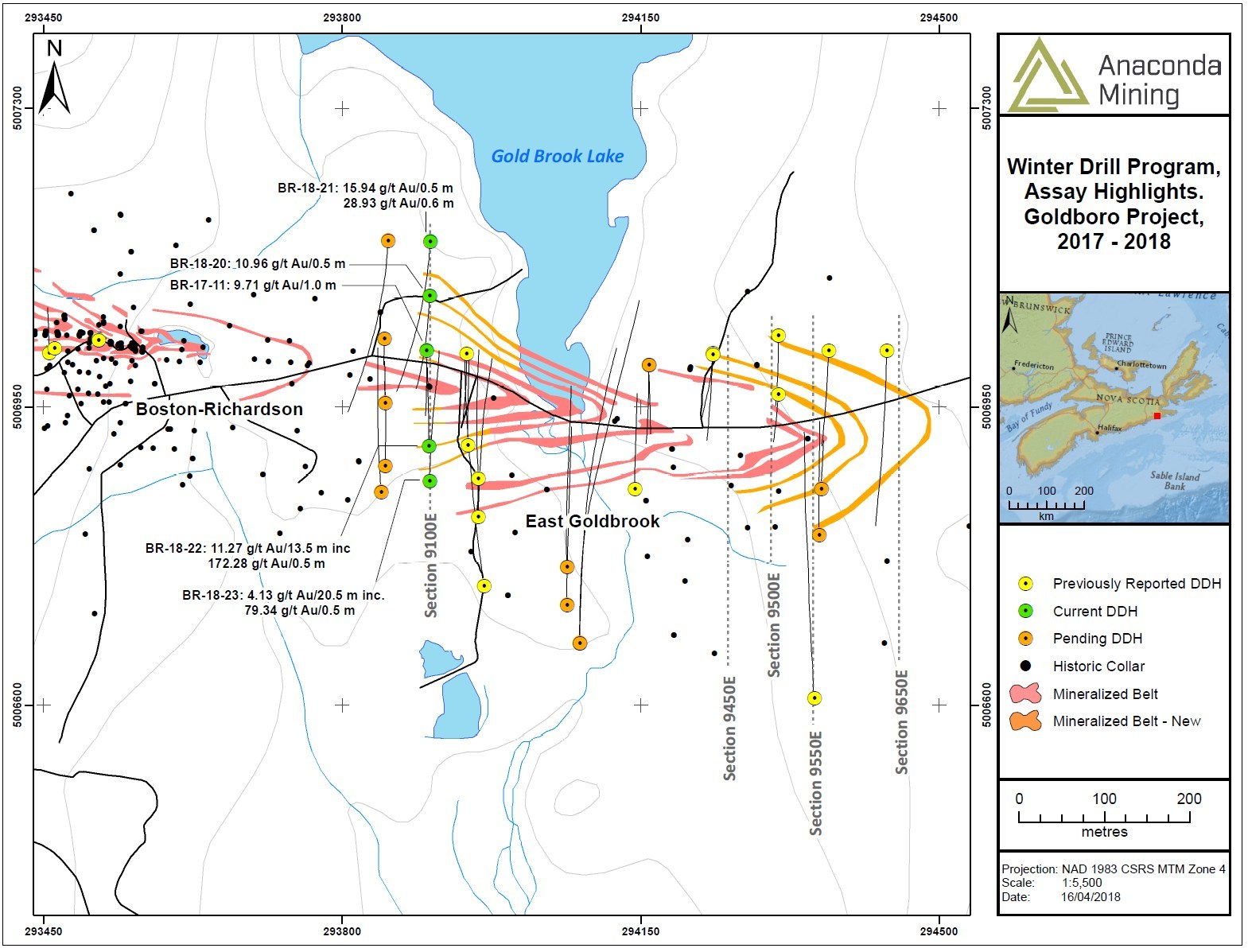
Last October, Anaconda began a 7,200 meter diamond drill program at Goldboro focusing on the Boston Richardson and East Goldbrook gold systems, with the aim of expanding the mineral resource along strike and down plunge, and to infill specific portions of the deposit to upgrade the Inferred Resources to the Indicated category.

Anaconda Mining Inc--Anaconda Mining Intersects Multiple Wide- H

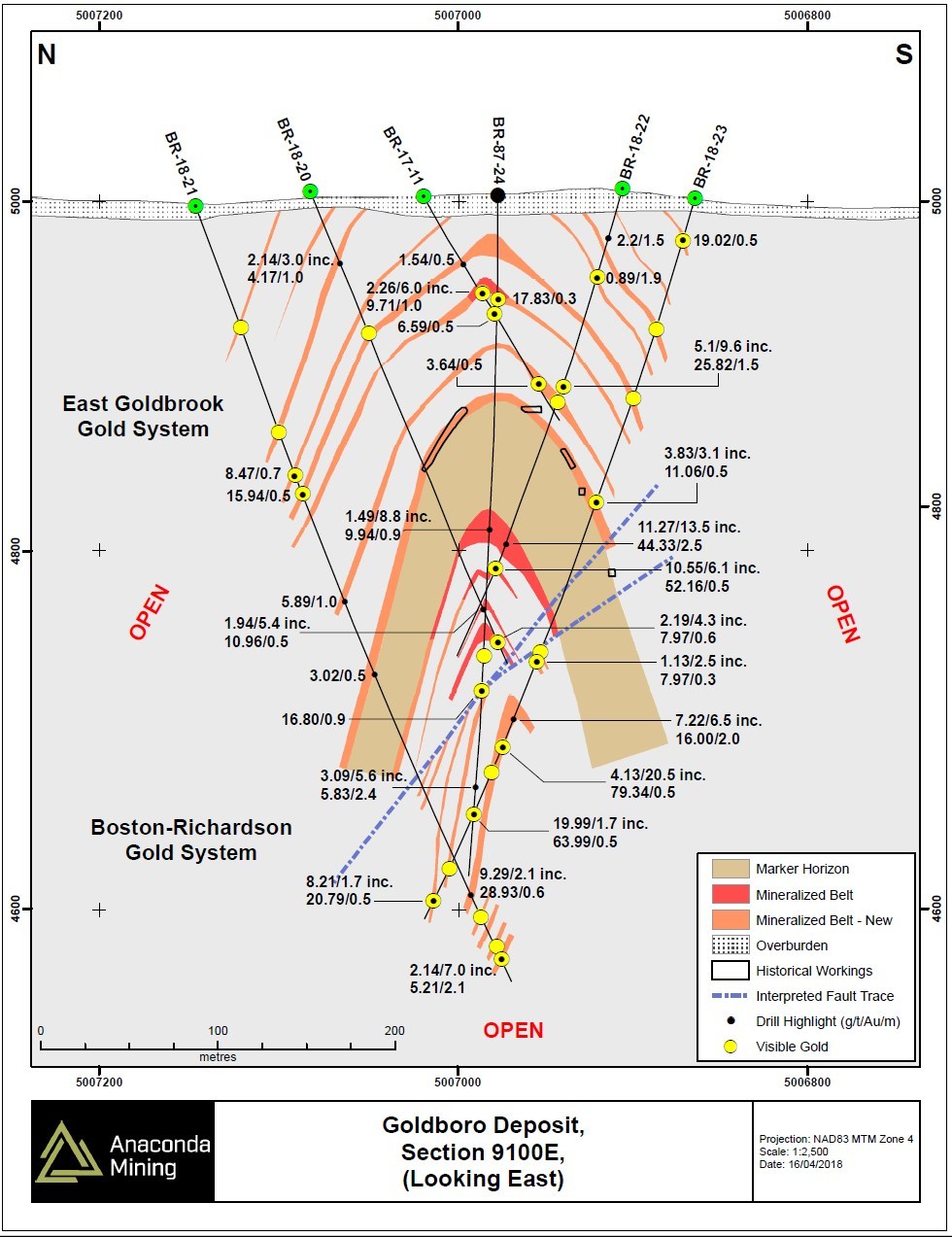
In news released on April 19, 2018, Anaconda provided an update on 5 of the 30 holes planned in the 7,200m drill program.  The news release reveals the successful extension of the Boston Richardson Gold System mineralization down-dip roughly 100m and extended the East Goldbrook system mineralization westward by 50m.

A few of the highlights of the 5 holes are as follows:

  • 11.27 grams per tonne (“g/t”) gold over 13.5 metres (201.0 to 214.5 metres) in hole BR-18-22, including 15.63 g/t gold over 1.4 metres and 44.33 g/t gold over 2.5 metres;
  • 4.13 g/t gold over 20.5 metres (324.5 to 345.0 metres) in hole BR-18-23, including 9.93 g/t gold over 7.5 metres and 79.34 g/t gold over 0.5 metres;
  • 10.55 g/t gold over 6.1 metres (223.0 to 229.1 metres) in hole BR-18-22, including 18.78 g/t gold over 3.1 metres;
  • 5.10 g/t gold over 9.6 metres (116.0 to 125.6 metres) in hole BR-18-22, including 25.82 g/t gold over 1.5 metres;
  • 7.22 g/t gold over 6.5 metres (310.5 to 317.0 metres) in hole BR-18-23, including 16.00 g/t gold over 2.0 metres; and
  • 9.29 g/t gold over 2.1 metres (420.6 to 422.7 metres) in hole BR-18-21.

Anaconda Mining Inc--Anaconda Mining Intersects Multiple Wide- H

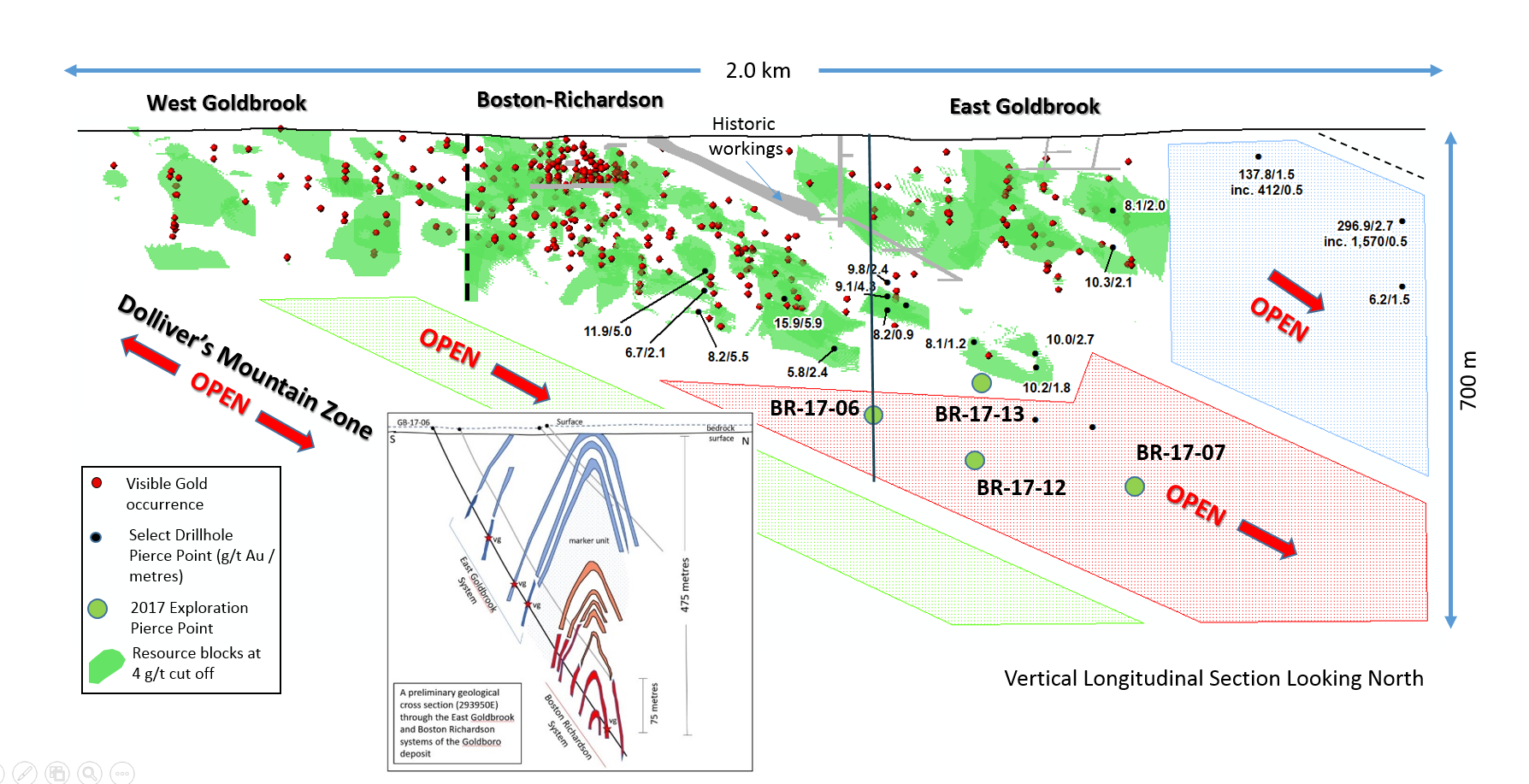
Take a look at the cross-section above. I want to draw your attention to the legend located in the bottom right; in particular, take a look at the new mineralization colour and contrast that against what you see in the image.

Stepping out along strike and down-dip, Anaconda is hitting new mineralization, which confirms that they’re getting closer to understanding the controls of mineralization within the Deposit. I had the opportunity to review the latest drill results from Goldboro with Anaconda’s VP of Exploration, Paul McNeill.

We reviewed some of the highlights of the drill program, but what stood out for me was McNeill’s excitement and interest in the fault system they encountered in this portion of drilling. As McNeill explained to me, an analogue to the Goldboro Project mineralization can be found in the Victorian Goldfields of Australia. Faults within these kinds of deposits are common and are can host high-grade gold.

With this in mind, McNeill and the rest of the Anaconda Exploration team will test the theory that the fault system is somehow a controlling structure for the deposit’s high-grade mineralization. A better understanding of it and how it has or hasn’t influenced the mineralizing fluids is a priority for them moving into the next round of drilling.

CEO, Dustin Angelo, affirms McNeill’s comments in the news release,

“We continue to prove that mineralization extends in all directions in both the EG and BR Gold Systems. We are encountering typical grade and thickness in most of the newly discovered mineralized areas and then we’re uncovering sweet spots that contain broader, higher grade intersections that are among the best results reported from Goldboro to date. The presence of a fault in the areas around holes BR-18-21 to -23 is an important feature that may control the localization of high gold grades and we plan to further test this potential for thicker high-grade intersections within the coming months.”

PUSH: Watch for the drill results from the next round of drilling expected within a few months,following more planned drilling in and around drill section 9100E.


Anaconda Mining Formally Offers to Acquire Maritime Resources

On April 13th 2018, Anaconda Mining made a formal offer to acquire all of the issued and outstanding common shares of Maritime Resources Corporation. The proposed deal would see each Maritime shareholder receive 0.39 of a common share of Anaconda for every common share held of Maritime. At the time of the deal, the offer represented a premium of 64% above the 20-day volume weighted average prices (VWAP) of the Maritime shares on the TSX Venture Exchange, and the Anaconda shares of the Toronto Stock Exchange.

In my opinion, this is a great deal for both Anaconda and Maritime shareholders because I believe there’s great synergy between the two companies. Firstly, let’s look at Anaconda’s contribution to Maritime shareholders:

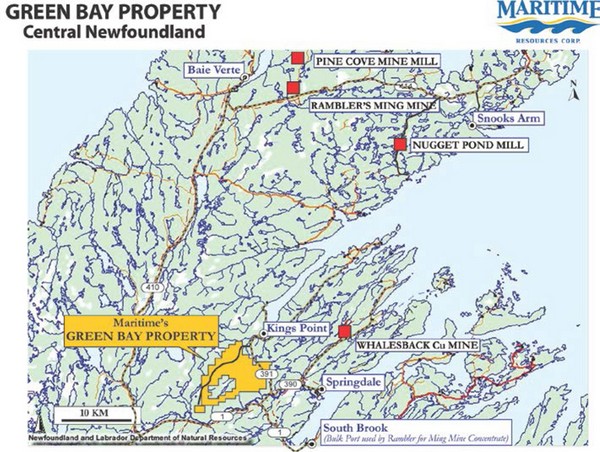
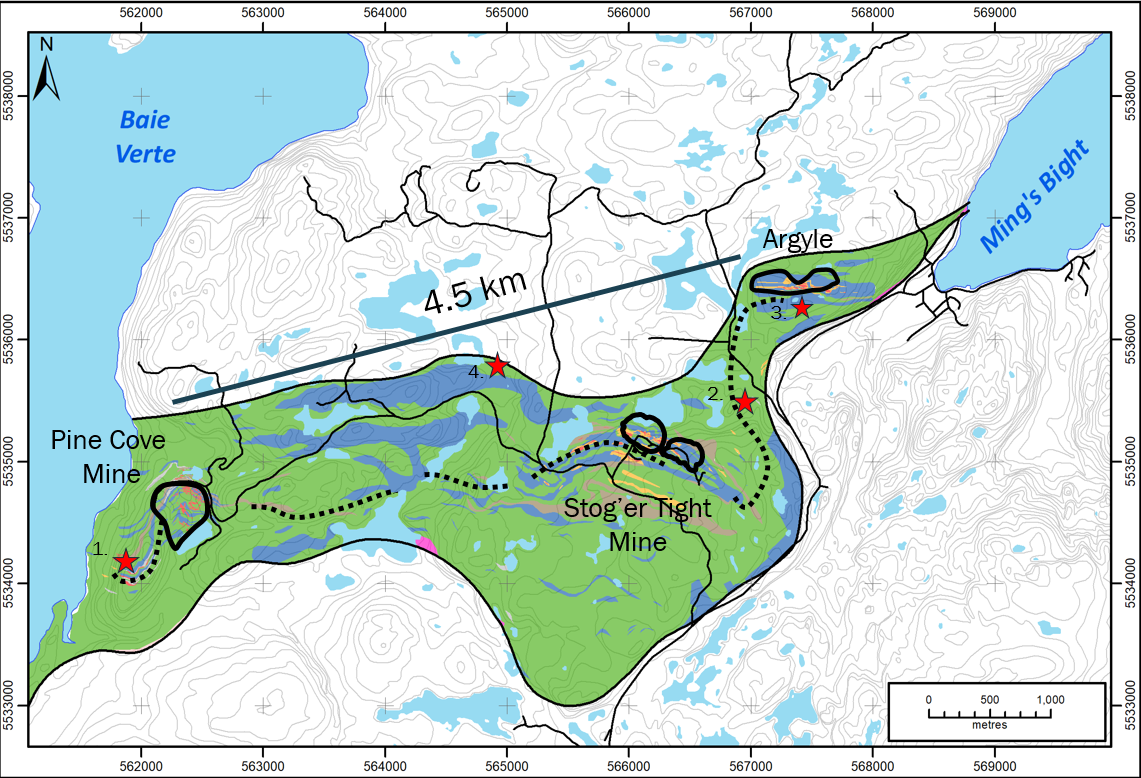
  • Infrastructure, in my opinion, is Anaconda’s largest contribution to the deal. With the existing Pine Cove Mill and newly transitioning Pine Cove Pit to tailings facility, Anaconda brings the much needed infrastructure to process the gold ore mined on Maritime’s Green Bay Property in a timely manner. This point can’t be under stated as infrastructure construction not only requires permitting and access to capital, but it also takes time to develop. While there are other scenarios that exist for processing the Green Bar Property ore, I believe Anaconda’s is the best because, for Anaconda, it’s a matter of “when” the ore is processed, not “if” we get the permit, and “if” we raise the capital to fund construction.
  • Milling Cost – As cited in Anaconda’s conference call on April 16 2018, the Pine Cove Milling cost has averaged roughly $20 per tonne, which is approximately 40% lower than the processing cost of $32.89 per tonne which was used in the Green Bay Property Technical Report.  Anaconda stated in their conference call on April 16th,

“we would bypass flotation and employ a similar whole ore leach process at the Pine Cove Mill that was done at Nugget Pond. Flotation accounts for a large portion of our losses when processing Point Rousse ore. When you take that out of the equation for Hammerdown ore, we should have similar recovery rates as experienced historically.”

  • 64% premium to the 20-day VWAP or a Maritime share price of $0.16 – this is a nice premium on the Maritime shares, and when mixed with what I believe is great upside potential in Anaconda, the risk to reward potential here, I believe, is very good.


What does Maritime Resources contribute to Anaconda as an acquisition target?

  • 43-101 estimated resources which are in close proximity to the Pine Cove Mill. The Hammerdown Deposit has an existing Measured and Indicated Resource of 727,500 tonnes at 11.59 g/t for 271,000 ounces of gold and an Inferred Resource of 1,767,000 at 7.68 g/t for 436,000 ounces of gold. The Orion Deposit has an existing Measured and Indicated Resource of 1,096,500 tonnes at 4.47 g/t for 157,500 ounces of gold and an Inferred Resource of 1,288,000 at 5.44 g/t for 225,100 ounces of gold.
  • Further exploration potential on the 12,775 acre Green Bay Property


Green bay project

Source: Maritime Resources


Simply, a takeover by Anaconda gives Maritime shareholders a premium on the current share price and, most importantly, in my opinion, moves it from an “if” investment to a “when” investment with the added upside potential of Anaconda’s existing exploration and development projects. The cumulative effect of these points is, in my opinion, a major de-risking of investment for Maritime Resource shareholders, and a great addition of 43-101 estimate resources for Anaconda Mining Shareholders.

PUSH: A successful conclusion to this takeover offer of Maritime Resources would be a major plus for Anaconda Mining.


Concluding Remarks

In my opinion, Anaconda Mining continues to present a great risk to reward investment proposition and a lot of value at its current price. Here are a couple of reasons why I think this:

  • First, the updated PEA on the Goldboro Gold Project, released just a couple of months ago, presents a low case scenario of gold at $1450 CAD/oz (roughly $1160 USD/oz), which gives the Project an estimated after-tax NPV at a 7% discount rate of $44 million CAD.  Not only do I believe the gold price will be higher than $1450 CAD/oz in the future, given the drill results just released from Anaconda, I believe this deposit is getting bigger and possibly higher grade. This would mean a higher probability of better project economics and, thus, a higher NPV.
  • Second, Anaconda is growing through acquisition and, with the latest bid for Maritime Resources, has taken great strides toward their goal of becoming a 100,000 oz of gold per year producer.
  • Third, Anaconda’s current MCAP (at the time of writing) is roughly $41 million CAD, which, in my mind, only roughly values the assets found within the Point Rousse Project – with its in-situ ounces (Stog’er Tight Deposit and Argyle Deposit) and infrastructure (Pine Cove Mill, Port and Tailings Facilities).  In my opinion, no value is given to the Goldboro Gold Project and its estimated after-tax NPVm, which is cited above. Additionally, I don’t see any value given to The Great Northern Project (Rattling Brook and Viking) which contain ~600,000 ounces of combined Inferred and Indicated gold resources.

I’m long Anaconda Mining and am eagerly awaiting upcoming news flow on the Maritime Resources acquisition and further Goldboro drill results.


Don’t want to miss a new investment idea, interview or financial product review? Become a Junior Stock Review VIP now – it’s FREE!


Until next time,


Brian Leni  P.Eng

Founder – Junior Stock Review


Disclaimer: The following is not an investment recommendation, it is an investment idea. I am not a certified investment professional, nor do I know you and your individual investment needs. Please perform your own due diligence to decide whether this is a company and sector that is best suited for your personal investment criteria. I do own Anaconda Mining stock. All Anaconda Mining analytics were taken from their website and press release. Anaconda Mining is a Sponsor of Junior Stock Review.


Posted on

Northern Empire Resources – Multi-Million Ounce Potential in the World Class Jurisdiction of Nevada

Northern Empire

What’s going to be the catalyst for the junior gold stocks to escape this sideways to downward movement? To me, the key to a momentum change is discovery. Although the market on a whole seems to be stuck in neutral, money has been injected into the best junior gold exploration teams, and because of this, I think it’s only a matter of time before we get a stellar drill hole, which will bring eyes and cash back to the sector.

Supply and demand fundamentals control the direction of markets over the long term, and when looking ahead at almost any metal’s supply fundamentals, I think it’s clear that we’re in for a metal supply crunch in the years ahead. Bull markets driven by supply destruction are very strong, mainly because it requires not only the discovery of new deposits, but those discoveries also have to be permitted developed, and that takes time.

It’s my contention that the next bull market in metals will be discovery driven, as the world’s major mining companies look to fill the supply gaps that are developing in most of their reserve and resource inventories.

In my opinion, buying the highest quality companies gives you the best possible odds of being right when the market turns. The company I’m going to share with you today, Northern Empire Resources Corporation, is, in my opinion, one of those high-quality companies, and they’re poised to discover and expand their resources at the Sterling Gold Project in Nevada.

Let’s take a look.


Northern Empire Resources Corp. (NM:TSXV, PSPGF:OTC Pink)

  • DTC Eligibility for its common shares listed on the OTC market in the United States


MCAP: $86.4 million (at the time of writing)

Shares: 66,586,700

Fully Diluted: 77,139,302

CASH: $16 million


Management/Insiders: 7.9%

Institutional Ownership: 32.7%

Coeur Mining: 11.6%

Imperial Metals: 3.7%


Northern Empire’s People

Northern Empire is led by President and CEO, Michael Allen, who is a professional geologist by trade and has 20 years of experience in the mining industry. Allen has worked in various senior roles over the course of his career with Redcorp Ventures, Silver Standard Resources and, most recently, West Kirkland Mining. For those who are not familiar, West Kirkland Mining’s gold project is located in Nevada, giving Allen 8 years of jurisdictional experience, and should prove to be an X-Factor when it comes to developing and exploring for gold on Northern Empire’s Sterling Gold Project.

Additionally, Northern Empire has a strong Board of Directors, made up of individuals with extensive experience in the mining industry. The Board is led by Executive Chairman, Douglas Hurst. Hurst, a geologist by trade, has a great track record for developing mining companies into premier takeover candidates. Hurst was a founding executive of both International Royalty Corporation and Newmarket Gold Inc. Both companies were taken over, first International Royalty Corporation by Royal Gold for $700 million, and most recently, Newmarket Gold by Kirkland Lake Gold for $1 billion.

The Board is rounded out by people whose careers share a common characteristic – successful company building. Each member has been involved in at least one development success in their career, and to me, it’s clear that this is the main goal for Northern Empire; to develop their Sterling Gold Project into a premier takeover candidate.

The other Board members are as follows:

  • Raymond Threlkeld has more than 32 years of experience within the mining industry. Threlkeld was Chairman of Newmarket Gold which, as previously stated, was purchased by Kirkland Lake Gold. He was also involved with Western Goldfields which was purchased by New Gold in 2009.
  • John Robins, a professional geologist by trade with 30 years of mining experience. He was a founder and Chairman of Kaminak Gold, which was purchased by Goldcorp for $520 million in 2016.
  • Adrian Fleming, a geologist by trade with over 30 years of experience in the mining industry. Fleming was President and Director of Underworld Resource Inc which was acquired by Kinross in 2010.  Fleming was an early mentor in Michael Allen’s career when they both worked on the Hope Bay Gold Project.
  • Jim Paterson with 20 years of experience on the financial side of the mining business, and the founder, CEO and Director of Corsa Capital Ltd.
  • Darryl Cardey and Jeff Sundar both have several years of experience within the mining industry and were a part of the successful development and sale of Underworld Resources.


Nevada, United States

Northern Empire’s 100% owned Sterling Gold Project is situated roughly 160 km northwest of Las Vegas, Nevada and encompasses a total of 14,109 acres over 4 contiguous claim blocks.  Nevada is situated in the western United States and has a long history of mining dating back to the 1840s. Although mining began over a 150 years ago, Nevada’s real fame in the gold mining industry didn’t come until the 1960s when ‘Carlin Style’ or sediment-hosted disseminated gold deposits started being mined.

Nevada Map - Sterling Gold Project


Why did Carlin Style gold deposits take so long to be mined? Simply, nobody saw them. Unlike the outcropping gold bearing epithermal veins that were discovered by early prospectors, Carlin Style gold is very fine grained and not visible to the naked eye.  Since the 1960s, Nevada has produced around 20 million ounces of gold, making it truly a world-class destination for gold mining.

2018 Fraser Rankings

Given this, it comes as no surprise to me that the Fraser Institute issued a mining investment attractiveness score of 85.45, ranking Nevada 3rd in the world. The Fraser Institute’s score is based on a mixture of criteria, which includes, but is not limited to, the jurisdiction’s legal system, taxation regime, quality of infrastructure, political stability, and arguably most importantly, the jurisdiction’s geological potential. In my opinion, in terms of mining investment, it doesn’t get much better than Nevada.


Sterling Gold Project

The Sterling Gold Project has a Global Resource of 23,811,800 tonnes at 1.29 g/t for 985,000 ounces of gold and can be broken down into two key areas; the Sterling Mine, which is in the southern portion of the property, and the Crown Block, which resides in the north.


Sterling Mine

The Sterling Mine is a past gold producer with the surrounding area having historical ties that extend back to 1906, with the Panama Mine operating until 1940. The region then saw limited exploration until 1980 when the Sterling Mine began production. The Sterling Mine consists of 3 separate open pits and 2 underground mines, which produced 194,996 troy ounces from 853,984 tonnes of ore for an average grade of 7.44 g/t, over its 20 years in operation.

The Sterling Mine’s deposit mineralization is Carlin Style and is amenable to heap leaching. In the past, the open pit and underground mined ore was placed onto heap leach pads and, without crushing, gold recoveries averaged 88%.

The Sterling Mine does have an existing pit constrained inferred resource of 3,081,000 tonnes at 2.57 g/t for 254,000 ounces of gold. The ‘pit constrained inferred resource’ refers to the estimated economic surface resources found within a 45-degree constant slope pit shell.

Additionally, there’s a non-pit constrained inferred resource of 350,000 tonnes at 3.38 g/t (1.7 g/t cut-off) for a total of 38,000 ounces of gold. The non-pit inferred resource represents mineralization that could potentially be of economic interest, if selective underground mining of the mineralized zone, below the projected pit shell limits, was carried out.

NOTE: The Sterling Mine pit constrained inferred resource grade of 2.57 g/t is fantastic, especially if you consider that it’s amenable to heap leaching for the extraction of its gold. This is a great example of the upside potential at the Sterling Gold Project, as Carlin Style gold mineralization that’s mined in an open pit and has good grades can be very profitable!


Gold Production at the Sterling Mine

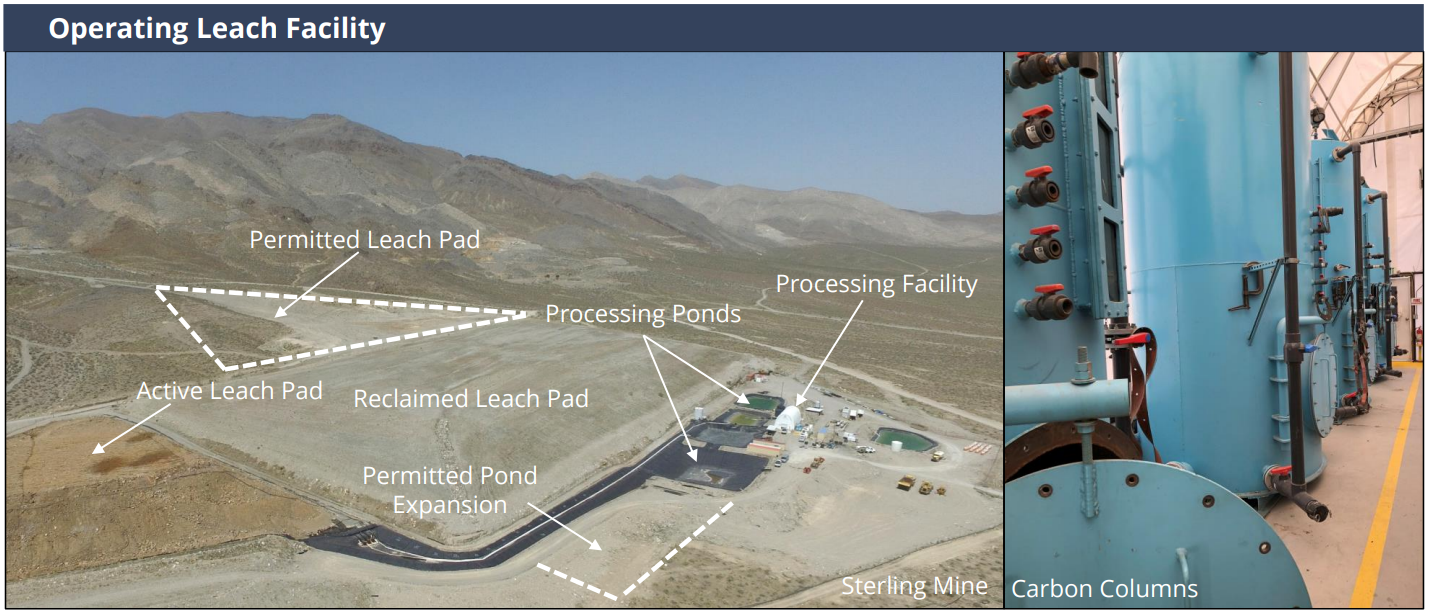
A major advantage to the past producing Sterling Mine is that its infrastructure is in place and ready for operation. In the photo below, you can see the layout of the processing areas: The active leach pad, the permitted leach pad, processing ponds and processing facility.

Sterling Mine leaching

Additionally, from the satellite photo below, you can see the layout of the permitted open pits, Burro, Sterling and Ambrose. In the top right of the image is the processing area, as shown above. Finally, the 144 Zone portal, in the bottom right, gives access to the historical underground workings.


With the necessary permits in hand, Northern Empire has greater control over their production start date, which is an enviable position for most gold exploration and development companies. Moreover, as an investor, the fact that Northern Empire has the necessary production permits in hand is a huge plus, because it reduces the overall risk associated with the Project.


Sterling Mine Exploration Potential

While having the production permits and an inferred resource are the basis for what looks to be a promising future for Northern Empire, the most exciting part of their story, in my opinion, is the exploration potential of the property.

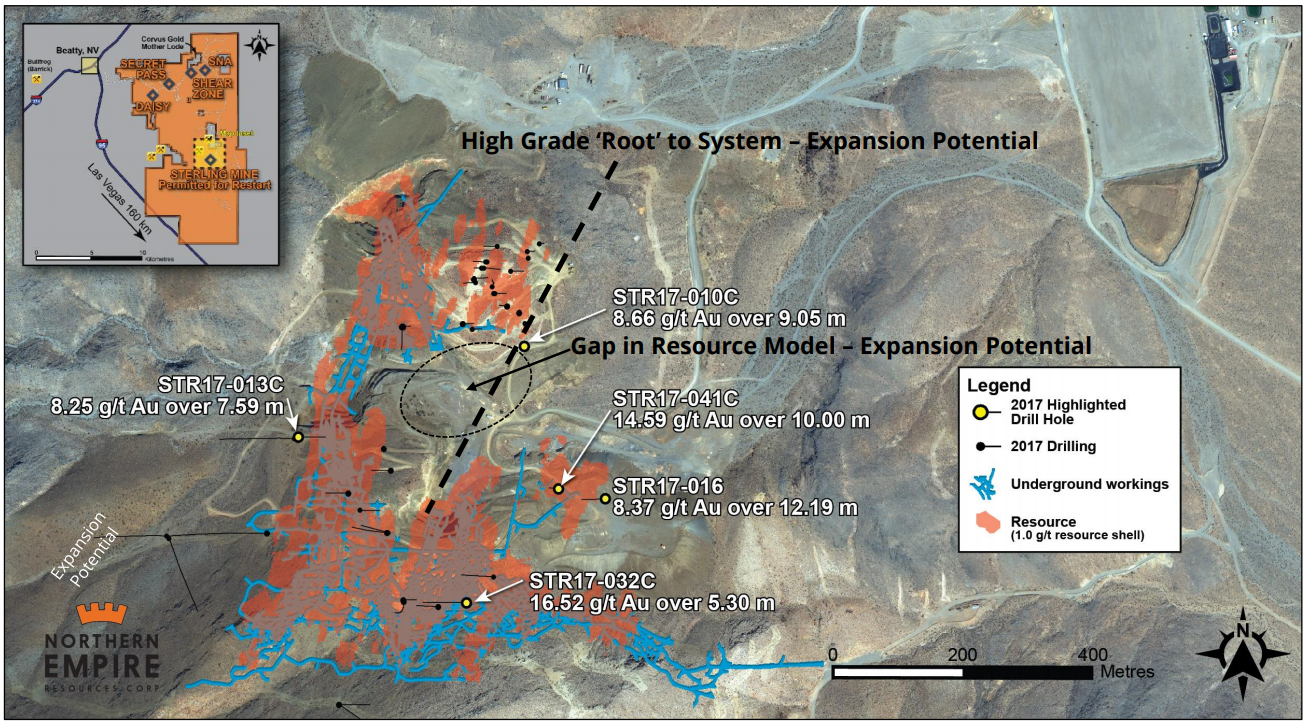
Exploration and infill drilling on the Sterling Mine will focus on the 2017 high grade drill holes that sit on the pit shell edge, as can be seen in the satellite photo below.

Sterling Mine aerial photo


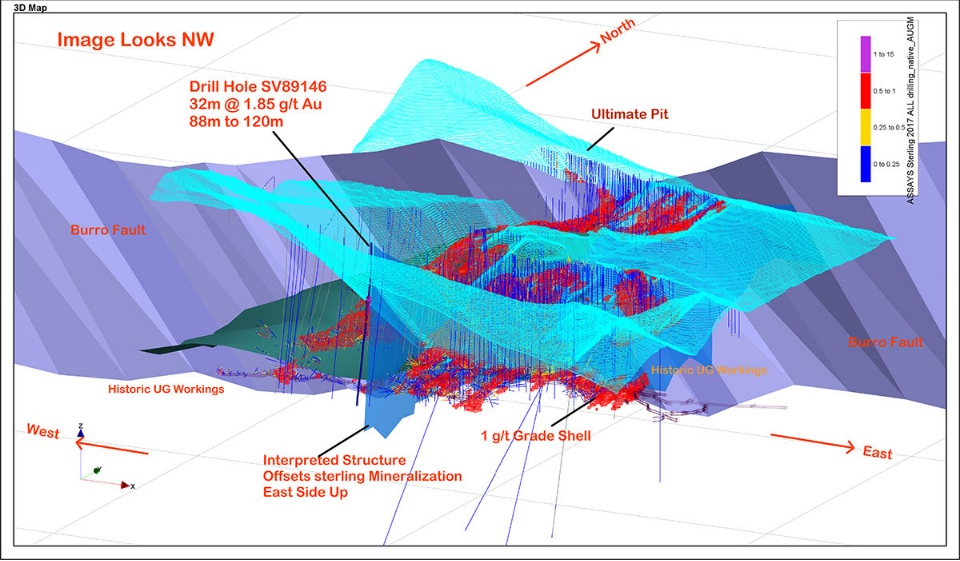
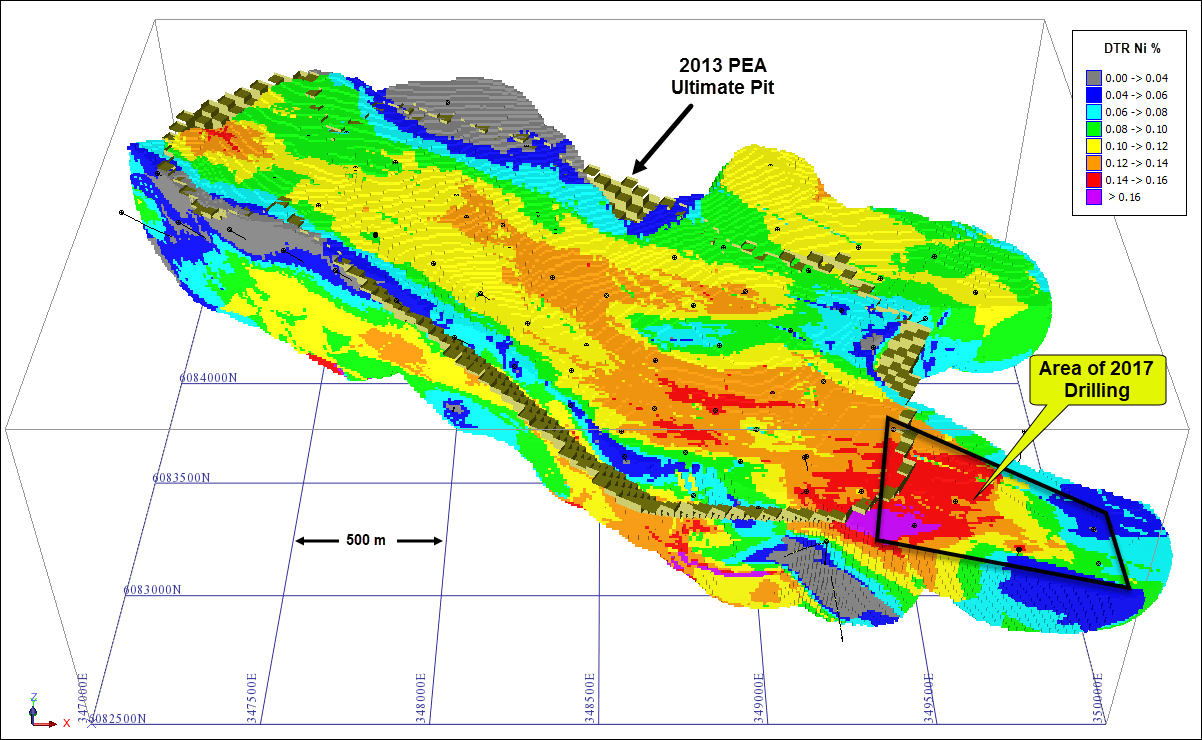
As well, in the computer-generated Sterling Mine model image, you can gain a better perspective on the 3 dimensional open pit shell and the location and orientation of the Burro Fault, which is thought to be one of the most important structures for the deposit.  Other minor faults in the area trend north to north-northeast and are important in terms of the future exploration of the Sterling Mine area. As the Technical Report states,

“they are significant because they are intimately associated with mineralization, and were almost certainly conduits for hydrothermal fluids.” ~ Technical Report – pg.7-8

Sterling Mine computer generated model


PUSH: Watch for drill results from the Sterling Mine. Further proof of continuity in the existing inferred resource and successful step out drilling will be major gains for the company.


The Crown of Northern Empire

Crown Block

The Sterling Gold Project’s north end is occupied by the Crown Block, which is further broken down into 4 main targets: Daisy Deposit, Secret Pass Deposit, SNA Deposit and Shear Zone. The target mineralization which is found in the Crown Block is concentrated around the same detachment fault structure that hosted Barrick Gold’s past producing, roughly 2.3 million ounce Bullfrog gold mine.

The gold within the Daisy and SNA Deposits are carbonate-hosted and classified as Carlin-Style, while the Secret Pass is volcanic-hosted and classified as epithermal.


Daisy

The Crown Block’s Daisy Deposit is a past producing open pit gold mine (Glamis/Rayrock), having produced 104,000 ounces of gold between 1997 and 2001. As listed in the Sterling Gold Project’s inferred resource table, Daisy has an inferred resource of 5,362,000 tonnes at 1.34 g/t for 222,000 ounces of gold.

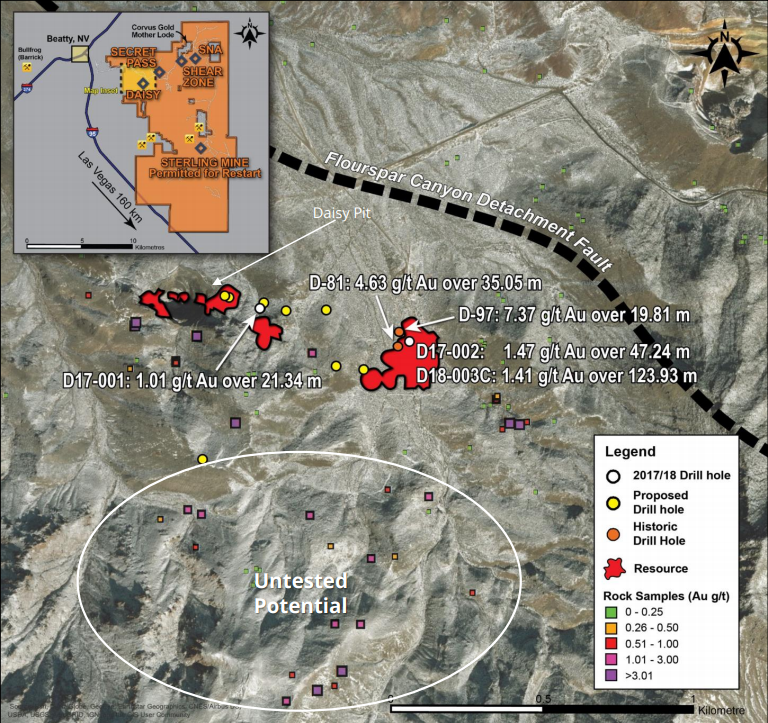
High grade surface samples, up to 15 g/t gold, and 2017 drilling suggest there is potential for expansion of the Daisy Deposit resource. Examining the satellite photo below, you can see the highlighted 2017 drill intercepts – holes D17-002, D17-001 and the 2018 drill intercept from hole D18-003C – and the location of high-grade surface samples which are represented by the purple squares.


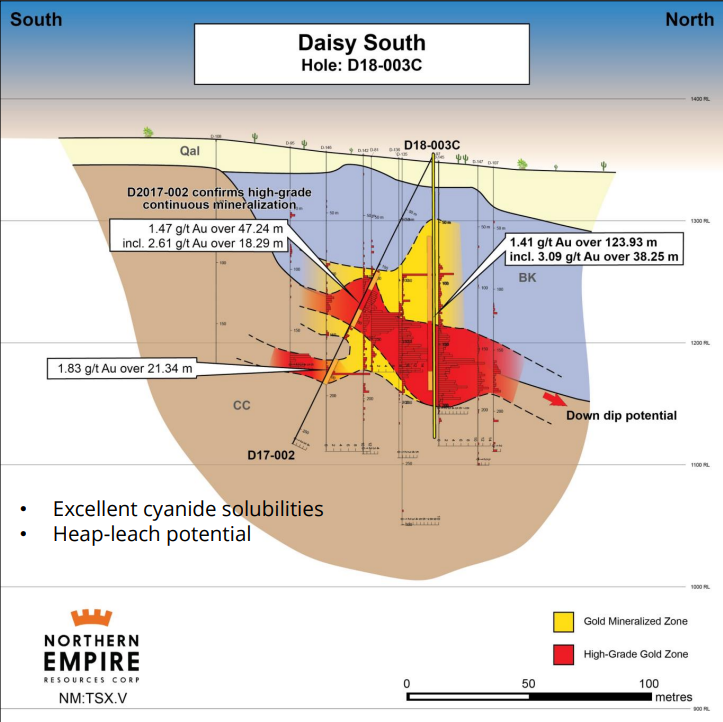
PUSH: 10 holes are planned for Daisy Deposit in the 2018 drill program. As mentioned above, one stellar drill intercept has already been released, assaying 1.41 g/t over 123.93m, a great result. Watch for more drill results from Daisy in the weeks ahead, as Northern Empire looks to expand the Daisy Resource down dip.

Crown Block - daisy cross section

Daisy Deposit Cross-Section – Open Down Dip to the north


Secret Pass

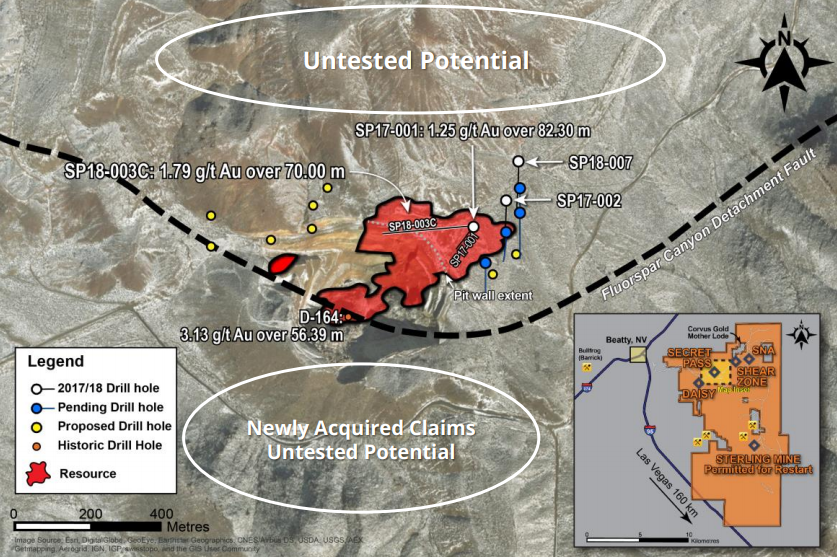
The Secret Pass deposit, like Mother Lode, is volcanic-hosted with disseminated gold mineralization and has a current inferred resource of 11,143,000 tonnes at 0.93 g/t for 335,000 ounces of gold. 2017 drilling on the Secret Pass Deposit was highlighted by SP17-001: 82m @1.26 g/t Au and SP17-002: 30.48m @0.55 g/t Au. Additionally released on March 20th 2018 – SP18-003C: 70.0m @1.79 g/t.

All three drill holes can be found on the satellite photo of Secret Pass below, including the location of pending and proposed drill holes for 2018. With the purchase of additional claims south of the deposit, Northern Empire will be able to pursue hole D-164, which returned a huge intercept of 56.39m at 3.13 g/t.

PUSH: 15 holes are planned for the Secret Pass deposit in 2018. Watch for drill results in the weeks ahead, as Northern Empire looks to expand the resource both laterally and at depth.

Secret Pass


SNA Deposit

The SNA Deposit is a past producing mine and was formerly referred to as Sunday Night Anomaly from 1991 to 1995. The SNA Deposit hosts Carlin Style gold mineralization and has an inferred resource of 3,875,000 tonnes at 1.03 g/t for 126,000 ounces of gold.

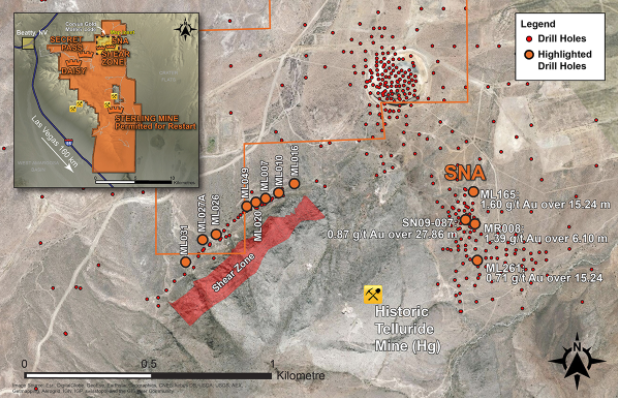
Interestingly, the SNA Deposit lies in close proximity to Corvus Gold’s Claim boundary, and more importantly, their Mother Lode open pit. In the satellite image below, you can see Corvus Gold’s claim boundary outlined in orange, along with Northern Empire’s SNA Deposit toward the bottom right.

Crown Block - SNA

In Corvus Gold’s 2017 drill program, they hit 51.8m of 1.86 g/t gold which included an interval of 19.8m of 3.43 g/t. The reason I mention this is because the hole was located roughly 8 meters from the claim boundary with Northern Empire. As you can see in the satellite image, Northern Empire’s property completely surrounds Corvus Gold’s Mother Lode deposit and needless to say, makes this is a very intriguing target area with a lot of potential for Northern Empire!

PUSH: +16 holes are planned for the SNA Deposit in the 2018 drill program. Watch for drill results as Northern Empire attempts to expand upon the SNA deposit resource.


Concluding Remarks

As I mentioned in my introduction, I believe that placing yourself in quality companies is the way to succeed in a business where the odds of success are typically stacked against you. That said, quality doesn’t mean they’re free of risk.

In terms of Northern Empire, I believe the biggest risk is an unsuccessful drill program in 2018, which would result in minimal to no improvement in their existing inferred resource. In this worst case scenario, I don’t see much upside from today’s current market cap.

While there’s always a chance of coming up empty handed when exploring, I think there’s a far better chance that their resource will increase, and with permits in-hand, Northern Empire’s Sterling Mine is ready to go.

Recapping Northern Empire’s strengths:

  • Good management team with extensive experience exploring and developing gold projects in Nevada.
  • The Fraser Institute ranks Nevada 3rd in the world for Mining Investment Attractiveness.
  • Northern Empire is in possession of all the necessary production permits to restart the Sterling Mine.
  • The Sterling Mine potential production scenario should be low cost, as the Carlin Style gold mineralization will be mined from an open pit and is amenable to heap-leaching.
  • Great exploration potential within the Sterling Mine and the Crown Block’s 4 main target areas: Daisy Deposit, Secret Pass Deposit, SNA Deposit and Shear Zone.  15,000m of drilling planned for 2018.
  • Existing inferred global resource of 985,000 ounces of gold at 1.29 g/t.
  • CASH – $16 million!!

I am invested in Northern Empire and am looking forward to news flow over the coming months.


Don’t want to miss a new investment idea, interview or financial product review? Become a Junior Stock Review VIP now – it’s FREE!


Until next time,


Brian Leni  P.Eng

Founder – Junior Stock Review


Disclaimer: The following is not an investment recommendation, it is an investment idea. I am not a certified investment professional, nor do I know you and your individual investment needs. Please perform your own due diligence to decide whether this is a company and sector that is best suited for your personal investment criteria. I do own shares in Northern Empire Resources. All Northern Empire Resources’ analytics were taken from their website and press release. Northern Empire Resources is a Sponsor of Junior Stock Review.


Posted on

PDAC 2018 Takeaways

PDAC logo

The 2018 edition of PDAC did not disappoint! Attendance was up from last year and, overall, the mood from most was cautiously optimistic. In my view, this is a good place to be, considering the current overall market dynamics. In my opinion, there’s definitely interest and money waiting to be deployed into the sector.  The criteria for that money to enter the resource market must be understood before being able to answer or hypothesize when the direction of the resource market as a whole will change.

PDAC introduced me to a few stories that, I think, have a lot of upside potential even if the next leg up in the resource bull market is still months away.


Is 2018 the Year for Mergers and Acquisitions in the Base Metals Sectors?

Before attending any investment conference, I always write out a list of goals or takeaways that I want to achieve by the end of the conference; presentations I’d like to watch, companies I’d like to speak with, people I’d like to meet, and things I’d like to learn or better understand.

For PDAC this year, I had a clear set of goals that was headlined by speaking to the major mining companies about the current base metals markets and what might be the catalyst for mergers and acquisitions (M&A). For those who are not familiar, major companies are not usually present at most resource investment conferences, making PDAC very unique in this regard.

What are the catalysts for M&A in the base metals markets? None of the major companies would come right out and give me a straight answer or list any criteria for an increase in M&A activity in the base metals market. While I figured this would be the case, going into the conference, I asked the question anyway; it’s complex enough that it leads to a lot of good discussion.

Here’s a short list of commonalities from their answers:

  • Profits – with the currently strong base metal spot price, most companies are generating good cash flow and believe prices will be higher in the future. My inference from this statement is ‘my balance sheet looks great, I’m in no rush to put any wrinkles on it by way of M&A. Additionally, by not developing any further supply, the price will remain high and we will continue to make profits.’
  • Risk – Greenfield/brownfield development projects have a lot of risk. This sentiment may have been the most pronounced with all of the major companies. ‘Why should I invest in a Greenfield/brownfield development project when I can put the same amount of money into an asset I already own and understand?’
  • Lack of quality acquisition targets – Each major company said that they are always looking for possible acquisition targets, but don’t see a lot of high quality projects out there. I view this comment in a number of different ways. First, I don’t disagree, the picking of truly world-class projects is small, and most likely only getting smaller in the future, until we change our criteria for what is world-class. Second, rising metal prices bring a lot of the 2nd tier projects into profitability, and may be the rose coloured glasses that are needed to spur M&A.

Although the major companies appear to be very confident that M&A isn’t a priority at this point, it’s my thought that it will only take one company to make a move and acquire one of the tier 1 projects and the flood gates will open as everyone else scrambles to buy up what’s left.

For me, I’m willing to wait and am looking to buy quality companies whose value is greater than their price, giving me the best possible odds of success. “When” questions pay, it’s just a matter of time.


Concluding Remarks

While I remain bullish on all metal prices, I’m increasingly becoming more selective in the junior companies with which I invest my money. The last year has proven to me, once again, that even though market fundamentals of a given commodity can be screaming for bull market, it doesn’t have to happen right away. Being a linear thinker is a good thing, but can be fraught with frustration and losses if mixed with a short-term view; the market can remain irrational longer than most of us can remain solvent! Therefore, for me, being highly selective in the companies with which I invest gives me the confidence to ride out the short waves of volatility and, ultimately, profit when the market confirms my bullish thesis.

One last thing, there’s nothing wrong with taking profit when it’s there!!


Don’t want to miss a new investment idea, interview or financial product review? Become a Junior Stock Review VIP now – it’s FREE!


Until next time,


Brian Leni  P.Eng

Founder – Junior Stock Review


Disclaimer – The following is not a recommendation, it is an idea. I am not a certified investment professional, nor do I know you and your individual investment needs. Please perform your own due diligence to decide whether attending an investment conference is suited for your personal investment needs. Junior Stock Review does not guarantee success from attending PDAC or any other investment conference. I have not been compensated to write this article, however Junior Stock Review is a media partner of PDAC International Convention 2018.

Posted on

FPX Nickel Closes Over-Subscribed Private Placement for $1,470,000

FPX Nickel Corp.

NOT FOR DISTRIBUTION TO UNITED STATES NEWSWIRE SERVICES OR FOR DISSEMINATION IN THE UNITED STATES

VANCOUVER, British Columbia, March 19, 2018 (GLOBE NEWSWIRE) — FPX Nickel Corp. (TSX.V:FPX) (“FPX” or the “Company”) is pleased to report that it has closed its previously announced non-brokered private placement for gross proceeds of $1,470,000 (the “Offering”). The Company expanded the originally announced private placement from 5,416,666 shares to 12,250,000 shares for gross proceeds of $1,470,000 (see FPX’s news releases dated February 26 and March 14, 2018).

The proceeds raised from the Offering will be used for the Company’s ongoing internal trade-off studies on the Baptiste Deposit at its flagship Decar Nickel District in central British Columbia, and for general working capital purposes.

The closing follows receipt of Conditional Acceptance of the Offering from the TSX Venture Exchange (“Exchange”).  Within the next several days, FPX will be submitting the documentation needed the enable the Exchange to issue its Final Acceptance of the Offering.  The Company anticipates receiving Final Acceptance shortly thereafter.

In closing the financing, the Company has issued 12,250,000 shares priced at $0.12 per share.  Finder’s fees of $33,181 were paid on a portion of the proceeds.  Officers and directors of the Company subscribed for 2,535,667 shares for gross proceeds of $304,280.

All securities issued under this Offering are subject to a hold period of four months and a day from the closing date.

About FPX Nickel Corp.

FPX Nickel Corp. is focused on the exploration and development of the Decar Nickel-Iron Alloy Project, located in central British Columbia, and other occurrences of the same unique style of naturally occurring nickel-iron alloy mineralization known as awaruite. For more information, please view the Company’s website at www.fpxnickel.com or contact Martin Turenne, President and CEO, at (604) 681-8600.

On behalf of FPX Nickel Corp.

Martin Turenne
Martin Turenne, President, CEO and Director

Forward-Looking Statements
Certain of the statements made and information contained herein is considered “forward-looking information” within the meaning of applicable Canadian securities laws. These statements address future events and conditions and so involve inherent risks and uncertainties, as disclosed in the Company’s periodic filings with Canadian securities regulators. Actual results could differ from those currently projected. The Company does not assume the obligation to update any forward-looking statement.

Neither the TSX Venture Exchange nor its Regulation Services Provider accepts responsibility for the adequacy or accuracy of this release.

Suite 725 – 1155 West Pender Street
Vancouver, BC Canada V6E 2P4
Tel: 604.681.8600
e-mail: info@fpxnickel.com

Posted on

CANSTAR RESOURCES, ADVENTUS ZINC AND ALTIUS MINERALS ANNOUNCE THE CONSOLIDATION OF NEWFOUNDLAND ZINC EXPLORATION PROJECTS, FOCUSED ON THE BUCHANS CAMP

Toronto, February 21, 2018 – Canstar Resources Ltd. (“Canstar”) (TSX-V: ROX), Adventus Zinc Corporation (“Adventus”) (TSX-V: ADZN) and Altius Minerals Limited (“Altius”) (TSX: ALS) are pleased to announce that they have entered into a three-way definitive agreement (the “Transaction”) dated February 20, 2018 whereby Canstar will acquire the Newfoundland base metal exploration assets of Adventus and the Daniel’s Harbour Zinc Project from Altius in exchange for: (i) the issuance of common shares of Canstar to Adventus and Altius; and (ii) a funding commitment from Altius of $500,000 as part of a $750,000 private placement (as further described below). The Transaction will allow Canstar to consolidate the majority of the Buchans Camp and adds three high quality Newfoundland zinc exploration projects to Canstar’s portfolio. Upon closing of the Transaction (the “Closing”), Canstar’s Newfoundland exploration team will initiate a comprehensive 2018 exploration program focused on the Buchans Camp, with a minimum 3,000 m of diamond drilling campaign anticipated in 2018 to be completed in phases (with full details of this program to follow from Canstar upon Closing).

Following the Closing, Canstar will focus its attention on polymetallic exploration in Newfoundland, in particular the Buchans Camp, where it will own the majority of the district’s mineral rights. The Buchans Mine was one of the highestgrade polymetallic mines globally, producing a historical 16.2 million tonnes averaging approximately 14.50% Zn, 7.56% Pb, 1.33% Cu, 126 g/t Ag and 1.37 g/t Au over its 56-year mine life (Kirkham, 1986). The southeast corner of the region also hosted Teck Resources Limited’s Duck Pond Mine, which operated between 2007 and 2015 with an initial reserve of 4.08 million tonnes averaging approximately 3.3% Cu, 5.7% Zn, 59 g/t Ag and 0.86 g/t Au (Guy Belleau & Petr Pelz, 2005). The Duck Pond 1,800 tpd flotation mill is currently on care and maintenance.


Highlights of Canstar Assets

 The Mary March Project, located 20 km east of Buchans and next to a provincial highway, which is a joint venture between Canstar (56%) and Glencore (44%). Canstar has first right-of-refusal to acquire the remaining interest from Glencore; and

 In 1999 and 2000, previous owners Phelps Dodge intersected 10.33% Zn, 118.1g/t Ag, 1.62% Pb, 4.1 g/t Au, 0.66% Cu over 9.23 m; 16.8% Zn, 660 g/t Ag, 12.2 g/t Au, 5.44% Pb, 0.18% Cu over 0.91 m; and 3.02% Zn, 1.08% Pb, 72.4 g/t Ag, 0.13% Cu over 20.6 m. These remain the best drill holes in the Buchans camp, outside of the historic Buchans mine.


Highlights of Adventus’ Newfoundland Assets

 Adventus is vending its 100% interest in its approximately 39,000 hectare land package located in the Buchans camp, which represents the largest land position in the camp;

 A heliborne time domain electro-magnetic (TDEM) survey flown in 2017 over the entire Buchans land package resulting in the identification of approximately 35 drill-ready targets, with some of the most exciting targets contiguous to Canstar’s Mary March and Nancy April projects; and

 Adventus is also vending its 100% ownership interest in the Katie and La Poile base metal projects, both having prospective volcanic massive sulphide targets supported by historic trenching and drilling results. Highlights of Altius’ Involvement and the Daniel’s Harbour Zinc Project

 Altius is vending its 100% owned Daniel’s Harbour Zinc Project, approximately 9,000 hectares of prospective lands surrounding the former high-grade zinc mine operated by Teck Resources Limited from 1975 to 1990. During this period, Teck reported production of approximately 7 million tonnes at an av Date: Ticker Symbols: 21-February-2018 ROX-V, ADZN–V and ALS-T — 2 —

 Altius and Canstar will enter into a 12-month technical services agreement with Altius to carry out the 2018 exploration program for the consolidated Newfoundland projects subject to TSX Venture Exchange (“TSX-V”) approval; and

 Canstar will complete a $750,000 non-brokered private placement the proceeds of which will be applied to a first phase Newfoundland exploration program, G&A, corporate activities as well as working capital. The financing will consist of the sale of 4,166,667 common shares issued at $0.06 per share on a hard dollar basis for gross proceeds of $250,000, and 6,250,000 common shares issued on a flow-through basis at $0.08 per share for gross proceeds of $500,000. Altius is subscribing for the flow-through shares for a total investment of $500,000 and will have pro-rata equity participation rights going forward. Altius will also receive a right of first refusal on any future royalty and/or streaming financing related the Mary March property.

Dr. David Palmer, Director of Canstar, commented, “We are pleased to enter into this transaction with Adventus and Altius. Canstar has long been a champion of the Mary March Project and the consolidation of these Buchans properties into a district-scale exploration project is a great opportunity for all Shareholders. We are pleased that Adventus and Altius share our enthusiasm for its potential and with the combined technical experience of all three companies and a new management team we will be able to advance exploration programs very effectively. We look forward to completing this transaction and commencing exploration.

Christian Kargl-Simard, President and CEO of Adventus, commented, “Adventus is excited to become involved in such a prospective suite of exploration assets in one of the best jurisdictions globally to operate. This Transaction provides synergies for all three parties, and a focused vehicle to unlock the value in the Buchans Camp and Newfoundland and Labrador. We believe the timing is right to commit modern exploration in this storied Canadian base metals camp. With the local infrastructure and high grades, new discoveries will create very significant value for all shareholders.”


Transaction Summary

Under the Transaction, Canstar will issue 86.7 million shares to Adventus for its portfolio of assets and Altius will receive 12.1 million shares for its Daniel’s Harbour Zinc Project. Upon Closing, including completion of the private placement, the current shareholders of Canstar will own approximately 49% of the consolidated company, while Adventus and Altius will own approximately 40% and 9%, respectively, and other investors in the private placement will own 2%. Following completion of the Transaction, Canstar will use commercially reasonable efforts to complete a minimum two million dollar flow-through private placement financing.

Upon completion of the Transaction, the Board of Directors of Canstar (the “Board”) will initially be comprised of four members, with three members appointed by Canstar and one member appointed by Adventus (and Adventus retaining the right to appoint a second member at a later date). The Board will initially consist of David Palmer, Dennis Peterson and Patrick Reid, existing directors of Canstar, and Sam Leung, the Vice President of Corporate Development for Adventus. Mr. Jack Hurley, an existing director of Canstar is thanked for his years of service and will continue as CFO. Dennis Peterson is acting as Chairman and interim CEO, while a CEO search is underway. A technical steering committee of Qualified Persons as defined by National Instrument 43-101 – Standards of Disclosure for Mineral Projects, consisting of Dr. David Palmer, Jason Dunning and Dr. Lawrence Winter will assist with the direction of Canstar’s exploration programs.

The Transaction will be subject to TSX-V approval for both Canstar and Adventus. Canstar is arm’s length to both Adventus and Altius. Adventus and Altius are “non-arm’s length parties” as Altius is an “insider” of Adventus as such term is defined under securities laws. Canstar will require shareholder approval pursuant to the policies of the TSX Venture Exchange as Adventus will become a “control person” of Canstar on closing and the Transaction is viewed as a “reverse take-over”. Canstar will apply to the TSX-V for a waiver from the requirement to engage a sponsor with respect Date: Ticker Symbols: 21-February-2018 ROX-V, ADZN–V and ALS-T — 3 — to the Transaction; however, there is no assurance that a waiver will be granted. Canstar intends to include any additional information regarding sponsorship in a subsequent press release. The Transaction is also subject to satisfaction of certain other closing conditions customary in transactions of this nature. Directors and officers of Canstar, representing 6.3% of the Canstar common shares, have entered into voting support agreements with Adventus and Altius, pursuant to which they will vote their common shares in favour of the Transaction. It is also anticipated, assuming the Transaction is approved that Canstar will complete a 5 for 1 share consolidation and all shares will be issued on a post-consolidated basis. As a result, upon completion of the Transaction, there will be issued and outstanding approximately 212,025,189 shares on a pre-consolidation basis and 42,405,038 shares on a post-consolidation basis. The effective price of the private placement will be $0.30 per hard dollar common share and $0.40 per flow-through common share.

Full details of the Transaction will be included in the management information circular of Canstar to be mailed to their shareholders and posted on www.sedar.com. It is anticipated that the meeting of Canstar shareholders and the closing will take place by May 2018. Lawrence Winter, Ph.D., P.Geo., Vice‐President of Exploration for Altius, a Qualified Person as defined by National Instrument 43-101 – Standards of Disclosure for Mineral Projects, is responsible for the scientific and technical data presented herein and has reviewed, prepared and approved this release.

About Canstar Canstar Resources is a Canadian mineral exploration and development company. Canstar’s objective is to discover and develop economic mineral deposits primarily in North America. Currently, Canstar’s focus is on its mineral exploration properties in Newfoundland. About Adventus Adventus is a well-financed and unique company focused on zinc-related exploration and project development globally. Its strategic shareholders include Altius Minerals Corporation, Greenstone Resources LP, and Resource Capital Funds; as well as other highly respected investors in the mining business. Adventus owns large prospective land packages in both Ireland and Newfoundland and Labrador, Canada, and is earning a 75% ownership interest in the Curipamba coppergold-zinc project in Ecuador. In addition, Adventus has a country-wide generative exploration alliance with its partners in Ecuador.

Adventus is based in Toronto, Canada, and is listed on the TSX-V under the symbol ADZN. About Altius Altius’ directly and indirectly held diversified royalties and streams generate revenue from 15 operating mines. These are located in Canada and Brazil and produce copper, zinc, nickel, cobalt, iron ore, potash and thermal (electrical) and metallurgical coal. The portfolio also includes numerous pre-development stage royalties covering a wide spectrum of mineral commodities and jurisdictions. It also holds a large portfolio of exploration stage projects which it has generated for deal making with industry partners that results in newly created royalties and equity and minority interests. The Altius exploration team was recently awarded the 2017 Prospector/Explorer Award from the Newfoundland Branch of the CIMM for its recent work on project generation.


Completion of the transaction is subject to a number of conditions, including but not limited to, TSX-V acceptance and shareholder approval. Where applicable, the transaction cannot close until the required shareholder approval is obtained. There can be no assurance that the transaction will be completed as proposed or at all.

Investors are cautioned that, except as disclosed in the management information circular or filing statement to be prepared in connection with the transaction, any information released or received with respect to the transaction may Date: Ticker Symbols: 21-February-2018 ROX-V, ADZN–V and ALS-T — 4 — not be accurate or complete and should not be relied upon. Trading in the securities of Canstar should be considered highly speculative.

The TSX Venture Exchange Inc. has in no way passed upon the merits of the proposed transaction and has neither approved nor disapproved the contents of this news release.


Forward-looking Statement

This press release contains “forward -looking information” within the meaning of applicable Canadian securities laws. Any statements that express or involve discussions with respect to predictions, expectations, beliefs, plans, projections, objectives, assumptions or future events or performance (often, but not always, identified by words or phrases such as “believes”, “anticipates”, “expects”, “is expected”, “scheduled”, “estimates”, “pending”, “intends”, “plans”, “forecasts”, “targets”, or “hopes”, or variations of such words and phrases or statements that certain actions, events or results “may”, “could”, “would”, “will”, “should” “might”, “will be taken”, or “occur” and similar expressions) are not statements of historical fact and may be forward-looking statements. Forward-looking information in this news release includes, but is not limited to, the closing of the Transaction, anticipated drilling at Buchans Camp, satisfaction of closing conditions, approval of the TSX-V, approval by the shareholders of Canstar and the potential for exploration.

Forward-looking information herein includes, but is not limited to, statements that address activities, events or developments that Canstar, Adventus and Altius expect or anticipate will or may occur in the future. Although Canstar, Adventus and Altius has attempted to identify important factors that could cause actual actions, events or results to differ materially from those described in forward-looking information, there may be other factors that cause actions, events or results not to be as anticipated, estimated or intended. There can be no assurance that such information will prove to be accurate, and actual results and future events could differ materially from those anticipated in such information. Accordingly, readers should not place undue reliance on forward-looking information. Canstar, Adventus and Altius do not undertake to update any forward-looking information except in accordance with applicable securities laws.

All monetary figures referenced in this press release are in Canadian dollars unless otherwise stated.

For further information from Canstar, please contact: Karen Willoughby, Director Corporate Communications, at 1-866- 936-6766 or kwilloughby@canstarresources.com.

For further information from Adventus, please contact Christian Kargl-Simard, Chief Executive Officer, at 1-416-230-3440 or christian@adventuszinc.com.

For further information from Altius, please contact Chad Wells cwells@altiusminerals.com or Flora Wood at 1-877-576- 2209.

Posted on

A Conversation with Trey Reik, Senior Portfolio Manager with Sprott USA

Trey Reik

Whether it be financial, political or social, there’s the potential for any decision we make to be fueled by emotion. In particular, when participating in a high risk, high reward area of the market, like the junior resource sector, it can be lethal to your odds of success.

In my experience, those who can use arithmetic as their primary “truth” are the best at eliminating bias and reducing the amount of emotion contained in an investment. Today, I have for you an interview with a man who uses arithmetic to construct, what I believe, is the most compelling argument for gold that I have ever heard.

This man is Trey Reik, a Senior Portfolio Manager with Sprott USA. Reik is a commentator on gold markets and monetary policy, including policies and actions of global central banks, global conditions for money and credit, and factors affecting supply/demand conditions for gold bullion.

I first heard Reik speak at the 2015 Sprott Natural Resources Symposium in Vancouver, British Columbia. From then on, I’ve always paid attention when I’ve heard or seen the name, ‘Trey Reik;’ there’s a lot you can learn from him, especially when it comes to his commentary on gold.

Without further ado, a conversation with Trey Reik.


Enjoy!


Brian: In my view, we live in a society of paradigms or bias that lock us into thought patterns that keep many of us blind to other alternatives – alternatives that may be more efficient or beneficial.

 In reference to financial markets and in particular gold, in your opinion, how does one keep an open mind and see through paradigms and their own inherent bias?


Trey Reik: I think that a lot of what’s been going on, at least in markets since the turn of the millennium, so the 2000s, is that we’ve hit a period in which central banking has become probably the most important variable on the investment landscape, and I would add much more important than it should be. This has really cast a prism or a rose-coloured glasses view of what’s really going on in the world. It has, I think, relieved people and investors from reality, to a great degree.

Let me just back up a teeny bit, and talk about it from the perspective of gold. Number one, I’ve given probably 1,000 presentations about gold over the 15 years in which I have been covering it, and I’ve never once convinced anybody to buy gold. I don’t expect to change people’s views today any more than I did yesterday or last month. Number two, gold’s a funny topic because almost everybody has an opinion, generally unburdened by a real strong command of any relevant underlying fundamentals or facts. Third, gold has more investment queues than any other asset with which I’ve been involved over my career.

Some people think it’s an inflation hedge, some people think it’s a deflation hedge. Some people think gold is a risk-on trade, other people would look at it as a risk-off investment. When we have stress in the financial system, some people would view gold as a safe harbour. Other people would still favour the US dollar, although far fewer than would have made that determination say, in 2008. Given the negative reflexive relationship between the dollar and the US gold price, you could actually have a situation where stress in the financial system has a reflexively negative impact on gold.

Now, I went through all of that because my gold thesis is a little different than most. I don’t really think gold has much to do with CPI-type inflation. The way I would pose this is  that if the price of hedonically adjusted hot dogs in Houston goes up, why would you buy gold? I don’t really see a strong connection there. Another way to look at inflation is if the prices of goods and services go up for healthy reasons, like a strengthening economy, I’m not really sure the price of gold should go up any faster than say, thumbtacks. If the inflation is of the monetary sort or variety, then I think gold should logically do a lot better.

Now, over the last 17 years, gold is up in 14 of those 17 years and has amassed a compound annual return since year end 2000 through year end 2017 of just about 9.5%. Actually, 9.65%. Over the same 17 years, the compound annual return of the S&P 500, including reinvestment of dividends was 6.32%. Gold has significantly outperformed the S&P with reinvestment of dividends for 17 years and is up in 14 of the 17. Now, if gold is up in 14 of the 17 years, it proves my point that it’s not related to some of these knee-jerk reactions that get ascribed in the press all the time to gold investors. In other words, we’ve had periods of inflation and periods of deflation over that timeframe. We’ve had round trips in equities and commodities. We’ve had yields on both the short end and the long end, largely falling over the timeframe, but we even had periods like June of ’04 to June of ’06 where the Fed raised rates at 17 consecutive FOMC meetings and quintupled the Fed funds rates from one-percent to five-and-a-quarter-percent, and gold went up during that timeframe by as much as 86%.

My point is, for gold to do as well as it has for so long, posting the best performance of any global asset, there’s obviously something more going on. I think what that is, is that at the margin, we have about $280 trillion now in global financial assets, and each year, in my opinion, my thought experiment, if you will, is that a very small portion of that global wealth seeks a home in hard assets, things that can’t be debased or defaulted upon, things that can’t be printed. That’s why fine art, in my opinion, has done so well over a period that has not exactly been exhibiting breakneck growth, but nonetheless, the art market’s been on fire. Things like Honus Wagner baseball cards, fine Bordeaux wines, all that kind of stuff has done really, really well.

Gold has benefited, I think from that migration. Each year, we have a different rate of migration from the financial asset pile to things like gold, and in certain years, that migration may have even reversed, like 2013, for example. The whole gold thesis is about that rate of migration going from say 1/10th of 1% to say, 1/2 of 1% ’cause 1/2 of 1% of $290 trillion is $1.45 trillion. The available gold stock is about $2.8 trillion. $1.5 trillion isn’t going to get into $2.8 trillion without a serious price dislocation.

When you talk about paradigms or things being misleading or that type of thing, although that’s a leading, almost political kind of question, I think the biggest misdirection, I think, of markets is the degree to which certainly over the past three years especially, but over the last 17 years, how big a part of financial asset valuations has become central bank policy.

Now, to back this up to two weeks ago, I think most of the market still believes that this disturbance that we had is–just as when we had the crisis of 2007, ’08, and ’09—the  first words out of people’s mouths are always, “It’s contained.” Just as we thought in 2007 that the disturbance was limited to subprime mortgages, we are currently, I think, a large percentage of folks would say that the current disturbance is limited to a very small group of perhaps leverage, but certainly a short bet on the VIX. I look at it very differently. I would suggest that after nine years of ZIRP and QE, but 17 years of egregious central policy and interventions really starting with Mr. Greenspan, the entire financial system has been imbued with this short-volatility way of looking at the world. I’m sure given your situation, that you’ve read Chris Cole’s stuff from Artemis, but he’s the Michael Burry of this trade. You remember Burry was the guy that figured out the subprime-short trade for Scion Capital in the movie The Big Short. Coles is, I think, the Michael Barry of this trade. If you’ve read his stuff, he estimates that there’s about $2 trillion-worth of short-volatility exposures.

He’s got it all broken out in the stuff that he’s written. If you have about $2 trillion of exposures left, we haven’t even really started to scratch the surface of re-pricing things back to reality. I would say that in an environment of 0% interest rates and QE, we’ve lost the ability to assess the demand for anything.

People who laugh or criticize gold, like Warren Buffett–here’s a guy, he’s got more financial assets, paper assets than any other human being on the planet, or I guess Jeff Bezos might be up there with him now.Warren Buffett, who has more to lose from gold doing well than any other person on the planet, and ask him what he thinks about gold? But yet we do. When we do, he says, “Well, if you take all the gold in the world and you fit it on a tennis court, you got this big lump of gold and then in the other, box B, you could have five General Motors or GEs, and all the farmland in America, and you’d still have a trillion dollars leftover. Who wouldn’t pick box B?” The answer is anybody who thinks box A, which is all the gold in the world, is going to go up faster than box B.

We have a system where people think they have these franchises and these moats and all the stuff that Buffett writes about, and impenetrable franchises, but in fact, the denominator of all of these things, the unit of account, even if you’re talking about cash flow, is dollars. The one thing that is not stable as a unit of account is dollars, so no one really has any idea what the value of any of these franchises are.

If we normalized rates, and we took say, Fed funds to, well what’s normal anymore? We took them from 1% to 5.25% as recently as 2006, but if we took them to 4-5%, and we took the 10-year Treasury yield to eight percent, would the financial systems still be intact? I think the answer is no.

Until we can normalize rates, we don’t know what the list of Buffett’s companies–the Nebraska Furniture Mart and Wells Fargo and he just sold his IBMno one knows what the demand for anything is at these companies with this much monetary debasement.


Brian: Since 2008, I have personally suffered from being too pessimistic on paper currencies, mainly the U.S. dollar and risk in the broader market.  Depending on perspective, this view both made me and cost me money.

Now, 10 years later, I have taken time to reflect on my investment choices and believe that bias or the so called “gold bug” in me prevented me from having a clearer picture of what was actually happening in the world.

However, I still believe that there is a price to pay for the massive amounts of money printing and low interest rates we have seen over the last 10 years. To me it is a “when” not “if” question.

My question for you is, has the “when” already occurred in the gold market? Meaning, realistically, should investors view the current gold price around $1300 USD/oz as the payback for the QE and low interest rates, or is the “when” still to come?


Trey Reik: I do believe there is no empirical equation that could generate a gold price that really means anything. The gold price is the reciprocal of your comfort with the financial system, the dollar, and central-bank stewardship. If you’re of the opinion as an investor that those three are fine, gold really serves no purpose. If you are like me, of the opinion that all three of those are deeply in doubt, meaning the value of the US dollar, debt levels, central bank stewardship, etc., then gold is a mandatory investment.

It doesn’t really matter if the price is $1,200 or $2,300, if those three issues are still a problem, you need to have gold in your portfolio. That’s what I was saying earlier; I have three litmus tests for when gold is a mandatory portfolio investment. I was sharing the first with you, which is whether you could normalize rates and then you have to decide what normalizing means. Let’s even call it 3% on Fed funds. I don’t think we can get there without a financial calamity or 6-8% on the 10-year Treasury. If you could normalize rates without big impact, gold’s role may have diminished.

The second litmus test would be if we take the ratio of debt-to-GDP, for the last 100 years the ratio of debt-to-GDP in this country has averaged 140-170%, except for two events. The depression and the Alan Greenspan/Bernanke/Yellen era. In the first example, we had GDP fall 50%, the debt remained constant, so the ratio got up to like 260%. FDR had to devalue the dollar and confiscate gold in the US and make it illegal, for what turned out to be 41 years. In the current environment, which is a numerator event, we’re just piling all this debt on top of relatively stable GDP. If we don’t get that debt-to-GDP ratio back to say, 200% from its current level of about 370%, goldwill remain a mandatory investment.

The reason is, that in order to get that ratio back into balance, the only two options are default or debasement. Each time the markets try to choose default, the Fed steps with QE1, QE2, QE3, Operation Twist, etc., and they will again. We’re either going to have 20 trillion or so of credit in the United States go away, or the other way to look at this is household net worth.

In March of 2009, household net worth, which is the Fed’s measure from Z1; basically it’s stocks, bonds, real estate, minus debt. Household net worth in March of 2009 was $54.79 trillion, GDP was $14.09 trillion. Today, household net worth is $96.94 trillion and GDP is $19.5 trillion. GDP has gone up $5.4 trillion from $14.09 trillion to $19.5 trillion, and household net worth over the same time period has gone up $42 trillion from $54 trillion to $96.94 trillion.

This means that over the past—let’s see, March of ’09, and now we’re in March of ’18, so the past nine years, household net worth has grown 7.77 times, or call it eight times faster than GDP growth. Now, the one thing I know for certain is you can’t grow wealth eight times faster than output forever. Once again, is gold necessary? Have we had the ‘when’ yet? Absolutely not. In the household net worth type of multiple to GDP, if you look at the 40’s, the 50’s, the 60’s, the 70’s, everything really through the 80’s, we used to have about a 3.5 times multiple to GDP and savings, is what household net worth should be.

Probably 30, 35, 40 trillion dollars worth of household net worth has to go away to get the system back in balance. This is like litmus test number two. We either need $20 trillion in credit, or $30-35 trillion in the combination of real estate, stocks, and bonds, (minus debt) to go away to bring the system back in balance. Until that happens, I think gold is a mandatory portfolio component because, once again, the only two options are default or debasement.

Then the third litmus test would be if we could get back to some sort of normalized GDP growth, and once again, we’re debating these days what “normal” is. Trends, capability, normal, say 3%, used to be 3.5%. We used to accomplish 3.5% growth with a savings rate, very importantly, in the 8-10% area. That would be healthy growth. It wouldn’t require the non-financial credit expansion that is now necessary to keep the debt pyramid from toppling, which is on the order of $2 trillion a year. Again, to review the three litmus tests would be normalizing rates without crashing the financial system, rationalizing the excess paper claims in the economy, whether it’s debt or the household net worth, and the third would be normalize GDP supported by savings as opposed to non-financial credit creation.

Unless you have basically all of those, or even two out of three, gold is still a mandatory portfolio investment, in my opinion. Which is, by the way, why even though it never gets any accolades, it is the best performing asset and is up in 14 of the past 17 years. That’s going to continue until we get the system in better balance between claims on future output and the future output itself.


Brian: Is there an event or series of events that would have to occur for you to change your mind about the long-term fundamentals of gold?


Trey Reik: One of the reasons that I’m as confident as I am is I’ve spent more time thinking about the underlying fundamentals than most human beings. There’s a lot of people that invest in gold for lots of different reasons, as we already discussed, but I’m not in that group. I’m investing in gold for a very specific tenant, which has to do with monetary variables and the claim on future output. There’s just too much paper claim out there. Until those imbalances are solved, one way or another, and I’m suggesting the only two solutions are default or debasement, there isn’t any other solution.

Well, the third solution would be we grow into it, but in order to grow into it, even if we had GDP at 10% for each of the next eight quarters, it would take GDP from $19.5 trillion to maybe $22 or $23 trillion, and that can’t support $66 trillion of debt any more than $19.5 trillion. Further, if the variables that I just gave you in the last 17 years hold anywhere remotely true, when we get GDP up to $22 or $24 trillion, the debt won’t have remained constant. It would  probably be up seven times faster than the GDP growth. You can’t grow out of it, you’ve got to have default or debasement. These imbalances are so profound that I’m not swayed to change my mind at all, even by periods like September 2011 to December 2015, when the high tick for gold was 1911 down to 1050 because these imbalances are still there.

Over the past 17 years, by the way, people always ask when’s gold gonna do its thing? Or why isn’t it doing better?… My response is always, It’s the best performing asset on the planet for 17 friggin’ years. I’ll be fine if gold keeps performing just like this, you know what I mean?


Brian: Yes, absolutely.


Trey Reik: Now, you mentioned the currency thing. I believe all fiat currencies have become an extension of the US dollar. Currency people have to pick one of the seven or five, or however many you want to say there are. That’s a shell game, and that’s all fine. It has gone on much longer than I would have thought possible. It is amazing that 2008 was 10 years ago, and here we are, but things are starting to change.

People talk a lot about the dollar and this is just an interesting thing, if you take the 10 worst market days in each year and you look at those 10 worst market days, you’d have 50 if you looked at five years. From 2008 to 2012, the 50 days when the DOW dropped at least 100 points, the dollar tended to rally on those days. During those days, dollar index rallied 80% of the time and an average 0.6% on these bad days.

Now, if you look at the next five years, from ’13 to ’17, and we look at the 10 worst days for the DOW, the dollar fell on those 50 days an average of .3 and it only rose 26% of the time. What I’m saying here is we are and, by the way, what happened on those 2,000 point days, I think fiat currencies are starting to fail. That’s a bench-clearing statement, but I think it’s true. We are in the early stages of a potential currency collapse, and so we may be getting “there.”


Brian: In your opinion, is the investment thesis for only gold the same as the thesis for only gold mining companies?


Trey Reik: The thesis is the same, but the deployment or the execution is obviously tricky. Gold is the best performing asset on the planet, as I mentioned, since 2000. Gold equities have had three big runs. The three big runs in gold equities were November 2000 to December 2003, , May 2005 to March 2008 and then November 2008 to September 2011.

Now, ironically, each one of the three was within a month or two of exactly three years. I believe that gold equities provide unparalelled alpha when the faith in US financial assets is being recalibrated. We never want to say stocks could go down, so I’ve come up with that phrase.

If we look at November 17th, 2000, through December 2, ’03, the GDX was up 342%, the S&P was down 22%. The next three year period, the GDX was up 185% and the S&P was up 10%. Then, in the third, it was 309% versus 39.70%. Now, if we compound the advance of the GDX in those three periods, which by the way, is nine years out of the past 16 years, it’s a little over 55% of the time you get a compound performance of 5,081.61%. The coincident performance of the S&P, to the day, was 20.39%, which means that gold equities outperformed the S&P by a factor of 249-to-one in nine of the past 16.5 years.

Now, the problem is the corrections between those advances measured negative 36%, negative 76%, and then after the last advance, negative 86%. If you compound those declines, you get basically 98%. That’s why gold equities in December of 2015 were trading below where they were at the end of the first of those three advances, where they were in December of 2003. The GDM in December of 2003 was at 799 and we got down below, I can’t remember the number, but it was much lower than by the end of ’15. Are they motivated by the same investment thesis? Loosely, but the key with gold equities is, as I think you learned after 2016, neither gold nor gold equities are a permanent investment. They serve different roles.

With what we call the jaws-of- life of the inverse correlation between the S&Ps, since October of 2012 through to today, never having been wider. The last time it was this inversely correlated, gold stocks was like 1996 to 2000, and we all know what was happening then. When people get dumb about US financial assets, gold stocks have a tendency to get left for dead. Then, when the inevitable correction comes, and there were two since 2000. The first was 50.5%, second was 57%. As I’ve proved in the prior example, gold stocks have a tendency to provide among the best alpha available in any asset class.

While I think it’s been necessary to have a good bullion allocation consistently in the last several years, I think that now would be an example of the time period where it’s also incumbent to have a representation in the equities themselves. It’s because of the alpha provided if we have one of these recalibrations of faith in US financial assets, and secondly, simply because of the inverse correlation, which has opened to such an egregious degree between the S&P and gold equities.


Brian: It has been a pleasure Trey, thank you very much for taking the time to answer my questions!


Concluding Remarks

The world’s politicians and a good portion of the mainstream media would have you believe that the actions carried out by the world’s central banks, mainly QE and low interest rates, saved us from the depths of what could have been a much worse situation in 2008. In my opinion, this couldn’t be further from the truth. While, it has taken longer than I have expected, there will be a price to pay for this poor monetary policy and, unfortunately, for those who are blissfully unaware, they will be rudely awakened, one day, when the market re-adjusts.

In my discussion with Reik, he cited three Litmus tests which can be used to gauge whether gold is currently a mandatory investment within your portfolio. Ask yourself:

  • First, is it possible to normalize interest rates?
  • Second, can the debt to GDP ratio be reduced back to historical norms?
  • Third, is it possible to get back to normalized GDP growth?

If you can honestly answer even one of these questions with a ‘yes,’ first, I’m surprised and, second, maybe gold isn’t a good investment choice for you.  In my mind, Reik presents a compelling thesis for the investment in gold and gold equities, making it a “when” not “if” investment choice for your portfolio.

For those interested in purchasing the physical metal, yet would prefer the convenience of purchasing it through the stock market, I highly suggest checking out the Sprott Physical Gold Trust, which is traded on the NYSE under the ticker PHYS, or the Sprott Physical Gold and Silver Trust on the TSX under the ticker CEF.

The Sprott Trusts offer a few advantages. First, they differ from bullion funds, in that all of the bullion owned by the trusts is held in the trusts’ allocated accounts in physical form. Second, all of the Trusts’ bullion is stored at the Royal Canadian Mint, a Federal Crown Corporation of the Government of Canada. Thirdly, for U.S. non-corporate investors who hold units for more than one year and make a timely Qualified Election Form submission, gains realized on the sale of the Trust’s units are currently taxed at the long-term capital gains rate versus the maximum applied to most precious metals ETFs and physical gold coins.

Additionally, I highly suggest following Reik’s market commentary by subscribing to Sprott’s Thoughts, one of the best sources of financial commentary in the resource sector. Also, I highly suggest attending the Sprott Natural Resource Symposium in July, where you will be able to see and listen to Reik in person, along with a fantastic group of speakers which includes Rick Rule, Doug Casey, and James Grant, to just name a few. I hope to see you there!


Don’t want to miss a new investment idea, interview or financial product review? Become a Junior Stock Review VIP now – it’s FREE!


Until next time,


Brian Leni  P.Eng

Founder – Junior Stock Review


Disclaimer: The following is not an investment recommendation, it is an investment idea. I am not a certified investment professional, nor do I know you and your individual investment needs. Please perform your own due diligence to decide whether this is a company(s) and sector that is best suited for your personal investment criteria. Junior Stock Review does not guarantee the accuracy of any of the analytics used in this report.

Posted on

FPX Nickel Announces Updated Mineral Resource Estimate for Baptiste Deposit at Decar Nickel District

FPX Nickel Corp.

Vancouver, February 26, 2018 – FPX Nickel Corp. (FPX-TSX.V) (“FPX Nickel” or the “Company”) is pleased to announce an updated National Instrument (“NI”) 43-101 mineral resource estimate on the Company’s Baptiste Deposit at its 100%-owned Decar Nickel District in central British Columbia.  The updated estimate includes additional drilling and assays from work completed during 2017 (see news release dated November 20, 2017), with considerable updates and modifications to geologic interpretation, block model wireframes and grade estimation strategy.

Table 1: 2018 Baptiste Deposit Pit-Constrained Mineral Resource Estimate *

Category Tonnes Davis Tube Recoverable (“DTR”) Nickel Content
(% Ni) (Tonnes Ni) (Pounds Ni)
Indicated 1,842,645,000 0.123 2,271,000 5,007,133,000
Inferred 390,788,000 0.115 448,000 988,111,000

* See Notes for Tables 1 and 2 below.

“The updated Baptiste mineral resource estimate incorporates the results of our successful 2017 drilling program, which confirmed a significant extension of higher-grade, near-surface nickel mineralization to the southeast of the previous resource outline,” said Martin Turenne, FPX Nickel’s President & CEO.  “The new resource estimate incorporates important new geologic interpretation and an updated estimation strategy and will provide an improved basis for future development studies.  This resource estimate, which was completed using a modest nickel price assumption of US$6.00/lb, will be incorporated into the Company’s ongoing internal trade-off studies, which aim to optimize the components of a mine plan for Baptiste.”

The block model tonnage and grade for each of the indicated and inferred resource categories were calculated at various cut-off grades as shown in Table 2.

 Table 2: 2018 Baptiste Deposit Block Model Tonnage and Grades Reported at a Range of Cut-off Grades (Base Case 0.06% DTR Ni) *

Cut-off Grade (DTR Ni %) Indicated Inferred
Tonnes DTR Ni Grade (%) Tonnes DTR Ni Grade (%)
0.02 1,906,630,000 0.121 504,880,000 0.097
0.04 1,889,612,000 0.121 434,287,000 0.108
0.06 1,842,645,000 0.123 390,788,000 0.115
0.08 1,746,351,000 0.126 334,757,000 0.122
0.10 1,526,532,000 0.131 272,280,000 0.130

* Notes for Tables 1 and 2

  1. The 2018 mineral resource estimate was prepared by GeoSim Services Inc. (“GeoSim”) using composited drill hole assay data and a geological model produced by Equity Exploration Consultants (“Equity”).
  2. The effective date of the 2018 mineral resource estimate is February 26, 2018.
  3. The 2018 mineral resource estimate is reported in compliance with current Canadian Institute of Mining, Metallurgy and Petroleum (“CIM”) standards, definitions and guidelines.
  4. Mineral Resources are not Mineral Reserves and do not have demonstrated economic viability but are required to have reasonable prospects for eventual economic extraction.
  5. Mineral resources are reported in relation to a conceptual pit shell, at a cut-off grade of 0.06% DTR nickel inside a resource shell based on an exchange rate of C$1 = US$0.80 and a nickel price of US$6.00/lb. The cut-off grade represents an in-situ metal value of approximately US$7.00/tonne which is believed to provide a reasonable margin over operating and sustaining costs for open-pit mining and processing.
  6. Block size used was 10x10x10 metres. A total of 978 specific gravity (“SG”) measurements were used to assign median bulk density values to the separate lithologic domains.  DTR Ni grades were interpolated using ordinary kriging in three passes.
  7. The mineralized serpentinized peridotite host rocks at Baptiste are cut by 34 steeply-dipping, non-mineralized dikes, which in total comprise approximately 3% of the rock mass in the classified resource blocks. These dikes are all greater than 5 metres thick and were identified as rock units that could be selectively mined as waste; these rock units were subtracted from the mineralized domain in order to eliminate the zero-grade assays.  Dikes less than 5 metres thick were identified as rock units that are internally dilutive and account for approximately 1% of the rock mass in the classified resource blocks.
  8. Tonnes and pounds have been rounded to the nearest 10,000 and grade has been rounded to three significant digits.

Figure 1 highlights the 2018 resource model grades, with reference to the ultimate pit outline in the Baptiste Deposit 2013 Preliminary Economic Assessment (“2013 PEA”) (see 2013 PEA filed under the Company’s SEDAR profile on August 21, 2013).

Figure 1: Map of 2018 Baptiste Mineral Resource Area, 2013 PEA Ultimate Pit Shell and Area of 2017 Drilling

Mr. Turenne commented: “As can be seen in Figure 1, the updated resource model incorporates the results of the 2017 stepout drilling program, demonstrating the potential to improve the development plan for Baptiste by allowing for the incorporation of additional near-surface tonnage to the southeast of the 2013 PEA pit outline.”

In comparison to the 2013 resource estimate, the 2018 resource estimate incorporates an additional eight diamond drill holes (totalling 1,917 metres) completed during the summer of 2017, one hole drilled during the 2012 drilling campaign (which was not included in the 2013 resource estimate), and an additional 2,053 samples from infill core re-sampling completed in 2012.  The total number of diamond drill holes used for the 2018 resource estimate is 82, representing 30,839 metres of drilling.  A total of 10,387 drill samples of core were used for the 2018 resource estimate.  The average drill hole spacing in the Baptiste Deposit is 150 metres.

The 2018 resource model consists of a large, delta shaped volume, measuring 3.0 kilometres long and ranges from 150 to more than 1,080 metres wide and extends 540 metres below surface.  The Baptiste Deposit remains open at depth over the entire system, and it is covered by an average of 12 metres of overburden.

Davis Tube magnetically-recovered (“DTR”) nickel is the nickel content recovered by magnetic separation using a Davis Tube, followed by fusion XRF to determine the nickel content of the magnetic fraction; in effect a mini-scale metallurgical test.  The Davis tube method is the global, industry standard metallurgical testing apparatus for recovery of magnetic minerals.

An NI 43-101 Technical Report describing the details of the 2018 mineral resource estimate will be filed on SEDAR within 45 days of this news release.

Qualified Persons

Ronald G. Simpson, P.Geo., of GeoSim Services Inc., is independent of FPX Nickel Corp. and a ‘Qualified Person’ as defined under Canadian NI 43-101.  Mr. Simpson is responsible for the 2018 mineral resource estimate and directly related information in this news release.  Dr. Peter Bradshaw, P. Eng., FPX Nickel’s Qualified Person under NI 43-101, is responsible for the other technical information (information not directly related to the 2018 mineral resource estimate) in this news release.

About FPX Nickel Corp.

FPX Nickel Corp. is focused on the exploration and development of the Decar Nickel-Iron Alloy Project, located in central British Columbia, and other occurrences of the same unique style of naturally occurring nickel-iron alloy mineralization known as awaruite. For more information, please view the Company’s website at www.fpxnickel.comor contact Martin Turenne, President and CEO, at (604) 681-8600.

On behalf of FPX Nickel Corp.
“Martin Turenne”
Martin Turenne, President, CEO and Director

Forward-Looking Statements

Certain of the statements made and information contained herein is considered “forward-looking information” within the meaning of applicable Canadian securities laws. These statements address future events and conditions and so involve inherent risks and uncertainties, as disclosed in the Company’s periodic filings with Canadian securities regulators. Actual results could differ from those currently projected. The Company does not assume the obligation to update any forward-looking statement.

 Neither the TSX Venture Exchange nor its Regulation Services Provider accepts responsibility for the adequacy or accuracy of this release.

Posted on

Anaconda Mining – Positive Preliminary Economic Assessment on its Goldboro Gold Project

As I have discussed numerous times, people are the most important part of a junior mining company. The reason for this, in my opinion, is because the vision and execution of that vision is what propels these junior mining companies forward. While great properties can be found accidentally, it does happen, most are sought out via a plan of action, which is specifically designed to identify the property or project with the highest potential, given the management teams criteria.

Today I have for you an example of how a bold vision, along with great execution is propelling a junior gold mining company into a mid tier gold producer on Canada’s east coast. This company is Anaconda Mining and the leader with the vision, is CEO Dustin Angelo.

In one of the first discussion I had with Angelo last summer, he explained that his goal for the company was to expand its production and eventually become a 100,000 of Au/year producer. He said Anaconda will achieve this by the developing its currently owned projects and will be looking to grow through the acquisition of gold projects on Canada’s east coast, which have an existing 43-101 resource estimate.

Angelo has an aggressive vision given the fact that their current production sits at roughly 15,000 oz of Au/year.  However, fortune favours the bold, and given Anaconda’s pedigree for success it comes as no surprise to me, that they have taken a couple giant steps towards the goal in the first month of 2018.

First, their Argyle Gold Deposit, which is a part of the Point Rousse Project near Baie Verte, Newfoundland announced its maiden resource, including some fantastic high grade drill results. Second this month, and the big game changer announcement for Anaconda, is positive Preliminary Economic Assessment (PEA) for its Goldboro Gold Project.

Let’s take a look!


Goldboro Gold Project

Anaconda’s Goldboro Gold Project is located on the north east coast of Nova Scotia, roughly 250 km northeast of Halifax. Goldboro consists of 37 mineral claims on 600 hectares and is accessible year- round via Highway 316 on a 2.5 km gravel road, with the other more obscure parts of the property having access via logging roads.

Anaconda acquired the Goldboro Gold Project from Orex Exploration early last year (2017), in all shares deal.  From many perspectives, this was a transformative acquisition for Anaconda, as it became their first property outside of Newfoundland and by far, their largest gold project, in terms of 43-101 resources.

The Goldboro Gold Project was acquired with a 43-101 complaint Measured and Indicated Resource of 2,556,000 tonnes at 5.48 g/t for 457,400 oz Au, and an Inferred Resource of 2,669,000 tonnes at 4.35 g/t for 372,000 oz Au.

Goldboro is entirely underlain by sedimentary rocks of the Goldenville Group, which are made up of greywacke, arenite and slate. Gold mineralization is found in quartz veins and within disseminated sulphides in the wall rock. Currently, the deposit known strike length is 1.6 km and can broken down into three main areas, the Boston-Richardson gold system and the East and West Goldbrook gold systems.


Positive PEA Results

The Goldboro Gold Project PEA results are in and in my opinion, are very positive. The PEA base case scenario, sees Goldboro being mined by both an open pit and underground workings, with on-site concentration through gravity and flotation circuits. Further leaching of the concentrate and recovery of the gold will be done at Anaconda’s fully permitted and operational Pine Cove Mill in Newfoundland.

To note, Anaconda’s PEA on Goldboro, does not include any of the 6000 metre drill program which they are currently completing. This PEA is truly a base case scenario,  which in my opinion, makes its results that much more impressive, as there is still a lot of upside potential given the high grade drill results which were released last summer.

Let’s take a look at the PEA base case scenario highlights:


Goldboro PEA Financial Figures

Long Term Gold Price Assumption for the PEA – $1550 CAD (roughly $1250 USD depending on the exchange rate)

After-Tax NPV @ 7% – $61 million CAD

IRR % – 26%

Pre-Production CAPEX Cost – $47 million CAD / additional $42 million CAD in years 1 and 2

Payback – 3.4 years

NOTE:  Anaconda has provided Net Present Value (NPV) – gold price sensitivity tables within the news release for those that would like to take closer look at how the project’s NPV changes with different gold prices and varying discount rates. I am not going to cover every scenario listed, but will instead talk about the extreme highs and lows of the project NPV.


Goldboro PEA Operating Figures

LOM average operating cash cost – $654 CAD/oz or $525 USD/oz

LOM average all-in sustaining cost – $797 CAD/oz or $640 USD/oz

Mining Rate – 600 tpd at an average open pit grade of 2.99 g/t and underground grade of 6.83 g/t. Translating into an average annual gold production of 41,770 ounces with up to 62,000 ounces in year 5.

LOM – 8.8 years, with 2.4 million tonnes of potential mill feed at an average grade of 5.13 g/t and recovery of 93.6% resulting in gold production of 375,900 ounces.


The strength of Goldboro’s operating figures are expressed in the NPV calculation of the project, as the base case scenario of $1550 CAD/oz is well above the average all-in sustaining cost of $797 CAD/oz.  Viewing Goldboro’s operating figures from the perspective of downside risk, I would say with respect to just the gold price, there is a lot of room for volatility. In reality, what would the world look like if gold were below $1000 CAD/oz? To be honest, I have no idea what that world looks, and believe it is unlikely we will see it.

Additionally, as I spoke about it in the introduction to the article, Angelo’s goal of reaching 100,000 oz of gold production per year is becoming more of a reality.  Anaconda’s current production, plus Goldboro’s projected average of 41,770 oz, put the Anaconda team more than half way to their aggressive goal!


NPV – Gold Price Scenario Comparison

Low Case – $1450 CAD/oz Gold

The low case scenario covered in the tables considers a gold price of $1450 CAD/oz, which is roughly $1160 USD/oz. The low case price is around $200 USD less than the current gold price. I am very bullish on gold and think that while there is always a possibility for it to fall to this level, I think given the current political and economic environment it is unlikely.

Never the less, at $1450/oz CAD and a 7% discount rate, the after-tax NPV for Goldboro is $44 million CAD. At the time of writing, Anaconda’s MCAP is roughly $46 million CAD, therefore at $1450/oz CAD or $1160/oz USD, Goldboro alone is estimated to be worth what the entire company is currently being valued at.

In my opinion, the infrastructure (Pine Cove Mill, Tailings Facility, Port, Roads, etc) and in-situ gold ounces of the the Point Rousse are easily worth the current MCAP, making the Goldboro Gold Project, at this point, icing on the cake, which has yet to be fully recognized.


High Case – $1700 CAD/oz Gold

The high case scenario covered in the table considers a gold price of $1700 CAD/oz, which is currently around $1360 USD/oz. Consider that the high case is around what the current gold price is sitting at, I believe this a conservative high price scenario.

The after-tax NPV at $1450 CAD/oz at a 7% discount rate is $86 million CAD, and gives us a clear picture what Goldboro is currently worth.  Given the fact that I see the gold price going much higher in the years ahead, I see tremendous value in the Goldboro Gold Project.


PUSH: Anaconda began a 6,000 metre drill program near the end of 2017. Watch for drill results in the coming weeks, as Anaconda completes both infill and step-out drilling on Goldboro, in an attempt to strength confidence in its inferred resource, and expand the overall size of the deposit.


The Point Rousse Project – Argyle Gold Deposit

On January 8th, 2018 Anaconda announced its maiden resource estimate of its Argyle Gold Deposit, which is a part of the Point Rousse Project, near Baie Verte Newfoundland.  Using the image below for reference, Argyle sits approximately 4.5 km from the Pine Cove Mill and 1.5 km from the Stog’er Tight Mine.


Scrape Trend


The Argyle Gold Deposit is defined over a strike length of 600 metres and to a down-dip depth of 225 metres and is open in all directions. Using a 0.5 g/t Au cut-off, Argyle’s maiden resource estimate is the following: Indicated Resource – 543,000 tonnes @ 2.19 g/t for 38,300 oz of gold, Inferred Resource – 517,000 tonnes @ 1.82 g/t for 30.300 oz of gold.

These are very encouraging results, given Argyle’s close proximity to the Pine Cove Mill and the fact that the Scrape Trend, the green area in the image above, has produced yet another gold deposit. Further, Anaconda has identified 4 other exploration targets within the Scrape Trend, which are identified in the image above.

Further economic discoveries in this area would be highly advantageous for Anaconda, as their proximity to existing infrastructure should prove to their development to be much easier than a Greenfield discovery.


Concluding Remarks

Anaconda has gotten off to a running start in 2018 with positive PEA results from the Goldboro Gold Project and the announcement of the Argyle Gold Deposit’s maiden resource estimate. The results of Goldboro’s PEA give us a glimpse at how transformative this project will be for Anaconda’s future as it represents an almost tripling of Anaconda’s annual gold production.

As is laid out in the Goldboro PEA news release, there are risks associated with any developmental mining project, such as environmental concerns, resource estimate reliability or reductions in metal prices. However, Anaconda’s team has proven themselves competent in the economic development of mining projects and I believe is well suited to navigate the potential pitfalls that may come with the development of Goldboro, Stog’er Tight or Argyle.

Drill results from the 6,000 metre drill program at Goldboro are upcoming and should provide some PUSH to the share price, as I believe we will see some high grade gold assays, as Anaconda further defines the existing mineralization and begins to step-out and expand the deposit.

In conclusion, I believe Anaconda is undervalued given their assets, the Point Rousse Project and Goldboro Gold Project. With the release of further drill results from Goldboro and Anaconda’s development of the Project, I believe Anaconda is due for a re-rating. Help in this regard should come from institutional level organizations which I believe will have interest in this burgeoning 100,000 oz/year gold producer, which is located one of the best jurisdictions in the world, Canada.


Don’t want to miss a new investment idea, interview or financial product review? Become a Junior Stock Review VIP now – it’s FREE!


Until next time,


Brian Leni  P.Eng

Founder – Junior Stock Review


Disclaimer: All statements in this report, other than statements of historical fact should be considered forward-looking statements. These statements relate to future events or future performance. Forward-looking statements are often, but not always identified by the use of words such as “seek”, “anticipate”, “plan”, “continue”, “estimate”, “expect”, “may”, “will”, “project”, “predict”, “potential”, “targeting”, “intend”, “could”, “might”, “should”, “believe” and similar expressions. Much of this report is comprised of statements of projection. These statements involve known and unknown risks, uncertainties and other factors that may cause actual results or events to differ materially from those anticipated in such forward-looking statements.  Risks and uncertainties respecting mineral exploration companies are generally disclosed in the annual financial or other filing documents of those and similar companies as filed with the relevant securities commissions, and should be reviewed by any reader of this newsletter.

Brian Leni is an online financial newsletter writer. He is focused on researching and marketing resource and other public companies. Nothing in this article should be construed as a solicitation to buy or sell any securities mentioned anywhere in this newsletter. This article is intended for informational and entertainment purposes only!

Be advised, Brian Leni is not a registered broker-dealer or financial advisor. Before investing in any securities, you should consult with your financial advisor and a registered broker-dealer.

Never, ever, make an investment based solely on what you read in an online newsletter, including Junior Stock Review, especially if the investment involves a small, thinly-traded company that isn’t well known.

Brian Leni’s past performance is not indicative of future results and should not be used as a reason to purchase any stocks mentioned in his newsletters or on this website.

In many cases Brian Leni owns shares in the companies he features. For those reasons, please be aware that Brian Leni can be considered extremely biased in regards to the companies he writes about and features in his newsletters.  You should conduct extensive due diligence as well as seek the advice of your financial advisor and a registered broker-dealer before investing in any securities. Brian Leni may buy or sell at any time without notice to anyone, including readers of this newsletter.

Brian Leni shall not be liable for any damages, losses, or costs of any kind or type arising out of or in any way connected with the use of this newsletter. You should independently investigate and fully understand all risks before investing. When investing in speculative stocks, it is possible to lose your entire investment.

Any decision to purchase or sell as a result of the opinions expressed in this report will be the full responsibility of the person authorizing such transaction, and should only be made after such person has consulted a registered financial advisor and conducted thorough due diligence. Information in this report has been obtained from sources considered to be reliable, but we do not guarantee that they are accurate or complete. Our views and opinions in this newsletter are our own views and are based on information that we have received, which we assumed to be reliable. We do not guarantee that any of the companies mentioned in this newsletter will perform as we expect, and any comparisons we have made to other companies may not be valid or come into effect.

Junior Stock Review does not undertake any obligation to publicly update or revise any statements made in this newsletter.

Brian Leni does own shares in Anaconda Mining. Anaconda Mining is a sponsor of Junior Stock Review.