Posted on

A Conversation with Doug Casey – Thoughts on UBI, Education, Culture and Crypto

Doug Casey

“Choosing to think is man’s most powerful tool and greatest virtue, and refusing to think is his greatest danger, the surest way to bring him to destruction.” The Market for Liberty – pg.8


Exponential growth is said, by many, to be one of the most misunderstood mathematical concepts in the world. For those not familiar, exponential growth in a graphical sense looks like a hockey stick lying at a slight angle, with the blade standing upwards. Exponential growth is slow at first, but eventually, like the hockey stick, reaches a point where it spikes.

What’s my point? Exponential growth can be found in basically every aspect of our lives, and when that spike or crescendo is reached, major change occurs. Today, technology is rapidly advancing, bringing us closer to a completely automated world – sooner than we may think.

Additionally, governments have been printing money at unprecedented rates, racking up debt and enough inflation to completely destroy our savings in the future. Paraphrasing the late Richard Russell, in the future, it will not be he who makes the most, but he who loses the least.

Today, I’m going to share with you a recent conversation with Doug Casey, founder of Casey Research. In our conversation, we discussed the proposed Universal Basic Income (UBI), Casey’s thoughts on the future of education, the seed bed of oppression – culture, the rise and popularity of crypto-currencies, and finally, a look at his new book, Drug Lord.

Enjoy!


Brian: Recently, I listened to an interview with Elon Musk, in which he says that within the next 10 years, not only will cars be electrically driven, but they will be autonomous, which in his estimation, will eliminate the number 1 occupation in the world, driving.

The consequences of progression in technology will not only affect driving, but the entire manufacturing industry in general. This progression doesn’t happen overnight, but over time, our technological progression will have major consequences for our current economic and social paradigms.

Musk continues in his thesis and suggests that the solution to this conundrum is a Universal Basic Income, which would be given to everyone without a job.

What’s your take on a universal basic income as the answer to a potential unemployment problem?

Doug: The so-called UBI is one of the most stupid and destructive ideas to come down the pike in recent years. Why? It is, first of all, a matter of ethics. I believe that all welfare of whatever type should be abolished, because welfare is nothing but disguised theft from the people who provide the capital to pay the welfare.

Look, if you’re going to survive in the world– and the world makes it hard to survive—you want to see as little theft as possible. The more energy you have to devote to protect yourself from thieves, the less you have with which to produce. Or figure out how to improve technology to produce more efficiently. The main thing that allowed us to move out of the Palaeolithic era is technology. But in order for that to develop you needed capital—even if that was just a bit of extra grain and skins for the winter. To do that it’s incumbent upon each individual to produce more than he consumes. The excess, savings, builds capital. You can’t advance if you’re a “consumer”; you have to be a producer and a saver.

The whole idea of UBI is destructive, from an economic point of view. It would treat humans as consumers, not producers. But worse than that, it’s destructive from a moral point of view. Why should a person have to support somebody else? Voluntary charity is one thing. But making welfare public policy is actually anti-human. Every time and everywhere the results have ranged from bad to catastrophic. It’s corrupted everybody it’s touched, from blacks in the inner cities to Indian tribes on reservations, cementing those groups to the bottom of society. Expecting to get something for nothing, with no exchange, is totally destructive of character. It’s worse for the recipient than it is for the givers, and from the givers’ point of view and from the economic point of view, it destroys capital– it encourages consumption and discourages production.

UBI has become a meme in recent years. But it’s an old idea. Free bread and circuses helped collapse ancient Rome. Mao’s China and the USSR both had a UBI. We’ve had idiot savants like Bill Gates saying that it’s good and necessary– but it’s neither.

They say it’s going to be necessary because intelligent machines will eliminate most jobs and cause mass unemployment. Don’t worry about unemployment, because everybody on this planet, that’s seven and a half billion people, each have an infinite desire for goods and services. You or I or anybody could work 24 hours a day, seven days a week, providing goods and services for other people. It’s just a question of motivation, price, and your ability to give other people what they want.  They say that the UBI is going to be necessary because robots are going to do everything. But this argument is just an updated version of what the Luddites of 19th century England were all about. They wanted to destroy the weaving machines that could produce much more cloth with much less labor. Stupid on many levels…

I’ve talked to UBI advocates, although alking to them is about as pointless as arguing religion with a born-again of some type…One of their favourite arguments is that when everyone has a fat guaranteed income, the masses will be freed up to create great art, think great thoughts, and invent new things. Just like the blacks in the ghettoes and the Indians on reservations do, I suppose.

UBI is just the latest cockamamie scheme from social engineers that want to reorder society as if other humans were just ants in their terrarium. Gates, Musk, and others appear to have very little knowledge  of economics or history.

The UBI is silly, destructive, unethical and has no redeeming value.


Brian: In an interview with Forbes, Mark Cuban said the following,

“The amount of change we’ll see for jobs in the next five or 10 years will dwarf what we’ve observed in the past 30 years, and that as artificial intelligence and as machine learning takes center stage, there will be a greater need for expertise in subjects such as English, philosophy and foreign languages.” ~ Forbes

Further, in an article written by James Altucher, he remarks that ideas are the true currency of the next Century.

Our current economic paradigm does not, in my opinion, pay back those who study the arts, but from what Cuban and Altucher suggest, it appears that they believe the future will be much different.

In your opinion, will it be a philosophical renaissance or are we headed for some other type of paradigm shift?

Doug: Well, to avoid confusion, let me say James Altucher and I are very much on the same page. Mark Cuban—not so much.

I guess it’s a question of the nature of education itself. As you may know, I don’t believe in the value of going off to college for 4 years; it’s usually just a very expensive way to piss away 4 of the best years of your life drinking and chasing the opposite sex– or I guess today I’d have to say maybe the same sex or the 48 genders that Facebook designates– while being inundated with unsound ideas from socialist teachers.

Few people even remember what they learn, since they’re uninterested in the material. Unless they’re taking science, mathematics, engineering, medicine, or the like, I encourage high school kids not to go to college. Chances are they’ll emerge burdened with a lot of debt and bad ideas.

As for what Cuban says about English, philosophy, foreign languages and so forth– these are things that you can and should learn by yourself. To start with, most schooling today, starting from grade school is just indoctrination. Education is something that you do for yourself, not something that anybody can give you or something that you can buy. I’m a great believer in auto-didacticism; most everything that’s worth learning is something that you can teach yourself.

The Internet today has all the world’s knowledge.

You don’t need the distraction of school. Historically– other than learning a specific subject in a disciplined atmosphere– the reason why you, went to college was for the values of western civilization to be transmitted. But, today, universities don’t do that—rather the opposite. They teach political correctness and cultural Marxism, which are antithetical to the traditional values of western civilization, and its historical culture.


Brian: I recently started reading The Market for Liberty. One quote that echoed what I have been thinking for a long time is the following,

“Because man must initiate and maintain the process of thinking by an act of choice, no one else can force him to think or do his thinking for him. This means that no man can successfully run another man’s life. The best thing one man can do for another is not to prevent him from enjoying the benefits of his thinking and productive work, nor to shield him from the bad effects of refusing to think and produce.” ~The Market for Liberty – pg.7

My question for you, is it the want or a need to control by a certain segment of the population, or is it the fear of living with the consequences of our choices, which has propelled us into a society that allows the government to have ever increasing control over our everyday lives?

Doug: For many years, I have been an anarchist. I want to define that word accurately. It’s simply a person who doesn’t believes in political coercion—“no ruler”, that’s what the word means. It certainly doesn’t mean violence, it doesn’t mean chaos. It means taking responsibility for yourself and your own life. The Market for Liberty is a fantastic book. It explains how an anarchic society would work from a practical point of view, why it would be freer, less violent, and more productive than any political system that we have today. To me, the essence of this is learning to be responsible for your own life. Not blaming things on anybody else, but recognizing that when you’re born, whether you’re a member of the lucky sperm club and are born rich with great parents, or just the opposite, that you own and control your own life.

It’s all a matter of personal responsibility. Life is like a poker game. You can be dealt a pair of aces or you can be dealt an unsuited two seven. You’ve got to play the cards the way they are, and to do this, you’ve got to have an attitude of personal responsibility, and allow and expect other people to also actualize themselves.

I’m totally opposed to any form of social engineering, or so-called world improvement. In an anarcho-capitalist society the law would be very simple: “Do all that you say you’ll do, and don’t aggress against other people or their property”.


Brian: I recently read an article entitled, Twenty Observations of Liberty and Society, by Jayant Bhandari.  Bhandari tells the story of his transition from life in India to his new life in the United Kingdom (UK). The contrasts which he observes, I think, are summarized in his final point,

“Every little bit of totalitarianism in our minds, however benign it may appear, helps to produce a complexly corrupt and coercive society, endlessly mirroring itself in the workings of the state. People should learn to see this connection. Libertarians should learn to see it. They should learn that the seedbed of oppression is not the state but the culture.” ~ Liberty – pg.53

Do you agree, is the seedbed of oppression culture?

Doug: Yes, Jayant is quite correct. There’s a movement called multiculturalism, which sees all the world’s cultures as co-equal. This is complete nonsense. About as foolish as saying an African village of mud huts ruled by a witch doctor is co-equal to New York.

But let’s try to be fair and objective. First off, all you have to decide what’s important. Which values are important? What do you want to see the world be like?

For me, it is things like freedom, liberty, science, capitalism, free markets, non-coercion, reason, individualism, voluntarism, and free thought. These things are closely related, are all the products of Western civilization, which originated in Greece 25 or 26 hundred years ago.

The other cultures in the world have different values, and they’re more often as not antithetical to Western values. I don’t consider other cultures co-equal. Most are backward, many are just degraded.

I do have respect for some aspects of Chinese culture; it’s brought a few things to the party. I’m a fan of Taoism, and some of Confucius’ thoughts. I’m a fan of their cuisine, of tai chi, and martial arts. But, other than that, there’s relatively little that Chinese culture has to offer.

Islamic culture actually brings negative, retrograde values to the world. Quite frankly, it’s authoritarian even totalitarian. It’s built on a foundation of religious dogma.

Indian culture– yoga is great, as is Indian food. But I don’t see much else of value.

After you look at those, there aren’t any other cultures that have done anything of value, to even be worth mentioning. We’d still be beating on the earth with sticks and eating each other if it weren’t for Western Civilization.  The culture of a country is more important than anything else. The politics, sociology, justice system, literature, values, and everything else arises from the cultural base.

Unfortunately, there are things—like multiculturalism– that are eating away at the foundations of Western civilization. And people actually think it’s good. People have been taught to think that Western civilization has been destructive and a bad thing. We are going to go back into the dark ages if its values collapse.


Brian: Thus far, 2017 has been the year of the crypto currencies, with Bitcoin headlining the surge of speculative cash flowing into the digital realm. In The New Case for Gold, James Rickards writes,

“The cashless, digital society is already here. Some observers are concerned about what they call “the war on cash.” Don’t worry – the war on cash is over and the government has won.” ~Rickards – pg.40

Firstly, do you agree with Rickards and, if so, what do you think will be the catalyst for the elimination of cash?

Doug: He’s absolutely right. Governments of the world tend to work together, as with FATCA. All bank and financial accounts have now basically become available to any government anywhere. There’s no more financial privacy, making it extremely hard to deny tax income to the state. The black economy is on its way out because of so-called “transparency”. Governments now know what you own and where it is.

Their next step is to get rid of cash, because they can’t track cash. It’s happening in Sweden, in particular, and it’s happening in parts of China. There is mention of getting rid of U.S. 50s and 100s and even 20s. They want everybody to use their smartphones, which are totally trackable. Or, at least, a credit card, with no cash, you have to save in a bank account; there won’t be any c-notes to hide under the mattress. You’ll become a total serf, where the government knows everything you have, has access to everything you have, and can take everything you have with a couple of keystrokes. Yhe trend  is horrible, disastrous, and it should be fought.

The funny thing about crypto currencies is they started out as hugely liberating. Bitcoin, is fiat currency like the dollar, but it’s better than the dollar because there’s no limit whatsoever on the number of dollars that can be created. Bitcoin is limited to 21 million. And the US government is going to be creating many, many trillions more dollars. As will the governments controlling every other currency in the world—they work together these days.

The U.S. government and other governments are going to be coming out with their own crypto currencies, which they’re going to try to force you to use. They’re going to try to slam the door on  Bitcoin and other free market crypto currencies. It’s another really dangerous and disturbing trend and, to me, it’s an argument for buying gold. Unlike paper dollar bills, which have no value in themselves, at least with gold you have a real asset. As crypto currencies become better known and more and more people start using them, people are going to start asking themselves questions about the nature of money, the nature of banking, and how central banks fit into this. Something they’re completely oblivious to right now.

It’s always a problem and a danger when government co-opts a new technology. But just like with gunpowder, the printing press, the Internet, and every other technology, the market will overwhelm them. Technology always frees and empowers the average person in the long run. The bad guys who inevitably congregate around government try to co-opt the technology and use it against people. But, in the long-run, technology is always liberating. I’m sorry to see cash go away—but it will be replaced by free-market cryptos and plain old gold coins.


Brian: Ever since I read Speculator last fall, I’ve been eagerly awaiting the release of the 2nd book from the High Ground novel series, Drug Lord, and picked up a copy at the Sprott Resource Symposium in July.

I loved the book, having almost finished the entire thing on my flight home to Toronto. In particular, one pivotal moment in the story stood out for me. Setting the scene, Charles Knight, the main character, is called to the Capital Building before a committee of government officials to be chastised about the off-label use of Visioryme’s drug, Sybillene.

During this hearing, Knight courageously says,

“There are essentially four ways to deal with evil. You can bow to it, and let it rule you. You can pretend it doesn’t exist. You can try to run, and hope it won’t find you. Or you can confront it, and attack it. Only the last alternative has a chance of success of more than a moment.” ~Drug Lord – pg.244

With this book, was there a particular lesson or theme that you wanted to bestow upon the reader, and if so, what? Why now?

Doug: Well, one of the worst things that the US government has bestowed upon the world is the War on Drugs. It didn’t just start with Nixon in the 70’s, but long before, with the Harrison Act in 19xx, which regulated cocaine and opiates, among other drugs. In this book, we talk about both the legal FDA-style drug business, and the illegal DEA-style drug business. How it works, the morality of drugs– and the intelligence or stupidity of using various drugs, and the effects they have on the body.

We’re exploring the positive aspects of the drug world in Drug Lord—which is rather unusual. I believe in what Aristotle called the Golden Mean, which is to say moderation in all things. It’s like water or food. Too little food and you’re malnourished. Too much food and you become fat, killing yourself another way. It’s the same thing with many drugs. For instance, completely unbeknownst to most people, LSD in micro-doses can have huge beneficial effects. It’s a question of moderation. And that’s just one of the things that we’re trying to explore in the book.

Wait until next year’s book, Assassin. You’re going to love it. Our hero, Charles Knight, explores the techniques, the history, and the morality of assassinations, so in a way, Drug Lord is just a gateway drug to much more hardcore novels which are going to follow, starting next year.


Brian: That’s great, I really look forward to it. Doug, as always, thank you very much for your time and for answering my questions, it has been a pleasure.

Doug: Thanks Brian.


A Summary of My Conversation with Casey:

  • Concepts such as UBI have been around for hundreds of years and have played a major role in the collapse of ancient Rome, Mao’s China and the USSR.  Simply put, UBI is destructive and will have a negative effect on the countries that adopt it.
  • Education is something that you do yourself, it isn’t given or bought.  Quoting Mark Twain, “I have never let my schooling interfere with my education.”
  • In life, you have to play the cards that you have been dealt, and to do this, you’ve got to have an attitude of personal responsibility, and allow and expect other people to also actualize themselves.
  • The politics, sociology, justice system, literature, values, and everything else arises from the cultural base.  Given that culture dictates such important facets of our lives, it isn’t a stretch to conclude that culture is the seedbed of oppression.
  • The cashless society is here, whether we like it or not. While this may initially be viewed negatively, rapid progressions in technology, such as crypto, ultimately work to free and empower the average person over the long term.
  • Casey and Hunt’s  2nd book in the High Ground Series, Drug Lord, can be purchased right now, follow the link. Drug Lord is a fantastic read, one that I recommend to everyone, check out my review here.


Finally, for those looking to protect their hard-earned money via internationalization, you have to check out Doug Casey’s International Man. International Man examines many topics, including off-shore banking, getting a 2nd passport, off-shore gold storage, and digital diversification, just to name a few.

Additionally, for those poised to make money in the broader market and/or the junior resource sector, you have to check out the newsletters offered by Casey Research. Letters such as The Casey Report and The International Speculator help tilt the odds of success in your favour by bringing the expertise of their top minds to the reader. Check it out!


Don’t want to miss a new investment idea, interview or financial product review? Become a Junior Stock Review VIP now – it’s FREE!


Until Next time,


Brian Leni   P.Eng

Founder – Junior Stock Review
 

Posted on

A Conversation with James Rickards

James Rickards


Don’t want to miss a new investment idea, interview or financial product review? Become a Junior Stock Review VIP now – it’s FREE!


We certainly live in an interesting time in human history. In both a financial and a social sense, we live in a world in transition, where crisis and turmoil is more common than stability. Although none of us can say exactly what will happen in the future, I think most would agree that change is on the horizon.

In my opinion, the steps we take to prepare for this change will be paramount to how successful we are at preserving our wealth. Given the rise of technology, more specifically crypto currencies, more and more options are arising and challenging the status quo of paper dollars as a means for holding wealth.

However, as much as I like crypto and its upside potential, I’m still drawn to gold, the longest lasting form of money in human history.

In my conversation with James Rickards, we covered a number of topics, but in my mind, the most important included his thoughts on crypto and what our monetary futures will look like.    A great quote from his book, The Road to Ruin,

“They wait for an exogenous shock, a natural disaster or financial crisis, then use fear created by shock to advance their vision. New policy is presented to mitigate the fear.”

When the inevitable change occurs, new policy awaits us, and I think you have to ask yourself, ‘will I be ready?’


Before we get to the interview, here’s a quick introduction to James Rickards:

James Rickards is the Editor of Strategic Intelligence, a financial newsletter, and Director of The James Rickards Project, an inquiry into the complex dynamics of geopolitics and global capital. He is the author of three New York Times best sellers, The Road to Ruin (2016), The Death of Money (2014), and Currency Wars (2011), as well as the national best seller, The New Case for Gold (2016), all from Penguin Random House. He is an Op-Ed contributor to a number of newspapers, including the Financial Times, New York Times, and Washington Post, and has been interviewed on BBC, CNN, CNBC, Bloomberg, Fox, and The Wall Street Journal.

Mr. Rickards is a guest lecturer in globalization and finance at The Johns Hopkins University, Georgetown University, The Kellogg School at Northwestern, and the School of Advanced International Studies. He is an advisor on capital markets to the U.S. intelligence community, and the Office of the Secretary of Defense, and is on the Advisory Board for the Center on Sanctions & Illicit Finance in Washington DC.

And, finally, on a personal note, Mr. Rickards is one of my favourite people to read and listen to when it comes to global financial commentary.


Without further ado, a conversation with James Rickards.

Enjoy!


As mentioned in the interview:

Meraglim –  Predictive Data Analytics

Also, my reviews of The Road to Ruin and The New Case for Gold


Posted on

A Conversation with Brent Cook of Exploration Insights

Brent Cook - Exploration Insights


I recently had the chance to interview Brent Cook of Exploration Insights. Cook is an economic geologist and one of the most respected newsletter writers in the business, so it is no surprise that every time I get the chance to speak with Cook I learn something or am reminded of a key aspect of investing in this risky junior resource sector.

This conversation was no different, as among other things, Cook highlighted one key to success for these junior exploration companies, which is to turn through as many prospects as possible, with minimum dilution to early shareholders.

Currently, I think there is only one business model in the sector which can give you this, the prospect generator model. Those prospect generating companies which do it well, have tight share structures and the ability to make a dollar go further than most in the junior sector.

All business models have positive and negatives, prospect generation not being excluded. However, in my opinion it give investors the highest chance of being right over the long haul.


Along with some discussion about prospect generation we also covered:

  • His outlook on gold
  • A rising zinc price and its affect on the junior zinc companies
  • The electrification of the world and its affect on the resource sector
  • Major mining companies, why and how they invest in junior companies

Without further ado, A Conversation with Brent Cook

Enjoy!


Don’t want to miss an investment idea, interview or financial product review, become a Junior Stock Review VIP now – it’s FREE!


Posted on

A Conversation with Adventus Zinc Corp. CEO Christian Kargl-Simard

Adventus Zinc Corp


https://www.youtube.com/watch?v=7Q1pWiUa9AQ

Don’t want to miss a new investment idea, interview or financial product review? Become a Junior Stock Review VIP now – it’s FREE!


Adventus Zinc Corp. – ADZN:TSXV

MCAP – $34.2 million CAD (at the time of publishing this report)

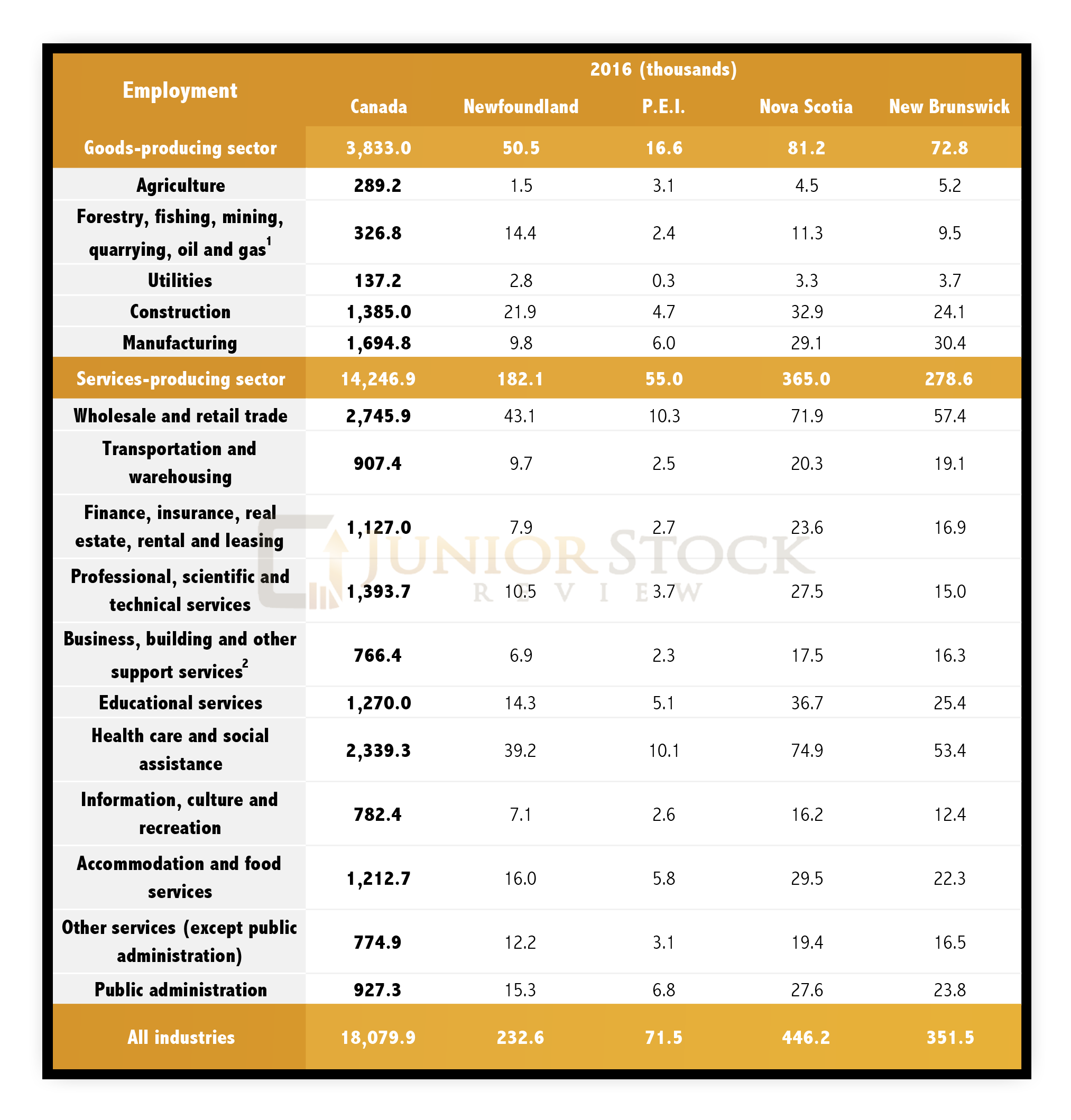
Adventus Zinc is a young company, having just completed its IPO in February of this year. Interestingly, it also has a great list of strategic shareholders, which includes Altius Resources Inc., Resource Capital Funds, Greenstone Resources, John Tognetti and Equinox Funds. Adventus has 10 projects in both Newfoundland & Labrador and Ireland, two premier mining jurisdictions; ones which I believe are only going to get more attention from the mining industry in the years to come. Check out the interview to get a good overview of the company.

Disclaimer: The following is not an investment recommendation, it is an investment idea. I am not a certified investment professional, nor do I know you and your individual investment needs. Please perform your own due diligence to decide whether this is a company(s) and sector that is best suited for your personal investment criteria. Junior Stock Review does not guarantee the accuracy of any of the analytics mentioned in this podcast. I do own Adventus Zinc Corp. shares. I have NOT been compensated to do this podcast.


Posted on

The Nickel Market: Investing Ahead of the Crowd – Part 2

Nickel Consumption By Use

In Part 1 of this report, we discussed the nickel supply fundamentals and identified important factors that can help to indicate where nickel supply is headed. To refresh your memory, here are a couple of the most important factors:

  • The partial Indonesian ban on nickel exports should continue as the country looks to develop its smelting industry.
  • The Philippines have suspended or closed roughly 50% of its annual nickel production due to environmental concerns. In 2016, the Philippines were the world’s largest nickel producer, given the current direction of government policy, and the fact that their nickel output is down 24% year-over-year in 2017, this will not be the case in 2017.
  • Analysts from Scotia and RBC Capital Markets expect nickel supply to grow at 2% per annum until 2020.
  • Total global nickel inventories are trending downwards, falling 15% to below 500,000 tonnes, since hitting a high in April of 2016.

Nickel Supply Versus Demand

Source: RBC Capital Markets

Let’s take a look at nickel demand, by first examining the refined production, which includes LME-grade nickel and host of intermediate nickel products such as NPI, nickel concentrate, ferronickel, nickel sulphate and more.


The Refined Nickel Supply

Nickel Refined Supply

Source: RBC Capital Markets


The global refined nickel supply for 2016 was around 1.9 million tonnes, which was 48,000 tonnes below the global demand. Of the 1.9 million tonnes of refined nickel, 44% is produced by former Eastern Bloc countries.  Given their less stringent environmental laws and overall lower cost structure, the former Eastern Bloc countries dominate the nickel ore refinement industry.

The global refined nickel capacity is estimated to be around 3.2 million tons. Putting it into perspective, current mine production is sitting at around 2.25 million tons, which is roughly 30% of the global refined capacity. However, note that the bulk of the capacity is in China and their figures, in my opinion, should not be taken as 100% valid.

The future of the global refined nickel industry will be shaped by a few key developments over the coming years.


Indonesian Ban and its Effect on Refinement

As discussed in Part 1, the global landscape for refinement changed in 2014 when the Indonesian government banned the export of its nickel ore in favour of promoting investment in refinement facilities within its borders.

Indonesia’s nickel refinement capacity has spiked dramatically since 2013, moving from around 10,000 tons in 2013 to over 100,000 tons in 2016. This new capacity mainly replaces capacity in China, as China’s refined nickel production has fallen by around 7% since the export ban.


The Environment vs. Metal Refinement

Currently, China has suspended the use of heavily polluting smelting operations in both the nickel and zinc industry. This is proof that air quality is becoming a leading political issue, even in states which typically buck the current political trends of the rest of the world. Time will tell how this will play out in the nickel market, especially in the face of what looks to be growing demand.

Interestingly, much of the nickel demand in the future is projected to come from electric vehicles (EV). The irony of the EV movement, in terms of it being non-carbon emitting, is the fact that the vast majority of the materials which make up the EV are all mined and refined, which is exactly what some countries are trying to curtail. I suppose you can’t have your cake and eat it, too.


Nickel Production Cost Curves

A cost curve is a graphical analysis which plots production capacity versus the costs of the entire industry. The cost curve is an important piece in the analysis of commodities as it allows the curious investor to see how the current spot price of the chosen metal fits in with the current cost of production across the sector.

Companies that find their cost of production in the lowest quartiles of the cost curve are those least likely to be affected by low spot prices. The nickel market has been plagued with low spot prices for a number of years, due to excess supply, but as we saw last year, this is changing.

RBC Capital Market’s cost curve for the nickel industry reveals that the 75th percentile of the industry’s cash cost is $5.05 USD/lbs, meaning that 25% of the world’s nickel producers will have negative cash flows as a result of $5.05 USD/lbs spot price.

Generally, for a healthy market, analysts look to the 90th percentile of the cost curve to suggest an sustainable price. In terms of the nickel market, the 90th percentile represents a cost of production of $7.85 USD/lbs.

Compared to today’s nickel spot price of around $5.17 USD/lbs, that is a 50% increase to reach a level in which 90% of producers will be able to produce nickel at a profit.


A Conversation with Martin Turenne

As in Part 1, I had the chance to ask FPX Nickel Corp. CEO, Martin Turenne, a series of questions pertaining to the global nickel market. Highlights from our interview will be shared throughout the report.

FPX Nickel Corp.

FPX Nickel Corp. (FPX:TSXV)

MCAP – $16.1 million CAD (at the time of writing)

CEO – Martin Turenne


Question #1

Brian: In every industry, the success of a company or sector is based around the delta between the cost of production and the selling price, or more simply, the amount of profit. Given that the current nickel price is roughly $5.17 USD/lbs, roughly 25% of the nickel industry’s producers are not making money.

In your opinion, what are the 3 biggest factors affecting the nickel spot price, and will their resolution lead the nickel spot price up to what many analysts believe is the key long-term price for nickel producers, roughly $7.85 USD/lbs?

Martin: The overall theme driving the price higher is the fact that nickel demand is exceeding supply, and will continue to do so well into the 2020s. The first reason for that is strong demand growth. In 2016, nickel demand was 6% higher than the previous year, which was by far the highest demand growth among the major base metals. I expect to see continued demand growth in that range for the next several years.

The second reason has to do with nickel supply growth, which is going to be relatively weak. Because nickel has been so badly beat up, and because there has been so little investment in nickel exploration and development, there just aren’t many new projects which can be brought into production in the next five to eight years. I’d argue this is a more acute issue for nickel than it is for metals like zinc and copper, which have attracted far more capital in recent years.

Finally, I think you will see operating costs increase in the coming years. In the past several years, operating costs in the mining industry have been declining mostly due to a strong U.S. dollar and lower energy costs. Going forward, a decrease in the U.S. dollar or increase in oil prices will lift the nickel cost curve, and thus lift the nickel price.

Nickel Demand

So far, we’ve covered the global nickel mine supply/production figures and also taken a look at global nickel refining numbers and the factors affecting their markets. The last piece of the puzzle is nickel demand, the how and why it’s used in society and where I believe it’s headed.

It isn’t a stretch to say that nickel is one of the most important industrial metals in the world. It’s used in construction, power generation/storage, food preparation, cell phones and vehicles. Nickel has a unique blend of properties such as corrosion resistance, high strength, and toughness.


World Nickel Consumption

Nickel Consumption By Use

Source: RBC Capital Markets


Question #2

Brian: 2/3 of refined nickel is consumed by stainless steel, the remainder is broken down into much smaller demand sources. This demand pattern has existed for refined nickel consumption for a while now.

How do you view the future of refined nickel demand? Will stainless steel still be the dominant consumer or are there other sources of consumption which may begin to play a bigger role? Please explain.


Martin: Among all the major base metals, nickel had the best growth profile in 2016, with demand rising 6% compared to 2015 demand. Going forward, analysts are predicting annual demand growth in the 2-3% range, which in my view is too conservative. Stainless demand will continue to play a dominant role in nickel, but the growth associated with electric vehicle (“EV”) batteries will be the big story over the next decade. Right now, EV battery nickel demand is approximately 70,000 tonnes per year, or only about 3% of total nickel demand. Going forward, Roskill predicts that number could reach 400,000 tonnes per year by 2025, which implies an average demand growth rate of 2% per year for nickel from EV battery demand alone. From today’s levels, I can see nickel demand growing 5% per year for the next several years, which would likely push the nickel price well above the current consensus number.


Stainless Steel

As you can see, 2/3 of refined nickel is used in the production of stainless steel, while a further 15% is used in the manufacturing of other ferrous and non-ferrous alloys.  Stainless steel is an alloy of traditional steel and the combination of nickel and chromium, typically with 8 to 12 percent nickel content.

Stainless steel’s uses are numerous, ranging from cookware to appliances, building materials and high-tech applications. The stainless or corrosion resistant properties are homogenous or consistent across the entire section of steel, giving it a huge advantage against the other corrosion resistant materials which are mainly coatings.

From a food preparation or eating perspective, there currently isn’t any other material that can withstand the temperature ranges, pHs, bacteria exposure or repeated usage like stainless steel.  Utensils, cookware, appliances and food prep surfaces all use stainless steel as the preferred material of choice.


The Use of Stainless Steel in Marine Infrastructure Construction

Stainless steel may get a huge boost in the near future as a few of the southern States (US) look to increase the grade of rebar used within all of their marine construction. For those who don’t know, my background is in steel manufacturing. I was General Foreman of operations at a rolling mill which produced rebar, angles, channels and flats.

Typically, concrete / rebar construction is designed with a 25 to 50 year life span, however, marine construction, in particular, has come under scrutiny for not being robust enough, which has prompted some States to look at increasing the construction specifications for the materials used in marine construction. For rebar, this means higher grade requirements and possibly being restricted to only corrosion resistant steel.

Currently, epoxy coated rebar is used for applications that require corrosion resistance, however, epoxy coatings have been known to crack, allowing for moisture to begin its oxidation of the steel.

Also, galvanized steel is an option for this application, as it, too, provides a corrosion resistant coating to the rebar. However, like the epoxy coating, it’s susceptible to wear and damage and a worn or damaged zinc layer leaves the under body of the steel product  vulnerable to moisture.

Without a doubt, construction is moving toward more stringent regulations for the structures being built in our cities. I believe one of the big winners of this movement will be the strong corrosion resistant materials, which are headlined by stainless steel.


Electric Vehicles

Arguably the largest catalyst for a major increase in nickel demand is the rise of electric vehicles or, more specifically, the use of batteries in our vehicles. As we discussed in the factors affecting the mining and smelting of nickel, the environment is a major political issue, one that is currently centred around clean air.

Governments around the world are pushing us toward a goal of reducing the amount of carbon we emit into the atmosphere. One of the first industries to feel this disruptive wave is the automotive sector, which has seen government subsidies for electric vehicles (EV) propel companies such as Tesla into the forefront of both the automotive industry and popular culture.

The culmination of these events has sent all of the other major automotive companies spinning as they try and catch up to a growing segment of the market.


Batteries

While nickel is used in a variety of ways in vehicles, by far its biggest use is within an EV, where it’s used in the batteries.  Currently, the misnomer is that a lithium ion battery is primarily made up of lithium, but the fact is, it isn’t. Lithium ion batteries contain more nickel, cobalt and manganese than they do lithium.

Nickel’s current use within the EV market is very small, especially when compared to global nickel demand. However, it’s the potential that we must gauge when it comes to nickel demand in batteries, not the EV market’s current consumption.


Lithium Ion Batteries

Depending on the application, currently, what makes up the cathodes for the most common lithium Ion battery is nickel, manganese and cobalt (NMC), or nickel, cobalt and aluminium (NCA) and an anode typically composed of graphite. To note, the cathode does contain other materials such as lithium, but in smaller quantities than the big 3.

For those unfamiliar with how batteries work, here’s a quick summary; there are three basic components to most batteries: cathode, anode and electrolyte. A chemical reaction causes a charge difference between the anode and cathode. This charge difference allows the electrons (electrical current) to flow between the anode and cathode and, in the process, the electrical current powers the piece of equipment to which the battery is attached.

A number of sources, including the Battery University, confirm that the NMC battery is the battery of choice when it comes to power tools and other electrical power trains. The cathode chemical composition is chosen on 4 key criteria: stability of materials, energy density, specific energy and cost.

Today, NMC batteries are typically found with compositions of equal parts, denoted 1-1-1, but have started to be made in ratios as high as 8-1-1. Due to higher cobalt prices and security of supply, the percentage of nickel is beginning to move higher.

Interestingly, depending on the applications, cobalt can be reduced and still maintain acceptable performance, as the higher percentage nickel batteries have higher energy densities and longer life spans, although, they produce a lower voltage.

Lastly, it should be noted that roughly only 50% of the current nickel mine supply is suitable for battery use, as the low-grade nickel products are inadequate for battery manufacturing. Given that nickel mine supply growth is mainly in NPI and FeNi, which are low grade products, it would appear that available supply for the emerging battery market is fixed at its current production rate. Considering this fact, it is apparent that a growing battery sector will certainly have an effect on the nickel market.


Projected Nickel Demand Via EV Batteries

Worldwide, Statista says that since 2014, on average, there have been 73.7 million cars sold each year. According to Inside EVs, in 2016, 777,497 EVs were sold worldwide. Considering that just 5 years previous only 17,425 EVs were sold, this gives us a Compound Annual Growth Rate (CAGR) of 88.33%.

Therefore, using the EV CAGR and projecting out until 2021, you get a demand of 18.4 million electric vehicles.

Now that we have determined the possible future demand for EVs, it is possible to calculate the amount of nickel which these EVS will require. To do this, I will use a figure published by Glencore on their twitter account, which states that,

“Every new #electricvehicle – from its motor & batteries, to the charging point will need c.160kg of copper, 11kg of cobalt & 11kg of nickel.” ~ Twitter – Sept. 7, 2017

Clearly Glencore is using a NMC battery configuration of 1-1-1, which I believe should give us a conservative estimate of future nickel demand.


Therefore, if 18.4 million EVs are sold in 2021, the amount of nickel demand is calculated by:

18.4 million EVs x 11 kg Ni/EV = 202,400,000 kg of Ni

202.4 million kg of Ni x 1/1016.05 kg = 199,203.4 tonnes of Ni

199,203.4 tonnes of Ni / 1,957,000 tonnes of Ni (2016 mine production) = 10% of 2016 mine production


This is just a rough calculation with a couple assumptions, however, it does give us perspective on how powerful and disruptive this clean air policy trend can be.  If the nickel market was hit with 199K tonnes of high grade nickel demand in the next few years, it would put tremendous pressure on the market, and in my opinion would result in higher nickel prices.

Dramatic price spikes in the nickel spot price will cause battery manufacturers to look for alternatives to nickel. This won’t happen overnight, but it’s pertinent to expect battery improvements along the way that may reduce or eliminate the amount of nickel used within the battery composition, just as manufacturers are reducing the cobalt portion of the batteries to compensate for higher cobalt prices.


Concluding Remarks


Question #3

Brian: Putting it altogether, there are a few key aspects of the nickel market which need to be watched in order to gauge where the nickel market is headed in the near term. That said, still contend that the future is bright for nickel.

Can you give us one final concluding comment on the nickel market, how you believe the narrative plays out and, ultimately, where the nickel market is headed in the next 12 months?


Martin: The spot price has made a huge move since mid-June, going up 35%, but since the base metals marked their bottom in January 2016, nickel is still lagging the price moves made by copper and zinc. Going forward, I expect to see nickel continue to play catch-up with those metals, largely because demand continues to exceed supply by a large margin. If we assume continued, steady mine production from Indonesia and the Philippines, the nickel market will continue to be in deficit and the spot price should be supported. But, if we see any further actions to restrict production in those countries, there’s potential for another explosive move upward. In either case, FPX Nickel is very well-positioned to capitalize on an increasing spot price with the ongoing advancement of our Decar project in British Columbia, which we believe is the finest development-stage nickel asset in the world.


It’s my contention that nickel will continue to play a major role in our everyday lives, as its uses continue to grow. Let me summarize my thoughts in a few key points:

  • Watch the actions of the Philippine government closely, as their choice to ban nickel ore exports and/or suspend/close mining operations within its borders will have major implications on the nickel ore supply.
  • Government environmental policy, particularly that associated with air pollution, will affect the nickel market in two ways: First, it will constrain supply as both the Philippines and China suspend/close operations. Second , it will create demand for nickel via the emerging EV automotive sector.
  • Infrastructure building regulations will only get more stringent as government looks to extend the life spans of their structures past 50 years. Corrosion resistant steels will play major roles in this trend, with stainless steel leading the pack.
  • Current nickel spot prices leave 25% of the nickel producers in negative cash flow. If this trend continues, producers will go out of business and supply will fall further. A rise in the nickel price isn’t necessarily imminent, but it’s inevitable.
  • Global nickel inventories are falling, but are still high relative to current production. Watch for continued drops in inventory levels, as it is my guess that the Philippine government will move forward with their decision to ban nickel ore exports.
  • High-grade nickel demand is set to grow in the future, as the EV market continues to grow worldwide.

While there are a few key aspects to watch, I still contend that the future is bright for nickel and will be looking for opportunities to invest ahead of the crowd.


Until next time,


Brian Leni  P.Eng

Founder – Junior Stock Review


Disclaimer: The following is not an investment recommendation, it is an investment idea. I am not a certified investment professional, nor do I know you and your individual investment needs. Please perform your own due diligence to decide whether this is a company(s) and sector that is best suited for your personal investment criteria. Junior Stock Review does not guarantee the accuracy of any of the analytics used in this report. I do own FPX Nickel Corp. shares. I have NOT been compensated to write this article.


Posted on

Anaconda Mining – An Undervalued Gold Producer on Canada’s East Coast

Anaconda Mining

With turmoil ramping up around the world in recent weeks, from Hurricane Harvey wreaking havoc in Texas to the mounting discord between North Korea and the United States over missile testing, and a weakening U.S. dollar, the price of gold pushed up over $1300/oz USD.

A rising gold price and the end of the summer doldrums could spell the beginning of the next leg up in the gold bull market. For those looking to profit in this next wave, today I have a gold producing company which is set to be re-rated in the coming months.

This company is Anaconda Mining, a gold producer with its flagship property, The Point Rousse Project, on the Baie Verte Peninsula in Newfoundland & Labrador. Looking out to 2020, the company’s short term goal is to significantly increase their gold production up to 50,000 ounces per year. Through further project acquisitions in Atlantic Canada which have NI 43-101 resources, and the development of Anaconda’s existing projects, they hope to leverage their team’s mine building experience and existing Point Rousse Project infrastructure, Pine Cove Mill, port and in-pit tailings facility, to push them towards their long term goal of becoming a 100,000 ounce per year producer.

Here is an executive summary of my conclusions on Anaconda, which will be followed by my in-depth analysis of the company.

  • Led by CEO, Dustin Angelo, Anaconda has a great team of professionals who are looking to take the company to the next level.  The Goldboro Project acquisition and further acquisitions in the future will cement Anaconda’s reputation as a premier gold producing company.
  • Anaconda Mining’s assets are located in Canada, more specifically, the provinces of Newfoundland & Labrador and Nova Scotia. These are premier destinations for mining as they present a stable political landscape and world-class geology.
  • Anaconda achieved gold sales totalling 15,562 ounces in the fiscal year ended on May 31, 2017. The gold was produced from the cash flowing Point Rousse Project, which includes the Pine Cove Mill and Mine.
  • Existing 43-101 Measured & Indicated + Inferred Resource Total of 1.1million ounces of gold
  • Anaconda Mining’s EV/Oz is well below similar gold companies developing properties on Canada’s east coast.
  • PUSH: Anaconda will be drilling Goldboro this fall, with the intent of both expanding the resource and shoring up the existing deposit. Watch for these drill results.
  • PUSH: A PEA on the Goldboro Project will be completed by the end of this year, giving us a clear picture on the project’s potential profitability.


Anaconda Mining (ANX:TSX)

MCAP – roughly $28.6 million CAD (at the time of writing)

Cash – As reported in Anaconda’s news release dated August 2017, reflecting fiscal year end on May 31, 2017 – $2.5 million CAD

Shares – 382.0 million – NOTE: On May 8, 2017 Shareholders voted to give management the right to consolidate shares – 0.25 to 1. The Board of Directors has discretion to implement a consolidation within 12 months.

Stock Options – 33.0 million

Warrants – 34.0 million

Fully Diluted – 449.0 million

Officers & Directors’ Ownership – 7.8%


Anaconda’s People

Since taking the helm of Anaconda Mining in 2010, CEO, Dustin Angelo, has eliminated the company’s interest bearing debt and funnelled cash flow towards the development of its Point Rousse Project and further expansion of their land package, increasing it ten-fold over the last 6 years.  The Goldboro Project, Anaconda’s most recent acquisition under Angelo, is the most aggressive to date, adding much needed gold resource ounces to Anaconda’s books.

Previously, Angelo held senior level management positions with Waller Capital Corporation, MHI Energy Partners and Elgin Mining Incorporated. These positions have given him a great base of knowledge and experience to draw on, as he leads Anaconda Mining into a major stage of growth, during what looks to be one of the biggest gold bull markets in history.

Also to note, Angelo is an accountant by trade, earning a BSBA in accounting and international business from Georgetown University and a MBA from the Columbia Business School.

Speaking from experience and a little bit bias, operations are the heart of any mining or manufacturing company.  Let’s take a look at who is leading operations for Anaconda.

At the top of operations is COO, Gordana Slepcev. Slepcev, prior to her promotion, was VP of Technical Services, managing the mining and geology departments at the Point Rousse Project. Now in her new position, she is responsible for all operational aspects of the company, including permitting, mine development,  strategic planning, project evaluation, and also delivering long/short-term planning and geological support to mining operations. Slepcev is a professional mining engineer and has prior working experience with Labrador Iron Mines Holdings, Agrium Inc., and Western Coal Corporation.

Next is Anthony Chislett, Operations Manager for the Point Rousse Project, managing all aspects of the milling and mining operations. The Pin Cove Mill will be counted on in the future to process ore from Anaconda’s other projects and still maintain a high level of efficiency in its recoveries. Chislett and those who operate the mill will be strong contributors in the near future as they get set to incorporate Goldboro’s ore. Chislett has a Certificate in Civil Engineering Technology and over 26 years of work experience over his career.

Additionally, Robert Dufour is the CFO, Allan Cramm is VP of Innovation & Development, Paul McNeill is VP of Exploration, and Lynn Hammond is VP of Public Relations.


Anaconda’s Board of Directors

Anaconda’s Board of Directors has a great balance of experience, with members who have strong resumes in both the geological and financial sides of the mining industry. Here is a quick look at the board members:

John Fitzgerald is the Chairman of the Anaconda Mining Board of Directors and former Chairman and CEO of Orex Explorations. Fitzgerald’s expertise in finance comes from 25 years in the investment banking industry. Also, he has been a member of or advised a number of different companies including Boston Poly Corporation, Epcylon Technologies, DayStar Technologies, Hesat Acquisition Corp., iSense Corporation and Trustwater PLC.

Michael Byron is a board member and also the CEO of Nighthawk Gold, a gold exploration company, exploring the Indin Lake Greenstone Belt in the Northwest Territories. Byron, a geoscientist, has been in the mining industry for over 30 years and brings  with him plenty of geological technical expertise to the Anaconda Board.

Additionally, on the geological technical side, is Kevin Bullock, a registered Professional Mining Engineer with over 25 years of experience in the mining industry. Currently, Bullock is the CEO of Golden Reign Resources and has held senior positions at a number of other junior mining companies, including being a Director at B2Gold.

On the financial side of the Board are Maruf Raza,  Jacques Levesque, and last but not least, Anaconda’s CEO, Dustin Angelo.


Newfoundland & Labrador and Nova Scotia

The bulk of Anaconda Mining’s assets, Point Rousse Project, Viking Project, Great Northern Project and Tilt Cove Property, are located on the island of Newfoundland in the province of Newfoundland & Labrador.  The Goldboro Project, their most recent acquisition from Orex Exploration, is located in Nova Scotia.

Both Newfoundland & Labrador and Nova Scotia are provinces located on Canada’s east coast. Both provinces have a long history of mining but have recently seen a staking rush, particularly on the island of Newfoundland.


Newfoundland & Labrador

I recently wrote an article about Newfoundland & Labrador and why I think it is a premier destination for our mining investment dollars; for the full article follow this link. Otherwise, here is a list of my summarized thoughts regarding Newfoundland & Labrador:

  • Newfoundland & Labrador’s geology has long been associated with base metals such as iron ore and nickel, however, I think this is quickly changing as a number of precious metals companies look to explore and develop some highly prospective properties. Compared to the rest of Canada, NL is under explored, especially for precious metals, such as gold.
  • Newfoundland & Labrador encourages mineral exploration within its borders with the Junior Exploration Assistance Program (JEA). While the available funds in the program are small, it is a step in the right direction towards encouraging mining investment in Newfoundland & Labrador.
  • Newfoundland & Labrador has a workforce which is accustomed to heavy industry. With low oil prices hurting the oil fields of Alberta, many native Newfoundlanders are finding their way back to the island and, with them, comes multiple years of heavy industrial experience. As properties develop, there is both a workforce to fill the needed positions and the infrastructure to produce and export their goods.
  • The people of Newfoundland & Labrador have consistently voted for Conservative and Liberal governments since joining Canada in 1949. I expect this tradition to continue, which presents a stable political landscape for mining companies looking to explore and develop properties within its borders.
  • From an investment standpoint, First Nations’ involvement in the mining sector can cause trepidation for the investor. In Newfoundland’s case, this isn’t an issue, as the First Nations do not control any large blocks of land that are prospective for mineralization. NOTE, it is a different story for Labrador.


Nova Scotia

  • Since 2013, Nova Scotia has been led by Premier Stephen McNeil, a member of the Canadian Liberal Party. Historically, dating back to Confederation, the people of Nova Scotia have voted either Conservative or Liberal, however, it should be noted that they did vote NDP in 2009, by electing Darrell Dexter who is a member of the NDP Party. For those unaware, the NDP Party is typically cast as being bad for business, and given their history, this isn’t without cause. However, even though the past is typically prologue, we need to examine the policies of each incoming government no matter what their party affiliation, as they are all capable of introducing policy which is detrimental to mining. One thing to keep in mind, Nova Scotia’s unemployment rate is almost 9%, a government which would hinder job creation in the province’s current state wouldn’t last long.
  • In total, there are 16,245 registered Indians in Nova Scotia. The Indian population is represented by 13 band councils and 2 tribal councils, the Confederacy of Mainland Mi’kmaq and the Union of Nova Scotia Indians. The Mi’kmaq are the predominant Aboriginal group in Nova Scotia, with 13 communities across the province.
  • Nova Scotia has a long history of mining dating back 300 years. Gold, in particular, has played a big role in the Nova Scotia economy, with 3 separate gold rushes having produced over 1 million ounces gold since the 1860s.
  • Geologically, Nova Scotia is broken up into two main geological terranes. The Avalone Zone, which forms the northern half of the province, and the Meguma Zone which forms the southern half. The two zones are separated by the Cobequid-Chedabucto Fault Zone, which runs east to west. This fault zone represents where the two zones collided over 400 million years ago. The geology specific to Anaconda’s Goldboro can be found later on in this article.


Anaconda’s Properties

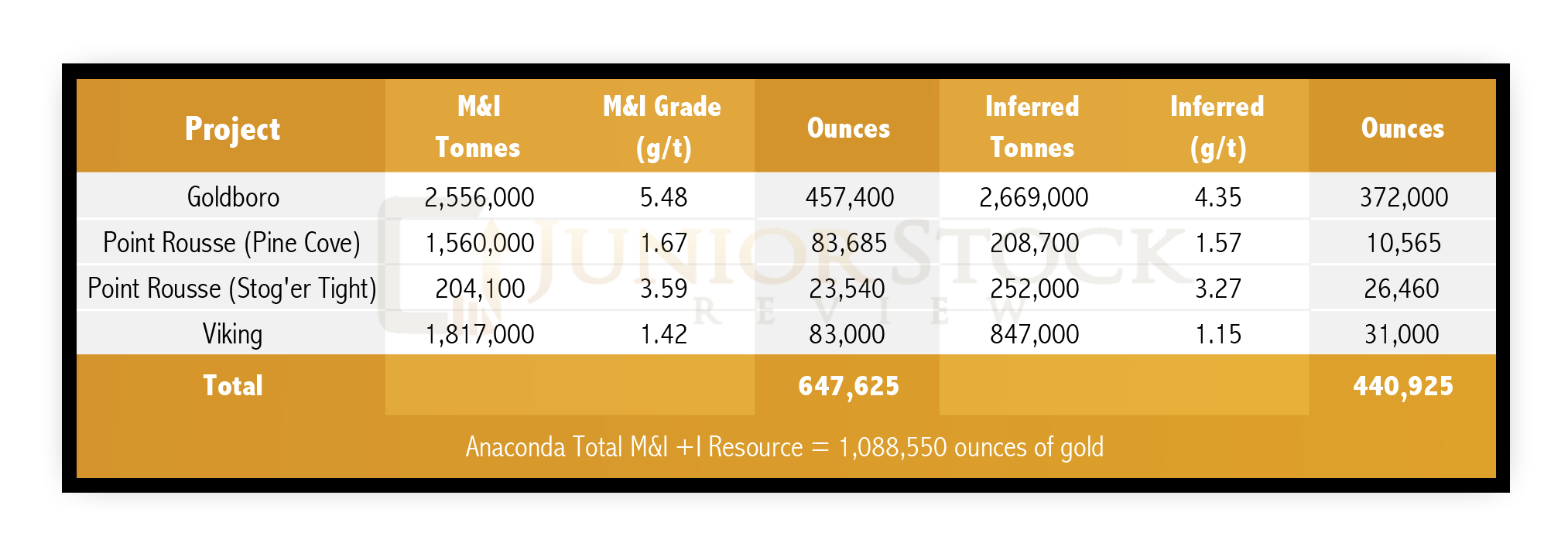
Anaconda Mining Total Resources

Source: Anaconda Mining Corporate Presentation – August 2017

The Point Rousse Project

The Point Rousse Project is Anaconda’s Flagship 6,300 hectare property and is located on the Baie Verte Peninsula which is on the north west coast of the island of Newfoundland in the province of Newfoundland & Labrador.

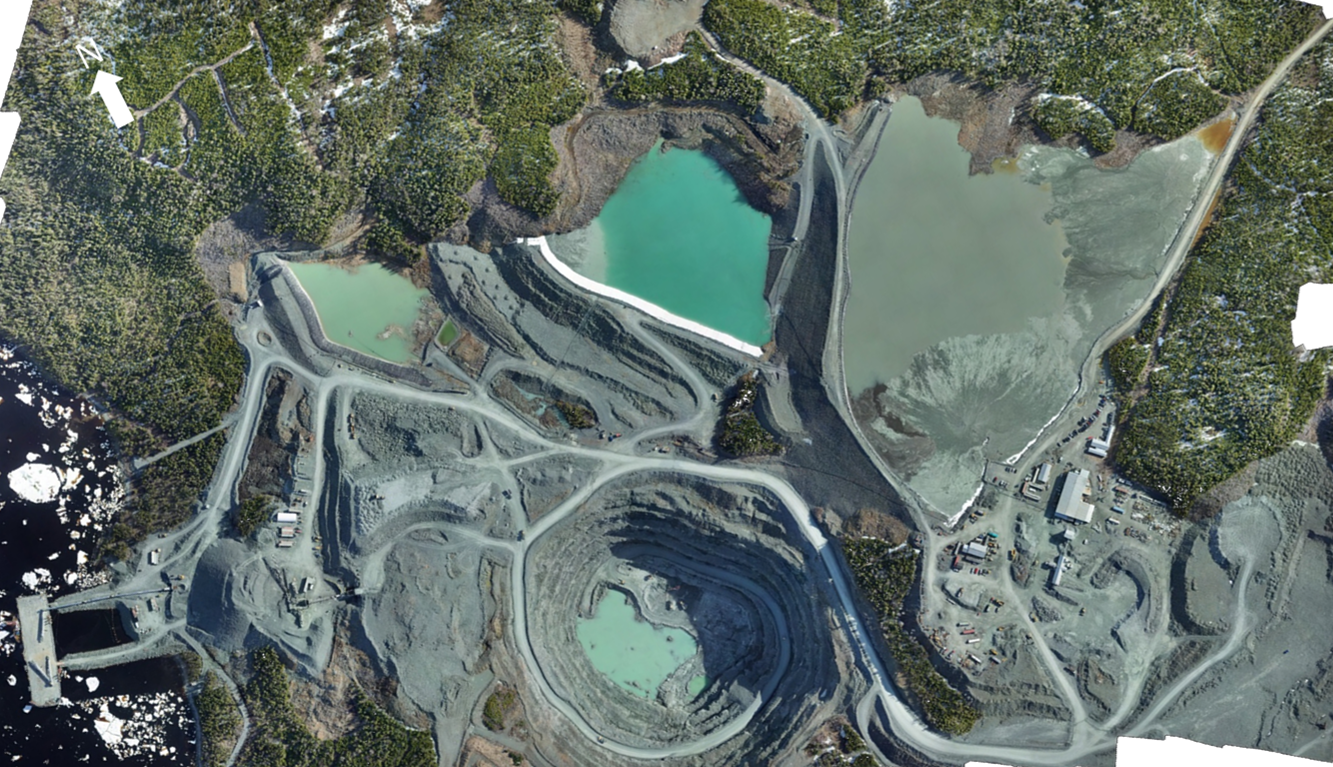
Aerial Map of Pine Cove Mill and Mine

Source: Anaconda Mining – Appendix Slide 1


The Point Rousse Project consists of the Pine Cove Mill and Mine, the Argyle Zone, the Stog’er Tight Deposit and Aggregates Project, all are located within 8 km of each other. The Project is underlain by Cambro-Ordocivian ophiolitic and cover-sequence rocks of the Point Rousse Complex, which is part of the Baie Verte Tract.

The Point Rousse Complex is host to both orogenic-style gold and volcanogenic sulphide mineralization. There are three identified mineralized trends within the Project: the Scrape Trend, the Goldenville Trend, and the Deer Cove Trend.


Pine Cove Mill and Mine

The Pine Cove Mill and Mine began producing in 2008, with commercial production achieved in September 2010.  To date, Pine Cove has produced 76,379.34 ounces of gold. In a news release dated August 25, 2017 Anaconda announced it fiscal year ending production figures which were highlighted by:

  • Pine Cove Mill increased throughput by 8% to 1,223 tonnes per day when compared to the 2016 fiscal year.
  • Operating cash cost per ounce sold was $1,126 CAD or USD $$856/oz and an all-in sustaining cost (AISC) per ounce of $1,735 CAD.  NOTE: Remember that AISC includes: CAPEX, Corp Admin and exploration expenses.
  • Additionally, the Pine Cove pit, generated $0.9 million CAD from the sale of waste rock.  Anaconda is working with Shore Line Aggregates and Phoenix Bulk Carriers to supply 3.5 million tonnes of construction aggregate using Anaconda’s waste rock from the Pine Cove Mine and Mill operation. The waste rock is transported via Anaconda’s Point Rousse Port Facility.

The Pine Cove Mine is an open pit design, which is designed to be 350 m wide by a maximum depth of 150 m by the end of mine life. The pit’s main access ramps are designed at a 10% gradient and are 15 m wide, facilitating two-way truck traffic. The pit rock is drilled and blasted and then loaded into haul trucks by excavators, which transport the ore to the crusher ROM Pad.

The future of Anaconda lays in the hands of the Pine Cove Mill, which operates as a grind/flotation circuit followed by leaching. The Mill will be counted on in future to process the ore generated by Goldboro and Anaconda’s other deposit on the island of Newfoundland.

Here is an excerpt from the 2015 Point Rousse Technical Report,

“The concentrator has a flotation circuit which produces a gold-pyrite concentrate that advances to the leach circuit. Comminution is via a two-stage crushing plant followed by a 10 ft by 14 ft primary ball mill. Cyclone overflow feeds the flotation circuit, with four unit cells for roughing and one cleaner cell. Mass recovery is typically 2-4 percent. Flotation concentrate is thickened in a 4.5 m diameter thickener and reground in a 5.5 ft diameter ball mill. Leaching is conducted in a series of four 70 cubic metre mechanically agitated leach tanks. Two drum filters and a Merrill-Crowe circuit are used for gold recovery from the pregnant solution. Cyanide destruction of leach tailings is achieved through the Inco SO2 process. The mill currently achieves 86-88 percent recovery.” ~ 2015 Point Rousse Technical Report – pg. 21

Anaconda has two tailings facilities and a polishing pond. The Tailings 1 storage facility had its final expansion in 2014, increasing its elevation up to 103 (msl). Additionally, in the last fiscal year, the Tailings 2 storage facility and new polishing pond were constructed on the property.


Stog’er Tight Deposit

The Stog’er Tight Deposit was originally discovered by Noranda Exploration Company in the late 1980s. Anaconda optioned the property from 1512513 Alberta Ltd. in 2012, with the intent of securing future supply for the Pine Cove Mill.

Anaconda has since worked on evaluating the deposit’s potential, by the verifying of historic drill data with the completion of nine twinned diamond-drill holes. Anaconda’s work indicates that other similar prospects lay adjacent to the Stog’er Tight Deposit and may represent an expansion of resource for the area.

Currently, the Stog’er Tight Deposit is estimated to contain Indicated Mineral Resources of 204,100 tonnes grading 3.59 g/t gold for a total of 23,540 ounces and an Inferred Resource of 252,100 tonnes gtrading 3.27 g/t gold for a total of 26,460 ounces, both using a cut-off grade of 0.8 g/t gold.

As mentioned in the August 25, 2017 news release, CEO, Dustin Angelo, states,

“Looking ahead to 2018, the Company is projecting to produce and sell approximately 15,500 ounces of gold.  Production in the first three quarters will be from the Pine Cove Pit, and will transition to the Stog’er Tight pit early in the 2018 calendar year.”


Argyle Zone

The Argyle Zone is a highly prospective zone located immediately northwest of the community of Ming’s Bight.  The Argyle Zone has seen a reconnaissance soil survey in 2012, with a total of 364 samples collected at 25m intervals. These samples returned some impressive assay values, highlighted by 112 samples assayed 25 ppb gold or greater to a maximum of 4.88 g/t and several pieces of mineralized float returned assay values of up to 9 g/t gold.

The property has since seen additional exploration work including an airborne magnetic survey, trenching and drilling. The trenching revealed strongly-altered, quartz-veined and pyritized gabbro. Highlights of the trenching include 3.75 g/t gold over 16 m and 1.49 g/t gold over 3.5 m. While a total of 5,000m of drilling has been completed on the zone, which is highlighted by 3.63 g/t gold over 12m, 5.52 g/t gold over 12m, and 9.31 g/t gold over 6m.

Argyle remains a highly prospective Zone within a stone’s throw of the Pine Cove Mill; it will need additional exploration to fully understand its potential.


The Goldboro Project

Anaconda’s Goldboro Project is located on the north east coast of Nova Scotia and consists of 37 mineral claims on 600 hectares. The main portion of the Goldboro property is accessible year- round via Highway 316 on a 2.5 km gravel road, with the other more obscure parts of the property having access via logging roads.

Highway 316 connects Goldboro to the nearest full service town of Antigonish, which sits approximately 75km to the north west. The capital of Nova Scotia and home to the province’s international airport, is Halifax, which sits 250 km to the south west.

Arguably the most important available access to the property comes from Isaac’s Harbour, a tide water port which is key for Anaconda’s plan to transport Goldboro’s ore back to their existing Pine Cove Mill in Baie Verte, Newfoundland & Labrador. Also, to note, a larger deep water port is located 60 km north east, in the Strait of Canso Superport.


Goldboro Infrastructure

The property has access to power and has existing buildings, a tailings pond, a settling pond and some advantageous underground workings.

Goldboro’s existing underground infrastructure includes a vertical shaft from surface down to the old 400 ft level and an inclined shaft from the bottom of the vertical shaft, running down plunge of the anticline fold axis of the main Boston-Richardson Belt down to the old 700 ft level. Also, there are several drifts which could possibly be used for future exploration, along with some minor workings in the East and West Goldbrook zones.


Goldboro’s History

The Goldboro property has a long history, dating back to 1862 when mineralization was first found, and then 1893 when mining began. In the 17 years that it was mined, it produced roughly 55,000 ounces of gold at an average grade of 4.5 g/t.

Modern exploration began on the property  with Patino Mines Ltd in 1981. Further work was completed on the overlying claims by Onitap, who completed diamond drilling, airborne VLF-EM and magnetic surveys and ground based IP surveys.

In 1988, Orex Exploration purchased the property from Onitap. Over the course of the next 26 years, Orex developed the property with further drilling and the refurbishment of its existing underground infrastructure, but also optioned the property to Placer Dome.

In 1995, Placer Dome optioned Goldboro with the objective of determining whether the property could be mined as an open pit operation. To determine this, they would focus on exploring for low-grade gold mineralization in the Boston-Richardson arenite or hanging wall sequence in the range of 0.5 g/t to 1.0 g/t.

Placer Dome was unsuccessful in their pursuit as they let their option on the property expire. They are quoted as saying,

” the property did not meet corporate requirements with respect to large open pit mining opportunities” ~ 2014 Goldboro PEA – pg.63

In 2010, Orex and Osisko formed a joint venture partnership for the exploration of Goldboro. Together, they drilled 59 NQ-sized drill holes with a combined length of close to 13,000m. The data from the drill program provided in-fill data to the property drillhole database.


Goldboro Gold Mineralization

Goldboro is entirely underlain by sedimentary rocks of the Goldenville Group, which are made up of greywacke, arenite and slate. Gold mineralization is found in quartz veins and within disseminated sulphides in the wall rock.

From the 2014 Goldboro PEA,

” Gold mineralization at Goldboro occurs in quartz veins and wall rocks adjacent to the veins. At the deposit scale, the veins form a swarm and are clearly located in the flexure zone (hinge and adjacent limbs) of the Upper Seal Harbour anticline. The gold-bearing veins are found in a 140- to 160-m wide envelope centred on the axial surface. The veins occur mostly on the limbs of the fold, but also in the hinge, and all are hosted by turbiditic metasedimentary rocks consisting of metagreywacke, arenite and slate.” ~2014 Goldboro PEA – pg.51


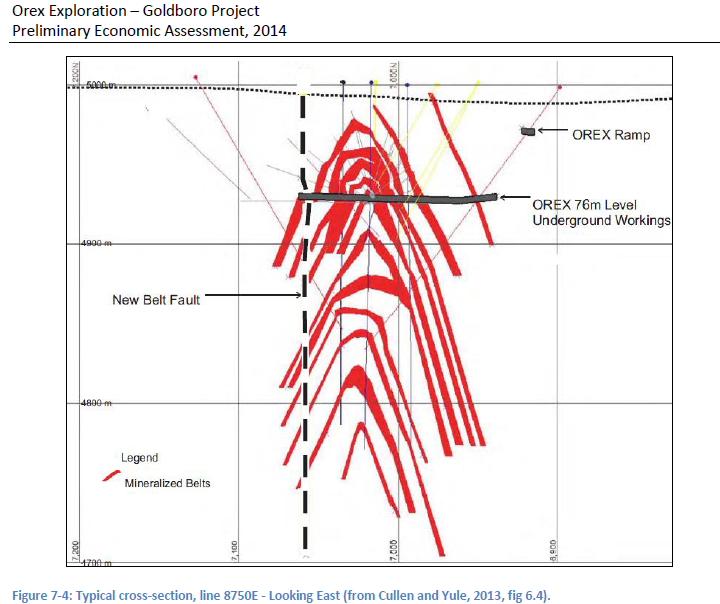
Goldboro Deposit Cross-Section

Source: 2014 Goldboro PEA – pg.48

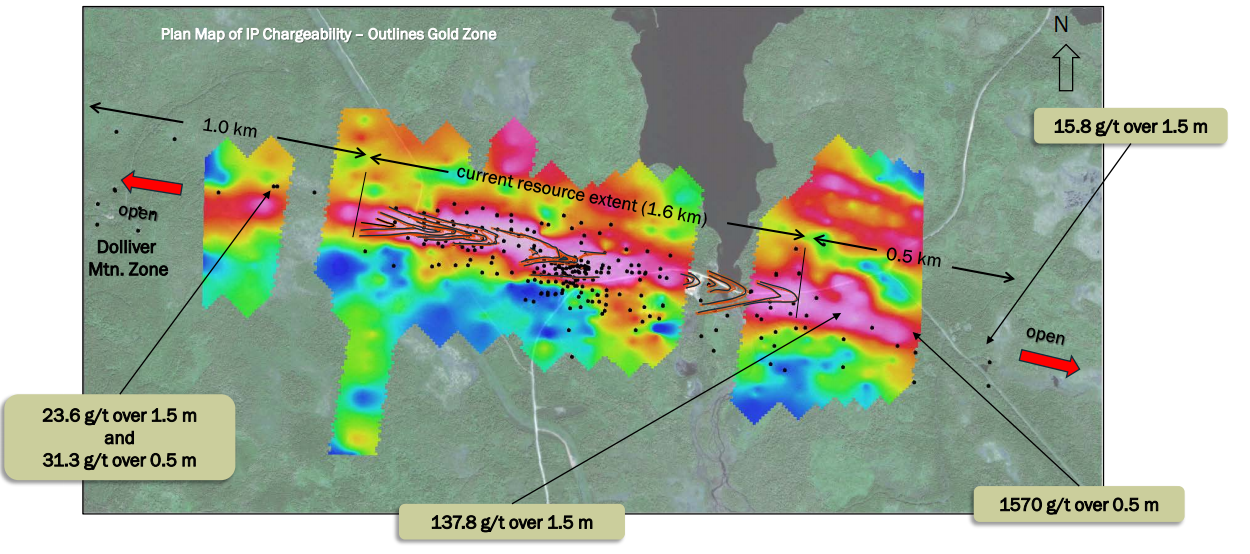
Goldboro’s deposit is broken down into three main areas, the Boston-Richardson gold system and the East and West Goldbrook gold systems. Currently, the deposit’s known strike length is 1.6 km and is associated with a geophysical anomaly. This anomaly extends east and west beyond the current known strike length of the deposit.

Goldboro IP Chargeability Map

Source: Anaconda Mining – Slide 14

The IP anomaly and the fact that historical drill results from those prospective areas east and west of the known strike length, led Anaconda geologists to believe that there is potential to expand the Goldboro Deposit east and west along strike.

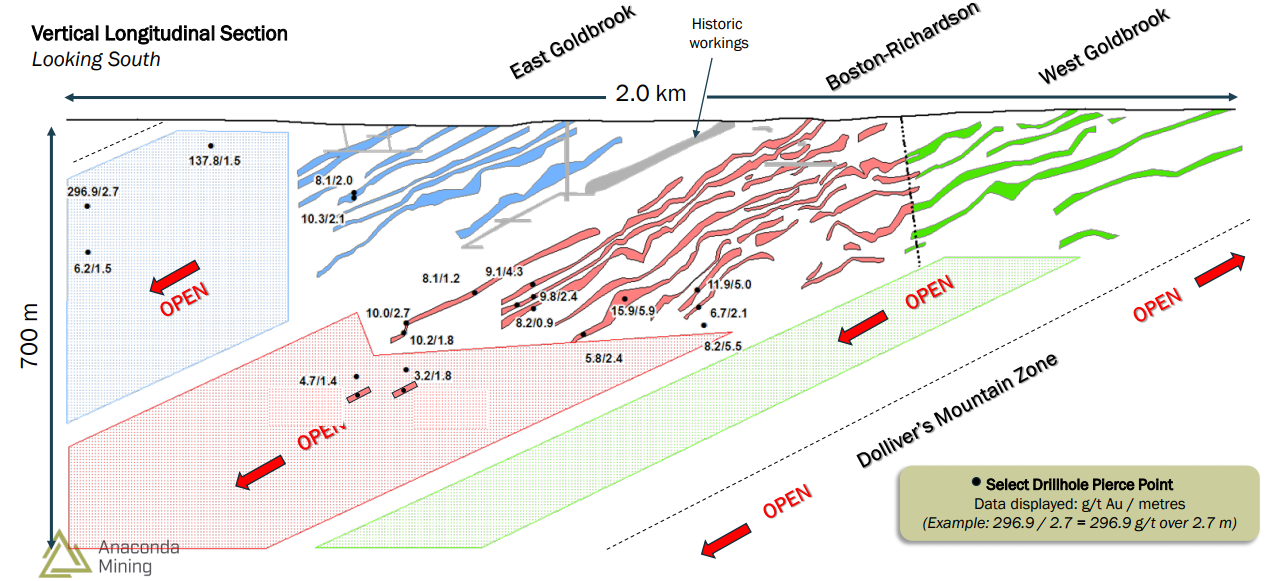
Goldboro Deposit Vertical Longitudinal Section

Source: Anaconda Mining – Slide 13

PUSH: Anaconda plans to drill Goldboro this fall, with the intent of both expanding the resource and shoring up the existing deposit.

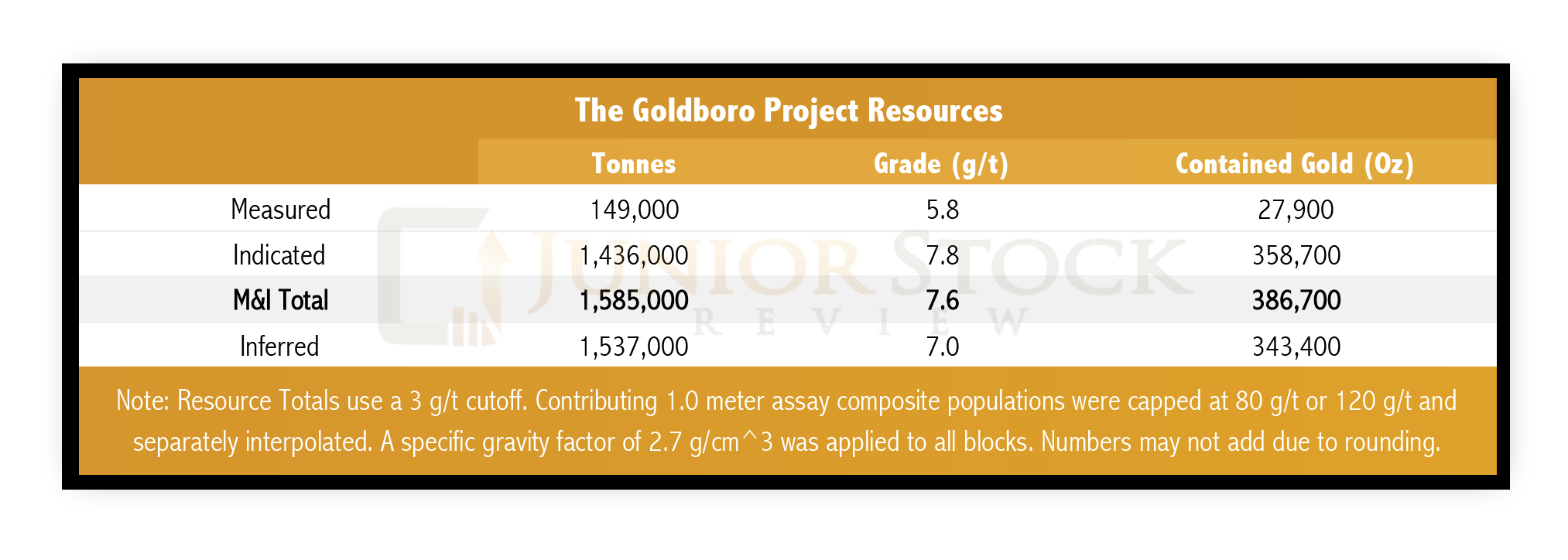
Goldboro Resource

Source: 2014 Goldboro PEA – pg.13


Boston-Richardson Gold System

As described earlier in the article, the Boston-Richardson (BR) gold system was the first mineralization discovered and mined on the property, along with being the host of the existing underground infrastructure.

The BR Belt is host to 15 tightly-stacked, high-grade, gold bearing vein zones. The zones are characterized by thick gold bearing quartz veins and thin veins arrays within the highly altered argillite, separated from the neighbouring vein zones by un-mineralized greywacke.

The BR Belt has been modelled to a depth of  350 metres and plunges eastward beneath East Goldbrook. Anaconda believes that the deposit continues at depth, as some historical drill results have retuned results with high grade and widths at depth in the eastern portion of the deposit.


East Goldbrook Gold System

East Goldbrook is host to 7 stacked vein zones, but has not seen the amount of drilling that the BR gold system has and, therefore, is home to the majority of the deposit’s inferred resource. Drill holes are broadly spaced at intervals of roughly 100 metres. Like the BR system, Anaconda believes that given historical drill results, a portion of the veins in East Goldbrook, extend farther west, beyond what is currently modelled.


The Nugget Effect

Interestingly, the Goldboro gold mineralization is subject to what they call the Nugget Effect, where the gold is present in large nuggets, fine disseminations within the wall rock and fine gold grains associated with carbonaceous material.

The nugget effect can both inflate and deflate the sampling results. However, a lot of work on Goldboro has focused on better understanding this effect, including undergoing  multiple instances of twinning drill holes in an attempt to validate results, drilling samples with a larger HQ-sized diamond drill core, plus the use of field duplicates, certified reference standards and field blanks were used during their 2008 program.

A.S. Horvath Consulting remarks,

“At Goldboro, historic conventional sampling, processing and analytical gold determination protocols consistently under-estimate the grade due to the extreme nugget effect.” ~ 2014 Goldboro PEA – pg.83


Anaconda’s Plans for Goldboro

Anaconda has a tremendous advantage when it comes to developing the Goldboro Project, as they’re the owner and operator of the Pine Cove Mill. Theoretically, the ore mined at Goldboro can be shipped via the tide water port, in Isaac’s Harbour, to Anaconda’s Pine Cove Mill on the Baie Verte Peninsula in Newfoundland & Labrador for processing.

A bulk sample of Goldboro ore is planned for completion in early 2018 and will test the Pine Cove Mill’s ability to recovey the gold from the ore. The successful completion of the bulk sample will be a major accomplishment by the Anaconda team and one that we, as investors, should pay close attention to.

The 2014 PEA on Goldboro estimated the total CAPEX cost for development, expansion and the sustaining of the Goldboro Project to be $46.4 million USD. Considering this cost, the estimated Net Present Value (NPV) at a 7.5% discount is $80 million USD, with an Internal Rate of Return (IRR) of 52% at $1200 USD/oz gold.

Within the PEA, one of the projected CAPEX costs is for processing equipment and the tailings management facility, which accounted for $16.1 million USD or 35% of the total cost. Therefore, although this is a crude estimate, the CAPEX costs in the newly proposed scenario of shipping the ore to the Pine Cove Mill may come closer to $30 million USD, which gives the project a lot of breathing room, as far as profitability is concerned.

PUSH: With the future mine production processing moving to the Pine Cove Mill and the additional drilling completed by Anaconda this fall, and a new PEA on the project by December of 2017, should provide us with a view of the potential profitability of this new arrangement.

Additionally, Anaconda has a few other goals to complete for the Goldboro Project this fall and winter, including: Complete an archeology study report, Mik’maq ecological studies, and environmental baseline studies for the property.


Summarizing the important points on The Goldboro Project:

  • The Goldboro deposit is open along strike, in both directions and at depth. Anaconda will be drilling the property this fall in an attempt to increase the resource size and infill drill the areas of the deposit where further information is needed.
  • The metallurgical drill program is completed and testing is underway. A bulk sample of the Goldboro ore is planned to be completed by early 2018 and will be a great indication of gold recoveries for the project.
  • A PEA of Anaconda’s Goldboro Project will be completed by December of this year. Given the savings provided by Anaconda’s existing Pine Cove Mill, it will be interesting to see how it translates into the project’s potential profits.


The Viking Project

The Viking Project is set on 6,225 hectares of property located roughly 180 km by road from the Pine Cove Mill and 10 km southwest of Pollards Point and Sop’s Arm in White Bay, on the island of Newfoundland.  The Project is underlain by rocks of variable age that are separated along the large-scale Doucers Valley Fault System.

The Viking Project has two main properties within it, The Kramer property and The Viking property. The mineralization and alteration on the Kramer property are developed in the Main River Plutonic rocks and adjacent Cambro-Ordovician quartzites. The Viking property’s mineralization and alteration are developed in potassium-fieldspar megacrystic to augen granodiorite of the Main River Pluton.


Kramer Property

Historic exploration on the Kramer property was conducted by BP Resources in 1987 and Spruce Ridge Resources from 2009 to 2013. The property has seen soil sampling, geological mapping, airborne magentics, VLF-EM, trenching and diamond drilling. Currently, gold mineralization is defined over a strike length of 1.3 km and remains open to the northeast and southwest. Some of the drilling highlights include 3.78 g/t gold over 5.15 m and 25.41 g/t gold over 0.5 m.


Viking Property

Historic exploration on the Viking property was conducted by BP Resources in 1987, Noranda from 1988 to 1990, Altius Minerals in 2006, and Northern Abitibi from 2007 to 2011. Like the Kramer property, Viking has seen soil sampling, geological mapping, airborne magentics, VLF-EM, trenching and diamond drilling, but to a much higher degree, with 62 trenches and 131 holes totalling almost 19,000 m.

Mineralization has been found along the Thor and Viking Trends. The Thor Deposit has a historical 43-101 resource estimate of 63,000 ounces of gold at 2.09 g/t in the Indicated category and 20,000 ounces of gold at 1.79 g/t in the Inferred category, however, Anaconda does not consider this to be a current mineral resource as an Anaconda Qualified Person has not completed sufficient work to classify it as a current mineral resource. See SEDAR for the technical report entitled, “MINERAL RESOURCE ESTIMATE UPDATE FOR THE THOR TREND GOLD DEPOSIT, NORTHERN ABITIBI MINING CORP”.


Additional Projects

Additionally, Anaconda has the Great Northern Project and Tilt Cove property which are very early stage projects. These will not be covered in this report, please see their respective web pages for further information.


Anaconda Mining Financials

Anaconda’s fiscal year report was released on August 25, 2017 and covered the company’s financial and operating results for the fiscal year ended on May 31, 2017. Here is a look at some of the important high level figures (Note: figures have been rounded and are in CAD unless otherwise stated)

  • Production – 15,562 ounces of gold at an average sale price $1,651/oz or USD $1,248/oz
  • Point Rousse Project EBITDA – $8.0 million
  • Consolidated EBITDA – $6.3 million
  • Revenue Generation – $25.7 million
  • Total cost of operations – $24.8 million at an operating cash cost per ounce of $1,126/oz or USD $856/oz
  • All-in Sustaining Cost (AISC) – $1,735/oz or USD $1,318/oz
  • AISC includes corporate administration, capital expenditures (CAPEX) and exploration costs
  • CAPEX included tailings and polishing pond construction of $1.9 million, mill equipment upgrades of $0.7 million, production stripping asset additions of $1.1 million and dock facility permitting/legal costs of $0.1 million
  • Exploration and evaluation costs were high, with purchase of Orex Exploration, as the company conducted its due diligence. Additionally, exploration of all Anaconda properties totalled $3.3 million for the fiscal year, as drilling, trenching, mapping and mineral resource estimates were completed.
  • Mine Operating Income – $900K
  • Expenses and other Income – $2 million
  • Loss before Income Tax – ($1.1 million)
  • Net Loss and Comprehensive Loss for the Period – ($3.6 million) or $0.02 Net Loss per share
  • Net Loss for the fiscal year is attributed to higher non-cash charges including depletion and depreciation expense and deferred tax expense.
  • Weighted average number of shares – 210,921,901


Anaconda Mining is a company in a major growth stage of its development, and their financials reflect it in their net loss for the fiscal year. However, this loss comes with the development of their projects: Point Rousse and Viking, and includes the transformative purchase of the Goldboro Project, which should pay back in a big way once in production. The upcoming PEA should provide us with a relatively clear guideline of how lucrative Goldboro will be.

Bottom line is that the Point Rousse Project creates a cash flow which the company can deploy into its other assets for development. This is a situation which many other companies try and foreshadow, but Anaconda is actually doing it.


Anaconda Comparables

Who are Anaconda’s comparables? This is a great question, one that is hard to answer for a number of reasons. One thing that I try and keep constant when comparing companies is jurisdiction, as this is a huge wildcard and arguably has the largest speculative affect on the value of a company.

Therefore, I will be comparing Anaconda to two companies, one in Newfoundland & Labrador and the other in Nova Scotia. While the two companies aren’t currently producing gold, I feel they are as close to comparables as you can get for Anaconda on Canada’s east coast.

NOTE: These calculations are approximations and shouldn’t be counted on as being exact or reflecting the enterprise values at the time of reading this report.


Anaconda’s Enterprise Value per Ounce of Gold

Before getting to the comparisons, let us take a look at Anaconda’s Enterprise Value in relation to their 43-101 Resource.

MCAP at the time of writing – roughly $28.6 million CAD

Cash – As reported in Anaconda Corporate Presentation dated August 2017 , reflecting fiscal year end on May 31, 2017- $2.5 million CAD

Debt – As reported in Anaconda Corporate Presentation dated August 2017 , reflecting fiscal year end on May 31, 2017- $1.0 million CAD

Therefore, Anaconda’s Enterprise Value (EV) = 28.6 + 1.0 – 2.5 = $27.1 million CAD

43-101 Total M&I + I Resource = 1.1 million ounces of gold

Therefore, EV / Resource = 27.1 / 1.1 = 24.6


Marathon Gold (MOZ:TSX)

The first company is Marathon Gold, which owns the Valentine Lake Gold (VLG) property in Newfoundland. The VLG property, is being developed as an open pit mine, which may be later converted to an underground operation. VLG has a 43-101 Measured and Indicated Resource of roughly 1.4 Moz of gold and an Inferred Resource of 0.8 Moz of gold, giving VLG a total of 2.2 Moz of gold.

MCAP at the time of writing – roughly $145 million CAD

Cash – As reported in Marathon’s Financials dated June 30, 2017  – $21.1 million CAD

Debt – As reported in Marathon’s Financials dated June 30, 2017  – $0 million CAD

Therefore, Marathon’s Enterprise Value (EV) = 145 – 21.1 = $123.9 million CAD

43-101 Total M&I + I Resource = 2.2 million ounces of gold

Therefore, EV / Resource = 123.9 / 2.2 = 56.3


Atlantic Gold (AGB:TSXV)

The second company is Atlantic Gold, which owns 4 gold development projects in Nova Scotia. Atlantic’s Touquor Project is its most advanced project, with open pit mining production slated for October 2017. Atlantic Gold has a 43-101 Measured and Indicated Resource of 1.7 Moz of gold and an Inferred Resource of 0.4 Moz of gold, for a total of 2.1 Moz of gold.

MCAP at the time of writing – roughly $277 million CAD

Cash – As reported in Atlantic’s Financials dated June 30, 2017  – $11.5 million CAD

Debt – As reported in Atlantic’s Financials dated June 30, 2017  – $128.3 million CAD

Therefore, Atlantic’s Enterprise Value (EV) = 277 + 142.2 – 11.5 = $407.7 million CAD

43-101 Total M&I + I Resource = 2.1 million ounces of gold

Therefore, EV / Resource = 407.7 / 2.1 = 194.1


While ounces in the ground are not created equal, using a comparison method such as EV/Oz is a great way to gauge the valuations of companies of similar ilk. In this case, I think it’s clear that Anaconda is undervalued in comparison to Marathon Gold and Atlantic Gold.

Anaconda’s production is small at approximately 16,000 ounces per year, but they are in full production and have acquired a project in Goldboro, which looks to bring them to the next level of gold producers. I expect Anaconda’s market capitalization to be re-rated in the near future, as its story becomes more widely known.


Concluding Remarks

In conclusion, Anaconda Mining is an under-valued gold producing company, which I believe is set for a MCAP re-rating in the months ahead. To refresh your memory, here’s a list of the contributing factors:

  • Anaconda has a great team of professionals led by CEO, Dustin Angelo.  The Goldboro Project acquisition and further acquisitions in the future will cement Anaconda’s reputation as a premier gold producing company
  • Anaconda Mining’s assets are located in the provinces of Newfoundland & Labrador and Nova Scotia, Canada. These are premier destinations for mining with a stable political landscape and world-class geology
  • Anaconda achieved gold sales totalling 15,562 ounces in the fiscal year ended on May 31, 2017. The gold was produced at the Point Rousse Project, which includes Pine Cove Mill and Mine
  • An existing 43-101 Measured & Indicated + Inferred Resource Total of 1.1million ounces of gold
  • Their EV/Oz is well below similar gold companies developing properties on the east coast of Canada
  • PUSH: Anaconda plans to drill Goldboro this fall and intends to expand the resource and shore up the existing deposit.
  • PUSH: A PEA on the Goldboro Project will take place by the end of 2017, giving us an idea of the potential profitability.


Don’t want to miss a new investment idea, interview or financial product review? Become a Junior Stock Review VIP now – it’s FREE!


Until next time,


Brian Leni  P.Eng

Founder – Junior Stock Review


Disclaimer: The following is not an investment recommendation, it is an investment idea. I am not a certified investment professional, nor do I know you and your individual investment needs. Please perform your own due diligence to decide whether this is a company(s) and sector that is best suited for your personal investment criteria. Junior Stock Review does not guarantee the accuracy of any of the analytics used in this report. I do own Anaconda Mining Inc. and Marathon Gold Corp. shares. Anaconda Mining Inc. is a Sponsor of Junior Stock Review.

Posted on

The Nickel Market: Investing Ahead of the Crowd – Part 1

Nickel Supply Versus Demand

First and foremost, the way to make money on a consistent basis in the junior mining sector is to buy quality. Chasing what is hot in the market typically means you are too late to the story. However, in my opinion, it’s still necessary to have a good idea of where the commodity is within the cycle, as buying near the bottom of the cycle will tilt the odds of success in your favour.

Today, we’re going to look at a base metal market which has been beat up over the last few years, but may be on its way up. This metal is nickel, one of the most important metals of our industrial world.

For the most part, nickel has been somewhat off the radar in the resource investment world; in the 4 years preceding 2016, the nickel market was over-supplied with nickel ore, sending the nickel price to 5 year lows under $4 USD/lbs.

2016 may have marked the bounce back in nickel prices for a number of reasons that we will get into later on in this report. Before we get into the supply and demand fundamentals, let’s take a look at some basic geological background information on the metal.


Nickel Ore

In the U.S. Geological Survey’s(USGS) 2017 review, it states that the world has 78 million metric tons of nickel reserves and produced roughly 2.25 million metric tons of nickel ore in 2016.

Global Nickel Reserves

Source: US Geological Survey

Nickel is most often found in two types of ores, sulfides or laterites. While nickel laterite ores are more commonly found in the world, they are mined less than nickel sulfide ores, which make up the vast majority of current and historical production.

Laterites are formed near surface, typically in tropical regions, where high rainfall and higher temperatures have released the nickel from ultramafic rocks, forming highly leached soils.  Laterite deposits are commonly found around the equator, for example the Philippines, Indonesia, Western Australia and southern Africa.

Nickel laterite ores are mined less often than sulfide ores because they require more extensive and more complicated processing to extract the nickel. Higher cost of production means these deposits typically sit and wait for higher nickel prices to make them economic.

Nickel sulfide ores are associated with ultramafic rocks, which sit near the surface. It’s theorized that during formation, ultramafic flows picked up sulphur droplets from adjacent rock. As the sulphur droplets moved through the ultramafic flow, they collected nickel, copper and other platinum group metals. Thus, we’re left today with nickel sulphide deposits that commonly have these other metal types.


A Conversation with Martin Turenne

I had the chance to ask FPX Nickel CEO, Martin Turenne, a series of questions pertaining to the global nickel market. Highlights from our interview will be shared throughout the report.


FPX Nickel Corp.

FPX Nickel Corp. (FPX:TSXV)

MCAP – $13.4 million CAD (at the time of writing)

CEO – Martin Turenne


FPX Nickel is developing its flagship Decar nickel project, located in central British Columbia, Canada.  The Decar project is a greenfield discovery of nickel mineralization in the form of a naturally occurring nickel-iron alloy called awaruite.


Nickel Supply Analysis

Nickel ore is mined all across the world, however, the majority of current production is concentrated in a few keys areas: the Philippines, Russia, Canada, Australia, New Caledonia and Indonesia.

As a country, the Philippines represents roughly 20% of the world’s nickel production. Rewinding back to 2013, global nickel production looked much different, as Indonesia was the largest producer in the world, representing an overwhelming 34% of the market. However, this changed very quickly in 2014.


Indonesia’s Nickel Ban

Why did Indonesia’s production fall in 2014? In a nutshell, the Indonesian government instituted a ban on nickel ore exports in an effort to encourage investment in downstream nickel ore smelting operations.  Prior to 2014, China, the largest importer of Indonesian nickel ore, would ship the raw nickel ore back to its smelters, where it would be processed into nickel pig iron (NPI).

NPI is a ferronickel product, the creation of which is credited to China, and it can be used in the making of stainless steel.  Stainless steel producers have a choice between using NPI or pure nickel in their process, however, NPI is typically a cheaper alternative.

NPI is created using low grade, laterite nickel ores which are mixed with coking coal and a mixture of fluxes. The process culminates in a blast furnace, which renders the unwanted impurities into slag and allows the molten mixture to be cast into molds, forming nickel pig iron.

While the Chinese provided Indonesia’s nickel mines with steady demand for the ore, the Indonesian government wanted more from the industry and, thus, in 2014 issued a ban on the exporting of nickel ore.

To date, it would appear that this ban hasn’t worked out as well as the Indonesian government would have hoped, as earlier this year they relaxed their stance on nickel ore exports, saying that some approved, low grade (less than 1.7% Ni content) nickel ores could be released into the market, provided the buyer expresses a commitment to build a smelting operation in Indonesia within five years.

Considering this, I asked Martin the following:

Question 1:

In your opinion, will the Indonesian government further relax or lift their nickel ore export ban and how will that affect the global nickel market?

Martin: If the Indonesian government wants to encourage greater investment in domestic smelting capacity, it will not further relax or lift the export ban. When the export ban was relaxed earlier this year, the nickel price dropped; the Indonesian Smelter Association has since reported the closure of 13 out of 25 Indonesian nickel pig iron (“NPI”) smelters due to low nickel prices. So relaxing the ban has defeated the purpose of its initial implementation, which was to encourage investment in new smelter capacity. The relaxation of the export ban has actually had a relatively neutral impact on global nickel supply this year; to the extent the ban is further relaxed, any increase in Chinese NPI production is largely offset by lower Indonesian NPI production, and this limits the potential for further development of Indonesian NPI smelters going forward.


The Environment and its Effect on the Nickel Market

I don’t think it should come as a surprise to anyone that the environment and how we live in it is becoming a larger political issue around the world with each passing day. A large segment of the population is demanding both industry and individuals reduce their impact on the environment, mainly via reducing carbon emissions.

The Paris Accord and the 450 Scenario are two examples of organized attempts to bring countries together in addressing our impact to the environment. While many countries have embraced these hefty goals for carbon emissions, there are still countries that choose not to conform to the trend, as well as others who are walking to the beat of their own drum by setting their own goals and plans to achieve them.

China has long been associated with poor air quality in its cities, an unfortunate trade-off for the country’s massive manufacturing industry. This trade-off has long been accepted, but this sentiment is quickly changing, as the Chinese government has begun to target industries that contribute significantly to air pollution, forcing them to shut down or improve their process.

Earlier this year, I wrote about the effect this has had on China’s zinc smelting operations and how that loss of smelting capacity has further contributed to the supply crunch in the zinc market. Nickel is no different, as, most notably, the Philippines are shutting or suspending nickel operations in an effort to reduce the industry’s affect on the environment.

The Philippines is particularly interesting in the nickel space, because they are by far the largest producer of nickel ore in the world. Anglo America states,

“The Philippines has ordered many nickel mines to shutdown, or to suspend operations, accounting for [roughly] 50% of the country’s annual output,  [roughly] 10% of world mine supply” ~ April 2017 Nickel Perspectives Presentation – Slide 7

Further, the Philippines Department of Environmental and Natural Resources’ (DENR) Environmental Secretary, Gina Lopez, said in reference to the mine closures and their environmental impacts,

“My issue here is not about mining. My issue here is social justice. If there are businesses and foreigners that go and utilize the resources of that area for their benefit and the people of the island suffer, that’s social injustice.” ~ DENR


Philippine Ban on Nickel Ore Exports?

In recent developments, as reported by Channel NewsAsia on August 25, 2017,

“Philippine lawmakers have filed a bill seeking to ban mining in watershed areas and exports of unprocessed ores and will require miners to get legislative approval before operating, in line with President Rodrigo Duterte’s pledge to overhaul the sector.”

This would have major implications on the nickel market if it becomes official policy. As stated earlier, the Philippine government had already started to suspend and shut down mining operations due to their affect on the environment. Taking it a massive step forward is incorporating a ban on the export of unprocessed ore.

We need to keep a close eye on this, because in my mind, this makes the nickel narrative very bullish.


Question 2:

Brian: In what appears to be a growing trend, the Philippines have ordered the suspension or closure of roughly 50% of their nickel producing mines due to environmental concerns.

In your opinion, will the environment continue to play a role in the global nickel market moving forward, or are the actions by the Philippine government an isolated situation?  If this is just the tip of the iceberg, how do you foresee it affecting future nickel supply?

Martin: The environmental factor could be significant going forward, because mining practices in the Philippines can be pretty gruesome for the local ecosystem, and the move to suspend operations has very vocal support from Filipino President Duterte and local populations. Beyond that, we have recently started to see some curtailing of NPI smelting operations in China, which are very dirty operations. Given China’s current crackdowns on polluting industries, and given that the country has capacity to produce up to 20-25% of global refined nickel supply, smelter shutdowns there are significant for the market.


Nickel Producers by Company

Top 10 World Nickel Miners

Source: Statista

Two companies stand above the rest when it comes to world nickel production, Vale and Norilsk Nickel. Combined, they control more than a quarter of the nickel produced in the world, let’s take a look at these two companies.


Vale  (VALE:NYSE)

Share Price – $10.17 USD (at the time of writing)

MCAP – $52.4 Billion USD

Vale is a major resource company with a variety of different areas of business: mining, logistics, energy and steelmaking.  While they have multiple cash flow sources, they are primarily a mining company.  As a mining company, they have operations that mine iron ore, nickel, coal, copper, fertilizers and manganese/ ferro-alloys.

Currently, Vale is the largest producer of nickel ore, with 14% of the global market.  Vale’s nickel operations are in Brazil, Canada, Indonesia and New Caledonia. Also, Vale is a refiner with both fully owned and joint venture operations in China, South Korea, Japan, the United Kingdom and Taiwan.

One of Vale’s largest footprints is in Canada with offices or mining operations in the following cities: Toronto, Sudbury, Port Colborne, Thompson, St. John’s, Voisey’s Bay and Long Harbour.

  • Vale’s Sudbury location employs roughly 4000 people and is one of their largest properties with six mines, a mill, a smelter, and a refinery. Along with nickel, the mines also produce copper, cobalt, platinum group metals, gold and silver.


Norilsk Nickel  (MNOD:LSE)

Share Price – $15.35 USD (at the time of writing)

MCAP – $24.14 Billion USD

Norilsk is a Russian company and the 2nd largest nickel producer in the world. As their name would suggest, nickel is their primary focus, however, they do produce a number of other metals, including: palladium, platinum, copper, cobalt, rhodium, silver, gold, iridium, ruthenium, selenium, tellurium and sulphur.

Norilsk’s main mining operations are as follows:

  • Polar Division – Located in Russia, north of Arctic Circle. The Polar Division has 4 mines which produce sulfide copper-nickel ores.
  • Kola MMC – Located in Russia, near the border with Norway and Finland. Kola has sulfide disseminated ores mainly containing nickel and copper.  The ore is then processed into a collective copper-nickel concentrate. Kola’s refining facilities can then create electrolyte nickel and copper, carbonyl nickel, cobalt concentrate and precious metals concentrates.
  • Norilsk Nickel Finland – Located in Finland, it is the only refining plant in the country. The refinery processes nickel concentrates from Norilsk’s other operations.
  • Norilsk Nickel Australia – Operations are currently suspended.
  • Norilsk Nickel Africa – 85% ownership of Tati Nickel Mining Company in Botswana and 50% ownership in Nkomati in South Africa.


Question #3

Brian: The major mining companies are typically a great gauge for the supply and demand fundamentals in their given sector.

In your opinion, from the information they are disseminating, where is the nickel market currently and where is it headed?

Martin: In terms of market fundamentals, all the analysts and the major companies are aligned in predicting supply deficits for the next several years and rising nickel prices. You just have to look at the deficit forecasts recently disclosed by Norilsk and Sumitomo Metal Mining, to name just two. We are also seeing companies like Glencore and BHP very publicly highlighting the growth in nickel demand from electric vehicle batteries, and the hugely bullish implications of that for the nickel price. Finally, we are starting to see majors starting to look for growth opportunities for their nickel businesses; that’s a common theme we hear when speaking to those companies and to investment bankers in the industry. As the nickel price continues to strengthen, that urgency to acquire new projects will pick up considerably.


Question#4

Brian: Mines are depleting assets and, therefore, regardless of where we are in the bull or bear cycle, the major mining companies, when push comes to shove, have to replenish their coffers with more pounds or ounces of metal on a continuous basis.

Roughly, 60% of the world’s nickel production is from major mining companies, which, in my mind, means that good nickel deposits are typically bought up in the market by the majors versus being developed by the junior that discovers them.

How close and what do you believe will be the catalyst for the next merger and acquisition rush in the nickel sector? Please explain.

Martin: Just one year ago at this time, mid-tier and major companies in base and diversified metals were still focused on repairing their balance sheets and in divesting non-core assets; growth wasn’t on their radar at all. With the subsequent run in the prices of base metals and bulks, those same companies are now generally very profitable again, and given that their pipeline of new projects is relatively empty, they are actively seeking growth opportunities and looking to add new development projects to their portfolio. We’ve started to see a few mid-tiers and majors investing into copper and zinc projects, and I would expect you will see them looking to add nickel assets into their portfolio next. The fact that there’s been so little investment in base metal projects in the past few years bodes extremely well for companies like FPX Nickel – companies with large, low-cost development-stage assets located in attractive jurisdictions.


Nickel Mine Production Changes

Existing and newly approved nickel mining operations are projected to show an average yearly increase of roughly 440,000 tonnes of production leading up to 2020. Let’s take a look at a few of the largest contributors by country.

  • Indonesia is set to have the largest yearly increase in production with an average of roughly 258,000 tonnes of laterite ore over the next 4 years.  Indonesia’s expected production increase is directly related to the low-grade ore which will exported.
  • Guatemala’s Fenix Mine is projected to show an average yearly increase of 27,000 tonnes of laterite ore over the next 4 years. The Fenix Mine was reopened in 2014 after 30 years of closure due to disputes over land ownership.
  • Finland’s Talvivaara (Sotkamo) and Kevitsa Mines are set to increase yearly production on average by 25,800 tonnes of sulphide ore over the next 4 years.  The Talvivaara Mine will show the bulk of the increase in production. It is located in Sotkamo, and is mined by Talvivaara Mining Company, a company which has had its share of issues, including bankruptcy in 2014 and a tailings spill. The company has since signed a 10 year deal with Norilsk Nickel, which will buy all of its nickel and cobalt production over the contract period.
  • Australia’s Nova-Bollinger Mine is projected to increase its average yearly production by 20,400 tonnes of sulphide ore over the next 4 years. The Nova-Bollinger Mine is owned and operated by Independence Group, which is an ASX listed diversified mining, development and exploration company.


A decline in the yearly production of currently producing nickel mines is projected to average 270,000 tonnes leading up to 2020. Here’s a look at some of the larger reductions in nickel production from around the world.

  • Australia’s Long and Savannah Mines are expected to decrease their yearly production by a combined average of roughly 10,000 tonnes until 2019 and 2020 where that will double to 20,000 tonnes.  The Long mine is owned and operated by Independence Group, which purchased the project in 2002 from BHP. The Savannah Nickel & Cobalt Mine is owned and operated by Panoramic Resources. All of the mineral concentrate produced by the Savannah mine is contractually sold to Jinchuan Group, one of the world’s largest nickel companies.
  • Brazil’s Mirabela and Niquel Tocantins Mines’ yearly production is expected to decrease by a combined 46,000 tonnes per year leading up to 2020.
  • Guatemala’s Montufar – Garnierite Mine is expected to decrease its average yearly production by 20,000 tonnes over the next 4 years.


Subtracting the projected decreases to increases in production, by 2020, the yearly available supply should roughly increase by 174,000 tonnes. However, a major wild card in this estimate is the actions by the Filipino and Indonesian governments. They hold a lot of influence on the future supply numbers, positive or negative.


Global Reported Nickel Inventories

When examining the supply numbers for any of the industrial metals, it’s important to check the inventory levels held by the London Metal Exchange (LME), Shanghai Futures Exchange (SHFE) and bonded warehouses.


London Metal Exchange

For those who aren’t aware, the LME is a major world centre for the trading of futures contracts in industrial metals. Established in 1877, the LME has a long history in the metals industry and, thus, has a great network of warehouses around the world.


Shanghai Futures Exchange

The SHFE is Asia’s answer to the LME, as it allows for futures contracts trading of a number of different commodities, which include:  gold, silver, copper, aluminum, nickel, steel rebar, zinc, etc.  While not being as old as the LME, the SHFE has become a major part of the global market, one that needs to be considered when researching any commodity.


Total Nickel Inventory Levels

Examining the total global nickel inventory, you see that they are down 15% from the April 2016 peak, and down 10% year-to-date in 2017. Currently, total global inventories sit just below 500,000 tons. (Source: ScotiaBank and RBC Capital Markets) Contrasting this against 2016 production levels, which were 2.25 million tons, the current total global inventory represents roughly 22% or 3 months of annual production.

To note, the LME nickel supply makes up roughly 80% of the total global nickel inventory. For those interested, the LME inventory data is readily available on their site or on the Kitco site. The LME’s nickel 5 year stock level chart shows that since 2012, nickel inventories have grown from just over 100,000 tons to a high in 2015 of roughly 450,000 tons. However, since 2015, these stock levels have fallen down below 400,000 tons.


Question #5

Brian: LME nickel inventory levels have trended downwards after hitting a 5 year high in 2015. Current LME nickel inventory is sitting just below 400,000 tons, which is roughly 18% of 2016 world nickel production.

How much influence does the LME inventory supply have on the nickel price? Secondly, is there a key inventory level which can be looked at as critical to its influence on the nickel market?

Martin: Global reported inventories do have a big influence, and we are a ways off from reaching a critical level in terms of perceived tightness in nickel inventories. I think the important takeaway is that global reported inventory levels are down 15% from the peak in April 2016, which reflects the supply deficit in 2016 and 2017; so we have some very positive momentum in inventory draw downs and spot price escalation. More importantly, the analyst consensus is for more severe supply deficits over the next several years, which is the fundamental driver for an increase in prices going forward. Among the major metals, nickel has by far the most upside from the current spot price; the long-term consensus forecast price is around $7.50/lb, which means the price has to go up 45% to reach a stable long-term equilibrium, whereas the current spot price for copper and zinc is already at or above the long-term consensus forecast level. If you’re looking for the base metal with the most upside, nickel is the choice.


Nickel Supply Concluding Remarks

Like all commodities markets, the supply fundamentals of any particular metal are complicated, not only from a quantitative perspective, but also because these markets are so large and widespread. Their size and geography leave them very susceptible to the jurisdictional risk that we all stress about when investing in individual mining companies.

There were a number of topics discussed in the article, let’s recap some of the key nickel supply numbers and the factors affecting its current and future supply:

  • 2016 marked the first year in the last 5 where the nickel supply was out-stripped by demand.
  • Major nickel producers believe that we will see continued supply deficits and a rising nickel price over the next few years.
  • The Indonesian partial ban on nickel exports should continue as the country looks to develop its smelting industry.
  • The Philippines have suspended or closed roughly 50% of its annual nickel production due to environmental concerns. In 2016, the Philippines were the world’s largest nickel producer, given the current direction of government policy, this may not be the case in 2017.
  • Subtracting the projected decreases to increases in nickel production, by 2020, the yearly available supply should roughly increase by 174,000 tonnes. The Philippines and Indonesia are wild cards in this projection.
  • Total global nickel inventories are trending downwards, falling 15% to below 500,000 tonnes, since hitting a high in April of 2016.


The Philippines and Indonesian will have a major impact on the direction of the nickel price. If things remain status quo, it would appear that the nickel supply should continue to get out-stripped by demand.

However, we have only covered only one component of the equation; we need to look at nickel demand. What does the nickel demand look like, currently? From there, we can make some conclusions about where we think the market is headed. Stay tuned!


Don’t want to miss a new investment idea, interview or financial product review? Become a Junior Stock Review VIP now – it’s FREE!


Until next time,


Brian Leni   P.Eng

Founder – Junior Stock Review
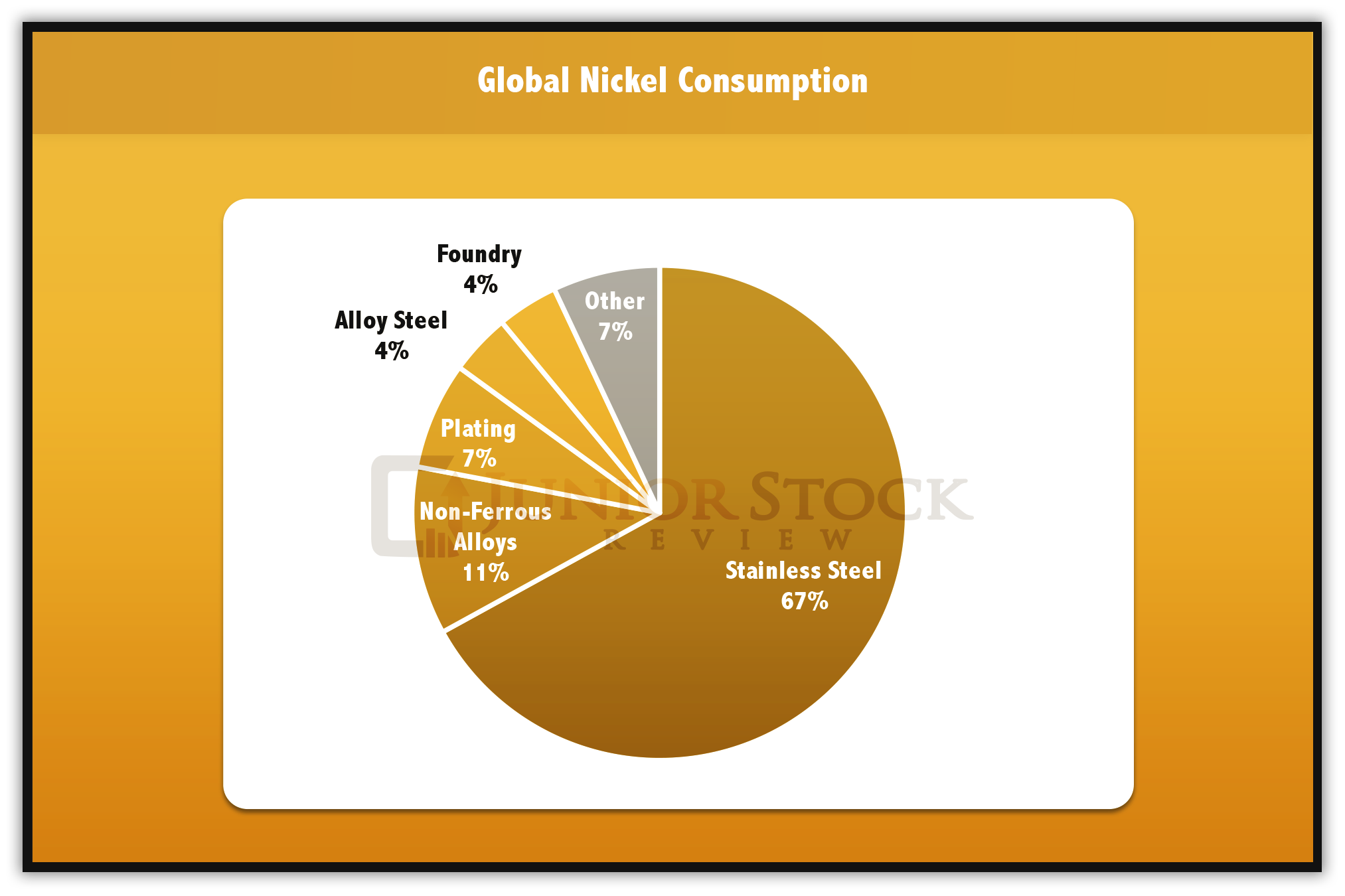


Disclaimer: The following is not an investment recommendation, it is an investment idea. I am not a certified investment professional, nor do I know you and your individual investment needs. Please perform your own due diligence to decide whether this is a company(s) and sector that is best suited for your personal investment criteria. Junior Stock Review does not guarantee the accuracy of any of the analytics used in this report. I do own FPX Nickel Corp. shares. I have NOT been compensated to write this article.

Posted on

A Conversation with John Kaiser

John Kaiser


Brian Leni: Hi. This is Brian Leni of Junior Stock Review. Today I have with me John Kaiser, of Kaiser Research. Hi, John. How are you?

John Kaiser: Hi, Brian. Good to be here.

Brian Leni: Well, let’s get right into it. I recently attended the Sprott National Resources Symposium, and when speaking to many attendees, I heard a lot of mixed thoughts on where the gold market was heading in the second half of 2017. Lower tempered expectations is usually the sign of a good buying opportunity in a market, something that I personally look for.

Where do you think the gold market is headed in the next six months, and is there anything we should look for to confirm this trend?

John Kaiser: Well, it’s very difficult to predict a trend in a metal such as gold, which is not subject to ordinary macroeconomic supply and demand drivers. There’s 5.6 billion ounces just sitting there in vaults, waiting to be sold and converted back into a regular currency so that people can do something with it. What drives the desire to tell or buy is very unpredictable. At the moment, inflation continues to be subdued in the United States, so the supposed main driver for a higher gold price is not really yet operative. We’re looking at a stock market that hasn’t had a serious correction since the crash of 2008, and a lot of anxiety that this may happen. Ironically, we’re seeing money flowing back into bonds, even though the yields are still extremely low. As we saw in 2008, if there’s a serious correction in the general market, that’s usually there’s a liquidity crunch, and we could expect gold to also be sold to raise capital to pay for problems that a sharp decline in equity prices has created.

Now, that’s sort of at the head winds for a higher price. We do, however, have a serious geopolitical situation. We have a president whose motto is, “Make America great again.” However, the stances and policies he’s adopted is actually accelerating America’s relative decline in the eyes of the rest of the world. That is creating geopolitical tensions. China and Russia are being sanctioned over the North Korea situation, which seems to be spiraling out of control. Even within the United States, we have the president fulmenting civil unrest by seeming to back neo-Nazi type sentiments. We have a split within the Republicans themselves as to whether or not they want to back this president. There’s a political crisis brewing, and that could actually stimulate the price of gold upwards, because it becomes driven by concern that the world is becoming unstable, that the reliance on the US dollar as a reserve currency, which by the way should already be seen as being in question by Trump’s push for isolationism, his attack on globalized trade, as on a globalized economy. That’s in essence saying the US dollar is not going to be that which the whole global economy depends on down the road.

There is this geopolitical factor, which could counterbalance any decline in the equity markets precipitated by some trigger event, and offset the desire to sell gold, and actually cause a desire to buy gold, and drive it higher. We are entering a very dangerous period, and I would say the bias for gold is more on the upside in the next six months, and not because of inflation, but more because of these geopolitical stresses that are evolving.


Brian Leni: Interesting. In my view, we live in a society of paradigms, or bias, that lock us into thought patterns that keep many of us blind to other alternatives, alternatives that may be more efficient or beneficial.

Whether it be financial, political, or social, in your opinion, how does one keep an open mind and see through the paradigms and their own inherent bias?

John Kaiser: I have this approach, which I call sort of a cost-benefit analysis. I say take any position, any policy, any trend, and ask yourself, “Who are the winners? Who are the losers?” In doing that, it forces one to look at it from the multiple perspectives. Not just that of the winners, but also the losers, and which forces one to say, “Okay, what would be the counter-policy, the opposite policy to this that would reverse the allocation of wins and losses?” Because most policies, most trends do create winners and losers. Then of course, one has to make a moral choice as to which side one wants, but in assessing any sort of a trend or situation, that is the way I like to approach it, so that I can see the different ways, and that of course allows me also to develop hedges, so that if things continue in this direction, what do I bet for? What do I bet against? And just in case it’s going to go in the opposite direction, where can I place a bet on that? You can do that with stuff like the whole climate change situation, the geopolitical situation. It’s really important to be able to look at it from both sides, from a cost-benefit analysis perspective.


Brian Leni: Excellent. My experience in the market has taught me that when I find a good opportunity for speculation, I need to risk enough capital to make it worth my while. However, I haven’t settled on a quantitative approach on how to choose the amount of capital to deploy into a position.

Firstly, do you agree with me? Secondly, can you share with us an approach to choosing the appropriate position size?

John Kaiser: Well, I look at all things as a gamble. I don’t look at it as investment. There are not guaranteed rates of return on anything. There are different degrees of risk. My own area of expertise is this high-risk resource sector. I tend to divide my capital into two categories: One is cash. That can be in t-bills or something like that, where it’s readily accessible, and the rest I divide up amongst very high-risk speculative resource juniors, and I create a mix of those based on these different scenarios. For example, if I think that China is going to become America’s enemy, I’ll look at metals where China is a dominant supplier, such as graphite, tungsten, antimony, rare earths. If I think that we are going to be in an inflation, in a geopolitically driven gold up trend, I’ll look for optionality plays, which would benefit from a modest increase of, say, gold going from 13, 12, $1200, $1300, to say $1600, $1700, which puts the project way into the money.

Then have at least 10 different positions, but be prepared to, when a story comes a long that is unusually interesting, if one of these different hedge positions starts becoming the one that’s in ascendancy, be prepared to move from the cash area, more amount into that particular slot and increase it, but never go like all in, and sell everything else, and put all your money. Have a flexible basket with multiple exposure, but be willing to let one of them become more weighted with exposure, and of course when things get high, start replenishing the cash component. If we get blindsided like we did in 2008, where the resource sector was roadkill as a result of these scrutinized mortgage-related meltdown, well, you know, the equity component gets cremated, so now all of a sudden you have like 90% cash. Not because you put it all in there, but because valuations are extremely cheap, you have this cash component available to redeploy and go bottom fishing, and rebuild positions that have become very good value as a result of a sort of across the board haircut that the markets have suffered.


Brian Leni: Nice. That’s a great approach. Well, paradigms and bias give us the basis for how we view the world. Emotion is the fuel that causes us to act without logic. The biggest lesson I have learned in my speculating career thus far is to act against the crowd, and buy when everyone else is selling, and vice versa. That’s a lot easier said than done.

Do you have a defined strategy that investors can adopt in some form, which works to minimize the role that emotion plays in their speculations?

John Kaiser: Well, one of the rules that I have is to never be right, and always be wrong. You accomplish that by buying things when nobody is particularly interested, as you suggest. Not necessarily when they’re falling, because when they’re falling, something is going wrong, and catching knives and anvils is not a smart thing to do. But after they’ve crashed on the bottom and done their little dead cat bounce, and have stabilized, research the fundamentals. Make sure they are still intact, and do what I call bottom fishing, value hunting.

Now, this requires patience, and I’m notorious for being way ahead of the curve on stuff, to the point that by the time I’m finally right, nobody cares, and those who have just jumped into the erupting up trend, they’re the ones who are the heroes. It’s something like that that has kind of happened with Noble Resources Corp, where poor Jay Taylor has been patiently covering this since 2013, based on this Wits 2.0 scenario in Australia, and they appear to have failed, and I kind of never liked it, but then something changed. I didn’t get the bottom. I mean, Jay was still there at the bottom, but I caught that erupting point, realized, “This is a new story. This is an emerging story.” So of course I get a lot of interest from people. Poor Jay. Of course, he’s been in it so long, it’s, “Okay. He’s finally right. Yeah. Yeah. Who?”

But when you are long a position such as, say, Jay Taylor is in, or, say, something like Scandium International that I’ve been in for a long time, or even the VAT Exploration, when they start going up, in most cases they tend to overshoot their value, but the value is like poor at the moment, but as the story expands and gets more fleshed out, and risk is removed, it’s going to go higher. You don’t want to sell all of it, and like sell it because the crowd is buying it. What you want to do is sell some. Not this silly “sell half when it doubles,” type rule, which with the kind of high-risk stocks that I invest in would be a disaster in the long run, because I’m shooting for five, 10 baggers, so you’ll maybe sell maybe 20% if it doubles, and you monitor it. But the important point I want to make is that I’m always wrong. I sell too soon, and I sell too late, but because I am selling in stages, and almost always miss the top, I nevertheless have to write a big check to the tax man at the end of the year.

Brian Leni: Yeah, which is the goal, right?

John Kaiser:  Yes. And because I’ve been wrong with everything that I’ve done, emotions get stripped out of it, because, “Oh, yeah, okay. I sold some. That’s why it’s going higher.” But never buy back in during one of those things. One of them, if you’ve sold some and it’s gone higher, just continue with that selling discipline. Never, ever buy back into a high-risk stock that has finally come to life.


Brian Leni: People are widely accepted as the most important facet of any junior resource company. Outside of a proven track record of success, in your opinion, are there any characteristics that are commonly shared by successful people in the resource sector? Characteristics that investors should look for?

John Kaiser: The people who have been successful almost have like now a self-fulfilling prophecy function at their work. When they come up with a new idea, the people who benefited in the past are quick to support it. They’ve also learned how to structure their deals so that the earliest tiers you have the people who have control over other people’s money. You insert them in there for preferred financing levels, so that down the road as the story evolves, these people will push the buttons to move other people’s capital into the market and expand it. It becomes a money-making machine, which is why I call these things machine plays. As long as these very successful people continue to deliver successes, this machine can go on and on. But the machine play itself can wear itself out, if management is not coming up with interesting stories.

I don’t like it when it is they’re just jumping onto a bandwagon and saying, “Okay, lithium’s been the buzz for a while, so let’s cobble together some lithium deal and stuff it in some shell, and plug in all the right people, and then open it up and have all the newsletter writers pump it and bring in the retail crowd, and hang them with the paper.” I don’t like that type of story. I like management groups, which in addition to having all the technical skills for executing programs, are also looking for something new and different that doesn’t quite have the acceptance of the market, so the type of story that they are backing, I am interested in that. I’m not interested in somebody finally jumping on to, say, the silver bandwagon, and preaching apocalyptic doom, and saying, “We have all these worthless deposits that are going to be worth a whole pile of money.” Of course, it’s underpinned by foolish logic of inflation. “Socialist policies are going to make everything money worthless.” None of that’s going to make worthless deposits worth anything, because providers of the inputs, labor, energy, materials, they all pay the market price, which is going to inflate along with the price of the metal, which is only going to really inflate according to actual inflation.

That whole inflation-based scenario is complete nonsense, but if they are doing something interesting, something different, are looking at projects which doesn’t require a monster gold or silver price to go up, or looking with some new method for this, or in some new area where people have been afraid to go, these are the things that I’m looking for. Do they have coherent, interesting stories that then, matching with their proven track record and their technical capability? That’s when I get really excited.


Brian Leni: That’s a fantastic answer. Thank you for that. You gave a terrific presentation at the recent Sprott National Resources Symposium, one I’m very happy I attended. Among the topics you discussed, the one that really caught my attention was your new initiative, The Share Collective.

Can you give us a breakdown of what The Share Collective is, and how it will benefit investors?

John Kaiser: Well, The Share Collective arose from a frustration that I, as a newsletter writer myself, have experienced. One is, “How do I find these good stories?” Now, sure, there’s about maybe a dozen prominent groups, you know, with the Lundins, the Beatys and so on. But you know, the entry, it’s never very lucrative. By the time those stories are available to the public, there is not very good value. But there’s numerous other groups who may emerge as the next Ross Beaty. Projects that are interesting but unloved because nobody understands it, because there’s no audience, and there’s like 1200, 1500 companies listed on the Canadian exchanges, and on the Australian exchange. How do you filter through all of this? I mean, there’s only so many hours in a day for me basically to even get rid of the first 90%, and then to do due diligence on the remaining 10%. There’s not enough time for me to get this work done.

Then the other problem was, well, what is the size of the prize? This company says, “We have this target here in, say, Utah. We have an existing resource that kind of works at the current metal price we have, but we need to make it bigger. In fact, we see something here that’s potentially very big, but it requires exploration dollars. High-risk exploration dollars to make or break.” I ask, “Well, if you are successful, what is that worth?” You know, “Your company has a, say, a $10 million valuation right now, but is that fair? Is that good value? Should I buy it at this point?” What I developed myself was what I call outcome visualization, where I imagine, “Okay, what’s the footprint? What kind of deposit could be there, and what sort of grades could one hope for?” Then assuming we have, say, 20 million tons of 10 gram per ton gold, “Well, what would it cost to mine that?”

Then you look up the numbers for a mine that was depleted in 10 to 20 years, and you run the discounted cash flow model, and this is all very complicated. You get a net present value number, an internal rate of return. You need an Excel spreadsheet. You need to set it up. You need to customize it. It’s a huge pain in the butt. Most people don’t do it, but I do it, and all the analysts in the mining industry do it. You come up with a number, and then I have this uncertainty lags and says, “Well, this is just a target testing stage, so even if it’s worth a billion dollars at the end of the day, it’s fair value right now as 1% to 1.5%, which is like $10, $15 million bucks.” I say, “Well, that is how the market is pricing it, so I actually like this company.”

But again, with the first point I made, how much time in the day do I have to do this? And so what about my numbers on it? Nobody cares about it. Maybe I made a mistake or so. I came up with this idea, “What if we create a giant sort of calculation system in a website where the crowd ends up doing this, puts together those numbers, then shares all those assumptions and the outcome into the public stage, this space associated with that project? And everybody can look at it and sort of grumble about this number and that number, copy it, tweak it, change it, submit it, and all of a sudden you have an intelligent discussion going on by these anonymous members of the crowd, and you can suddenly see a distribution of what the expected outcome is.”

This is really critical for the market, because in the junior space, resource junior space, it has lost its audience. The brokers don’t play this network hub role anymore, where they call up people and tell them, “Oh, this is really great. You need to buy it. It’s going to be like a $10 stock.” That doesn’t happen anymore, and just looking at technical analysis, well, then you’re competing against the algo traders, so your ordinary retail investor has really no chance just doing technical day trading. The resource sector, because of its complexity, because of the public’s inability to see what would be the reward if everything actually becomes reality, it has killed the market, and I’ve created this as a way of reviving the market, making it easier for the crowd to handicap the potential outcome, to share in a public space, and then everybody can trade. You know, they can say, “No, this is BS. Wits 2.0 is never going to happen,” so they’re going to short it or sell it. Others will say, “No, no. This is going to happen.”

But all of a sudden you have the market trading becomes intelligent, rather than just being a random event where the algo traders have the upper hand, because they can always sell short on the down take, and crush the bid, and totally discourage the market. Now, you can actually see, well, given the consensus expectation, now it’s being pressured to the lower end, so now value hunters can come into the market, and it will even be the algos themselves who will see, “Okay, this is about as low as we can push this stock right now. Now we’ll go in there.” And you’ll get trading volatility within constrained ranges, backed by what I call the rational speculation model, and tied to the crowd’s expectations. Those expectations will, of course, adjust to new results by the company, so the company goes and drills, drills down dip, gets assays, starts demonstrating what the average grade is going to be. The crowd has to adjust its expectations always to the flow of fundamental data, so it’s dynamic in that sense. In the sense that we don’t know what the results will be. We have hopes and expectations, but we now, with this share collective, we have a means to track, “How is reality matching up to expectations?”

And more interestingly, what the share collective also enables is a second level of gambling. Not just gambling on what the truth machine’s going to churn up out of the ground, but also gambling on the behavior of the crowd. I mean, right now you can look at this Novo Resources Corp and its Karratha project in Western Australia. There’s three competing theories. One is that this gold nugget thing will never amount to anything. Another is, yes, it’ll amount to something, but it’s a local freak show. There’s maybe going to be 10 million ounces there, and who knows what it’s going to be worth. Then there’s the third, grander hypothesis, which is while this company has staked 10,000 square kilometers, and this is actually another version of the Witwatersrand Reef, which has over two billion ounces in it in these reef-style conglomerate bins, and this company has tied up probably two-thirds of the available stock and potentially owns the future of gold production.

You have these different scenarios in there, and the public can bet as to which one they want to support. Right now, we’re in the roller coaster stage of the market trying to figure out, “Okay, is this thing just going to be nothing, or is it going to be at least this 10 million ounce thing that suggests it could end up being worth maybe one to one-and-a-half billion? Or are we talking the off scale scenario where it could end up being a $50 to $100 stock that ends up supporting like a 10 to 15 billion dollar valuation, because this is the next Beric or Newmont in the making?”

Brian Leni: Yeah, it’s an interesting story.

John Kaiser: It is.


Brian Leni: Finally, for those looking to gain an edge in the resource sector, you need to check out John’s resource sector research portal, Kaiser Research Online.

What is the value proposition for Kaiser Research Online?

John Kaiser: Kaiser Research Online has two dimensions to it. One is, we have the whatever, 1500 Canadian and Australian resource companies in there. We have all their projects there. We track their financial status. We track the people. You can click on a people tree, and start seeing what other companies the insiders have been associated with, and there of course you look for the ones that are de-listed, and the best one are the ones that were de-listed because they were taken over at a premium, and of course the bad ones are those which simply died because management is incompetent. You have a way of figuring out something about the track record, without having spent the last 30 years watching this and knowing who is what. But the most important part of this dimension is, I have a search engine where you can put in company and project level criteria, and do a search which then displays all the companies with all the data, chart, and links to like the stock forums, and NCR, and all these things there so that you can do your homework.

This discarding, getting rid of them, 90% of the junk, and putting together a query of how you think the future’s going to unfold … You know, you think rare earth prices are going to go up, well who all has a rare earth deposit? Skip the companies that are hideously in debt, and then you narrow it down to that 10%, then you kind of do your own research. That’s the thing that costs $800 a year, or $250 every 90 days on an auto-renewal basis. The other part is, I am a stock picker, so I have my spec value hunter recommendations, which is anywhere from one to two dozen companies where I put out formal buy, buy and sell recommendations. These are the ones that I sift up. I’m like a super user of my own site. I filter through it and look for these things, and then cobble together a set of recommendations. If you pay the $250 on a non-auto renewal basis, you get 90 days of access to all the search engine, all that stock information, but then afterwards you get another 270 day access to just the spec value hunters, hunter stuff.

I have two audiences: Those who don’t really care what I pick, but use my portal as a research engine, and then the other is those who just want to follow my picks and don’t really want to do all this research on their own.

Brian Leni: Excellent. You know, there’s a ton of value there, and I suggest it to anybody who’s listening that they check it out. John, it’s been an absolute pleasure. Thank you very much for taking the time to answer my questions.

John Kaiser: Brian, thank you so much for doing this interview.


Posted on

Drug Lord Book Review – Drugs, Sex and Speculation

Drug Lord

Drug Lord is the 2nd book of 7 in the High Ground Novel Series, written collaboratively by Doug Casey and John Hunt. Drawing on Casey’s experience as an international speculator and Hunt’s career as a medical doctor, Drug Lord tells a riveting tale about Charles Knight as he transitions into one of society’s unjustly besmirched and most politically incorrect occupations, a drug lord.

For those who haven’t read the first book in the High Ground Novel Series, Speculator, here’s a quick snapshot of how the main character, Charles Knight, developed into the man that we meet in Drug Lord.

Speculator tells the story of Charles Knight as he finds himself in the fictional West African country of Gondwana, where he’s performing his due diligence and investigating a junior gold mining company in which he has a major position.

What Knight finds will forever change him, because he’s given a crash course in some of the evils that lurk in our world. Knight is a curious young man of high moral character and, thus, won’t allow the fraud that he has uncovered to go without repercussion. Read my review of Speculator here.


Drug Lord

Drug Lord takes place seven years after Knight uncovers B-F Exploration’s fraud, and he’s making his way back to the United States, where he’s planning to use the culmination of what he’s learned, thus far, in his young life to disrupt the hypocritically governed pharmaceutical industry.

Knight’s plans are two-fold; distribute cheap generic brands of a few immensely popular drugs, including Viagra, and take a large speculative position in a small drug development company, Visioryme. This two pronged plan forces Knight to use his intuition and street smarts to navigate both the Federal Drug and Administration (FDA) hurdles and establish himself on the streets as a drug lord.

Knight is opposed by agents of the FDA, DEA, the newly formed Sybillene Eradication Task Force (SETF) and the return of Sabina Heidel, the sociopathic vixen from Speculator. The opposition is fierce and will stand at nothing to stop Knight, not even the killing of innocents.


Morality

In my opinion, the major theme found throughout the book is morality, and more specifically, living a moral life is not only a personal pursuit, but something that you should look for in other people, as well. Knight holds himself and the people he calls friends to a high moral standard. In a conversation between Knight and his business associate, Epsilon, where Epsilon asks why Knight let ‘the Fat Man,’ a drug cartel leader, live, Knight replies;

“I don’t know if it was wise, Epsilon…But the Fat Man didn’t attack us. So, for better or worse, I think we had no choice. Epsilon replies, ‘Let’s hope it works out for the best, Paladin.’ Charles frowned. In the dictionary, hope falls between hell and hysteria.” ~Drug Lord – pg.226

This is a very important conversation for two reasons: Firstly, Knight’s decision to not kill ‘the Fat Man’ was based on his morals; if the person hasn’t done wrong to me, I can’t do wrong to them. This ideology is the basis for how Knight acts and reacts to the world around him.

Secondly, from a speculation perspective, whenever you’re hoping for an outcome instead of having a calculated reason to believe in an outcome, you and your speculation are most likely doomed.


Anti-Depressant to Naked Emperor

A pivotal point in the story, Knight finds himself in the Capital Building before a committee of government officials. Knight has been called before this committee because Visioryme’s drug, Sybillene, a newly FDA-approved anti-depressant medication, is revealed to be a ‘truth serum,’ so to speak. When 10 times the recommended dosage is taken, it allows people to see through the smoke and mirrors of everything that’s a fraud in our society.

This off-label use is a threat not only to institutions like the FDA, but up to the highest cog on the chain, the United States government.  While the committee believes Knight will back down from their evil and immoral pursuit of shutting down the distribution of Sybillene, Knight has other ideas.

Knight says,

“There are essentially four ways to deal with evil. You can bow to it, and let it rule you. You can pretend it doesn’t exist. You can try to run, and hope it won’t find you. Or you can confront it, and attack it. Only the last alternative has a chance of success of more than a moment.” ~Drug Lord – pg.244

These courageous words speak a lot of truth; in the face of evil or adversity, what will you do? In my opinion, most of society pretends evil doesn’t exist, shutting off their ability to critically think through the trials and tribulations that are and will affect us as a society in the future.

Instead, the ‘thinking’ is left to government officials, primarily sociopaths, that seek to control and proliferate an agenda which doesn’t have the population’s best interests at heart. On a personal level, the older I get, the more I think that people are really only capable of effectively governing themselves, because although this comes with the stigma of being selfish, living our lives by a set of morals and the intention of our own success allows everyone in the society to prosper.


Concluding Thoughts

Today, in 2017, we stand on the precipice of major change because the world financial system is broken and will inevitably need to change. How and by whom it is changed will speak volumes about where society is from a cognitive perspective.

Sybillene or Naked Emperor, as it became more popularly known in the book, could be a metaphor for future events, however, it will come down to a choice; more of the status quo or can we make a dramatic change in the direction of liberty? Time will tell if we are true to ourselves.

To conclude, Drug Lord is a fantastic follow up in the High Ground Novel Series, one that will keep you glued to your seat as you follow Knight in his journey.  There are many lessons to be gleaned from this story, but at the very least, it’s highly entertaining! You won’t be disappointed.


Don’t want to miss a new investment idea, interview or financial product review? Become a Junior Stock Review VIP now – it’s FREE!


Until next time,


Brian Leni  P.Eng

Founder – Junior Stock Review
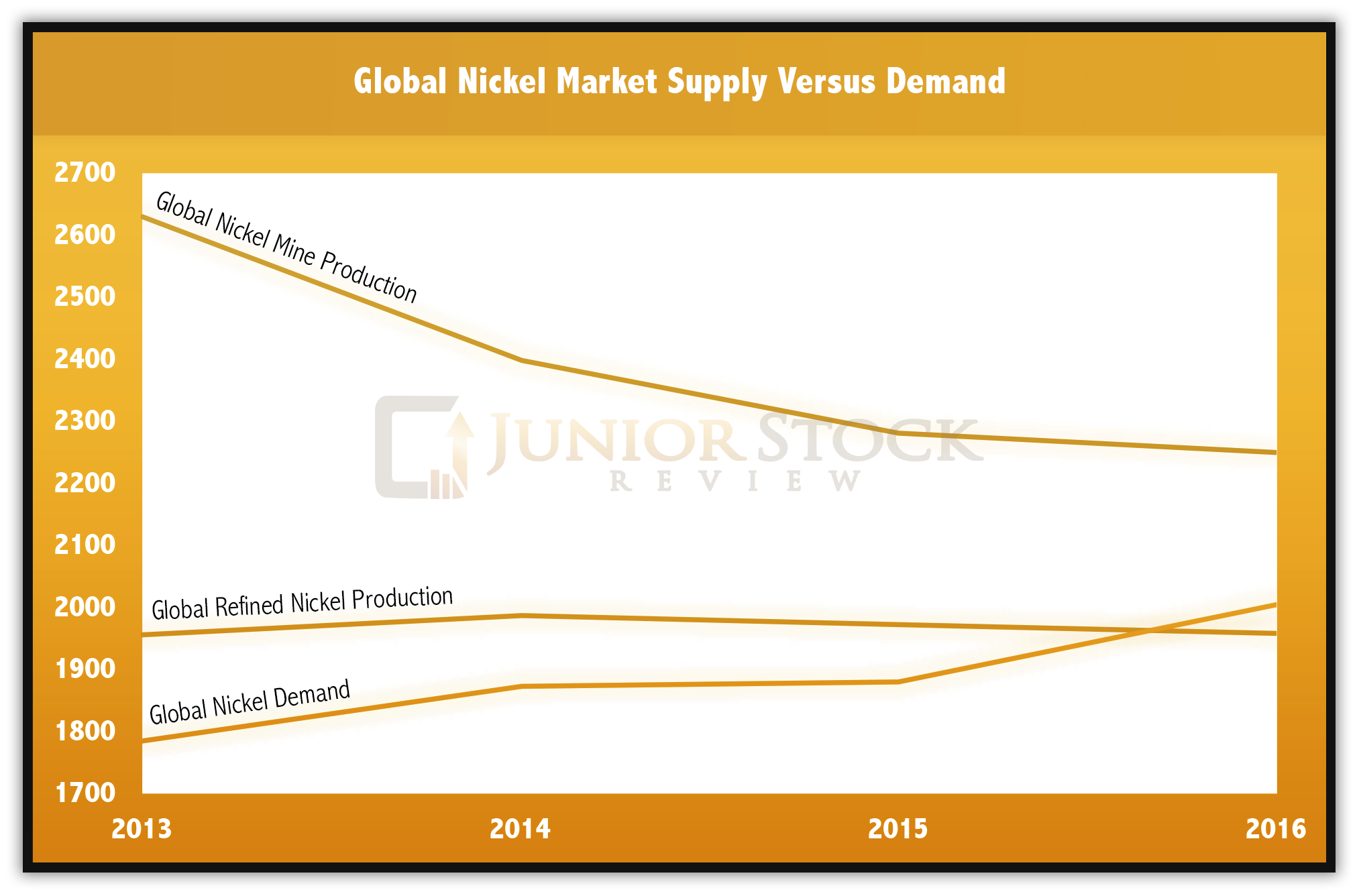
Posted on

Newfoundland & Labrador – A New Frontier for Gold Exploration

Anaconda Mining's Viking Project

Canada is well known for its gold mineralization; the Abitibi Greenstone Belt in Northern Ontario and Quebec, the Golden Triangle in Northern British Columbia and the White Gold District in the Yukon.

Anaconda Mining's Viking Project

Source: Anaconda Mining – Viking Project

Lesser known, but quickly emerging as the next frontier in Canadian gold mining exploration and development, is Newfoundland & Labrador (NL). Over the last year, NL has seen a staking rush and looks to be added to the list of world-class destinations for mineral exploration.

Fraser Institute Rankings - Canada

Source: Fraser Institute

This opinion is shared by the Fraser Institute, as it Ranks NL 5th in Canada and among the top in the world when it comes to mining investment attractiveness. The mining investment attractiveness score is a combination of the politics and, most importantly, the geological appeal of the region.

Examining the rankings, you can see that NL ranks ahead of a couple of the more well known Canadian provinces, Ontario and British Columbia.

Let’s take a look at why NL scores so well in politics and geologic attractiveness.


Newfoundland & Labrador’s Geology

NL’s Ministry of Natural Resources’ website has a tremendous library of resources available to anyone looking to learn what the island has to offer from a mineralization perspective.

The island can be broken down into 4 geological zones: (NL Ministry of Natural Resources)

  • Starting on the western most portion of the island, we have the Humber Zone, which hosts Mid-Paleozoic extensional cover basins, Siluro-Devonian plutonic & volcanic rocks and Early Paleozoic rift, slope, shelf and foreland basin-facies carbonate and siliciclastic rocks.
  • The Dunnage Zone sits on the Humber Zone’s eastern border and hosts Silurian marine to terrestrial volcano-sedimentary basins, Cambro-Ordovician marine volcanic and sedimentary rocks of arc and back-arc origin, including ophiolite.
  • The Gander Zone is found in two spots on the island, amongst or in the middle of the Dunnage zone and on the Dunnage Zone’s eastern border. The Gander Zone is considered by many to be the most prospective for gold exploration in the province. The Gander Zone is host to Silurian synkinematic granitoids and high-level Devonian plutons, Silurian metamorphosed Early Paleozoic quartz-rich terrigenous siliciclastics; Ordovician magmatic rocks.
  • Finally, the Avalon Zone makes up the eastern most portion of NL. It hosts Devonian terrestrial basins, Cambrian shallow-marine, shaley platformal cover, latest Neproterozoic (post-560 Ma) pull-apart basins and related peralkaline magmatic rocks and Neproterozoic (760-565 Ma) volcano-plutonic arc complexes and siliciclastic sedimentary basins overlain by shaley deltaic rocks.


The age, type and structure of the rock, especially in the Dunnage and Gander Zones, make them especially interesting for precious metals exploration. For me, I will be focusing on gold exploration and development companies in these regions, as I believe they have the highest probability of making and developing an economic discovery.

To note, most of the island of NL is covered with a glacial till or cover of some sort (most notably bogs), making the outcropping of mineralization much more rare than other provinces in Canada, where it is quite common.

This aspect of NL makes it that much more important to have a strong geological background in your exploration team, as they will be highly dependent upon their ability to interrupt much subtler geological information. NOTE: Pay close attention to the exploration teams for the companies you research, as they should (preferably) have a background in exploring in this type of terrain.

I had the chance to ask the CEO of Anaconda Mining, Dustin Angelo, and the CEO of Torq Resources, Michael Kosowan, a series of questions pertaining to the exploration and development of properties in NL. Who better to give us an idea of what it’s like to conduct mining business within the province than these two leaders?


Anaconda Mining

Anaconda Mining (ANX:TSXV)

Gold Producer, Developer and Explorer

CEO – Dustin Angelo

Anaconda Mining is a gold producer, explorer and property developer in Newfoundland & Labrador and Nova Scotia. Their main producing property, Point Rousse, produces roughly 16,000 oz of gold per year and is located on the Ming’s Bight Peninsula located in the Baie Verte Mining District. Anaconda’s other projects include Goldboro and Viking, which bring Anaconda’s total gold resource to over a million ounces and counting.


Torq Resources

Torq Resources (TORQ:TSXV)

Gold Explorer

CEO – Michael Kosowan

Torq Resources is a mineral exploration company with a goal to establish a tier-one mineral portfolio. Currently, Torq owns 120,000 hectares of prospective gold property in Newfoundland & Labrador. Torq is led by CEO, Michael Kosowan, and board members, Ivan Bebek and Shawn Wallace, who are serially successful entrepreneurs within the mining sector.


Brian: From a geological perspective, why explore for mineralization in Newfoundland & Labrador?

Anaconda Mining Inc. – CEO: Dustin Angelo

“The long geological history with diverse geological terranes that have seen multiple mountain building events and deep crustal scale fault zones lend themselves to strong potential for gold mineralization.  The Appalachians as a whole is a mountain belt that has not seen a lot of exploration for orogenic gold deposits despite similar age rocks throughout the globe (e.g. Lachlan fold belt in Eastern Australia) being a significant host for gold mineralization.  Recent discoveries and development projects (e.g. Valentine Lake, NL; Moose River Mines, NS) are starting to show the potential for the Appalachians to host large gold deposits.  Newfoundland is becoming a recognized place to look.”


Torq Resources – CEO: Michael Kosowan

“Newfoundland presents a significant underexplored opportunity for Torq and its shareholders. Early indications demonstrate the potential for orogenic and epithermal styles of gold mineralization. High grade gold intersections have been reported throughout central Newfoundland, as demonstrated by the recent success of Marathon Gold at Valentine Lake and Antler Gold at Wilding Lake. There are a number of structural scale suture zones and thrusts (large faults) which represent large scale fluid pathways which potentially have focused fluid flux along them and, if these fluids carried metals, there can be significant mineralization.”


Newfoundland & Labrador’s Base Metal Production

From a mining perspective, NL is most known for its base metals discoveries and production, with the Voisey’s Bay Discovery being the most famous, in my opinion. NL’s Ministry of Natural Resources released a report on the province’s mines in February of this year.

The report mainly covers the producing mines within the province, giving the reader an overview of the mine activities and some production statistics.

NL is currently home to 9 producing mines:

  1. Vale Newfoundland and Labrador Limited, Voisey’s Bay
  2. Iron Ore Company of Canada, Labrador City
  3. Tata Steel Minerals Canada Ltd., Menihek Area
  4. Atlantic Minerals Limited, Lower Cove
  5. Anaconda Mining Inc., Pine Cove – Open Pit Gold Mine
  6. Rambler Metals and Mining Canada Limited, Baie Verte Peninsula
  7. Barite Mud Services Inc., Buchans
  8. Hi-Point Industries Ltd., Bishop’s Falls
  9. Trinity Resources Ltd., Manueals

One of the graphs provided gives an overview of the gross value of mineral shipments over the last 8 years by metal type. The graph shows that, overwhelmingly, iron ore is the number one mineral export in the province, followed by nickel and copper.  This heavy dependency on base metals makes the province even more susceptible to the global economy and its ebbs and flows.

However, the current push towards making NL a world-class destination for precious metals exploration will help bring some much needed jobs to the province and further diversify its metal exports.

I asked the NL Ministry of Natural Resources,

“Currently, the majority of the mine production comes from base metals such as iron ore and nickel. Do you see progress in any other metal(s)? Possibly gold?”

*Answer provided on behalf of the Newfoundland & Labrador Ministry of Natural Resources:

“There are a number of advanced exploration projects for potential investment, including opportunities for gold, base metals, rare earths and other commodities. High gold prices as well as new gold discoveries and new analyses of public geo-scientific data are fueling gold exploration.

Marathon is continuing to advance exploration and increase reported resource for its Valentine Lake Gold Property located in Newfoundland. They have currently reported measured and indicated resources totaling 1,388,200 oz. of gold at 1.91 g/t and inferred resources totaling 766,500 oz. of gold at 2.24 g/t. Drilling in 2017 is continuing to focus on expanding the Marathon Deposit at surface and to depth.

Anaconda Mining is continuing to actively explore to expand its resources and extend the life of its existing mining operations. Rambler Metals and Mining is producing copper-gold concentrate at their Nugget Pond mill from the Ming Mine on the Baie Verte Peninsula.”


Brian: Will there be an attempt to grow the mining industry within the province? If so, how will it be done?

*Answer provided on behalf of the Newfoundland & Labrador Ministry of Natural Resources:

“To increase exploration and development activity we are working on sharing mineral information globally – similar to sharing seismic data with oil and gas companies around the globe. We believe this will help attract mineral exploration activity that has the potential to generate significant new industrial activity in the coming years. We are committed to working closely with the mining industry and the communities in which they operate to attract investment and develop the economy of Newfoundland and Labrador.”


Ultimately, I believe the future is bright for base metals, and today’s lows may be great buying opportunities. Gold discoveries and further promotion of NL’s prospective gold properties should help to spur further investment into the province and help diversify NL’s base metal mining dependency, as there is no better way to spur investment in a region than to have a major discovery!


Newfoundland & Labrador Infrastructure

A jurisdiction’s geology is of the utmost importance when it comes evaluating the value of a prospective property. However, while a nice high grade gold discovery is fantastic, if there’s no power or road access to the property, the sexy high grade gold can soon become just an average or uneconomic discovery.

While the island portion of NL is, comparatively to the rest of Canada, just starting a major push towards precious metals exploration, it has long been a logging province. For many of the current companies that own prospective properties within the province’s interior zones, these logging roads provide much needed access to some of the more remote land claims.

I posed the question regarding infrastructure to Angelo and Kosowan;

“Is Newfoundland & Labrador’s infrastructure conducive to exploring and developing mining properties? Please explain.”


Anaconda Mining Inc. – CEO: Dustin Angelo

“Newfoundland has excellent infrastructure to support exploration work. Much of the province is transected by provincial highways that access historic fishing communities along the coast.  The island has traditionally been logged for pulpwood and the island has an extensive network of logging roads that allow access to remote areas.  Small hydroelectric projects occur throughout much of the island and in tandem with numerous coastal communities means that electricity is generally fairly close to most exploration areas.

There is a strong geo-scientific community on the island and historical exploration data and drill core are available through the government. Skilled workforce trained in mining and exploration.”


Torq Resources – CEO: Michael Kosowan

“There is great infrastructure throughout the majority of Newfoundland. That said, parts of Newfoundland, particularly the Central region, are very remote. Ninety five percent of Torq’s properties are accessible from the ground via forestry roads. There is also an analytical laboratory located in nearby Springdale for processing samples. Gander, the closest major town, is adjacent to and provides excellent infrastructure to our Gander suite of claims.”


Mining as an Employer in Newfoundland & Labrador

Where does mining stand in NL’s employment rankings? Examining the table below, courtesy of Statistics Canada, mining represents 8.5% of the goods producing sector employment. For me, this is surprising as I would have thought that it would have represented a larger portion of the employment in the province already.

Maritime Province's Employment Numbers

Source: Statistics Canada


I asked Kosowan and Angelo,

“Does Newfoundland & Labrador have the available workforce to fill the needs of the growing mining sector?”


Anaconda Mining Inc. – CEO: Dustin Angelo

“Yes, there are a great number of local experienced workers plus an equal number that are working a rotation (Fort McMurray, diamond mines, Ontario mines while waiting for employment at home). With the downturn in Alberta and Labrador, Anaconda has seen a significant influx of skilled workers looking for jobs.”


Torq Resources – CEO: Michael Kosowan

“ Yes, it does indeed − both in numbers and in experience. Torq attended the CIM conference in St. John’s last November (called Stratton Resources, at the time) and we were very impressed with the number of experienced prospectors and exploration services companies. Torq recently completed a regional scale sampling program with 90% of the crew residing in Newfoundland.”


While mining isn’t currently the largest employer in the province, mining jobs are typically well paid and, therefore, usually a priority for any provincial government. In the next section of this report, I will cover NL politics and how the provincial government is looking to increase the number of mining related jobs through improving its mining investment attractiveness.


Newfoundland & Labrador Politics

To many, the biggest risk associated with speculating in junior mining companies is the risk associated with the jurisdiction in which the company is exploring, developing or producing. Interestingly, not only do you have to look at a country’s overall politics, but it’s an absolute must to review the state or provincial politics to gain a sense of the amount of risk you are taking on.

Provincially, NL is governed by the Liberals, who have been in power since 2015. The Conservatives and Liberals have flip flopped control of the province since NL became a part of Canada in 1949.

How do the NL Liberals approach mining? I did a little digging and found their platform from the beginning of their term, called their Five Point Plan. On page 15 of that document, there are two paragraphs on the promotion of growth in mining. The Liberals say,

“Despite challenges associated with fluctuating commodity markets, the mining industry remains a valuable contributor to the provincial economy with strong potential for recovery and growth in the coming years. Liberals believe in continued development through industry partnerships and innovation, while also ensuring that benefits are maximized for local economic regions where mining operations take place.” ~ Five Point Plan


On page 15 of the Liberal government’s Five Point Plan, they outline a few points regarding the mining industry and what they wish to address during their term. How is that plan progressing?

*Answer provided on behalf of the Newfoundland & Labrador Ministry of Natural Resources:

“As a province, we support growth in the mineral industry through prospector training and mentoring, the mineral incentive program, which supports grassroots prospectors and junior mining companies, public geo-science, the core storage program, promotions, and efficient and transparent regulation.

In 2016, 21,000 claims were staked in the province, just over three times the amount staked in 2015, and the most in the last five years. We want to ensure that everyone, every growing company, has the opportunity to learn, grow and advance their operations. To support development and to streamline processes, government has created industry facilitators.

Assigned among existing staff, these facilitators will liaise with companies in early stages of exploration and development to guide them through the provincial policy and regulatory frameworks, helping facilitate their progress.

The industry facilitators also connect with our colleagues in other departments to ensure the companies they work with get timely support from departments across government.

Having this kind of support available to mining companies will help them navigate the various supports and regulatory functions so they can operate successfully in the province, now and well into the future.

By creating an attractive environment for exploration, we are strengthening the industry, and growing private sector jobs and the economy throughout our province.”


Further, I asked Kosowan and Angelo,

“Is Newfoundland & Labrador’s provincial government focused on improving its investment attractiveness for mining? If so, how?”


Anaconda Mining Inc. – CEO: Dustin Angelo

“Yes, since the Liberal Government came in during late 2015, it has made a concerted effort to diversify away from the oil and gas sector. Anaconda has had several conversations with the relevant ministers and the Premier about focusing on mining. The government is working on mining centres of excellence in conjunction with its college campus system. From a financing standpoint, the government provides loans through the Department of Business, Trade, Culture and Rural Development to help companies, including mining companies, fund innovation initiatives. Anaconda has been the recipient of such loans. In addition, the Department of Natural Resources has embarked on a restructuring to better serve mining companies who are permitting for various activities.

Lastly, the Provincial Government funds the “Junior Exploration Assistance Program” (JEA), which aims to grow the mineral inventory of the Province through the discovery of new mineral districts, occurrences, prospects and deposits. Anaconda has benefitted from JEA as well as the provincial Research & Development Council (RDC), and federally from Atlantic Canada Opportunities Agency (ACOA) and the Industrial Research Assistance Council (IRAP). Recent financial support was received to develop technology for narrow vein mining.”


Torq Resources – CEO: Michael Kosowan

“Yes. They have a very well set up mineral incentive program through the Department of Natural Resources.  This program provides rebates through the Junior Exploration Assistance Program (JEA). Grants top out at $150K in Newfoundland and $225K in Labrador. The 2017 budget is $1.3M and there were 39 JEA applicants this year. Additionally, the Newfoundland Geoscience Atlas website is a phenomenal source for minerals data including, but not limited to, downloadable claims, mineral occurrences, historic drilling, geology, available geophysical surveys and geology. The online staking system is also quite handy. The online staking and Geoscience Atlas make exploring in Newfoundland that much easier.

True story: in 2016, Torq’s prospectors filed more claims than the government’s online intake system could handle, and inadvertently crashed it. News spread, and Newfoundland is now considered, by some, to be the next hotbed of mineral exploration.

There is also the Matty Mitchell Prospectors Resource Room which is designed to help local prospectors connect with juniors through major companies. The majority of the historic drill core is available for viewing and sampling at core facilities throughout Newfoundland. Lastly, the Geologic Survey Division is well set up and open to meeting with industry and disseminating their knowledge. They are well staffed with some fantastic geologists who have a wide range of expertise.”


Newfoundland & Labrador First Nations

Not just in Canada, but around the world, First Nations’ involvement in mining are met with trepidation by investors. This isn’t without cause, as in the past and I’m sure in the future, disputes over the development of First Nations’ lands into producing mines will be disputed.  However, there are many First Nations which welcome mining into their communities, along with the cash flow and improvements that typically follow with the development of an operating mine.


 In my research, I found that the Mi’kmaq First Nations occupy some areas in Newfoundland, with their main reserve in Conne River. Excluding Labrador, do the Mi’kmaq First Nations or any other First Nations control any lands that are being mined or have the potential to be explored and developed in the future?

*Answer provided on behalf of the Newfoundland & Labrador Ministry of Natural Resources:

“First Nations on the island of Newfoundland are encouraged to participate in any public regulatory review process in which they are interested, and we often work bilaterally with each of the First Nations to address concerns related to areas of local or cultural significance to the First Nations, regardless of Aboriginal rights to the lands in question (The Mi’kmaq First Nations do not have Section 35 rights of the Constitution Act on the island of Newfoundland).”

Past is typically prologue, so looking at a First Nations’ track record in negotiating land development is key, in my opinion, to understanding the risks associated with investing in a company which is exploring or developing a property in a First Nations’ controlled area.


Newfoundland and Labrador have 3 groups of First Nations peoples: the Inuit, the Innu, and the Mi’kmaq. Let’s take a closer look.

Inuit

The Inuit communities are found along the north coast of Labrador. The people of these communities are descendants of the prehistoric Thule, a marine oriented group of hunters, which were drawn to the north coast of Labrador due its abundance of both marine and land wildlife. The Thule are originally from Alaska and moved across to the Arctic and further east to Greenland and the Labrador coast around 1250 AD.

The Nunatsivut First Nations are a self governing community in Labrador of Inuit descent. The Nunatsivut  have 55,000 square miles of land which they are willing to develop if the opportunity presents itself, as they describe in this quote,

“We have a lot to offer including 55,000 square miles of land that is rich in natural resources; a recognized and responsible self-government; a willing and innovative workforce; and a challenging but rewarding climate for new ideas and businesses. Our goal is to create long-term benefits for our people.” ~ Nunatsiavu


Mi’kmaq

The Mi’kmaq First Nations are located on the island of Newfoundland. While they were recognized by the Government of Canada in 2011 as an indigenous Band, the Mi’kmaq do not have Section 35 rights of the Constitution Act on the island of Newfoundland. What does that mean? Section 35 provides Aboriginals with constitutional protection on fishing, logging, hunting and the right to land.

The Miawpukek First Nations (Conne River) community, the largest of the Mi’kmaq, is located in an area known as the “Coast of Bays Region,” which is on the south coast of Newfoundland. The community is approximately 224 km south of Gander and has approximately 787 on-reserve members and 1779 off-reserve members.

Qalipu is a Mi’kmaq First Nation located in Newfoundland which has no reserve land. The Qalipu community is made up of 66 traditional Mi’kmaq communities, spread out across 9 different electoral wards. Offical Qalipu offices are held by community reps in Corner Brook, Glenwood, Grand Falls-Windsor and St. George’s, giving the widespread Qalipu community representation.


Innu

The Innu First Nations  (Naskapi-Montagnais) are located in central Labrador and are made up of two main communities, Sheshatshiu and Natuashish.  The roughly 2200 members of the Innu community elect a Band counsel which represents the community’s need and concerns.

In 2001, they established the Innu Business Development Centre (IBDC) to formally deal with companies that want to conduct business with their community. An example of a successful negotiation with a mining company is with Inco, now Vale, on a mining royalty for the Voisey’s Bay Project.


Two Final Questions Regarding Newfoundland & Labrador

Finally, before making my concluding remarks, here are two final questions which I posed to my three interviewees:

 What differentiates Newfoundland & Labrador as a destination for mining versus the rest of Canada?


Anaconda Mining Inc. – CEO: Dustin Angelo

“Newfoundland and Labrador has a young mineral tenure system.Modern claim staking began in the late 1970’s. Prior to that, the only exploration undertaken was on Charter Land. The advent of the mineral tenure system in the late 1970s led to a boom in gold and base metal discoveries in 1980s to present. As such, gold exploration in Newfoundland is still relatively shallow compared to the Timmins area, for example (over 1.5km deep).

There are 722 gold showings on the island. The Baie Verte Peninsula went from ~ 35 to 150+ during the exploration boom in the mid 80’s with 4 gold deposits discovered on this peninsula alone. Several new discoveries in recent years illustrate the potential (ie: Argyle, Wilding Lake, Frank Zone, Hope Brook).”


Torq Resources – CEO: Michael Kosowan

“Newfoundland is differentiated by the lack of exploration history by juniors. The island has really only been open for exploration for about 25 years.  The vast majority of Newfoundland was tied up in leases or grants to the big forestry companies until recently.”


*Answer provided on behalf of the Newfoundland & Labrador Ministry of Natural Resources:

“Mining is one of the oldest and leading industries in Newfoundland and Labrador and is a major contributor to our economy. Today, more than 5000 people are employed in the industry, particularly in rural communities, and almost $3 billion in mineral shipments are forecast. Globally, Newfoundland and Labrador is currently ranked 16th on the Fraser Institute’s 2016 International Mining Survey as one of the most attractive jurisdictions worldwide for investment attractiveness.

Our diversified minerals industry provides a wide variety of commodities to the world market. Eleven mineral commodities are produced or mined in the province. Five metal mines currently produce: iron ore, nickel, copper, cobalt, silver, and gold. In Newfoundland and Labrador, we have armed ourselves with public geo-science, clear regulations and support for prospectors and junior mining companies through the Mineral Incentive Program, all in order to create the greatest opportunity for exploration and development.

We are also doing more work online and providing services and information through a digital format. One of the services we provide is our online mineral staking system or MIRIAD – which was the first of its kind in Canada. Development of MIRIAD began in 2002 with the system going live on February 28, 2005. This is a great resource that gives companies or individuals the ability to obtain the mineral rights of an area by staking a claim online from anywhere in the world. We also make geo-science data publicly available for free through the Geological Survey’s Geo-science Online (Geo-science Atlas). Online geo-science data has been available to the public for the past 20 years.

And, we are moving to establish online services to help increase exploration and development activity. The Department of Natural Resources plans to share core sample information with more companies worldwide through digitization and web access.

We believe this will help attract mineral exploration activity that has the potential to generate significant new industrial activity in the coming years.”


What are the greatest challenges for exploring and developing mineral properties in Newfoundland? 

“The greatest challenges for exploration on the island is the generally extensive glacial till cover and presence of extensive bogs, lakes and ponds across much of the island.  These obscure the geochemical and geophysical signature of low lying areas (valleys that are host to faults, eroded alteration zones) that potentially host mineralization.

In some areas that have some of the best potential there is a lack of systematic geo-scientific and exploration data that requires companies to start from scratch.”

Anaconda Mining Inc. – CEO: Dustin Angelo


“We’ve had very few challenges. We see opportunity and significant potential in Newfoundland. The remoteness is one of the attractions, as it has led to the Island being underexplored historically. As frontiersmen, this excites us.

Torq searches the globe for high-quality precious metals assets. We’re looking for the next big discovery. Our team is visionary and not bound by convention. We have the confidence and budget to conduct grassroots exploration. We also have the experience and tenacity to manage the risks for which the majors have little appetite. Exploring Newfoundland and unlocking its value is our first step in building a world-class portfolio.”

Torq Resources – CEO: Michael Kosowan


Concluding Thoughts

Summarizing my thoughts on Newfoundland & Labrador, I believe it’s a province which is set to play a much larger role in Canada’s mining industry in the years ahead. Newfoundland checks all the boxes when it comes to being a desirable jurisdiction for investment:

  • Newfoundland & Labrador’s geology has long been associated with base metals such as iron ore and nickel, however, I think this is quickly changing as a number of precious metals companies look to explore and develop some highly prospective properties. Comparatively to the rest of Canada, NL is under explored, especially for precious metals, such as gold.
  • Newfoundland & Labrador encourages mineral exploration within its borders with the Junior Exploration Assistance Program (JEA). While the available funds in the program are small, it is a step in the right direction towards encouraging mining investment in Newfoundland & Labrador.
  • Newfoundland & Labrador has a workforce which is accustomed to heavy industry. With low oil prices hurting the oil fields of Alberta, many native Newfoundlanders are finding their way back to the island and with them comes multiple years of heavy industrial experience. As properties develop, there is both a workforce to fill the needed positions and the infrastructure to produce and export their goods.
  • The people of Newfoundland & Labrador have consistently voted for Conservative and Liberal governments since joining Canada in 1949. I expect this tradition to continue, which presents a stable political landscape for mining companies looking to explore and develop properties within its borders.
  • From an investment standpoint, First Nations’ involvement in the mining sector can cause trepidation for the investor. In Newfoundland’s case, this isn’t an issue, as the First Nations do not control any large blocks of land that are prospective for mineralization. NOTE, this is a different story for Labrador.


Newfoundland & Labrador is a great jurisdiction for mining and is a place where I ‘m looking to deploy some of my investment dollars. Stay tuned for future articles on specific companies that have garnered my interest.


Don’t want to miss a new investment idea, interview or financial product review? Become a Junior Stock Review VIP now – it’s FREE!


Until next time,


Brian Leni  P.Eng

Founder – Junior Stock Review
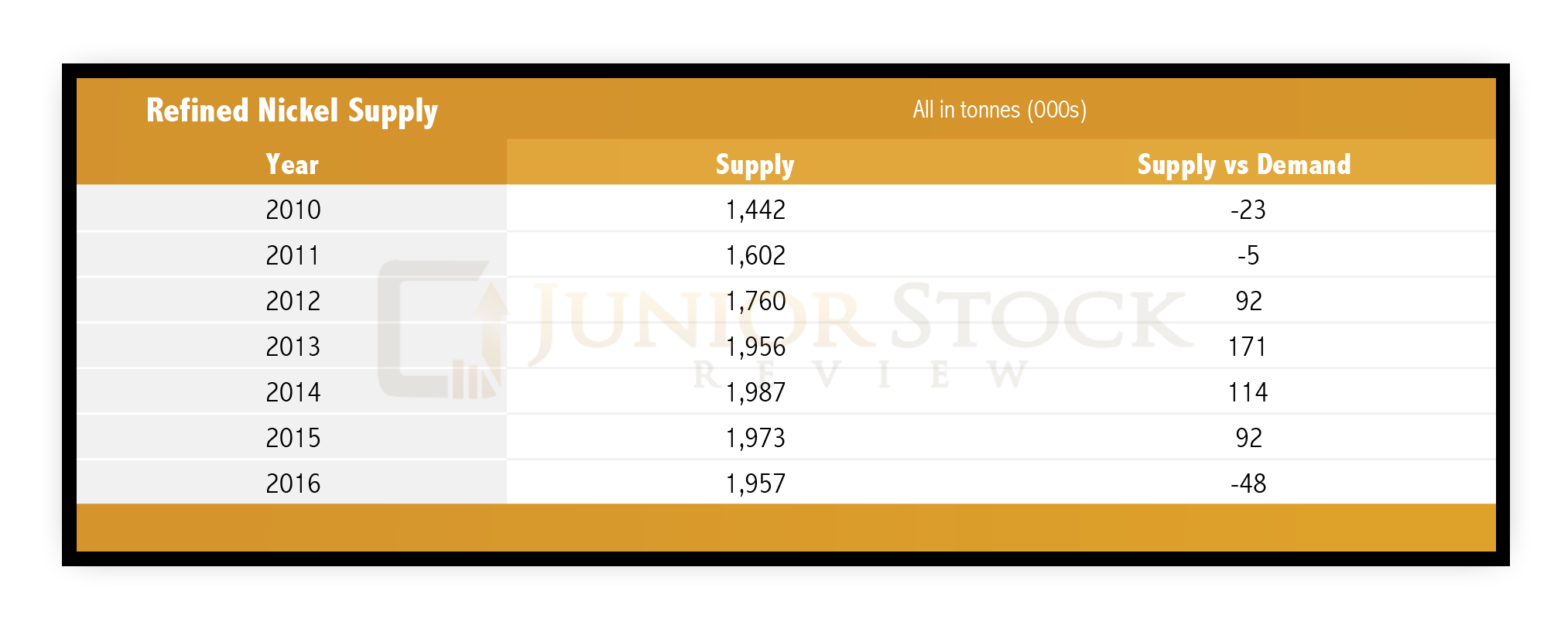


Disclaimer: The following is not an investment recommendation, it is an investment idea. I am not a certified investment professional, nor do I know you and your individual investment needs. Please perform your own due diligence to decide whether this is a company(s) and sector that is best suited for your personal investment criteria. I do own Anaconda Mining shares. I do not currently own Torq Resources shares. I have NOT been compensated to write this article.