Posted on

Zinc’s Bullish Narrative – Part 1 – A look at Supply

Zinc Price

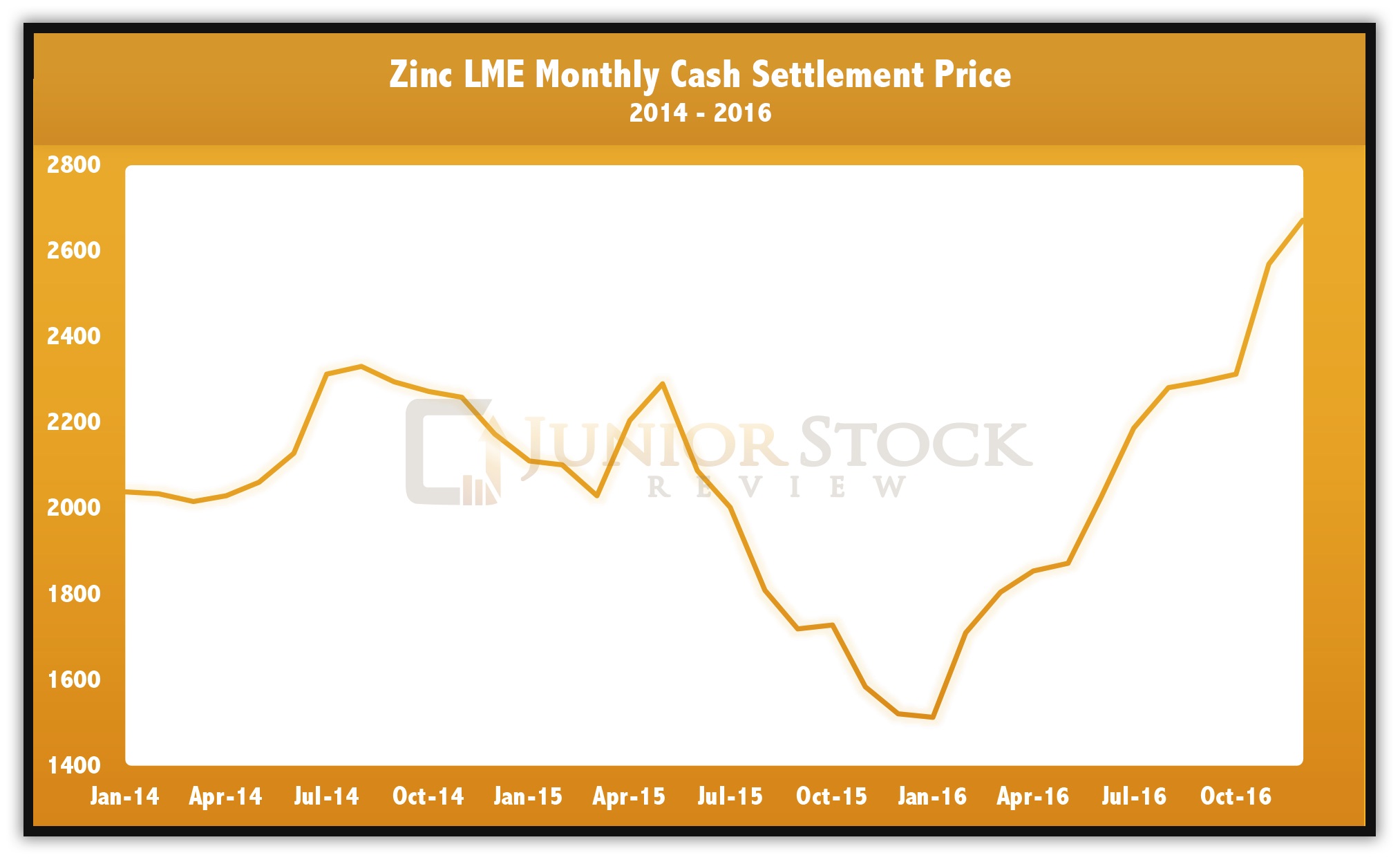
Zinc has exploded upward from its low in January of 2016 and it doesn’t appear to be coming down any time soon. Supply constraints caused by mine closures, mining issues and Glencore’s 500K tonne production cut have led the way to higher zinc prices in 2016.

Zinc Price

Source: London Metals Exchange

To understand this bullish trend in zinc prices, I’ve put together a 2-part series examining the supply and demand fundamentals of the zinc industry.

Here, in Part 1, I’ll examine the supply side of the zinc market, including a few tidbits on the zinc mineralization and the ore bodies in which it’s found.

Enjoy!


Zinc Mining

There’s an abundance of zinc in the earth’s crust, but like many metals, abundance doesn’t necessarily mean it can be extracted economically at the current price. Because of zinc’s relative abundance and important uses, zinc is mined in over 50 countries. Here’s a look at the current world zinc reserves:
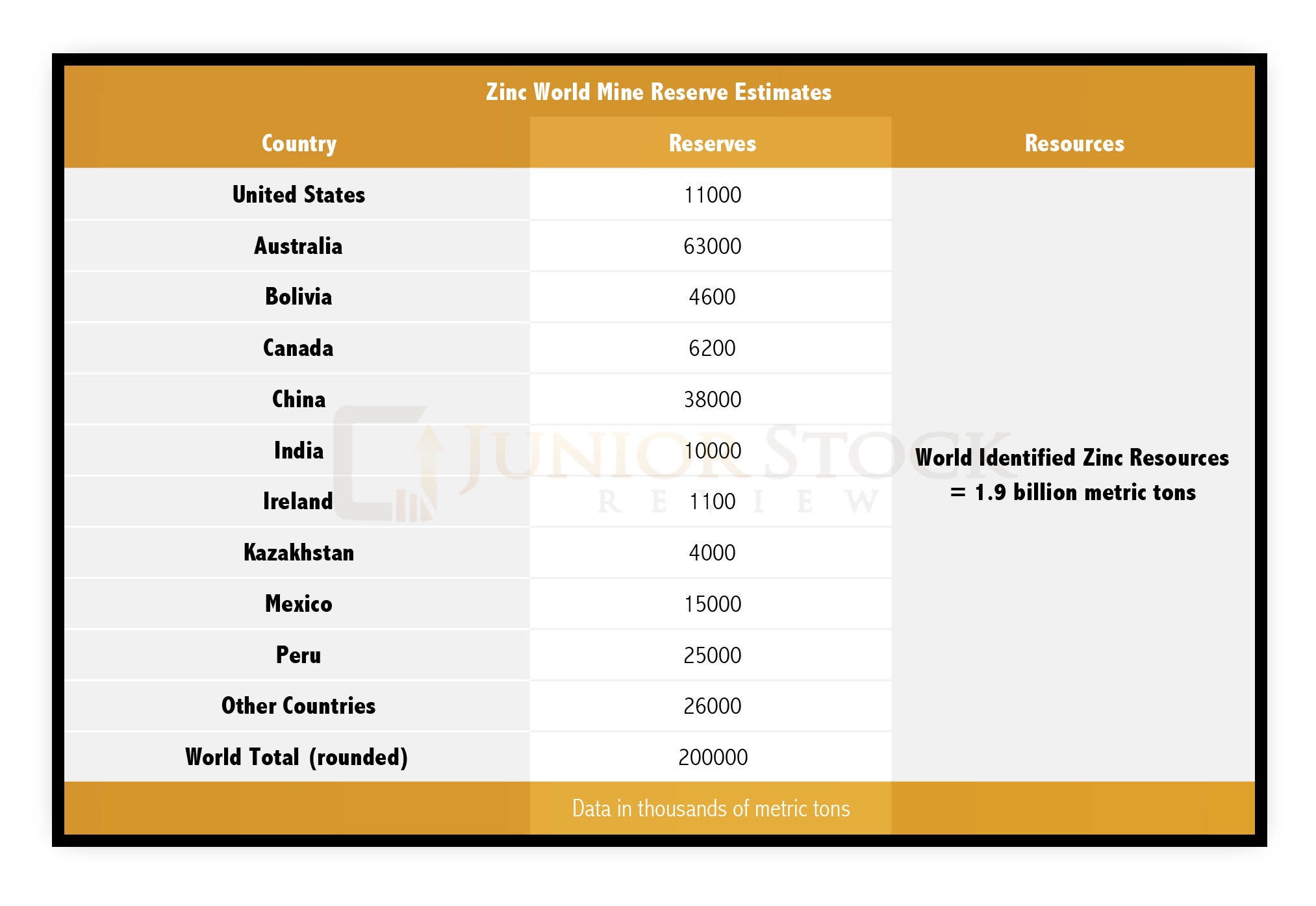
 

World Zinc Reserves

Source: U.S. Geological Survey


Some commonly found mineral forms of zinc are:

  • Sphalerite (zinc blende) – the most commonly mined zinc mineral in the world. The Sphalerite Mineral contains 67% zinc.
  • Marmatite – a zinc-iron sulfide, which is commonly found but rarely mined
  • Smithsonite (calamine) – zinc carbonate, typically found near surface
  • Hemimorphite – hydrated silicate
  • Willemitte


Zinc mineralization is commonly found in 4 types of ore bodies:

  • Volcanic hosted Massive Sulfides (VMS)
    • “[VMS] deposits are predominantly stratiform accumulations of sulfide minerals that precipitate from hydrothermal fluids at or below the sea floor, in a wide range of ancient and modern geological settings (Figs. 1, 2). They occur within volcanosedimentary stratigraphic successions, and are commonly coeval and coincident with volcanic rocks. As a class, they represent a significant source of the world’s Cu, Zn, Pb, Au, and Ag ores”~ Geo Science World
  • Carbonate hosted Lead-Zinc  (Mississippi Valley and Irish Types)
    • “These ore bodies tend to be compact, fairly uniform plug-like or pipe-like replacements of their host carbonate sequences… Mississippi Valley Type or MVT ore deposits, after a number of such deposits along the Mississippi River in the United States…  Irish-type carbonate lead-zinc ores, exemplified by Lisheen Mine in County Tipperary, are formed in similar ways.” ~Wikipedia
  • Sediment hosted (SEDEX deposits)
    • “SEDEX deposits form deep under the ocean where vents in the sea floor allow hydrothermal fluids to mix with seawater.  These hot, saline fluids have percolated through several kilometers of sediments and crystalline rocks, picking up precious metals along the way. As the metal-rich hydrothermal fluids hit the cool sea water, they precipitate material onto the sea floor at and near the vents.  Metal-rich minerals are deposited between layers of fine-grained mud, sand and silt.”~ Geology for Investors
  • Intrusion related (high sulfidation, skarn, manto, vein)
    • “These deposits are typically found in carbonate rocks in conjunction with magmatic-hydrothermal systems and are characterized by mineral association of calcium and magnesium. Typically the ore body contains more lead than zinc and is associated with silver.” ~International Zinc Association


Zinc is mined in the traditional manners: Underground, in an open pit, or a combination of the two. To note, underground zinc mining is the most common process, representing more than 60% of annual production.

NOTE: Zinc deposits aren’t unlike many other mineral deposits, in that they do have a number of issues that prevent projects from being economic. Here’s a brief list of some of the issues: Poor by-product grades, low grade zinc, remote deposit locations and high impurities such as manganese.

The zinc ore is drilled or blasted, the rough ore is then brought to the surface or to an area on the surface where it is crushed and finely ground. For efficiency and economics, the finely ground ore is then processed through a froth flotation circuit where the zinc concentration is increased anywhere from 3.5 to 15% to an average of around 50%.

The froth flotation process is as follows:

  • Zinc ore, water and chemicals are mixed together in banks of flotation cells.
  • Air is then constantly blown into the cell, providing constant agitation of the solution.
  • The zinc sulphide particles stick to the air bubbles which rise to the top of the cell.
  • The tailings or unwanted metals of the solution sink to the bottom of the cell, leaving the concentrated zinc sulphide on the surface.
  • After a period of time, the zinc sulphide concentrate can be skimmed from the cell’s surface, dried and packaged for delivery to the smelter, where the concentrate will be further refined.
    • Not all concentrates are created equal, as the residual elements such as the amount of iron make some concentrates more desirable than others due to their lower refinement costs.
  • It should be highlighted that the transportation of the concentrate to the smelter is the mine’s responsibility and, therefore, in some cases, makes up a huge portion of their cost. Needless to say, it’s an advantage to have a smelter in close proximity to the zinc mine.


NOTE: In addition to the zinc concentrate, other base metal concentrates such as lead and copper concentrate are commonly created.  Base and precious metal by-products can really add to the bottom line and, in some cases, they are the reason the deposit is economic. In turn, however, when these by-product metal prices fall, so do the economics of the mine which depends on them.


Zinc Mine Supply
World Zinc Supply

Source: International Lead and Zinc Study Group


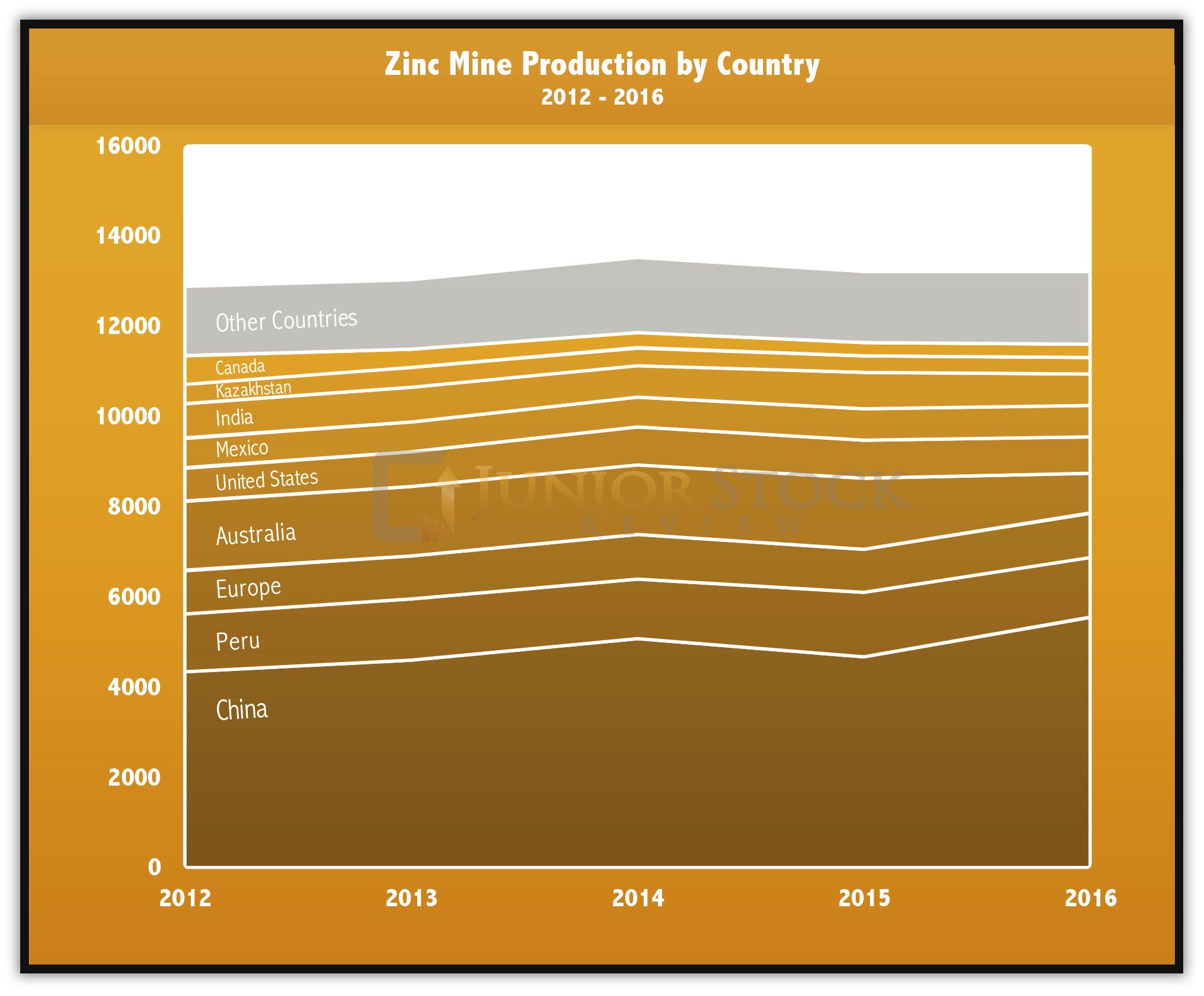
Zinc is mined all around the world, but a couple of spots in particular make up roughly half of the world’s mine production each year; China and Peru. In reality, China is the heavyweight when it comes to zinc production as its 5.5 million tonnes of zinc production is 4 times as much as the next largest producer, Peru, with 1.3 million tonnes. Australia is an honourable mention as before 2016, it held the position as the 2nd largest zinc producer in the world.

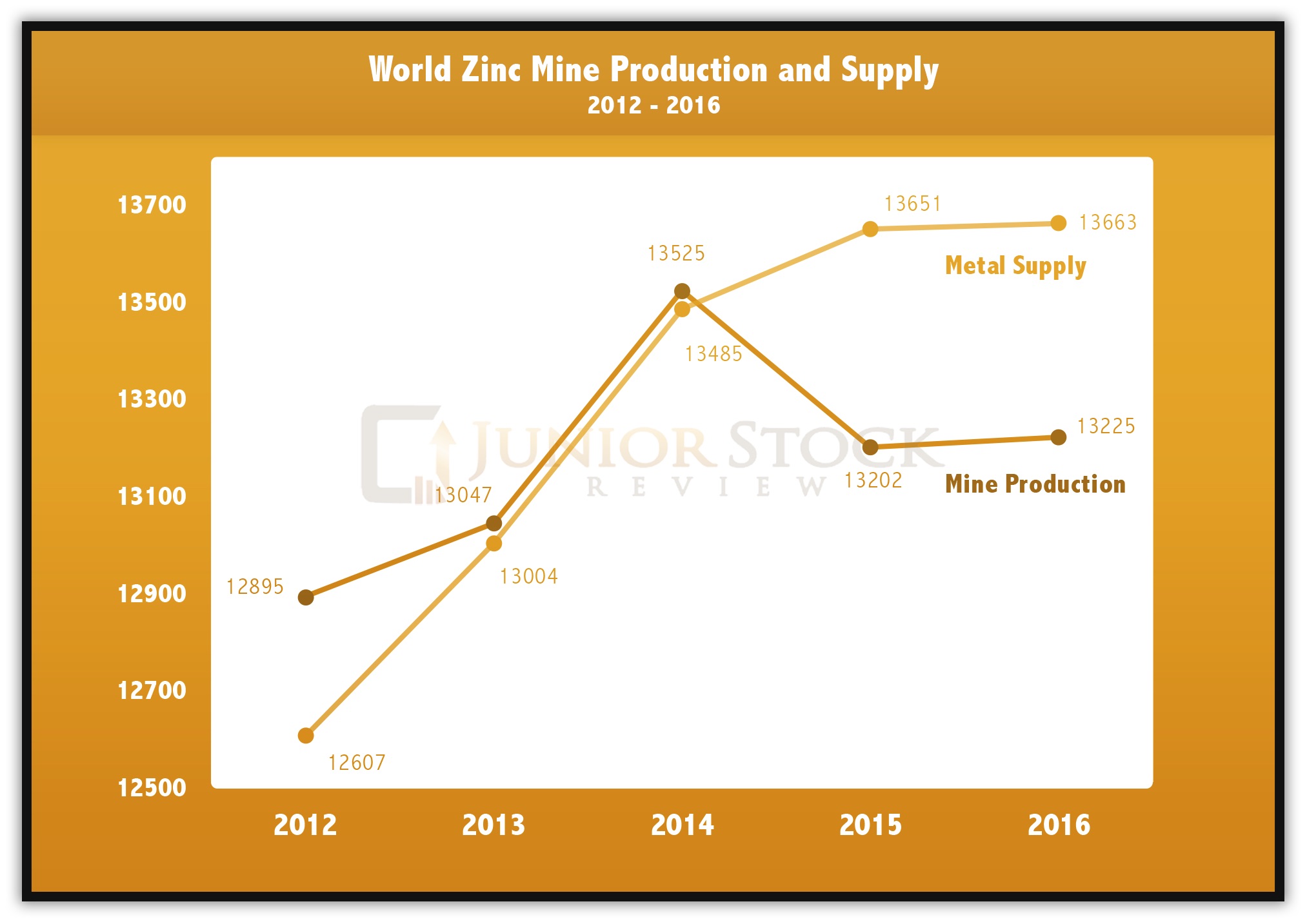
Over the last year, China has ramped up its production by almost 20%, however, this big leap in mine production was almost erased by the drop in production by the rest of the world. In total, 2016 ended with 22 more tonnes produced than 2015. The caveat to this analysis is that any data from China should be taken with caution as it may not be completely reliable.

The countries with the largest drops in zinc mine production since 2015 were Australia at -43.1% or 680K tonnes, India at -16.8% or 138K tonnes, Peru at -6.0% or 85 tonnes, and the United States at -2.3% or 19 tonnes.
 

Zinc Mine Production versus Refinement

Source: International Lead and Zinc Study Group


Australia

Australia’s production was drastically cut in 2016 due to the shutting down of MMG’s Century Mine. Century was Australia’s largest open cut zinc mine and was highly valued by smelters because its zinc concentrate had such low iron content, which helped minimize the smelter’s refinement costs.  The Century Mine’s loss of production will have to be filled by an increase in production from other mills or new zinc mines coming into production, or a combination of the two.

Additionally, on October 9, 2015, Glencore announced a reduction in its mine production by 500K, or a third of their annual zinc metal production, across their operations in Australia, South America and Kazakhstan. The reason for the reduction? The company states that the low zinc and lead prices do not properly reflect the metals scarcity and, therefore, they’re moving ahead with the cut in production until prices rise.  Glencore’s reduction affects its Australian mines by approximately 380K tonnes, and its Peruvian operations by 80K tonnes.  As the zinc price rises, Glencore may decide to bring this production back online , which will not happen overnight, but will have an impact on the zinc market supply dynamics when it does.


India

Indian zinc is mined by Hindustan Zinc Limited (HZ) a subsidiary of Vedanta Limited. HZ’s production is led by their flagship operation, the Rampura Aqucha Mine (RAM), which has a zinc reserve of 51.1 mt at 14.0% Zn, and an ore capacity of 6.15 mtpa. Details can be found in HZ corporate presentation from last summer and the summer of 2015. In particular, look at the last slide of 2015’s presentation. The last slide details HZ’s mine reserves, highlighting the quickly declining open pit portion of the Rampura Aqucha mine. The open pit will be depleted by 2018, removing a significant source of zinc from the global market. The plan is to transition this into an underground mine, where there is still a substantial amount of zinc contained, however, they’ve experienced issues with the transition.


United States

American zinc mine production was impacted by Nyrstar’s placing of its Middle Tennessee Mines (MTN) on care and maintenance. The news release issued on December 7, 2015 outlines that the company’s decision to put the mining operation on care and maintenance was related to the current zinc price and, therefore, to minimize their cash consumption, they had to take action. MTN’s impact on the market is around 50K tonnes per annum.

On January 7, 2016 Nyrstar announced the formal launch of the sale process for all or the majority of its mining assets. Further, on September 27, 2016, Nyrstar announced that it would be restarting its MTN operations, given the rise in the zinc price and its expected sustainability in the future. The restart of MTN will cost USD $14 million, and it will take over a year until the mill is at full production.  Given the current bullish outlook for zinc prices, I think that these assets will find a buyer.

Also, American production will be affected by zinc production declines from one of the world’s largest producing mines, Teck’s Red Dog, which is located in Alaska. In early 2016, Teck announced a forecasted reduction in its zinc production in the years ahead; see SEDAR for further information.


Future Mine Production (Restarts / New)

There are some new and existing mining projects that are scheduled to come online in the next few years, stretching out to 2021. Here’s a list of the biggest 4:

There are a more projects planned over the same time period, but each is much smaller in size than the 4 that I have listed here.


Mine Contractions and Closures

While there are a few big mines coming back online or starting up, there are a number of closures and contractions that will occur over the next 5 years. The production contraction is headlined by Teck’s Red Dog, Sumitomo’s San Cristobal and Glencore’s Mt Isa, which will all see a steady decline in their output. Mine closures are headlined by the HZ’s RAM open pit and Kayad, Sterlite’s Skorpion (Closure by 2021) and Glencore’s Bracemac-McL in Canada, which is on pace for closure in 2019.

There are more contractions and closures albeit they are much smaller than the ones listed. Cumulatively, however, there is roughly 1,000K tonnes being removed from the market. Unfortunately, we may be able to count on the loss of production with more confidence than the mine expansions and re-starts.


Zinc Stockpiles

Besides mine production, another source of zinc in world markets is from stockpiles.  The International Lead and Zinc Study Group data shows that zinc stockpile inventories have been steadily dropping over the course of the last 4 years. Currently, world zinc inventories sit at 1.3 million tonnes, down 82K tonnes from last year. Currently, the largest stockpile holders are the producers and the London Metals Exchange, which both have inventories around 400k tonnes.


Concluding Remarks

In all, zinc mine production has been relatively flat over the last 4 years, with an increase of only 330K tonnes since 2012. As discussed, MMG’s Century mine production is gone and will need to be filled with new production, if that deficit is to be filled. Glencore’s missing 500K tonnes of production will have an effect on the market when it returns, but that won’t happen overnight. Using Nyrstar’s Middle Tennesse Mine as a gauge for re-start, I think that you can expect it to take 6 to 12 months for Glencore to be back at full production. Finally, India’s giant zinc mine is making a big transition moving to underground mining; time will tell if they are able to maintain production levels from this prolific mine site.  Mine production is falling faster than it’s being replaced, and the bottom line, in my mind anyway, is that until Glencore announces they are bringing their missing capacity back online, the diminishing zinc supply will lead to higher prices.

Disregarding China, the impact of new and re-starting mines will almost be nullified by the amount of mine production contractions and closures over the next 5 years. If new projects aren’t developed, we could be standing in much of the same position that we’re in today, as far as supply is concerned.

China will have an impact on the future of the zinc market – the size of this impact is what’s in question. What’s surprising is that China is paying closer attention to the environmental and safety impacts of mining and manufacturing.  Inspections over the last year have resulted in production suspensions and closures of the smaller producers that couldn’t comply with the more stringent regulations. I think China will continue to lead in zinc production in comparison to the rest of the world, however, the current large difference in production levels may not be as significant in the future as it is today.

Zinc supply fundamentals are bullish, but don’t tell us the whole story. In Part 2 of this series on zinc, I will take a look at world zinc consumption, which should allow us to make some conclusions about where the zinc market is headed in the months and years ahead.


Don’t want to miss a new investment idea, interview or financial product review, become a Junior Stock Review VIP now – for FREE!


Until next time,


Brian Leni  P.Eng

Founder – Junior Stock Review


Sources:

Australian Atlas of Minerals Resources, Mines & Processing Centres

CEO.ca – #zinc

Geo Science World

Geology for Investors

International Zinc Association

University of Tasmania

U.S. Geological Survey

Zinc Die Casting


Disclaimer: This is not an investment recommendation, it is an investment idea. I am not an investment professional, nor do I know you and your specific investment criteria. Please due your own due diligence. I have NOT been compensated to write this article and do NOT have a business relationship with any of the companies mentioned in this report. I do NOT own shares in any company mentioned.

Posted on

A Conversation with John Hunt – Author, Doctor and Speculator

John Hunt

Throughout human history “imagined orders,” a term coined by Yuval Noah Harari, author of Sapiens, have been used to control populations. Harari states,

“Imagined orders are not evil conspiracies or useless mirages. Rather, they are the only way large numbers of humans can cooperate effectively.” ~ Sapiens – pg.110

It’s vital to define the words we use so that our perspectives can be fully understood. This being the case, I believe Harari would define ‘imagined orders’ as a set of principles that are not rooted in objective validity, meaning they don’t have ties to the laws of biology, physics and chemistry, that govern our world.

‘Imagined order’ is inter-subjective, meaning that even if one person’s consciousness is able to escape the grip of the imagined order, the mass consciousness is unaffected. Examples of inter-subjective concepts are: law, money, gods, nations and schooling.

By now, I’m sure you’re thinking, ‘okay what’s his point?’ My point is that we’re all free to make our own choices, but it’s my contention that on a grand scale, more and more people are relying on the State to make their decisions for them, further expanding the imagined order of our world. The ability to critically think and question our current state of being is lacking, and from my perspective, it’s only going to get worse unless we’re able to wake from this slumber.

Today, I have for you an interview with John Hunt. John is a pediatrician and Chief Medical Officer at Liberty Healthshare, which is a health sharing ministry created to help families combat the burden of excessive health care costs. He has also written a number of books that include Your Child’s Asthma, Assume the Physician, Higher Cause, and his most recent, a series of books collaboratively written with Doug Casey, the High Ground Novel Series; Speculator was released last year, and the next book, Drug Lord, will be released this summer.

Now, Speculator was my first introduction to John, but I found that book so fascinating and important on so many different levels, that I thought it made good sense to interview John to get to know the man behind this masterpiece a little better. If you haven’t already, be sure to read my recent interview with John’s co-author, Doug Casey.

During our conversation, Hunt and I discussed a few of the inter-subjective concepts that I discussed earlier, as well as his two recent books, Speculator and Drug Lord. Check it out, there’s a lot of value to be gleaned from his answers, actionable wisdom that can be applied in all areas of your life.


Brian: You have a very interesting background, majoring in geology at Amherst College and then receiving your medical doctorate from George Washington University.

To me, geology and medicine seem to be worlds apart. How or why did you choose this path for your education?

John: Amherst was a reasonably classical liberal arts college back then, before it became one of the zillion progressive arts indoctrination centers it is now. It doesn’t matter what your major is in true liberal arts—the idea is to teach your brain how not lie to itself. Unfortunately, progressive arts teaches the opposite skill.

Geology teaches a brain how to think in four temporal-spatial dimensions concurrently with ongoing physics and chemistry, with a good smattering of economics in there too. It’s preparation for anything that requires rational intelligence later. Certainly it’s good prep to help holistically think about patients. I didn’t realize all this at the time. I was just a dumb kid that enjoyed rocks and liked the geo professors. My geology training helped a lot while writing Speculator with Doug Casey, though.


Brian: In my opinion, the general population’s ability to think critically is on a steady decline. Following the birth of my first child, I started reading books about education and the different schools of thought for how children are best educated. In particular, two books stood out from the rest; Dumbing us Down and Weapons of Mass Instruction by John Taylor Gatto. Gatto, the former winner of the New York State Teacher of the Year award, tells a fascinating story of the American education system. In essence, I believe his message to the reader is that the essential function of the school system is to produce good employees, which yield unwaveringly to authority and stick to the status quo of social norms.

I have a two-part question for you; First, do you agree with Gatto’s thesis regarding the American education system? And second, if so, what needs to occur in order for it to change?

John:  Gatto’s work influenced my thinking a lot, so it’s no surprise I agree with him. Schools indoctrinate kids into doing what authorities tell them to do, while video games numb children’s brains to suicidal military missions from which they fancifully can keep coming back to life. The kids are prepped to be either obedient serfs or cannon fodder.  Some go on to college to pay the hyperinflated tuitions that result from too much money available in the form of college debt. Without the feds in there, college tuitions would be much cheaper, but the kids didn’t get taught that in school, so they get suckered into selling their lives as indentured servants, paying off forever the company store owned by the government. Politicians claim to fight to create jobs (work) on the one hand while fighting also for shorter work weeks (less work) on the other hand. How about the politicians stand up for freedom instead of work, and let us figure out what we want to do with our freedom? Back to education—to fix it, the governments have to get out of the way. Then the inventors can invent, and the people—instead of the politically powerful—can choose their education. That’s all it takes. Ain’t gonna happen though, so the answer is that the parents and students need to ignore and avoid the government and its subsidies and insanities, and not just in the educational sector, but everywhere government inserts its parasitic tendrils.


Brian: I believe the power of exponential growth is not fully appreciated or understood by most people. Human evolution has grown leaps and bounds in the last Century from a technological standpoint, and it doesn’t appear to be slowing. In fact, author Ray Kurzweil wrote in his book, The Singularity is Near, that with the current pace of technological advancements, humans will merge with machines by 2050 and begin to explore the stars.

Do you agree with Kurzweil’s statement about the current pace of technological advancement and his prognostication about our merger with machines?

John:  It’s already happening. The question is will the free market producers much longer be able to outpace the parasitic majority who have been taught in their schools and colleges that stealing from others and enslaving them is their right. By that I mean all the egregious taxation we now suffer that is far outside of the US Constitutional limits (theft), and foolishness such as the right to health care (aka the belief that you have the right to compel someone to provide you with healthcare). If the free market can be left to grow, reasonably unabated, then within a thousand years freedom will bring humans to immortality, incredible power, and near omniscience. But if those who preach the ends justify the means philosophy keep control of the education system, media and politics, then ignorance and immorality will prevail and we’ll fall back into dark ages. Any species in the universe that is even 10,000 years ahead of us evolutionarily won’t allow us to become a member of their galactic club of omniscience and omnipotence if our species still thinks initiation of force and fraud is acceptable. Those alien types (legal or illegal) will keep us down until we grow up, and swat us like flies if we forcibly encroach upon them. So we libertarian types need to gain the cultural ascendency and teach the moral high ground for our species to thrive.


Brian: Although I still struggle with this sometimes, my biggest take-away from your book, Speculator, was the importance of listening to your gut.

In the book, Uncle Maurice gives Charles the following advice,

“Contrary to common opinion, intuition wasn’t mystical; it was scientific. Intuition was the ability to properly integrate many subtle pieces of information. To have good intuition, therefore, someone needs experience and data and a logical mind that can fuse them into coherence” ~ Speculator (PDF pg.17).

There are a lot themes in Speculator. Is there any particular lesson or theme that you wanted to bestow upon the reader, and if so, what? Why now?

John:  Listening to your gut works well, but only if you aren’t prone to lying to yourself. Most people lie to themselves to protect their ego from their own internal contradictions. Internal contradictions induce stress unless the person deals with them or refuses to perceive them. Example—college tuitions rise not because of better teaching, but because of poor stewardship of resources by academics (equivalent to bad fiscal policy) and the ever increasing flood of easy money (equivalent to bad monetary policy). The solution the progressive have for high tuition? Make more easy loans available! That of course was the cause of the problem in the first place but they are in denial about this internal contradiction. They lie to themselves.  Another example—medical costs are sky high because of insurance intermediacy and the third party payor mentality—called moral hazard. Moral hazard leads to price inflation, and in health care it is caused by insurance. The response of both progressives and conservatives? To mandate or subsidize insurance—the very thing that caused the problem. To survive with such blatant internal contradictions again requires prominent denial of reality. People lie to themselves all the time. The sequel to Speculator, which is titled Drug Lord, is about the epidemic of people lying to themselves. But the theme of Speculator and the whole series is that morality (natural law) trumps civil law (political law) any day of the week and twice on Tuesdays.


Brian: While there’s an obvious connection between Doug Casey and the speculation theme in the book, how would you describe your connection? Are you a speculator?

John: At this point in economic history, stock market investors are really all speculators. The government and central banks are now every bit as influential on the success or failure of a venture as whether it produces value. What should be conscientious investment decisions instead need to be speculative guesses about what distortion the fiscal and monetary “authorities” are next going to apply to the markets. I could say that I speculate that the dollar will continue to fail, that gold and bitcoin will be money. But really I am just gambling in bitcoin because—despite my constant reading about it—too many others have far better knowledge than I do about it. I speculate that government and central bank manipulations will result in a bubble burst that will hurt everyone except those who caused it and a few who prepared. So I am at least partly prepared. But I hedge, by having investments that thrive in the political economy, although I know they will suffer when the political economy melts down. I’m a speculator, sure.


Brian: I recently interviewed Doug Casey, co-author of the High Ground Series, and he mentioned that the second book, Drug Lord, would be hitting the shelves this July. In the interview, Casey makes the comment,

 “we’re trying to reform the unjustly besmirched reputations of a number of highly politically incorrect occupations.” ~ Junior Stock Review Interview

Casey is referring to the reputation of a few of the figures that have been and will be featured in the books, such as speculators, drug lords and assassins.

Where do the negative connotations regarding these types of people come from? And what does it say about the social construction of our current society?

John: It’s another example of the collectivist contagion rearing its incredibly ugly head. It’s not speculation, drug dealing or assassination that is wrong per se. Speculators who profit without force or fraud are acting morally and should not be lumped in with fraudsters. Which is immoral—the drug dealer who make possible some voluntary transactions between individuals, or the pharmaceutical company that lobbies for monopoly power through unconstitutional actions of the FDA and lies with statistics to convince naïve medical academies and government guideline committees about the value of their very marginal product? In regards to assassins, the Bible does not say, “thou shalt not kill” but rather “thou shalt not kill unjustifiably”. It is a sad reality that there is no organizational concept on the planet more active in the killing of the innocent than government. Collectivists group, and then attack, the 1%, even though some of the 1% are brilliant producers who help everybody. In contrast, individualists recognize that some of the 1% are cronies, and some of the 99% are cronies, and we prefer to judge against the cronies individually. Collectivists define racism as one race oppressing another. This group think definition falsely accuses good people of being racist—based solely on the color of their skin, nullifies individual responsibility, and obviates individual power to end racism. This collectivist definition has resulted in the recent exacerbations of racism in this country. Individualists define racism in the much broader terms of discrimination based on race, which places the individual moral agent into the process of choosing right from wrong.  Overall, our culture has been infected with a destructive contagious disease called collectivism.  We need a vaccine.


Brian: It has been a pleasure John, thank you for answering my questions.


The imagined order of our current state of being should be questioned as a number of our society’s strongest beliefs are broken and appear to be on their way to getting worse. The ability to critically judge ourselves and the inter-subjective concepts that we live by is vitally important, in my opinion.

On another note, I’m eagerly anticipating the release of John and Doug’s latest book, Drug Lord, this summer. If it’s anything like Speculator, it’ll be a MUST read for anyone looking for an entertaining story. For those looking to explore some deeper concepts, I’m certain John and Doug will not disappoint, as they attempt to reform the unjustly besmirched reputations of a few of the society’s most politically incorrect occupations.


Don’t want to miss a new investment idea, interview or financial product review? Become a Junior Stock Review VIP now – for FREE!


Until next time,


Brian Leni  P.Eng

Founder – Junior Stock Review


Posted on

Gold Rush Quebec – 2017

Beaufield Resources

Quebec’s Abitibi Greenstone Belt is one of the top ranked regions in the world for mining investment attractiveness – and for good reason. Currently, there is one region in particular in the Abitibi which has attracted a lot of attention; the Urban-Barry Greenstone Belt, which sits 170 km northeast of Val d’Or and 125 km southwest of Chibougamau.

The Urban-Barry belt is located in the Abitibi sub-province of Superior. This area is underlain by Archean Volcano-Sedimentary, which mainly contains gold mineralization in quartz-carbonate veins mineralized with sulphides. Although a few of the companies in the area possess a NI 43-101 resource, the area hasn’t seen a lot of exploration, in relative terms. The area will, however, see thousands of metres of drilling over the course of 2017, which should provide insight into the value of the mineralization in the area.

What’s the source of the excitement for this region of the Abitibi? In my opinion, it’s because of the great results that Osisko Mining (OSK:TSX) has been releasing over the last few months. Their Windfall Lake Gold Deposit has had some stellar drill holes and appears to possess all of the makings of the region’s next mine.

Windfall is in close proximity to Beaufield Resources (BFD:TSXV), Bonterra Resources (BTR:TSXV), Metanor Resources (MTO:TSXV) and Urbana Corporation (URB:TSX). Each of these juniors own prospective land packages around Windfall and are fully financed to explore for the next economic gold deposit in the area.

Today, I would like to introduce you to the Beaufield Resources story.  Beaufield owns property in the heart of the Urban-Barry Belt, where it shares its border with Osisko’s Windfall Gold Deposit. I believe the company has a ton of potential, especially in the near term with its Urban property. Let’s take a look:


Beaufield Resources (BFD:TSXV)

  • MCAP – $28 million (at the time of writing this report)
  • Shares Outstanding – 195 million
  • Fully Diluted Shares – 215 million
    • Options – 6 million
    • Warrants – 14 million
  • Osisko owns 16.4% of the company – a sign of the potential value in the properties that Beaufield owns.
  • Closed a $6 million financing on Feb 9, 2017
    • Issuing a total of 40 million common shares at $0.10 and 13.3 million flow-through shares at $0.15.
    • O3 investments a wholly owned subsidiary of Osisko Mining subscribed to 31.7 million of these shares.
  • $8 million in working capital


Beaufield’s People

  • Beaufield has seen some changes in management as of late, with long time President and CEO, Jens Hansen, and Board of Directors member, Bernard Deluce, resigning.
    • Ron Stewart, a Professional Geologist with over 30 years experience within the mining industry has been appointed interim President and CEO. Stewart has experience on both sides of the table, having worked in both capital markets and as an Executive on a few junior resource companies. He has held positions with Dundee Capital Markets, Macquarie Capital Markets, Clarus Securities, Verena Minerals (now Belo Sun Mining), and Kinross Gold Corp. Presently, Stewart is also the President and CEO of Eros Resource Corporation. Stewart has a well rounded background and will be able to bridge the gap between the exiting Jen Hansen and a new, permanent CEO.
    • Robert Wares was appointed Chairman of Beaufield’s Board of Directors. Wares has over 35 years of experience in the mining industry, with a long history of success. He is credited with the discovery of the Canadian Malartic gold deposit and was a co-founder of Osisko. Wares is a fantastic edition to the Beaufield team, one that I suspect will prove to be instrumental in their success in the months ahead.
    • Mathieu Stephens is a Professional Geologist and VP of exploration and has been with Beaufield since 2008. I had the chance to speak to Stephens at PDAC this year and was very pleased with what I heard for this year’s upcoming drill program.
  • In February of this year, a press release was issued by Jim Deluce (Former BFD Director) and Shanghai Huaxin Group Limited, expressing their displeasure with the progress the company has made over the last few years, as well as with the recent financing terms, which they believe were too favourable to the financing parties (which included O3 Investments, a subsidiary of Osisko). In all, this group of concerned shareholders represents around 21.5 million shares or 11% of the company.
    • Beaufield has responded to the complaints in a news release, which can be found here. In my opinion, Beaufield has done a great job with their response and I feel comfortable as a shareholder that the situation will not affect their progress moving forward. The Beaufield shareholder’s meeting has been rescheduled for April 11, 2017.
    • Beaufield responded to my question, via email, pertaining to the concerned shareholder with, “The new Board has been endorsed by the concerned shareholders.  The Annual Meeting of Shareholders will be held onApril 11, 2017 and the shareholders will receive over the next week the proxy material. We are confident this matter is settled and that the company will be able to focus its efforts on exploration and create value for its shareholders.”


Beaufield’s Properties

  • Urban Property, located within the Urban-Barry Belt, consisting of 3 blocks of property: Rouleau Block, Golden Retriever Block and Macho Block
    • Urban Property Historic Resource (not 43-101) – 540,000 tons @ 7.2 g/t, which is roughly 125,000 oz Au
    • The Rouleau Phase 1 drill results
    • Rouleau Phase 2 drilling has begun and is focusing on deeper drilling and a series of exploration targets just beyond the known Rouleau zone. Results should be released in the next 2 to 3 weeks.
    • 1500 m from Windfall’s Caribou zone lies the ET zone of the Rouleau Block. This area is of particular interest because it shares a similar geophysical signature,
      • “A linear magnetic depression that is interpreted to be related to a magnetite destructive silica-sericite alteration corridor associated with the Windfall intrusive system.” ~ Beaufield Corporate Presentation
      • The geophysics and geology clearly indicate the presence of a fold in this area, meaning that the host lithological units of the Windfall deposit may be present within Beaufield’s ET zone.
      • Two holes will be drilled before winter is over, so we will stay tuned for those results.
    • The Golden Retriever Block is currently priority, as the Beaufield team believe that this area, which is partially covered by swamp, may be a continuation of the mineralization found in the 1980s on Osisko’s Black Dog Property. An induced polarization survey was executed on this target area and did indicate a strong chargeability anomaly.
    • The Macho Block drill program is still under consideration. If it happens it will be in the summer as Beaufield has prioritized its drilling for the immediate future.

The Urban property is the focus of my speculation, as I believe there is a ton of potential in drill results that we will see over the course of this year.  Urban, however, is just one of 5 properties that Beaufield owns; here is a hyperlinked list of Beaufield’s other 4 properties:


The Beaufield story is not without its potential detractors:

  • Management changes – the issues and changes within the management structure that have arisen over the last couple of months may be concerning for some. In my opinion, Beaufield has dealt with the situation well and has appointed some quality people to help add value to shareholders in the immediate future.
  • Exploration blunders – bad drill results are always a risk with mineral exploration companies, however, given the Beaufield property locations and their due diligence in preparing for their drill programs, I believe the odds of good results are closer to being in our favour.
  • Share structure – there are a lot of shares out, which is all too common for an exploration company of this age and size, however, I am willing to accept this, due to the upside potential I see with this year’s drill program results.


There are always detractors or potential pitfalls in every junior company’s story, but now I would like to review the reasons I believe Beaufield has such great upside potential.

  • Great land package – Not only is the Urban-Barry Belt arguably the hottest exploration area in Canada right now, but Beaufield owns some great properties in some other highly prospective areas, such as the area around Goldcorp’s Eleonore gold mine or its Trolilus-Tortigny Property, which possesses a 43-101 resource estimate (Au, Ag, Cu and Zn). There is a lot of potential in Beaufield’s properties.
  • PUSH – we should have a good idea of Beaufield’s potential in the next 6 months, giving us great short term PUSH for upside in the stock price. Plus, I wouldn’t hang my hat on this, but good results from the neighbouring Osisko, Bonterra Resouces or Metanor Resources could see a spike in all of their share prices.
  • $8 million in working capital – it is one thing to have great properties, but you need money to explore them and $8 million gives Beaufield the working capital it needs to add value for shareholders.
  • Osisko’s ownership and involvement – Osisko has a great management team and, for me, their interest in a company goes a long way. Osisko owns 16.4% of Beaufield and has one of their own, Robert Wares, on the Board of Directors. For me, this is a good indication of Beaufield’s potential.


You be the judge. Great properties, short term PUSH, $8 million in working capital and keen interest from one of the best junior mining teams in the mining industry. I’m biased because I bought shares within the last two weeks. Do your own due diligence and decide for yourself.

Stay tuned for a look at the other main juniors in the Urban-Barry Belt, Bonterra Resources and Metanor Resources.


Don’t want to miss a new investment idea, interview or financial product review, become a Junior Stock Review VIP now – for FREE!


Until Next time,


Brian Leni  P.Eng


Founder – Junior Stock Review


Disclaimer: This is not an investment recommendation, it is an investment idea. I am not an investment professional, nor do I know you and your specific investment criteria. Please due your own due diligence. I have NOT been compensated to write this article and do not have a business relationship with Beaufield Resources. However, I do own shares in Beaufield Resources.


Posted on

A Conversation with Doug Casey – LIFE, FREEDOM AND SPECULATION

Doug Casey

While it can be highly profitable to know which stocks the sector’s best are picking, I prefer to know the philosophy and process behind their success.

“Give a man a fish, and you feed him for a day. Teach a man to fish, and you feed him for a lifetime.” ~ Unknown

Now, don’t get me wrong, I’ve definitely benefitted from paying attention to industry heavy hitters’ stock picks. Without a doubt, however, my biggest successes have come from applying the lessons I’ve learned about speculation from those same individuals – people like Doug Casey.

This line of thinking is what shaped the series of questions I asked Doug, and while they may seem a bit unorthodox, I believe there’s a lot of actionable wisdom to be gleaned from his answers. Look closely and you will discover what is, in my opinion, the basis for successful speculation in the most volatile market in the world, the junior resource sector.

Without further ado, A Conversation with Doug Casey:


Life

Brian: Last fall, in an interview with Albert Lu’s, The Power and Market Report, you mentioned that you have become less attached to physical or material things, as you’ve gotten older.

You’re still an active speculator and you speak regularly at various investment conferences around the world, so if it’s not the desire to make more so that you can buy more stuff, what motivates you to keep going?

Doug: The first rule, the prime directive of all living beings whether they be amoebas, people, corporations or governments, is to survive. And, in order to survive, you need resources. So, it’s genetically programmed into all entities to get more “stuff”, because resources helps you to survive. Of course I want more money because it allows you to do more things; money helps you to survive. Perhaps take advantage of a new technology, a break-through that enables you to live for 200 years. It’s not that I’m un-interested in a higher standard of living and more wealth. Everybody is, that’s natural. But from a psychological point of view, I’ve put it lower on the totem pole.

I’m thinking about writing a book that would be called Renaissance Man. It would centre around the three most basic verbs in every language; be, do and have. Most people concentrate on the ‘have’ verb; I want to have a new car, I want to have a new house and I want to have a new girlfriend. This is actually very stupid. The ‘having’ is not important; more important is ‘doing.’ In order to ‘have,’ you need to ‘do;’ you need to create something, you need to provide a good or service first in order to ‘have’. The ‘do’ is very important. You need to gain skills. Gaining possessions is marginal, gaining skills is much more important.

Even more important than that is the verb ‘be;’ you can change and improve your essential being. That allows you to do things, and that, in turn, allows you to have things. People just think of the end product – the have – without thinking of the ‘be’ and the ‘do.’ Of course, on the other hand, if you have stuff and you’re not corrupted, you can use the ‘have’ to facilitate your ‘doing’ and the ‘doing’ can facilitate your ‘being’ something different. It works both ways.

To answer your question, I’m trying to concentrate more on the ‘be.’


Brian: Last year, in an interview with Jeff Berwick, you mentioned that the book, The Market for Liberty, changed your life, transitioning your political philosophy from an Objectivist to a Libertarian. A change in political philosophy is a major transition, one of which I’m not sure every person is capable. In my view, we live in a society of paradigms or bias that lock us into thought patterns that keep many of us blind to other alternatives that may be more efficient or beneficial.

Whether it be financial, political or social, in your opinion, how does one keep an open mind and see through paradigms and their own inherent bias?

Doug: A very good question. I’ve become more pessimistic as I’ve gotten older because it occurs to me that most people, even if they use the phrase, ‘I think,’ what they really mean is ‘I feel.’ In other words, it’s not a rational process, it’s an emotional process for most people. That’s why political movements are always disasters.

In my own personal pilgrim’s progress, I started out like most kids, as a liberal. I became a conservative after I read Barry Goldwater’s, Conscience of a Conservative. It made sense, but, in high school, I had had no other political exposure. Then, after college, I read Ayn Rand’s book, Virtue of Selfishness. I suggest absolutely everyone read it. It’s only 120 pages. But it’s so brilliant I had to put it down after the first page because I was in shock. I couldn’t believe that someone could crystallize all the things that I’d thought about, but hadn’t put together yet.

Then, when I read, Market for Liberty, I realized what was wrong with Objectivism, which is actually a secular religion. Market for Liberty is an extremely important book; it shows how a society would work without government. The big problem is that everyone thinks: “what should the government do?” or “maybe if we change the government to do this instead of that, everything is going to be better,” This is completely barking up the wrong tree. The problem is the state itself; it’s government as an institution. The State is an anachronism in today’s world, it’s out-moded, it’s a stupid, destructive, coercive concept. It’s actually inherently evil. Market for Liberty explains how society might work without the State. Stop listening to liberals, conservatives, republicans and democrats; listening to them is a waste of time. That’s my take on the subject.


Freedom

Brian: In my opinion, the vast majority of people undervalue freedom. Instead, fear has taken over and is playing centre stage. Ironically, fear is quelled with greater government regulation and comes at the cost of our freedoms – which are diminishing by the day.

I recently read James Rickards’ latest book, The Road to Ruin, and even though I agree with him, it still surprised me to read, “Facism is not in our future, it is here now.” ~ The Road to Ruin pg.256. Over the last decade, whistle blowing has hit the mainstream, with Julian Assange and Edward Snowden becoming household names.

My question is do you think that the segment of the population that has heard the claims made by people like Assange and Snowden truly understand their magnitude? Please explain.

Doug: Apparently half of the people in the US, or thereabouts, think that Snowden and Assange are traitors, which is ridiculous. They’re heroes, both of them are heroes. I don’t know what they are like personally, but their actions are heroic. As far as what Rickards said, yes, he’s absolutely right. In fact, all the States in the world are socialist or fascist.

You have to define these terms accurately. Marx did that; he coined the term ‘capitalism,’ incidentally. He defined capitalism and socialism and, actually, using a Marxist analysis, you can define fascism as well as communism. It’s all about the means of production, ownership of property.

Fascism is an economic system, first and foremost. It’s not really about jack boots, good looking black uniforms, and soldiers goose stepping. It’s an economic system,perfected by Mussolini. It’s one where both the means of production and private goods are privately owned, however the state controls them all.

Socialism has been a disaster throughout the world, of course. It can be defined as state ownership of the means of production, but you can still own consumer goods– houses and cars and stuff like that. But the state controls it all. Fascism is much more economically productive than socialism but not nearly as productive as pure capitalism, where everything, absolutely everything, is owned—and controlled– privately. But that doesn’t exist anywhere. There are no capitalist systems in the world. They’re mostly fascist systems.

The average person conflates the government with the country; they’re different things.  Calling Assange and Snowden traitors is goofy- traitors to what? I mean, to the country? Not to the country, no, they’re trying to preserve the values of the country. Traitors to the government, which is different. Who really cares about the government? The government just a bunch of deep state types, basically criminal personalities that are controlling the country and making people think that the government is the country. It’s not. In fact, it’s a dead hand on top of the country. The fact that most people conflate these two things alone tells me that there’s no hope.


Speculation

Brian: While paradigms and bias give us the basis for how we view the world, emotion is the fuel that causes us to act without logic. The biggest lesson I have learned in my speculating career, thus far, is to act against the crowd and buy when everyone else is selling – and vice versa.

Would you say that you have successfully removed emotion from your speculations and investments, over the course of your speculating career? Why or Why not?

Doug: I try to, but it’s very hard to separate your rational mind from your emotions. In fact, when I feel like buying something or selling something, I say, “wait a minute, maybe I should do exactly the opposite of what I feel.” So, it’s very hard, but it’s important. If you start thinking that way, acting against your own emotions, it does improve your results because, as a general rule, you don’t want to be in what they call a ‘crowded trade,’ where everyone thinks, “yeah, this is going to happen”. Maybe there are actually good reasons why something should happen, and maybe it will happen. But, if everybody already believes that and is already long or short, there’s no profit in it, the profit is already gone.


Brian: Whether it’s Kondratieff wave theory or William Strauss and Neil Howe’s (authors of The Fourth Turning) analysis of the cycles of generations, human history appears doomed to repeat itself. Although, as a species, the human race is continually improving itself (the ascent of man) from a technological stand point,

Do you think we can ever break the boom and bust cycles that have been a common thread in our history?

Doug: Yes, I think we can. Boom and bust cycles have a significant psychological element, of course. But in the modern world, cyclical booms and busts, are basically a result of monetary manipulation. In other words, central banks create the business cycle. There’s a cyclical aspect to everything but central banks, which claim they exist to smooth out cycles and make things more predictable, have actually done exactly the opposite and accentuated these things.

A more basic problem is the psychological aberrations that lie within everybody’s mind. Everyone has their own set of psychological aberrations, and when you put a bunch of people together in a group the size of a nation state, they necessarily act according to the lowest common denominator, and the lowest common denominator is these psychological aberrations that make people act like chimpanzees. So, perhaps you’re never going to get rid of business cycles from a psychological point of view, but you could hugely improve things by getting rid of central banks, which create an actual monetary business cycle.

This is why the rich have been getting richer and the poor are getting poorer, whereas in the past, previous to the creation of the central banks around the world, 100 or so years ago, it was a more level playing field. The rich, not the poor, are in a position to profit from inflation.

Technology and science have made things better, of course. We would already be colonizing the moons of Jupiter if it hadn’t been for the State and the distortions that it has caused in the economy.


Brian: As you know, the junior resource sector is regarded as the most volatile in the world. The combination of geology, accounting and a general knowledge of markets can make the average investor or speculator feel as though the odds are perpetually against them.

In your opinion, how does one tilt the speculating playing field in their favour?

Doug: Well, I developed a mnemonic with the 9 Ps,* to help in assessing junior mining stocks, Mining is a crappy business, it’s a 19th century choo choo train business. This is why kids today aren’t going into mining. Sure, it’s fun to play in the dirt with big yellow trucks. And you need all of the things that come out of the ground. But it’s a horrible business.

It used to be a good business; you found a deposit, you developed a mine, nobody gave you any trouble, you made a lot of money. Today, it’s harder than ever, even with modern technology, to find a deposit anywhere on Earth, which is very picked over,. And mining is much more capital intensive than it used to be. You’re mining lower grade deposits, and it’s 10 years from the time you find something until the time you can start mining, because of regulations, NGOs, native groups, and taxes. It’s a horrible business.

That said, mining stocks are still the most volatile stocks in the world. But volatility isn’t your enemy. Volatility is your friend if your timing is good. Or it can be your deadly enemy if your timing is bad, obviously. *NOTE: The Nine Ps of Resource Stock Evaluation: People, Property, Phinancing, Paper, Promotion, Politics, Push, Pitfalls, Price – A Special Report Detailing each P can be downloaded for FREE from Casey Research.

Brian: In your Introduction to Strategic Investing, on page 21, you give the reader 4 steps to solidify their financial base, while providing them with protection against unexpected dangers and the liberation to become a successful speculator. The four steps are: Liquidate, Create, Consolidate and Speculate.

Strategic Investing was published in 1982; in your opinion, do these steps still hold true in today’s world? Please explain.

Doug: They are more important in today’s world than they were back then. Strategic Investing, in fact, is a very good book. About a quarter of it, or more, is about the stock market. The stock market was less than 1000 then, and I said the market was going to 3000—which people thought was absurd.. And I recommended a bunch of stocks which were yielding 10-15% in current dividends.

But at the same time, I felt – and I still do feel – that we were going to have a major depression. You have to look at western civilization itself, which has been going downhill since the start of WW1. American civilization has been going downhill since the mid ’50s, and the average American’s standard of living has been going down since the early ’70s. Now I think we are entering the trailing edge of this huge financial hurricane that we entered in 2007. You have to look at the long term time frame for all of these things.

Listen, we’re going to have a depression that, despite the huge advances in science and technology which are ongoing and wonderful, is going to be the biggest thing that has happened in modern history— much bigger than the unpleasantness of 1929 to 1946.

In that context, it makes sense to liquidate, which means get rid of everything you don’t need, that’s just a burden. Reorient yourself, consolidate, find out what you want to do, what your skills are, who your connections are. Take advantage of that. Stop thinking like an employee. And you’re going to have to learn to speculate, because in times of monetary chaos, there are a lot of opportunities for a speculator. But you have got to have the capital in order to engage in speculations, and so those 4 things, I think, are more important now than they were in ’82, which incidentally, was a very chaotic time.


Brian: In my opinion, your book, Speculator, can be read on a number of different levels. It’s simultaneously a great adventure story – complete with death, love and suspense – a useful guide to speculation, and a philosophical commentary on some of the most important social topics of our world. Although I still struggle with this sometimes, my biggest take-away was the importance of listening to your gut.

In the book, Uncle Maurice gives Charles the following advice,

“Contrary to common opinion, intuition wasn’t mystical; it was scientific. Intuition was the ability to properly integrate many subtle pieces of information. To have good intuition, therefore, someone needs experience and data and a logical mind that can fuse them into coherence” ~ Speculator (PDF pg.17).

With this book, was there a particular lesson or theme that you wanted to bestow upon the reader, and if so, what? Why now?

Doug: Speculator is the first in a series of 7. We’re going to release the next one in July, Drug Lord. We’re trying to reform the unjustly besmirched reputations of a number of highly politically incorrect occupations.

People automatically think, “Oh, speculator. Must be a horrible person taking advantage of the problems of poor people that are losing everything they have.” In Speculator our hero, Charles Knight, who is 23, goes to Africa, exposes a mining fraud, gets involved in a bush war and makes a huge amount of money. But he’s highly ethical. We show the speculator as a good guy.

In the next book, Charles becomes a Drug Lord, dealing in both legal and illegal drugs. We show how that business works, the morality of it, and that you can be a good guy as a drug lord, too. When he becomes an assassin in the third book, we deal with the morality and history and the techniques of an assassin.

You have to break away from the crowd. That’s the big lesson, That’s what our hero, Charles Knight, does by dropping out of high school, not going to college, and running off to Africa. He does this throughout his life, doing things that few others do.  Most people act like potted plants. They’re born some place, they grow up there and they stay there. That’s OK for plants, but it’s not a very good survival strategy for a human being. There are a lot of themes in Speculator.


Brian: Doug, it’s been an absolute pleasure, thank you very much for taking the time to answer my questions.


There isn’t just one way to be successful in life, we all have different paths to achieving our goals. There are, however, skills that we can develop, over time, that will help us overcome most obstacles that we encounter.

In this conversation with Doug, we tackled a few of the topics that I, personally, believe are major hurdles for individuals during their pursuit of wealth. These are highlights for what I believe were the most important takeaways from my conversation with Doug:

  • Stop focusing on the ‘HAVE.’ Instead, concentrate on the ‘BE’ in order to ‘DO.’
  • Read Ayn Rand’s Virtue of Selfishness, and Morris and Linda Tannehill’s, Market for Liberty. These books could change your life.
  • Liquidate, Create, Consolidate, and Speculate – There are going to be opportunities to speculate, but you will need to have the capital in order to engage. These four steps have never been more important than they are now.
  • Most importantly, be a contrarian, act opposite to the crowd, do things that nobody else is doing!
  • Watch for the release of Drug Lord in July – the next adventure in a 7 part series that began with Speculator, a story that’s not only exciting and enjoyable to read, but draws on some very important lessons for speculation and our society .


Don’t want to miss an investment idea, interview or financial product review? Become a Junior Stock Review VIP now – for FREE!


Until next time,


Brian Leni  P.Eng

Founder – Junior Stock Review

Posted on

Insights on the Resource Market with Brent Cook and Joe Mazumdar

Brent Cook - Exploration Insights

In January of this year, I attended the Metals Investor Forum and heard a presentation entitled, Entering the Twilight Zone, given by Joe Mazumdar of Exploration Insights. Exploration Insights is a highly respected newsletter publication within the junior resource sector.

Brent Cook, the letter’s founder, is an economic geologist who has worked in the mining industry in a number of different roles. As an independent consultant, he provided advice to numerous mining companies around the world such as, Newmont Mining (Santa Fe), Freeport McMoran (Cyprus-Amax) and Rio Tinto Mining, just to name a few. Cook also worked for Rick Rule at Global Resource Investments, providing analysis and commentary on a host of different junior resource companies.

Exploration Insights added a key component to the team in 2015, with the addition of Joe Mazumdar. Previously, Mazumdar was a Senior Mining Analyst at both Canaccord Genuity and Haywood Securities. He has also worked for a number of mining companies over the course of his career, which include Newmont, IAMGOLD and Rio Tinto.


Entering the Twilight Zone

The title of Mazumdar’s presentation reflects where we stand in the current resource market, as most aren’t quite sure where we’re headed. One thing is for certain, however, the road ahead will be volatile as President Trump attempts to execute the promises he made during his campaign.

Here are a few notes on what Mazumdar had to say about some of the metals. These comments are summarized from my notes, please don’t take them for verbatim. If you would like to watch the presentation, you can check it out here.

Copper – Days of inventory are dropping versus a rising real copper price. Mazumdar believes this is a real trend and that an event such as the 2013 Binghamton Canyon landslide disaster would certainly lead to a price spike.

Uranium – The supply overhang is still very large, it’s going to take a couple of years to unwind. Mazumdar believes that if you want to participate in the uranium sector now, buy a good uranium explorer, as most of the producers can’t make money at this U3O8 price.

Gold – The gold price is rising in all of the world’s major currencies, which is a very good sign for the future of gold, and a glimpse into how much uncertainty still exists in the market. Trump is expected to add $5 trillion to the American debt total, and real interest rates could stay negative; all of the makings of an inflationary environment, which would be great for gold.


Current Exploration Insights Portfolio Position Percentages:

  • 45% Prospect Generators
  • 42% Explorers & Developers
  • 13% Producers

To further summarize Mazumdar, we’re positioning ourselves in high risk / high reward companies, as there aren’t a lot of high quality assets out there and the majors aren’t exploring to replenish their reserves. Therefore, the highest pay back is going to be with those that are exploring for new discoveries, which will eventually be taken over by the major mining companies.

Finally, Mazumdar finishes off his presentation with what Exploration Insights uses for its criteria in picking companies and keeping them within their portfolio:

  • Solid management team
  • District size land packages
  • Companies that have a high potential for M&A activity versus leveraged / optionality
    • Majors are looking for at least 15% after tax IRR
  • Find the fatal flaw as soon as possible and then sell


I recently had the opportunity to ask Cook some questions about the current gold market, and how he thinks the average investor can tilt the odds in their favour when buying companies in the junior resource sector. Check it out:


A Conversation with Brent Cook of Exploration Insights

Over the last ten years, I’ve used a number of different financial products to try to give myself an edge in junior resource speculation. I believe it’s tremendously important for people to match their own investment persona with the financial product that they’re going to be using.

What do I mean by matching your investment persona with financial products? Specifically, in the context of the junior resource sector, which is about as risky as it gets, various financial products offer varying risk levels to the investor.

Last fall, I wrote two articles on this concept. The first article, Risky Business, reviews the varying levels of risk by company type in the junior resource sector. They range from the highest risk, which is an exploration company, to the lowest risk, which is a metal streaming company.

The second, Financial Products & Your Investing Persona, covers five questions that I believe people should ask themselves before purchasing a financial product, such as a newsletter.


The Exploration Insights team is very strong and I believe it provides great bang for your newsletter buck. Without further ado, here’s my conversation with Brent Cook:

Brian: When I recently attended the Metals Investors Forum (MIF) and the Vancouver Resource Investment Conference (VRIC), I was pleasantly surprised by the amount of optimism currently circulating among company personnel and investors. One company executive said to me, “financings are being over-subscribed and investors are responding positively to good news releases…these are the hallmarks of a bull market.”

Most of 2016 was very good to those invested in gold and gold stocks, but by August, some of those gains started to be eaten away by a correction. Now, at a historically strong segment of the year for gold, in your opinion, will the gold market begin its next march up?

Brent: There are two driving forces behind the gold price right now. The first is, unfortunately, global tensions and political uncertainty. The gold price is tied to the US dollar and my suspicion is that as Trump reels out of control, confidence in the US dollar wanes pushing the gold price higher in US dollar terms.

The second catalyst Joe and I see is that the mining companies are becoming increasingly anxious to replenish their reserves. On the whole, the gold mining industry has been producing in the order of 90 million ounces a year, yet finding less than half that per year. This is a long term issue that we think will positively impact the more competent junior explorers.

So I expect the gold price to be higher by year end.


Brian: At the VRIC, I was able to catch the Newsletter Writer panel with yourself, Louis James, Frank Curzio and Benj Gallander. During the panel, you mentioned that you are passionate about mineral discovery and that finding the best exploration companies is your specialty.

For the average investor, picking an exploration company is a daunting task because, statistically, exploration companies have a 1 in 1000 chance of finding an economic discovery. With the odds seemingly stacked against us, in your opinion, how does the average investor tilt the odds in their favour when picking an exploration company?

Brent: Good question, but not an easy answer. The stated odds of 1 in 1,000 take into account all the prospects that are receiving any attention. The majority of these prospects are worthless and can be screened out with a minimal amount of due diligence. So the odds are really not that long.

Our job is to narrow the 1,500 or so exploration companies down to about 100 using some basic geology, looking at management, share structure and the ability to fund exploration. From that 100, it comes down to finding the fatal flaw in a property or company.


Brian: News Releases with drill results, soil sampling, tilling or geophysical surveys can be confusing for the average investor, however, some still want or need to digest the information themselves.

In your experience, is there a straightforward way (or a checklist of sorts) for the average investor to synthesize the information and identify what’s most important?

NOTE: The Exploration Insights website does have a Drill Hole Interval Calculator here.

Brent: Some basic questions any speculator should ask are: Does the geologic setting offer the potential for a significant discovery, meaning can the conceptual target realistically cover the exploration and capex costs. Usually it can’t.

Metallurgy, or metal recovery, is also a big question that has to be answered as soon as possible. If you can’t get the metal out of the rock economically, the property is of no value. There are of course many more red flags and fatal flaws to watch for. We have a free report on Fatal Flaws available to anyone interested—just contact us via our website, Explorationinsights.com, and request the report.

I have found that too many companies or geologists don’t have a real sense of what they actually need to find in terms of grade/tonnes to cover the exploration and development costs. There is too much “dreaming” in this industry.


Brian: In many presentations, you have stated that we are losing the equivalent of a Carlin Trend in gold production each year, and the odds of replacing these lost ounces is almost hopeless, at this rate.

Is there a frontier left in the world that has yet to be explored, or an area that still holds a lot of potential for economic mineralization?

Brent: It is getting harder and harder to make an economic discovery. Most of the politically accessible ground has been explored pretty well, and outcropping ore bodies are few and far between. That means that the industry has to look under cover, drill deeper and spend more time analyzing the data. Because most new discoveries are going to be deeper, all the costs of exploration through development are higher, therefore, your hurdle to profitability is higher and odds of success lower.

Regarding places to look, most new deposits will be found in known belts like the Andes, Tethyan belt, Canadian and Australian shields, Western US and West Africa. The most prospective ground in the world, for the most part, resides in countries that end in –stan.


Brian: For the average investor, I think the geological side of the junior company analysis is the hardest to understand and put into practice.

For the investor looking to increase their knowledge of economic geology, are there any resources that you would recommend (books or videos)?

Brent: Our letter tries to educate subscribers on the details of geology and mining and the Fatal Flaws report is useful. The Northern Miner has a good introductory book. We have listed a number of sites and books under the “Links” section of our website


Brian: I, personally, feel that the Exploration Insights newsletter is the BEST bang for your buck in the industry.

When someone subscribes to Exploration Insights, what can they expect? In  your opinion, what are the greatest takeaways? And where can someone go to find more information on subscribing?

Brent: Thanks, Joe and I try.

Exploration Insights is about what we are buying, selling and avoiding with our money. We only receive money from subscriptions and our trading. Because it is our money on the table, we are very cautious in this very risky sector.

Exploration Insights comes out every Sunday and we put out comments and alerts if something notable happens during the week. When we buy a stock we lay out our investment thesis and expectations. We track the company’s progress and continually re-evaluate our thesis. We also discuss various aspects of the industry that we think will provide context and background to help subscribers with their own speculations.


The gold bull market will be full of volatility, but investors who are able to control their emotions and buy during the dips will see tremendous success in the years ahead. Controlling your emotions is just one way to tilt the odds in your favour. Cook covers a few other important questions to ask yourself, both when examining companies for possible speculation or reviewing the news releases put out by the companies you already own.

Cook and Mazumdar have a tremendous amount of knowledge and experience to share. Arming yourself with top notch financial products like Exploration Insights is key to maximizing gains in the most volatile sector in the world – junior resources.


Don’t want to miss a new investment idea, interview or financial product review, become a Junior Stock Review VIP now, for FREE!


Until next time,


Brian Leni  P.Eng

Founder – Junior Stock Review

Posted on

2017 Vancouver Resource Investment Conference – January 22 to 23 2017

2017 Vancouver Resource Investment Conference

Ready to take your due diligence skills to the next level? Conferences are a great way to do just that. Junior companies are built upon the strength of their people, and meeting these people in person is the best way to judge just who it is that you’re speculating in.

I attended the Vancouver Resource Investment Conference (VRIC), sponsored by Katusa Research and Cambridge House, the weekend of January 22 and 23. The VRIC was an opportunity to learn from some of the best in the business, as they broke down the current trends in the market and explained where it is that they feel we’re headed in the weeks and months ahead.

Vancouver Convention Center


The conference was held at the Vancouver Convention Centre, where there were 4 workshop stages and 1 main stage for company presentations and speeches from the likes of Doug Casey, Marin Katusa, Brent Cook, Tommy Humphreys, and James Kwantes, just to name a few. There were some insightful discussions among the panel members, and some interesting company stories.

Having never attended a Cambridge event before, I can’t compare the attendance to previous years, however, some repeat conference goers did tell me that this appeared to be the best attendance in years. I take this as a great sign that we are early into a bull market, with a ton of upside potential as the junior resource sector starts to becomes sexy again.

Here are a few highlights from the event:


Words of Wisdom from Casey

Doug Casey, Founder of Casey Research and legendary speculator, was inducted into the Cambridge House Hall of Fame at this year’s event. The ceremony consisted of a classic Casey acceptance speech and a Casey roast, performed by Marin Katusa, Frank Guistra and Frank Holmes.

Here are some of the highlights from the 4 speeches Casey gave at this year’s conference:

  • Buy the best – Now, this may seem like an obvious statement, but what I think he means is take your time and do your due diligence – know what you’re buying.
  • Be patient – The junior market is highly volatile; don’t be sucked into emotional buying and chase a stock price that is rising quickly. You can’t, so to speak, kiss all of the girls; there will either be other opportunities or you will have a chance to buy the stock at a reduced price in the future.
  • We are exiting the eye of the storm, things are going to get rocky. Casey believes that we are headed toward further turmoil, the intensity of which, he predicts, will be worse than 2008.
  • Internationalization for yourself and your assets – this entails acquiring additional passports through residency (Argentina is his favourite). Buy international real estate, it can’t be repatriated
  • Hold your savings in gold – the smaller the physical size of the coin or bar the better, because they blend in with other coinage quite easily.
  • China, not Russia, could be the country that the United States has issues with in the future – Casey believes that President Trump will be able to find common ground with Putin, while China could prove to be much harder to deal with.
  • Doug’s Picks: Northern Dynasty (NDM – TSX) and Uranium Energy Corporation (UEC – NYSE). Marin offered a third pick: Blackbird Energy (BBI – TSXV)
  • Buy in tranches – the junior sector is volatile, buying in tranches allows you to dollar cost average your position
  • Keep a store of cash ready for a rainy day – the volatility in the sector provides buying opportunities, you need cash to deploy when opportunity knocks
  • Recommended Brent Cook’s newsletter, Exploration Insights. I second that recommendation!


Newsletter Writer Panel

An interesting panel that was held on the last day of the conference was the Newsletter writer panel, which included Louis James (Casey Research), Brent Cook (Exploration Insights), Frank Curzio (Curzio Research), Benj Gallander (Contra Herd Investment Letter),and was moderated by Marin Katusa (Katusa Research).

Katusa asked the panel a number of questions, including: Top pick, advice for subscribers, and what sets them apart from other newsletter writers. Here is a summary of the notes I took from what Brent and Louis had to say; this isn’t verbatim and only reflects my understanding of what was said:


Brent Cook

  • Top Pick – Mirasol Resources (MRZ:TSXV)
  • When a company story changes and your thesis now relies on hope, you are in trouble and need to sell
  • Limit portfolio size to no more than 20. It isn’t possible to follow more than 20 companies and still perform the proper due diligence
  • Cook is an economic geologist; this is what sets him apart
  • His passion is discovery and exploration companies are his speciality
  • He’s partnered with Joe Mazumdar who is an economic geologist and analyst. Previously, Mazumdar has worked at Haywood Securities and Canaccord Genuity as a senior analyst.

Louis James

  • Top Pick – Pretium Resources (PVG:TSX)
  • Do more due diligence, put boots on the ground and visit the company properties
  • Don’t rush into buying a stock, the junior market is volatile and will most likely come back to you
  • Find the fatal flaw of the company, there is always one (this echoes Exploration Insights’ Fatal Flaw Article that’s available on their website – a must read!)
  • If you read a news release and you don’t know how it will affect the company, it’s a sign you probably have too many companies in your portfolio
  • Louis’ boots on the ground approach sets him apart from the crowd
  • Louis is very passionate about his work and takes his responsibility to his subscribers to heart, feeling each win and loss


Quants

Frank Holmes, CEO and Chief Investment Officer of U.S. Global Investors, opened the VRIC speeches early on Sunday morning to a packed crowd. His presentation was on the changing world of market investment.  U.S. Global is an investment manager, who specializes in precious metals, natural resources and emerging markets. Holmes remarked that they have seen a drop in the amount of money flowing through their funds, yet the stocks their funds follow are still rising. Through his research to determine how money was alternatively flowing into these investments, he found Quants.

Quants uses artificial intelligence or algorithms to examine markets and companies. This data mining is then used to adjust cash flows into the companies that fit the specific criteria.  The algorithm criteria can be companies with low General and Administrative costs to Profits, or the algorithm will buy and sell related to sentiment, scanning news for specific words and phrases.

The use of artificial intelligence certainly isn’t new to the financial markets, as high frequency traders use similar algorithms to control their trading, going in and out of stocks in fractions of a second. Interestingly, remembering back to May 6, 2010, the NYSE was hit with a flash crash, which was traced back to the HFT algorithms that all decided to sell at the same time. Here is a useful link to the SEC report.

The fact is, these algorithms are designed by some very smart people, who are graduates of a handful of universities. This commonality in teaching no doubt leads to similar thinking patterns and, therefore, similarities in algorithm design, which means they come to the same conclusions relatively quickly.

In the end, I’m not entirely sure about Holmes’ conclusion, but I would hazard a guess that he’s pointing out the complexity and ever-changing nature of the financial markets.


An Investment Conference in Your Pocket – CEO.ca

Tommy Humphreys, founder of CEO.ca, gave a great speech on day 1 of the conference. Among other things, he outlined how you can access an investment conference, like the VRIC, every day through your phone.

For those not familiar, he’s talking about his website, or App, which is an online community, bringing together a whole host of people from investing newbies to experts, to discuss and share ideas for investment and speculation in the highly volatile, junior sector of the stock market.

For those interested in attending a conference in person, check out the FREE Subscriber Investment Summit (SIS) in Toronto on March 4th.  The SIS is hosted by Humphreys, Eric Coffin (Hard Rock Analyst) and Keith Schaefer (Oil and Gas Investment Bulletin). I attended this conference last year and it’s time well spent.


Conferences are a great way to expand your knowledge of the sector and to speak to the people who are running the companies in which you’re speculating. Learn who these people are – you’re trusting them with your money. Turn your BS detector on and expand your due diligence process!


I look forward to seeing you at the SIS and PDAC conferences in March!


Until next time,


Brian


Posted on

A Conversation with Jayant Bhandari – Commentary on India’s Currency Ban

Jayant Bhandari

Today, in 2017, we live in a world of constant flux. The greater recession that began in 2008 continues to plague the world economy, forcing governments to participate in unprecedented ‘Quantitative Easing (QE)’ to stabilize their economies and weaken their currencies. The stability bought with QE has come at an enormous price, as the amount of debt accumulated to keep markets from imploding is reaching crazy levels. The debt overhang will have to be dealt with at some point, and when it does, the government could seek out your savings to pay for it.

Some wise words from one of the world’s most successful International Men and speculators, Doug Casey:

“The day is coming when your local government may stop seeing you as a milk cow and start seeing you as a beef cow, and you want to have options before that day.”

In James Rickards’ new book, The Road to Ruin, Rickards refers to a freezing of the world’s financial system to quell the contagion of a future financial crisis. Sounds crazy? Well, it isn’t. Ask residents and bank account holders in Cyprus circa 2012. Their bank deposits became the cash used to bail-out their “too big to fail” banks. Bank accounts were frozen and 10% removed as a levy or ‘bail-in’ tax to the Cypriot banks, which were severely affected by the struggles of the Greek economy, the downgrading of Cypriot bond credit rating, and finally, exposure to an over-leveraged housing sector.


Modi’s War on Cash

In November of last year, the Indian government took a major step towards invoking more control over its people, with the removal of the 500 and 1000 rupee bank notes. To gain a better perspective on the situation in India, I corresponded with Mr. Jayant Bhandari, who knows firsthand the affects of this devastating move by the government.

For those unfamiliar with Bhandari, he has worked for U.S. Global Investors, Casey Research, and published his writing on a number of different platforms. Bhandari is very well respected in the resource sector community, and not only provides sound advice from an investment stand point, but also has a solid grasp of politics, the economy, and culture.

Bhandari now works independently and is continuously travelling the world looking for investment opportunities, primarily in the resource sector. Also, he runs a yearly seminar in Vancouver, entitled Capitalism and Morality, which is attended by resource sector heavy weights, Doug Casey and Rick Rule.


The Interview:

Brian: Mr. Bhandari, could you please give readers who are unfamiliar with India’s currency ban a few points on what has happened over the last 2 months since the ban of 500 and 1000 Rupee bank notes?

Jayant: On the night of 8th November 2016, Indian Prime Minister came on the TV to declare that these two highest denomination bank notes, equivalent to US$7.50 and US$15 respectively would no longer be legal tender. Their banning meant that 86% of the monetary value of all currency in circulation disappeared overnight. This created a major crisis in the country—people suddenly had no money. India is mostly a cash based economy. Without cash it was no longer possible for people transact. Money died that night.

When the banks opened, there were long lineups everywhere in the country. People were trying to convert their banned notes into smaller denomination notes, which were still legal tender. But banks did not have those. People wasted a huge amount of time lining up at banks. And then went home empty handed. Even if you could get hold of cash, the maximum allowed was Rs 4,000 (about US$60).

If businesses could not pay, they had to lay off people. If people could not buy, businesses suffered. India is an extremely poor country. A vast majority lives on daily earnings. They had no option but to start going hungry. Anything between 20% and 80% of the economic activity as a result might have come to a halt. Tens of millions of people were laid off.

Now, 50% of Indians have no bank account. So these people did not even have the option to deposit their cash. At least 150 people died in lineups. And then you can imagine how many died unheard and how many tens of millions suffered silently. The situation hasn’t really changed much even after these two months. The problem is that once you destroy the economy it is extremely difficult—almost impossible—to revive it.


Brian: The New York Times reports, “The ban is intended both to curb the flow of counterfeit money and to take aim at terrorist organizations that rely on unaccounted-for cash. It is also expected to help the government clean up a system that has relied on cash to pay bribes and avoid taxes.” ~ New York Times

Has the Indian government succeeded in their attempt to curb the flow of counterfeit money and reduce cash that is available to terrorists and bribing?

Jayant: India is an extra-ordinarily corrupt country. As a result of the ban, the tax authorities suddenly got a lot of new power. They increased their raids on people’s homes to look for unaccounted money. They started asking for higher bribes. They got paid what they asked for. I am told that the general level of bribes have gone up 100%.

Now, corruption exists because there are too many complex regulations. Instead of reducing these regulations and decentralizing, Modi has increased regulations and centralization of India.

Moreover, Modi has protected bureaucracy from legal actions. This is truly Orwellian, for the real corrupt people have been sheltered, while small businesses, which have no choice but to pay bribes, were troubled.

Hundreds of millions of Indians desperately poor, who earn a dollar or two a day, had neither unaccounted money nor the capability to collect bribes. These people suffered and went to bed hungry for no reason.

In other words, corruption has gone up, not down.

The new notes are much more prone to be counterfeited. The paper is of bad quality and the ink tends to smear. There have been many reports of bad printing. These bills are certainly of worse quality than those banned.

Terrorism… Someone truly naive might think that troubles in Kashmir can be ended by banning cash. The troubles have continued relentlessly. In fact, under Modi troubles at the border with Pakistan have significantly increased. Modi has massively increased India’s military budget. This combined with increased nationalism and Hindu fanaticism, in which Modi has a huge hand, has brought India very close to a war with Pakistan.

Ironically, Indian army has killed many multiples of its own people than it has of aliens. Indian armed forces operate with impunity in Kashmir, in the north eastern parts, and in tribal areas. They run a regime of terror in these areas. Across the country, fake encounter killings are the norm. Any alleged criminal should expect to be beaten up by the police, the reason no sane person—even if he is raped or assaulted—calls the police. I do make reports once in a while and end up police station just to make sure I keep myself updated.  


Brian: It is ironic that governments feel they need to intervene on corruption, when in my mind, at least, politicized economies are what fuel corruption. Ergo, further government regulation, such as a currency ban, only leads to further and more pronounced corruption and greater instability.

In your 8 part series on India’s currency ban (thus far), you have spoken about Prime Minister Narenda Modi’s popularity and his almost cult like following. How has Modi influenced the public?

 Jayant: Modi is a bully. He has been behind encouraging fanaticism among Hindus for the last two decades or more. Indians crave for a strong leader—this helps people transfer responsibilities of their lives to someone else. In short, all you need is demagoguery and sociopathy to rule Indians.


Brian: In James Rickards’ book, The Road to Ruin, he discusses shock doctrine and how fear is used to advance new policies that are used to quell fears but, typically, come at the cost of everyone’s liberty.

In your opinion, what do you think Modi’s next moves will be during this time of turmoil and fear?

Jayant: : I completely agree with what Rickards says. Modi did want to generate fear in the society and he has archived that. Indians never had much liberty, but now their situation is worse and getting worse by the day. In my view, India is rapidly on the path to becoming a police state.

Modi has destroyed India’s economy. He will now have to keep plugging holes. You simply cannot undertake a massive social engineering project of this kind and not have to keep doing patch up jobs.

He will likely impose capital controls to stop people from moving their wealth abroad. Modi has also been generating fear among gold owners. He will very likely restrict how much gold people can own.

Apart from having to keep doing patch up jobs, Modi will also have to keep people thinking that he is doing something. He has recently offered a slew of free stuff to the poorest people and to the Middle Class. Of course this means that more money will be stolen from these people. Unlike what happens in the West, not even a part is returned back in India. Indian politicians and bureaucrats keep all of it for themselves. India pays for schools, roads and bridges that merely exist on paper, with nothing on the ground. They don’t like to steal 5% or 10%. They like to steal all.

I have seen fragile old people sitting outside banks and begging to collect a few dollars of pension they should get. But somehow—even in this electronic age—it does not come to their accounts. They end up going door to door, humiliating and demeaning themselves. These are heart-wrenching sights. But a demagogue likes a humiliated, self-respect lacking society.

Whatever Modi does going forward, it will be for the sole aim of making India a police state and to increase his grip on the society.


Brian: From your series of articles, it’s clear that you think the outlook for India’s future is dismal. What would have to change in order for you to see it differently?

Jayant: India is an unnatural country. It was created by the British. There are 1.34 billion people with all kinds of ethnic, religious, regional, lingual etc. differences. All these matter, for India is a tribal society. They don’t necessarily like each other. When India became independent, it would have been much better if they had carved out 30-50 countries or many more. If I had control, I would institute constitutional provisions for regions to secede. And I would undertake rapid decentralization of India.


Brian: I don’t think it’s a stretch to believe that other governments from around the world are watching India’s currency ban with a keen eye. With most countries operating at a deficit each year, I am sure that demonetization is an option they would like to pursue.

For readers from the western world, it may seem far-fetched to think that it could happen to them. Can you see other countries following India’s example and pushing towards a cashless society? And, if so, why?

Jayant: In my view the situation with countries in South Asia, the Middle East, Africa and most of South America is dismal. These are tribal people. They will have horrendous social and political problems. Most of what I said so far applies to all these countries. They will all disintegrate within my lifetime, to tribal structures.


Brian: Once entrenched, political trends like the war on cash are extremely hard to break. I believe it’s more intelligent to use the knowledge of impending political policy for profit, better known as speculation, or at the very least, take the necessary precautions to protect yourself.

In Part 2 of your series on the India Currency Ban, you state,

“As Indian, be a speculator – even if the government does not like it and will blame you for all ills. Try to keep as much of your money in cash, in Rs 100 notes. Rs 2,000 notes have no value when you go shopping for groceries. Keep a supply of water and dried food sufficient for a few months’ needs.”

What advice would you give to people in other countries, where demonetization or a freezing of the financial system is a possibility?

Jayant: In the last 200 years of modern government, people have become very mobile and economies have become extremely complex. At the same time governments have become less competent, for everyone now has a right to vote and those who man the governments are less competent than they were earlier. All these governments are very brittle, much more outside the West than inside it.

While the state is increasingly an unnatural entity, populace are increasingly nationalistic and dependent on their governments. I am not sure how this will play, except that many countries will disintegrate. What I am sure is that there is a lot of pain ahead.

Savers and their wealth will be at huge risks. They will be made scapegoats. They should diversify internationally. And the time to take action is yesterday, particularly for people outside the West.


Brian: While Quantitative Easing or money printing by most of the world’s economies has propped up the financial system, thus far, things still appear to be rocky.

Though none of us have crystal balls, if you were to make your best educated guess, is the world’s financial calamity over or are we headed toward further crisis?

 Jayant: What we call money these days is fiat currency. It has no inherent value. Over the last 200 years or more the world has gone through exceptional economic growth. Governments and their printing presses have grown accustomed to continual printing of more and more fiat currency. But now, economies of the West are stagnating. And economies of most emerging markets are in negative-yielding mode, where they have mostly been except for the interlude of the last three decades. Everywhere—expect with some hope from Trump Presidency—the world is doing more of what created the original problems.


Brian: I tend to agree with the late Richard Russell, as he said before passing, “in the future to come, it isn’t who makes the most, but loses the least.”


Mr. Bhandari, thank you very much for answering my questions.


Catch Mr. Bhandari’s Musings on Investing on his website, or you can follow him through social media on his Facebook page or on Twitter, @JayantBhandari5


Until next time,


Brian

Posted on

The Road To Ruin

James Rickards The Road to Ruin

Rickards’ Latest Book Predicts Financial Lockdown for Looming Crisis

In my opinion, The Road to Ruin is a book that everyone should read, no matter their interests.  James Rickards is at his best as he foretells how the world’s elites will deal with the impending financial crisis, which he believes will hit us by 2018.


ICE NINE

The premise of Road to Ruin is to reveal a plan set out by the world’s elites to freeze the financial system in the face of crisis. No longer will the governments of the world turn to quantitative easing (QE), but will “ICE NINE,” as Rickards puts it, everyone’s financial assets, essentially locking down the world’s financial system. This will mean shutting down the stock exchanges, freezing bank accounts and controlling anything and everything financial in people’s lives.

The effects of QE weren’t  felt by the average Joe, because most of the QE was filtered into America’s too big to fail companies, and mainly banks. A financial system lock down, however, will, without a doubt, be felt by everyone. Fortunes will be frozen in their trading accounts, unable to buy or sell. Bank accounts will be frozen, leaving us with a bare minimum in the way of available cash to buy food, if we are willing to line up and wait our turn at the ATM.

You may be thinking it will never happen, but unfortunately, as Rickards points out, this plan has already been executed, albeit on a smaller scale, in Cyprus in 2012.

Cyprus is the best example of this new way of dealing with a financial crisis, as the European Union was concerned about the contagion of the Cypriot crisis and, therefore, shut down their financial system. The residents of Cyprus had their bank accounts frozen, left to rely on a daily stipend that was plagued by massive lineups. Basically, most had to get by with whatever cash or tradable items they had in their possession.

Those with over $100,000 Euros on deposit with Laiki Bank and Bank of Cyprus were given a haircut of 10% on their deposits . This haircut is referred to as a ‘bail-in,’ and it was used to help re-capitalize the failed banks, reducing the cost to the rest of the European Union.


Economic Theory

Rickards’ points out, on numerous occasions, that the Federal Reserve and other central banks around the world are using wrong and outdated models to forecast the future of the world’s economy. Rickards states,

“General equilibrium models also suffer from fallacy of composition. Elites assume local equilibria can be aggregated into a larger equilibrium called the economy. This is like inferring the totality of human nature from a strand of DNA without ever meeting a human.” ~The Road to Ruin pg.210

Equilibrium systems do not have memory, and as Rickards points out, this is a major sticking point when using it for financial market modelling. To further explain his position, he uses a comparison of an economist using equilibrium theory and Ricardian principles (referring to David Ricardo’s, The Principles of Political Economy and Taxation) to examine markets, and the physicists of today using Newton’s theories to explain the universe when Einstein’s Theory of Relativity would do a much better job.

Interestingly, physics is a fantastic way to examine how complex subjects are examined. Newton’s theories came first and work well for the world that we live in, day to day, while Einstein’s Relativity works best on a grand scale, mainly space. Finally, Quantum Mechanics is best used to explain the quantum world, which wasn’t even considered during Newton’s days.

Parlaying this analogy to economics, I much prefer Rickards’ breakdown of financial tools, Complexity Theory, Behavioural Psychology, and Bayesian Statistics, as he uses a different method to look at each aspect of the financial markets, just as physicists do with their theories of nature.


The Cycles of Life and Financial Markets

Whether it is Kondratieff wave theory or William Strauss and Neil Howe’s (authors of The Fourth Turning) analysis of the cycles of generations, we are in a crisis period of world history, or ‘winter,’ so to speak. Winter periods are characteristic with major historical turning points; decisions made by the people in crisis will dictate how the next major generational cycle will take form. Fear will either drive us to a prosperous spring or lead us down a very dark path.

Rickards adds to this sentiment and points out,

“They wait for an exogenous shock, a natural disaster or financial crisis, then use fear created by shock to advance their vision. New policy is presented to mitigate the fear.” ~The Road to Ruin – pg.89

“Fear is contagious, like a virus” ~The Road to Ruin pg 295

In my mind, it’s clear that both the Canadian and American voting public have been affected by the turmoil of the last 8 years. As leaders, both Justin Trudeau and Donald Trump are better known for everything but a political background, which certainly speaks to the public’s desire for something ‘different’ in a political leader. The question that remains to be answered is whether the public have chosen wisely or emotion has once again skewed judgement.


Fascism

The Road to Ruin goes much further than I thought it would into the realm of government control over markets and people’s everyday lives. While most believe what we see today to be a further  push toward socialism, Rickards states,

“Facism is not in our future, it is here now.” ~The Road to Ruin pg.256

Those who follow the ‘alternative media’ have been exposed to this line of thinking for more than a decade, with 9/11 truly being one of the most polarizing events this world has ever seen, on a number of levels.

What is fascism? Rickards summarizes Jonah Goldberg’s 2008 book, Liberal Fascism, when he says,

“fascist regimes may be quite unalike. Some are murderous such as those of Hitler and Stalin. Some are doctorial such as those of Mussolini and Franco. Some operate within democratic frameworks such as those of Wilson and FDR. What unites them is a shared view that the state is the exclusive mediator of human activity…action through state power” ~ The Road to Ruin pg.257

Over the last decade, whistle blowing on the activities of governments and elites has hit the mainstream, with Julian Assange and Edward Snowden becoming household names.  My question is whether the claims by these people were really heard. With the picture that Rickards paints, I would tend to say that they have not been, or rather, the claims were heard but not fully understood.


Special Drawing Rights

How will the elites resolve the financial crisis once they freeze the system? Well, Rickards believes that they will institute more fiat currency, Special Drawing Rights (SDR). SDRs are controlled by the world’s central bank, the International Monetary Fund (IMF) and are backed by the world’s largest currencies; the American dollar, the Euro, the Japanese Yen, the British Sterling, and finally, its most recent member, the Chinese Yuang.

The Chinese have gained access to this privileged currency group with their massive accumulation of gold, over the last decade. China is the number 1 producer of gold in the world and the number one consumer, engulfing each ounce that it produces within its borders.

Rickards pointedly states:

“The elite agenda is to hoard gold and substitute special drawing rights as the currency of world trade and finance” ~The Road to Ruin – pg.59

If you want to know more about SDRs, I highly suggest reading Rickards’ previous books, Currency Wars and The Death of Money. These books take a much more in-depth look at the subject and are good reads.


Rickards’ Financial Toolkit

Rickards is one of the most trusted financial minds in the world and his rolodex is proof of how far his reach really is.  The Road to Ruin is laced with commentary from the conversations he has had with some of the heaviest hitters in the American Financial world. Along with this commentary, Rickards reveals the financial toolkit that he uses to examine the state of the world’s financial system, which includes:

  • Behaviour Psychology – The key to understanding behaviour psychology, according to Rickards, is to realize that human behaviour in financial markets is irrational and inefficient. For those interested in the topic of the irrational behaviour of humans, check out Dan Ariely’s Predictably Irrational; it’s a great read and a little scary if you apply what he says to your own life!
  • Complexity Theory – Rickards explains Complexity theory using 4 main attributes: diversity, connectedness, interaction and adaption. A system which has these attributes is complex and, therefore, is much harder to predict or forecast than the equilibrium systems that most economists of today use to model capital markets.
  • Casual Inference or Bayesian Statistics – Bayesian probability says that certain events are path dependent, or simply, they have memory. In a random process such as the tossing of a coin, the preceding coin toss does not affect what is going to happen with the next coin toss. In a complex system, such as the stock market, events occurring over the course of time have an effect on the buying and selling that occurs, making the possible outcome more or less likely.


In closing, The Road to Ruin covers a lot of important information that people need to be either reminded of or alerted to. The bottom line is that we live in a world in transition, where crisis and turmoil is more common than stability. I believe Rickards’ message is to be cognizant of the outcomes of a flawed financial system, the motivations behind the elites who control the governing bodies of the world, and finally, to prepare yourself and your family for the freezing of your financial assets.

“Society does not get endlessly richer and more sophisticated. Periodically things collapse. It is not the end of the world. It is the end of an age.” ~The Road to Ruin pg.297

Check out James Rickards’ new book, The Road to Ruin. You won’t be disappointed!


In Rickards’ conclusion to the book, he gives the reader a portfolio for weathering the impending storm. Now, I think it only fair to Rickards that you purchase the book to find out what’s in that portfolio. I will, however, review a few financial products that I believe will help those who want to prepare for the financial future that Rickards is predicting, over the course of the next month or so. Stay tuned!


If you enjoyed this article and don’t want to miss another financial product review or investment idea, become a Junior Stock Review VIP now, for FREE!


Until next time,


Brian Leni  P.Eng

Founder – Junior Stock Review


Posted on

A Look at NexGen, with Commentary from Peter Epstein

NexGen Energy Ltd.

I’ve broken Part 4 of my series on uranium down into segments, as I review the companies I believe have the best chance for success in the upcoming uranium bull market. The companies covered thus far include Cameco, Energy Fuels, GoviEX, and today, NexGen Energy Limited.

For this report on NexGen, I had the opportunity to exchange emails with a fellow resource market researcher and publisher, Peter Epstein of Epstein Research. Epstein is a Chartered Financial Analyst (CFA) and possesses an MBA from NYU’s Stern School of Business. Epstein is well versed in the analysis of junior resource companies, and in particular, NexGen.

Enjoy the interview!


Interview:

Brian: 2016 has marked 12 year lows for the uranium spot price, hitting $17.75 USD / lbs  just a few weeks ago. While the uranium price action has been devastating to most of the companies in the sector, the market has responded to stories like NexGen’s.

NexGen’s maiden resource estimate was strong enough to propel its share price from the 60 cent CAD range all the way to a high of $2.86 CAD in the months after. NexGen is receiving recognition in a down market; it’s speculation, but one can imagine the valuation in a uranium bull market.

None of us have a crystal ball and can tell the future, but what do you see happening in the future for uranium?

Peter: Yes, crystal balls around the world have failed miserably to predict the uranium price for 3-4 years running.  Sell-side research firms have fared no better.  I really do believe that $17.75/lb. is a low in the cycle, but I’m not sure how far or how fast the spot price might rebound.  I mean, adjusted for inflation, $17.75/lb.  in 2004 dollars is equal to ~$14/lb.  Longer-term, I’m comfortable with contract prices in the $60-$70/lb. range, with periods above and below that level.

Headwinds are centered on supply and shadow inventory (lbs. that might come to market if prices rise).  But, offsetting that, from say 2020 on, is the serious risk of security of supply.  In 2015, a combined 47% came from top producing country Kazakhstan, along with Russia & Ukraine.  By contrast, 34% came from Canada, Australia & the U.S.  Further, with depressed prices, a lot of projects have been delayed, cancelled/abandoned.  Some large projects require prices of $70-$85/lb. to be viable (while maintaining a reasonable margin for error).

Regarding demand, despite euphoria over China, it’s hard to move the global demand needle. Still, 3% growth year after year for 20-30 years could be all it takes to spark a sellers’ market, that’s not near-term, but certainly a decent possibility by the early 2020’s.


Brian: As I’m sure you will agree, investing your money with the junior resource sector’s best people is the most tried and trusted method for success in an unforgiving junior market. Let us take a look at the key members of NexGen’s team.

NexGen is led by Mr. Leigh R. Curyer, who has over 20 years experience in the uranium sector. Curyer’s formal education is in accounting and finance from the University of South Australia. As Head of Corporate Development with Accord Nuclear Resource Management and CFO of Southern Cross Resources (now Uranium One), Curyer has gained significant experience in evaluating prospective uranium projects around the world. Also, before being appointed to CEO of NexGen in 2012, Curyer spent just over 5 years running his own consulting business, offering services to resource sector companies that included incorporating, corporate development, international financing and directorship services. Finally, Curyer has raised over $500 million in equity over the course of his career in North America, Europe and Australia, which is a KEY skill to have in the junior resource sector.

Next on Curyer’s team is VP of Exploration and Development, Garrett Ainsworth. Ainsworth is a Professional Geologist, receiving his degree from the University of London. Before joining the NexGen team, Ainsworth was a project manager with Alpha Minerals Inc. and Fission Uranium Corporation. Ainsworth is credited with being instrumental in the success of the Patterson Lake South project, where he oversaw the staking of new claims, the discovery of the boulder field and a number of high-grade uranium drill hole discoveries.

On November 9, 2016 NexGen announced the appointment of Dr. Mark O’Dea to its Board of Directors. O’Dea is a powerhouse in the resource sector; his company, Oxygen Capital Corporation, has helped grow a host of successful junior resource companies, such as True Gold, Pilot Gold and Fronteer Gold. Personally, I have made a lot of money speculating in companies that O’Dea was involved in.  My most recent O’Dea winner was True Gold, which sold their Burkina Faso property to Endeavour Mining this past spring.

In my mind, O’Dea is game changer, and his interest and involvement in NexGen Energy speaks to the quality of NexGen’s Arrow project and other future prospects.

Curyer’s management team is rounded out by Travis McPherson, Corporate Development Manager, and Grace Marosits, CFO. To me, it’s clear that NexGen has a great management team and a board of directors to steer the company towards success in the coming uranium bull market.


Uranium Abundance in ppm
Source: World Nuclear Association


Brian: NexGen’s property is set in a premier jurisdiction, the Athabasca Basin in northern Saskatchewan, Canada, which is home to the highest-grade uranium deposits in the world.  For those unfamiliar with the NexGen story, its Rook 1 Project (Arrow, Bow and Harpoon Discoveries) is located in the Basin’s Southwest corner.

Unlike Cameco’s Cigar Lake and others in the Basin, which are sandstone-hosted (egress type) deposits, NexGen’s Arrow discovery is basement-hosted (ingress type).

Why is this an advantage for NexGen?

Peter: That’s a great question. This distinction is what makes the Arrow discovery the single best un-developed project on the planet.  You correctly mentioned Athabasca grades being ~100x greater than the global average; that begs the question – why doesn’t Cameco have ridiculous, insane margins?  Because its two giant mines, McArthur/Key Lake & Cigar Lake are subject to substantial, ongoing technical risks and commensurate elevated capital and operating costs, mostly due to the challenge of keeping water out.  McArthur & Cigar are aptly named, they are both underneath bodies of water!

So, the crucial advantages NexGen’s Arrow project has are 1) it’s basement hosted and 2) it’s not under a lake.  This should enable the Company to incur less capital & operating costs, and fewer and less costly technical challenges, while benefiting greatly from the monster uranium grades in the basin.

As one major NexGen shareholder explained, “The sandstone is water-charged and has a toothpaste-like consistency.  It is unstable for mining and requires complex freezing techniques.  Basement hosted deposits can be mined with conventional techniques.


Brian: NexGen’s maiden resource estimate, which was announced this past March, is an Inferred 201.9 million pounds @ 2.63% U3O8, making it the largest undeveloped uranium deposit in the Basin. The deposit is large and it appears that the NexGen management is focused on making it bigger, with some terrific drill results released on December 20th.

While the best people and great properties in good jurisdictions top most people’s lists of considerations when speculating in a junior resource company, the next is often whether or not the company has the cash to execute its plan.

Does NexGen have the cash needed to execute their drilling plans for 2017, and to complete a Pre-Feasibility Study (“PFS”)?

Peter: NexGen’s balance sheet is an underappreciated factor in assessing the Company.  They are funded for the next 2 years.  That’s expected to cover funding for aggressive drill campaigns, a few updated mineral resource estimates and delivery of a PFS.  Perhaps more important, in my opinion, management has access to additional funds from the market, if needed.  To be clear, I don’t think the Company will need much if any equity capital in 2017.  But even if they did, it would very likely be an issuance of less than an additional 5% of outstanding shares.

Most pre-production juniors are under a tremendous amount of pressure to keep the coffers full, which is a material drain on management resources.  NexGen has moved beyond that difficult phase and can concentrate fully on advancing its projects.  I like to say that NexGen is fully funded through takeout.


Brian: I attended the Subscribers Investment Summit in Toronto this past March, and caught Tommy Humphreys’ (of CEO.ca) interview with Warren Irwin of Rousseau Asset Management. They primarily discussed NexGen and the merits of its world-class discovery.

At the time, Irwin’s outlook was that this discovery could get much bigger, making it a strategic asset for takeover by any of the major uranium producers in the world.

In your opinion, what’s the end game for a deposit like this?

Peter: Look, the end game is clear, my crystal ball says that NexGen will get acquired in 2018 or 2019.  By then, the uranium price will likely have improved and demand for secure supply will be higher as a muted supply response shines a light on how tight the market might get from 2020 on.  What really strikes me though is the sheer number of global natural resource companies with the financial wherewithal to take NexGen out.

Dozens could make that move, and not just uranium companies.  I often say that Teck Resources is an ideal suitor.  It has invested billions into an Oil Sands venture that can’t be looking that exciting at current oil prices.  Due to a global march towards zero % interest rates, Teck can borrow low-interest capital to fund acquisitions.  And, it’s share price was up something like 800% in 2016!  That’s a powerful currency to deploy for M&A.

Any global natural resource player like a BHP, Rio or Vale should care, but why not E&P companies?  Why not precious metal Majors?  Why not coal & iron ore companies?  NexGen offers compelling geographic, geopolitical and commodity diversification.  I mean, a company prudent enough to make a move into uranium near the low of the cycle would presumably be smart enough to shoot for the very best, that leaves NexGen as the prime target.


Brian: Thank you very much, Peter, for answering my questions on NexGen Energy.

Where should readers go to learn more about yourself and Epstein Research?

Peter: Readers should, dare I say must, go directly to Epstein Research and enter an email for FREE, instant delivery of my work.  It takes 12.5 seconds.  Fear not, one will not be inundated, I post only 2-3 times a week.

In addition, I post my articles and written interviews on up to 15 unaffiliated websites including, equities.com, StockHouse, SeekingAlpha, TalkMarkets, MiningFeeds, MetalsNews, EquityGuru.  I’m very well versed, but not an expert like Donald Trump, in uranium, gold, silver, copper, lithium and coal.


NexGen’s story is compelling and has the ability to improve with further drilling and a PFS to be completed over the next couple of years. I completely agree with Peter; NexGen will most likely be acquired in the future, giving the purchasing company, arguably, the uranium sector’s most influential mine site, as its size and production costs should be amongst the top in the world.

Putting it all together, you get a great management team, a tier 1 property, and the cash needed to execute further drilling and a PFS. NexGen presents a great value proposition in a depressed uranium market.


Until next time,


Brian


Disclaimer: Junior Stock Review – The following is not an investment recommendation, it is an investment idea. I am not a certified investment professional, nor do I know you and your individual investment needs. Please perform your own due diligence. I have not been compensated to write this article. However, I do own shares in NexGen Energy Ltd.


Disclaimer: Epstein Research – Please note the following. Mr. Epstein had no prior or existing relationship with NexGen Energy until [1/15/16]. As of that date, NexGen Energy became a paid Sponsor of Epstein Research. At that time, Mr. Epstein owned shares in NexGen Energy Ltd. He is not a registered or licensed financial advisor. His article(s) on NexGen Energy and others must be considered carefully in this context. The content contained in articles and written interviews on NexGen Energy is for informational and/or illustrative purposes only. Readers are strongly advised to consult with their own licensed or registered financial advisors before making investment decisions. This company is highly speculative, and therefore not suitable for all investors.


Posted on

Looking Back at 2016 with Brian Leni, the Junior Stock Review

Junior Stock Review Logo

By Peter @Newton Bell, 29 December 2016

Following on our discussion of the Proust Questionnaire, Brian Leni and I turned our attention to the markets.  We talked about Brian’s series of articles on the uranium and lithium markets, and I learned that production from brines can vary greatly depending on weather. I put some questions to Brian about the implications of the cost declines of solar and we even talked briefly about the potential of thorium reactors! Find all that and more below.

>>

P: It’s the end of the year here – 2016 – and it’s been a wild year for our segment of the markets. We just had another rate hike here recently from the Federal Reserve, so I wonder if January 2017 will resemble the one just past.

B: Tough to say. Personally, I don’t know what to think.

P: I remember sitting there in January, watching things happening and being scared out of my wits!

B: I try not to focus on the short-term, but I think some things still make a lot of sense.  For example, the gold thesis has never been better. It’s still “not if, but when.” The short-term fluctuations are probably going to prove to be good buying opportunities as people realize you can’t just keep going into debt to solve our problems.

P: Developments around the world continue to be staggering. Whether its India overnight changes to what counts as legal tender, or all the stuff happening in the Middle East. There was some nasty news recently about Israel, an outcome that they didn’t want at the UN regarding Jerusalem.  Tensions in the Far East, too. And the USA approved a $600+ billion dollar military spending package a couple of days before Christmas. Same as it ever was, I guess.

P: You had a big piece out about lithium there, about the supply and demand fundamentals. Any comment on what it was like to do all that research there? (Lithium)

B: The lithium market is very interesting. For a metal that, I believe, is going to be in high demand over the next couple of years, it’s hard to find and put together the information for supply and demand dynamics.  The market is still very small. There are four main players. You’re talking about concentrations of production coming predominantly out of the lithium triangle in South America – that’s Chile, Argentina and Bolivia, and the main hard rock source from Australia. The rest of the world is in a race to catch up.

B: When the gigga-factory and the electrical car movement really starts to hit its stride, it will be a scramble to meet that demand. It’ll be interesting to see how this plays out.

P: It’s tough because I’ve heard Rick Rule say there are enough known reserves to satisfy demand for a long time.

B: Chris Martenson, of PeakProsperity.com, has some relevant theories that can be applied to that.  He has a line of analysis where he explains the concept of peak oil. Most people think of peak oil as “we’re going to run out of oil,” but he points out that it’s not necessarily the case.  There are massive oil reserves and even more that we have yet to find. What may end up being more important is the rate at which you can extract the oil versus the rate it’s consumed; inflow versus outflow.

B: A similar argument could be made for lithium. While there are significant lithium reserves in the world, the rate at which they can be harvested is going to be, in my mind, the sticking point.  Simply put, there are typically technical issues with bringing these deposits to production, and especially with brines. The brine settling ponds are impacted by the weather, with evaporation being a key aspect of the refinement process. Therefore, any changes in weather patterns in the world could wreak havoc on this process, hurting production figures.

B: I don’t disagree with Rick.  There are a lot of known deposits of lithium out there, but I think it’s more complicated than just referring to the number of reserves that exist in the world.

P: Well, that’s something I haven’t heard before — the variability in the production from the brines. If we’re talking about a market with a few large sources of supply and these sources have great potential variability caused by weather, then that is a very interesting set up for tightness in the market.

B: Definitely.  The lithium triangle in South America is the premier source of cheap lithium. Politically, Argentina has changed dramatically with their new president, and South America as a whole is looking pretty good from a political risk perspective, but who knows how the Trump effect could reverberate down there.  If he decides he wants to add tariffs to certain commodities, he could add a source of instability to the lithium market.

B: Suppose something did happen to brine production in the lithium triangle. You could, conceivably, see half of the global production of lithium come offline.  That would be a serious development that could have major impacts under the current demand profile, let alone in a growth scenario.  I don’t know what is going to happen, but it is very interesting to see how all these different things could significantly affect this relatively small market.

P: Right.  The growing demand profile for lithium always seems to be the thing that gets people excited.

B: Yes. The Paris accord was passed last year — lots of press around that. And the International Energy Agency has something called the 450 Scenario, which calls for reductions of carbon emissions to achieve global concentrations of greenhouse gasses of 450 parts per million. They plan to do that in segments – by 2040.  For example, if the United States is to comply with the reduction of carbon emissions related to vehicles, they will have to reduce their emissions by 3%.

B: Deutsche Bank came out with their forecast for lithium demand, which I cited in my report.  It was a linear distribution going out to 2025. From my experience, not much in real life follows a linear path, it is typical exponential growth that dictates most behaviour. If demand increases faster than expected, it becomes about how fast you can get the lithium out of the ground to meet demand. It might not be a long-term demand squeeze, but the setup is there for at least a year of huge volatility.  The markets may be able to get it under control by bringing on other sources of supply, in line with what Rick has said, but you could have short-term fluctuations with major price swings, in my opinion.

P: Well, I am curious to learn more about the potential for declines in lithium brine production caused by weather. The bits and pieces that I’ve heard about the engineering aspects of brine production are very interesting. Any other commodities that you’d like to discuss here?

B: Despite my interest in lithium, I tend to concentrate on things that are out of favour. For the last two and a half months, I’ve written a four-part series on uranium and why I think the future is bright (Uranium Scenarios – Part 3B of 4). The more people who doubt it, the more I like it. I think it was Marin Katusa who came out a couple of weeks ago and called a bottom in uranium prices.  Time will tell if he’s right, but it is better to be early than late for this one, I think!

P: Any comments on solar and wind, broadly, as competitors for nuclear energy?

B: Yes.  I see a couple of things to discuss there. Typically, when people are talking about alternative energies like solar and wind, they’re focusing on the environmental impact. If you compare it to nuclear power, neither have any direct carbon emissions.  If you look into the construction and fabrication of solar cells and wind turbines –it all requires mining.

B: Some of the European data I’ve seen suggests that nuclear power actually has a lower carbon footprint than renewables.  You can then look at the physical footprint of the renewables.  The footprint for wind turbines can be quite large and they often take up a lot of farmland. I live in a part of Ontario where there is a lot of controversy over windmills, because people don’t want to live next to them for a number of reasons.

B: And, with solar farms, the efficiencies on the photovoltaic cells are pretty poor right now.  They need to create huge solar farms to produce enough electricity to register on the grid.  In Canada, we live north of the 49th parallel, and the amount of sun is pretty low in comparison to some of the southern States or countries across the equator.  I don’t think solar is the answer for baseload power either, at least in its current technological state.

B: If people can get over the fact that there’s radioactive waste then uranium is the obvious answer.  In the long term, the uranium business will change as the industry is coming up with new types of nuclear reactors.  These new reactors are going to use what we now consider to be nuclear waste; material with well under the 3.5% U235 fissile material that’s commonly used as fuel.

P: I’ve heard troubling comments about the cost declines in solar — negative electricity prices on spot markets during mid-day in some of the deregulated markets, like California and Germany.

B: I don’t know much about that.  In Ontario, at least, there was a feed in tariff programme where the provincial government gave 20-year contracts to power producers, large and small, for fixed prices somewhere between 75c to $1 per kWh.  That is significantly above the peak rate that we pay for electricity in Ontario, which is around 10c. A lot of the market is still subsidized and somebody is paying for it in some shape or form. It would be interesting to see what the actual cost is to produce renewable energy in Ontario, all in.

P: Well, the issue of non-market actors coming in and doing things to help seems to be a big issue throughout history.  Getting in there and distorting the price signals.

B: Absolutely.

P: Commodity markets are prone to exaggeration at the best of times, I think, but add in some government assistance and that can just make things all the more complicated. Distorting the signals is a big deal — seems to me that they can cover up problems in the short term, allow them to persist, and develop into something bigger.

B That seems to be why government intervention generally doesn’t work — you can’t create these imbalances.  An example from the natural world, we tried to fix the problem with the Purple Loosestrife plant in Ontario by bringing in an African beetle to eat it.  Which, on the surface was great; they solved that problem. But, what happens with this new influx of beetles? The solutions can cause more problems and things can get out of hand quickly.  Somethings are meant to die — it’s sad, but it’s part of life. You have to let it happen.

P: And investing around that — I guess that’s why we get painted with the brush of being evil speculators sometimes.

B: That’s right!

P: To change gears a bit, does technological change that figure in prominently to your thinking and investing?  I see it there in the uranium industry, but I suspect that it may be hard to invest in that yet.

B: They’ve got these fast neutron reactors that are being tested in China and in Russia, and there’s also thorium reactors.  Thorium reactors are interesting because thorium is much more abundant in the world and the waste isn’t as much of a concern. It’s something the Chinese are really pursuing, but their dates for these things are far away — maybe 2040 or 2050.

B: My thoughts are that most of this technological change is exponential. You could plot a linear path as much as you like, but when things follow an exponential path, it could be upon us before you know it! As such, I think the next boom in uranium is going to be great and there may be another cycle to be had before we get to the next generation of technologies — I think uranium is one of those things that you take it one cycle at a time. Don’t try to get too ahead of yourself about what might happen in 20 years because so much can change by then.

P: I’ve heard a distinction made about growth markets versus dependency markets, which has been helpful for me.  Coal is, apparently, an example of a dependency market because it is still essential commodity, but there’s not a lot of new coal demand coming on stream and that doesn’t really incentivize exploration. Its not really a sexy business to be in. From that perspective, the rally in coal prices this year will undo itself by bringing forward some of the known production sources — it’s not the start of a long-term bull run in coal driven by new demand sources.  I wonder if uranium is moving in a similar direction.  I recognize there is a lot of new demand coming onIine from nuclear plants around the world, but wonder how technological change may affect that in the future.

P: Anyway, I’ve always enjoyed hearing about the thorium stuff there and always loved to hear how rare earths and thorium are often found together.  I feel like that is really futuristic stuff there — a host of next-generation metals from one source.

B: This is off topic, but some of Nikolas Tesla’s free energy theories are just incredible. Some people say that the stuff he was working on actually exists, but has been supressed because there’s no profit to be made. Who knows, but if you want to talk about revolutionary — free energy could change every aspect of our lives and society. We fight most of our wars about energy, so it’s interesting to think what could happen if energy were free.

P: That’s always been something I’ve liked about the world of junior stocks — you need a bit of optimism and hope that you could change the world for the better. It can be as simple as creating jobs in a place, or as big as new types of nuclear power.  Maybe we’re both new to it, but that ambition always appealed to me.

P: So, can we expect to see you actively writing in 2017?

B: I’m looking forward to publishing some stuff in the next couple of weeks, here. And I’ll be at the Vancouver Resource Conference and PDAC, as well.

P: Well, please post some updates to CEO.CA so we can follow along.  Thanks for the chat, Brian, I look forward to talking again with you.

B: Thanks, Peter.  My pleasure.  All the best for 2017.