Posted on

The Lithium Supply and Demand Story

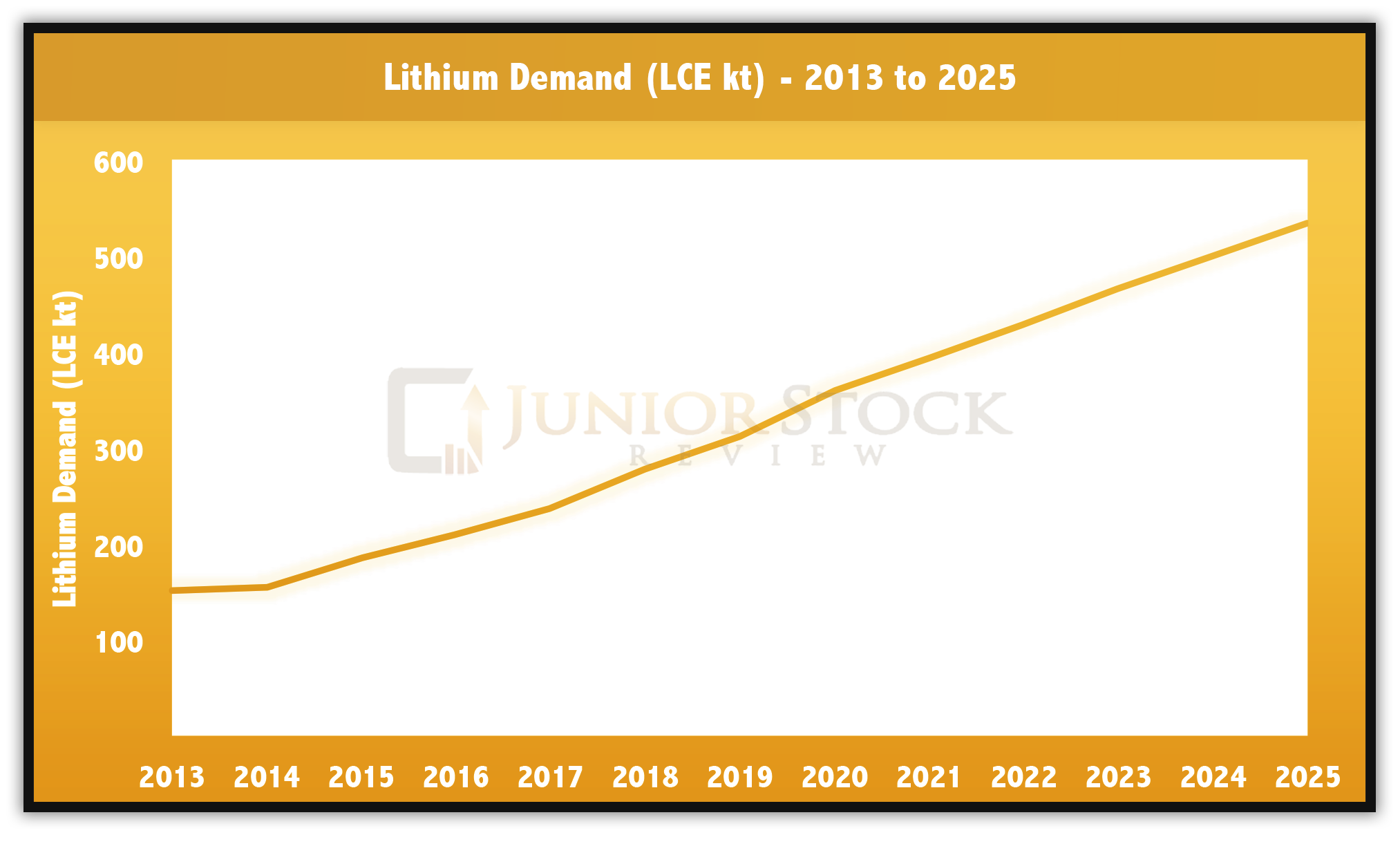
Lithium Demand Graph

Why lithium? Great question. In my opinion, it’s simultaneously the simplest and most complex metal. Lithium’s ‘simplicity’ comes from the fact that it’s been used in industry for quite some time, and most of the general public know the metal in its battery form. Its complexity relates to the science behind how and why it’s presently used, but more importantly, the role lithium will play in the future.

Lithium isn’t rare, but the lithium market is definitely under developed in comparison to most other industrial commodities, leaving the space to a select few conglomerate giants and a group of junior companies. The fact is, lithium has a ton of applications, from lubricating grease and glass fabrication, to glazes for ceramics, and finally, batteries. In particular, lithium is and will continue to play an increasingly important role in the battery-powered clean air future.

Let’s take a closer look at the lithium narrative…


Lithium – Hard-Rock and Brine

Lithium is present in a number of different minerals, but for those who deal with its commercial extraction, there are really only a few that are of interest.


Pegmatites

Pegmatites are commonly found throughout the world, but lithium-rich granite pegmatites are much less common, making up less than 1%. Granite pegmatite-ore bodies are the hard-rock source of lithium. The lithium minerals that occur in granite pegmatites are spodumene, apatite, lepidolite, tourmaline and amblygonite.

Spodumene is the most commonly occurring lithium hard-rock mineral, which, once upon a time, made it the number one source of lithium metal in the world. It has since been surpassed by brines, which, for a number of reasons, have become the largest contributor to lithium production.

Pegmatite Hard-Rock Processing

Lithium hard-rock recovery can be broken down into a few key steps: crushing of the ore, concentration by froth floatation, followed by hydrometallurgy and precipitation from an aqueous solution. From here, depending on the application, the producer will typically create either lithium hydroxide or lithium carbonate, which can be sent to factories to be manufactured into its final form.

When evaluating a hard-rock lithium deposit, there are a few key things to look for:

Lithium Grade – Arguably the most important figure in any type of deposit. Typically, the higher the grade of lithium, the more economic the deposit.

By-Products – Not to be confused with ‘harmful’ impurities, by-products can help reduce the cost per ton because they have value. For lithium hard-rock deposits, tantalum, beryllium and caesium are examples of profitable by-products of the refinement process.

Impurity Levels – High concentrations of impurities (non-profitable by-products) can lead to higher refinement costs and could limit their use in end use applications, such as glass and ceramics.

Location – Poor proximity to infrastructure can make a high grade lithium mine a lot less profitable or not even economically feasible.


Brines

Lithium brine deposits are accumulations of saline groundwater that are enriched in dissolved lithium. Lithium concentrations are typically measured in parts per million (ppm), milligrams per litre (mg/L) and weight percentage.

Brine is pumped up from the ground and placed into man-made ponds, where the lithium is concentrated via evaporation. Depending on the climate and weather in the region of the brine deposit, lithium concentration can take a few months to a year. Typically, lithium concentrations range between 1 and 2%. Unlike their hard-rock cousins, these concentrations can be sent to processing plants for end use production.

All lithium brine deposits have a few common characteristics (Bradley, Munk, Jochens, Hynek, Labay. USGS – A Preliminary Deposit Model for Lithium Brines, 4).

  • Arid climates
  • Closed basin containing a playa or salar
  • Tectonically driven subsidence
  • Associated igneous or geothermal activity
  • Suitable lithium source-rocks
  • One or more aquifers
  • Sufficient time to concentrate a brine


Similarly to the list of common characteristics for brine deposits, there are a few things that are particularly important when evaluating a brine deposit:

Evaporation Rate – evaporation is dependent upon the climate in which the deposit is located. Hours of sunlight, humidity, wind levels and temperature all have an effect on the evaporation rate. A low evaporation rate could make the difference between an economic deposit and an uneconomic one.

Lithium Grade – Arguably the most important figure in any type of deposit. Typically, the higher the grade of lithium, the more economic the deposit.

By-Products – Not to be confused with ‘harmful’ impurities, by-products can help reduce the cost per ton because they have value. For lithium deposits, the primary by-product is potassium.

Location – Poor proximity to infrastructure can make a high grade lithium mine a lot less profitable or not even economically feasible.

Impurity Levels – The magnesium to lithium ratio and the sulphate to lithium ratio are very important figures to look at when examining a brine deposit, because separating these impurities from the lithium is one of the largest expenses in the brine refinement process. For both of these ratios, you’re looking for low figures.

Brines are today’s answer to lithium demand as they are more wide spread, typically larger in resource scale, and generally have lower production costs.  Countries such as Chile, Argentina and China extract the majority of their lithium production from brine deposits.


The Lithium Supply Story
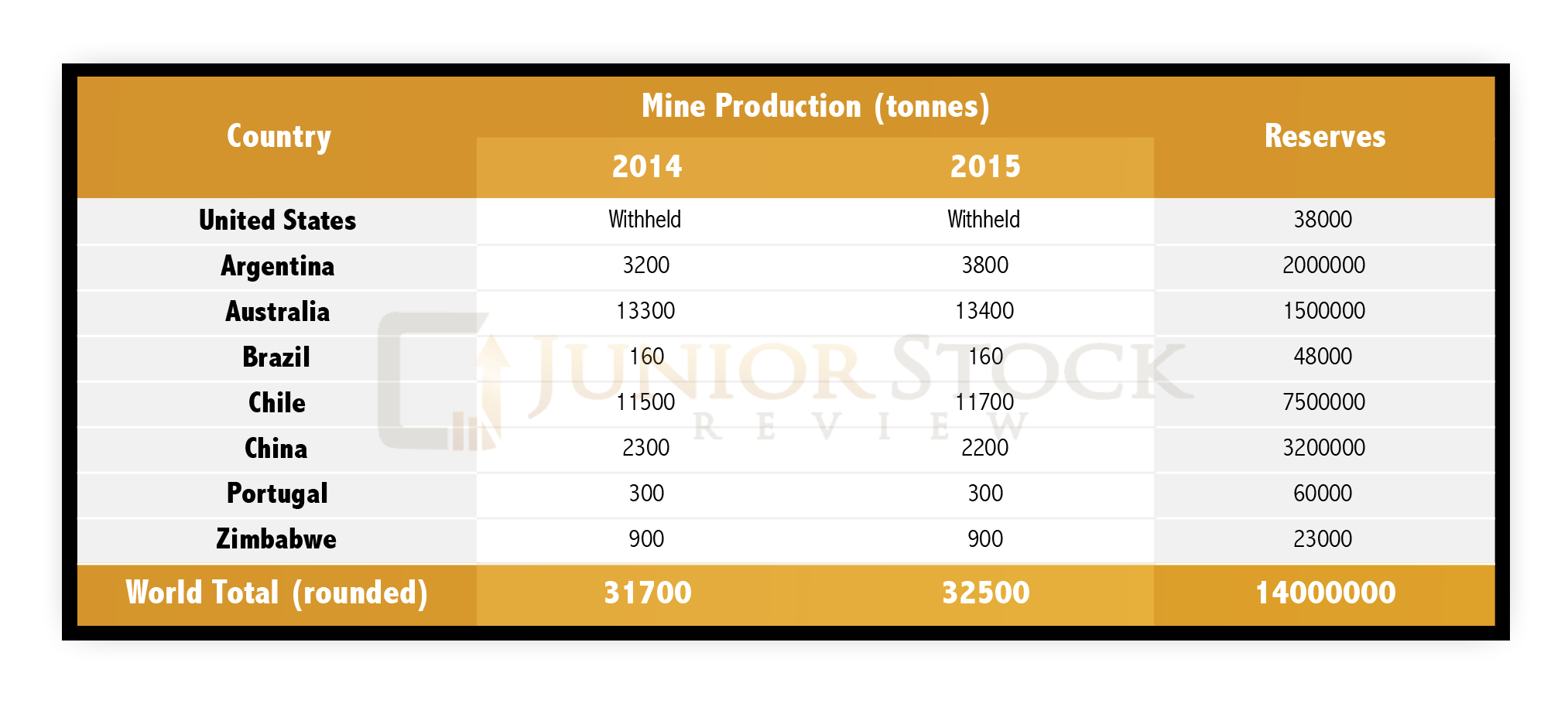
Lithium Mine Production

Source: United States Geological Survey (USGS)

Lithium reserves exist on 5 continents: North America, South America, Africa, Asia and Australia. As the table shows, however, there are reserves on 5 continents but the concentration is in South America, where there’s approximately 66% of the world’s reserves.

‘The Lithium Triangle’ refers to Chile, Argentina and Bolivia. Beginning with Chile, the number 2 producer of lithium in the world and 1st in reserves, their reserves are held in brine deposits. Its main brine deposit is The Salar de Atacama, which is located in the Antofagasta region. The Salar de Atacama is approximately 3000 square kilometres and has an estimated 6.8 Mt of lithium reserves.

For reference, ‘salar’ means a salt-encrusted depression (as in the nitrate fields in Chile) that may or may not be the basin of an evaporated lake

The other key player in The Lithium Triangle is Argentina, the number 3 producer of lithium in the world and 3rd in reserves. Argentina’s source of lithium, like Chile, is found in brines. Although Bolivia currently makes up the smallest portion of The Lithium Triangle, it’s thought to have the largest undeveloped lithium brine in the world, Salar de Uyuni. USGS Mineral Commodity Summaries estimates that this prized salt flat contains 9 million tonnes of identified lithium resource.

China is the number 4 producer of lithium in the world and 2nd in reserves. China’s lithium deposits are found both in hard-rock and brine sources. Its lithium-rich pegmatite deposits are found in Jiajika, Barkam, Altai, Koktokay and the Nanping district, while its lithium-rich brines, which possess the vast majority of its reserves, are found mainly on the Quighai-Tibet plateau.

Currently, Australia is the number 1 producer of lithium in the world. Australia’s lithium is held in hard-rock deposits, mainly the Greenbushes deposit, which is currently in production. Finally, the Mount Cattlin and Mount Marion projects, which aren’t yet in production, are expected to alleviate some of the supply crunch for world demand in the future.


Lithium is primarily sold through private contracts which are controlled by 4 companies:
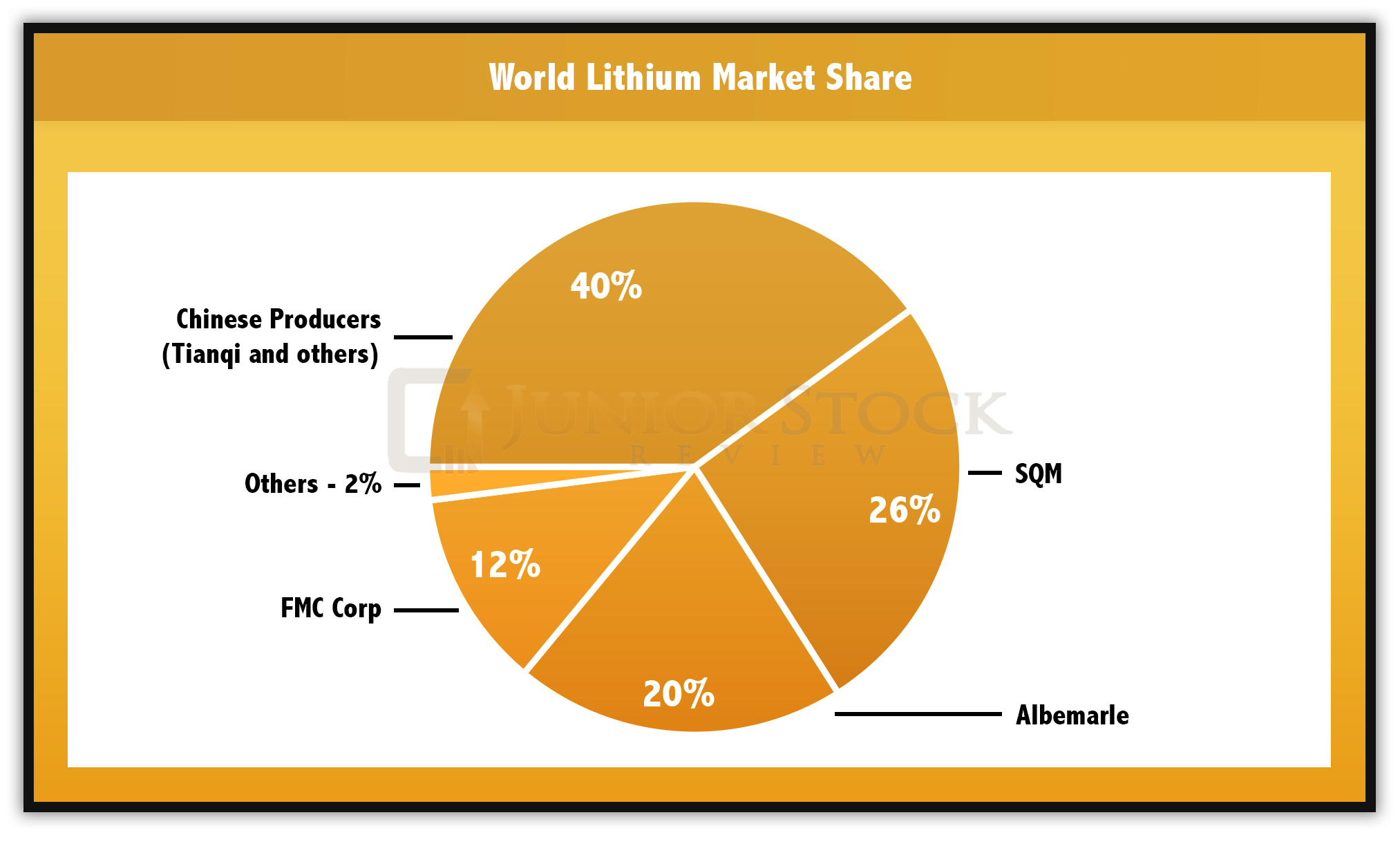
Lithium Market Share

Source: Sociedad Quimca Y Minera De Chile  – Corporate presentation – Slide 11


With only 4 major players in the lithium market, I have put together some quick points on each company to give you an idea of who they are, where they are, and what they do.


Sichuan Tianqi Lithium Industries  – Tianqi information taken from their website, unless otherwise cited.

  • Collectively, Chinese lithium producers have a market share of 40% (SQM – slide 11)
  • Traded on the Shenzhen Exchange (SZSE)
  • Based in China and founded in 1995. As stated on their website, “We…are a key enterprise to the Provincial Government’s initiative for the ‘Promotion and Support of Emerging Strategic Industries,’ ”
  • Tianqi offers a diverse product line, with both specialty and industrial application lithium products.


Sociedad Quimca Y Minera De Chile (SQM) – All information acquired through corporate presentation

  • Lithium market share of 26%
  • Founded in 1968 to reorganize the Chilean nitrate industry. Over time, converted from a fully Chilean State owned company to a private enterprise by 1988.
  • Ownership Structure: Pampa Group and Kona Group – 32%, Potash Corporation – 32%, Bank of New York (ADRS) – 23%, and Other – 13% .
  • SQM is involved in a number of market segments, such as specialty plant nutrition, iodine, lithium, industrial chemicals, potassium and metals exploration.
  • SQM lithium resources are held in salar brines within the Atacama Salt Desert region of Chile. Joint Venture Project in Argentina planned for production in 2019, with a 50K Mt/year capacity.
  • Traded on the New York Stock Exchange (NYSE).


Albemarle –  All Albemarle information taken from website and Corporate Investor Presentation (September 13, 2016)

  • 2015 Lithium market share of 20%.
  • Traded on the New York Stock Exchange (NYSE).
  • Headquartered in Charlotte, North Carolina, United States.
  • Albemarle Paper Manufacturing Company was founded in 1887.
  • Albemarle is involved in a number of market segments, such as refining solutions, lithium and advanced materials, bromine specialties, fine chemistry services, and Chemetall surface treatment.
  • In 2015, Albemarle acquired Rockwood Holdings, parent company for Rockwood Lithium, for USD $6.2 Billion.
  • Albemarle operates the world’s 2nd largest brine project on Salar de Atacama in Chile, with an output of 25 ktpa, and the Silver Peak brine operation in the U.S., with an output of 6 ktpa.
  • Australian Hard-Rock Resources – Greenbushes Mine (through Talison JV) – Albemarle’s share of annual capacity is 30 ktpa.

FMC Corporation  – All FMC information taken from website.

  • Lithium market share 12%.
  • Traded on the New York Stock Exchange (NYSE).
  • Established in 1883, FMC roots are in agriculture.
  • Corporate Headquarters in Philadelphia, Pennsylvania and Charlotte, North Carolina.
  • FMC is involved in a number of market segments, such as agriculture, health and nutrition and lithium.
  • 79% of FMC’s lithium revenue is derived from the sale of lithium specialty products, such as lithium hydroxide, butyllithium, and high purity metal.


Technological Affects on Lithium Supply

A major impact to the lithium supply story could come from a technological breakthrough in the refinement of lithium brines. Current research and development dollars spent by South Korean giant, POSCO, and privately owned, Energi Corporation, are exploring methods of refining lithium brine without the use of evaporation.  The current major cost in the brine refinement process is the removal of impurities such as magnesium, calcium, iron and potassium via evaporation and additives.  If they are successful, it will revolutionize the lithium mining industry, as more deposits will become economical and existing mining operations could change production methods to capitalize on cheaper processing costs. When or if this occurs, is a big question.

That said, the fact that R&D dollars are being spent in lithium refinement is a major plus, in my books. With this much interest, I think you can almost guarantee a strong future for lithium, worldwide.


Lithium Demand

Currently, lithium’s demand is rooted in the following applications (in no particular order):

Lubricant Grease – An estimated 2.38 billion pound market, in which lithium-based greases make up 75%. Lithium-based greases generally have good stability, high temperature characteristics and water-resistance properties.

Glass – Lithium typically sourced from the mineral spodumene reduces the viscosity and thermal expansion of glass and, therefore, leads to increased melting efficiencies and/or larger effective furnace capacities. The end result is a substantial energy savings for the glass manufacturers.

Ceramics – Lithium is used in the ceramics industry to produce glazes. The glazes improve a ceramic piece’s shock absorption and stain resistance, protecting the piece against damage. Lithium carbonate is typically used for this application.

Health Products – Lithium, in small amounts (around 0.170 mg/L), is prescribed to those with bipolar disorders or individuals with depression who don’t respond to anti-depressants.

Batteries – Batteries are possibly the best known lithium application of all. It’s where the future lays for lithium demand. This will be explained further in the next section.


Batteries

Why is lithium used in batteries? Simply, with current technology, lithium provides the best combination of energy density (weight to power ratio) and price.

Batteries have essentially three main components: cathode, anode and electrolyte. When the cathode and anode are connected via a wire, for example, electrons flow from the anode through the wire to the cathode, creating an electrical current.

Currently, there are an estimated 80 different lithium-ion battery chemistries in production, with these varying chemistries all exhibiting different characteristics, such as capacity and voltage. Lithium is typically found in the cathode of the battery, commonly in the form of lithium cobalt oxide, while the electrolyte is commonly in the form of a lithium salt, such as LiPF6, LiBF4 or LiCLO4. The anode material is commonly carbon-based, with graphite being the most popular.

Overall, a lithium ion battery’s output is around 3.6 volts, which is more than twice as much as its alkaline cousin.


What does the current lithium demand by application look like?
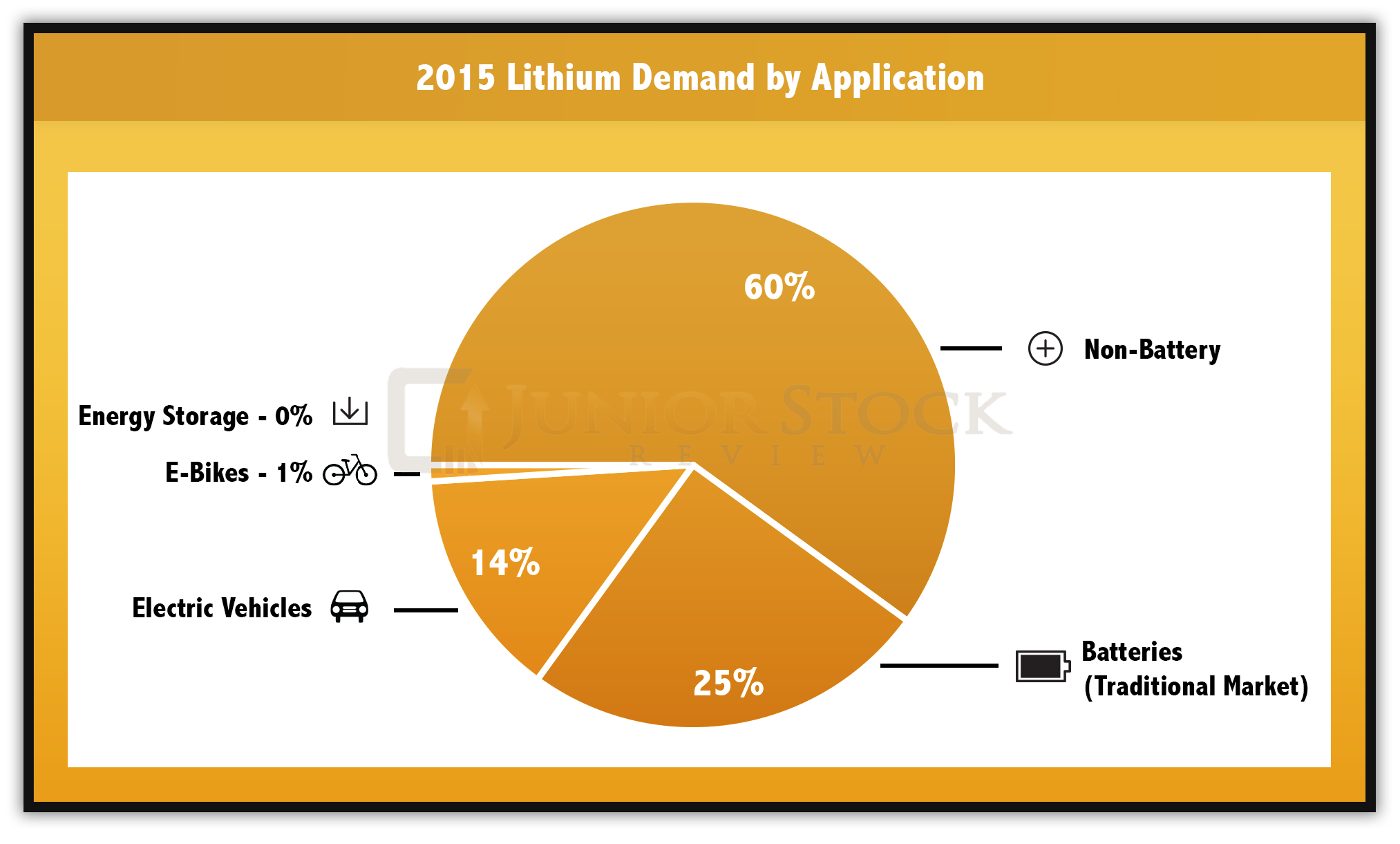
2015 Lithium Demand by Application

Source: Deutsche Bank Markets Research – Lithium 101 – pg.23

Projected demand for 2025 is much different, not only in overall demand tonnage, but the percentages each application encompasses. The future is expected to be bright for batteries in the non-traditional markets; electric cars, e-bikes, and energy storage.
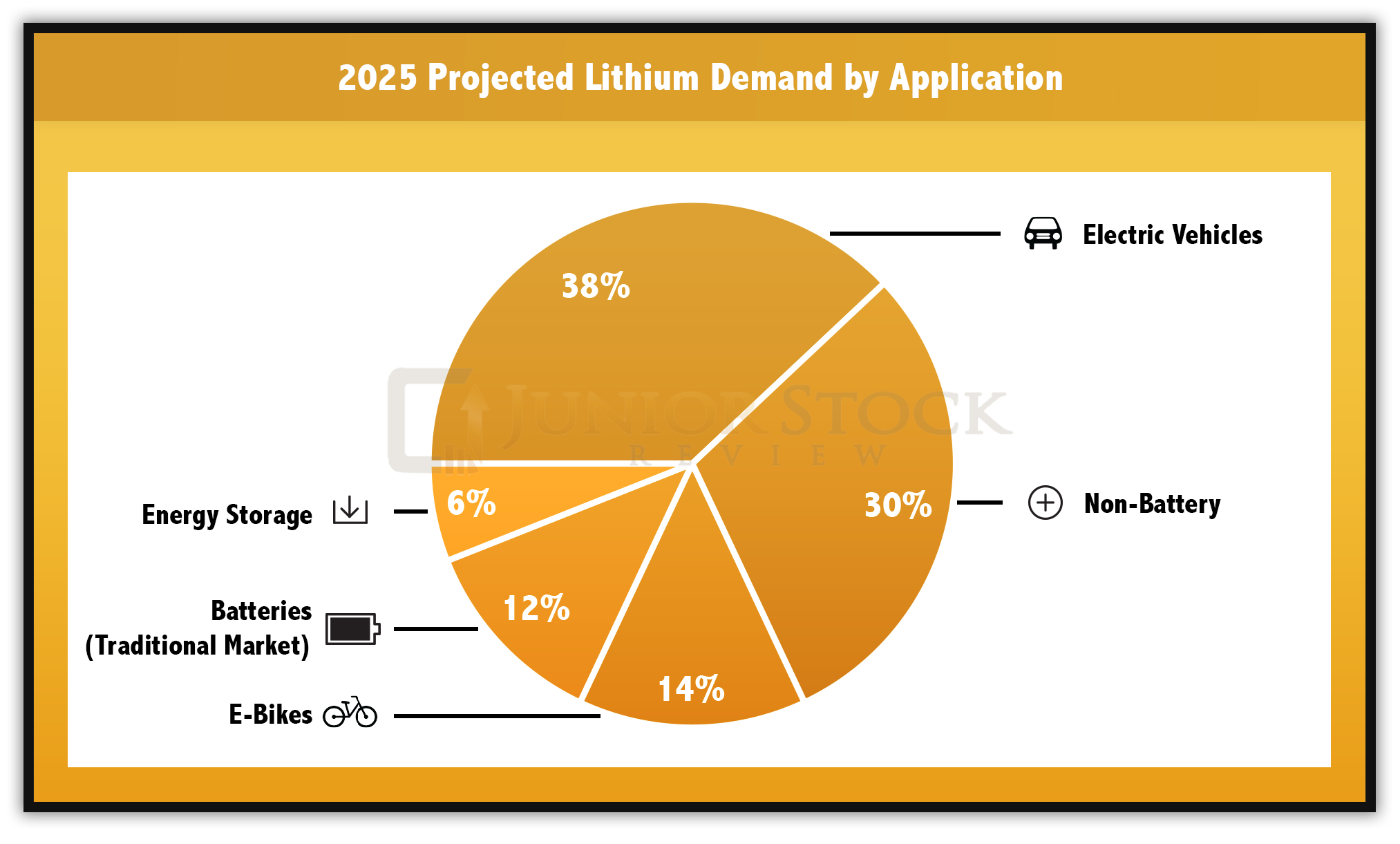
2025 Lithium Demand by Application

Source: Deutsche Bank Markets Research – Lithium 101 – pg.23


Lithium Present and Future Market Demand

Lithium Demand Graph

Source: Deutsche Bank Markets Research – Lithium 101 – pg.23

The interesting thing about this projected demand curve is that it is linear. The reason I think that’s interesting is that most things in life don’t follow a linear path, especially those things that are rapidly changing, such as the lithium market. Now, the opposite could be true, the demand could be flat or declining in the future, but I tend to think that the future for lithium will be exponential.

For those who don’t know what an exponential function looks like, think of a hockey stick turned upwards with the blade in the air. Basically, it looks linear for a while, constant growth, and then boom – to the moon it goes.

Why do I think this? Mainly because of the politicized nature of green energy. Whether it’s the 450 Scenario or some other push to reduce carbon emissions, governments across the world are allocating more and more policy and CASH to the cause. The final inflection point could be massive and it could happen before 2025, in my opinion.


Emissions Perspective

The 450 Scenario calls for long-term concentrations of local greenhouse gases to be at 450 ppm CO2 equivalent by 2040. To put that into perspective, we globally emitted 32,381 Mt of CO2 in 2014 (International Energy Agency, 2016 Key World Energy Statistics, 45). Under the 450 Scenario, that number reduces dramatically to 18,777 Mt of CO2.

Using the United States as an example,  Statista states that there were around 260 million registered vehicles in the United States in 2014. The U.S. Energy Information Administration (EIA) estimates that U.S. fossil fuel consumption for transportation in 2015 resulted in a combined 1,545 million tonnes of CO2, which is 29% of the total CO2 emissions by the country.

Emissions per vehicle = 1,545,000,000 / 260,000,000 = 6 tonnes/vehicle

Therefore, my estimated carbon emissions per U.S. vehicle is around 6 tonnes per year. If the United States figures to comply with the goals of the 450 Scenario, to drop transportation emissions to 26%, in-line with the rest of the world, they will need a reduction of 3% (29% to 26%) (International Energy Agency, 2016 Key World Energy Statistics, 46). The following calculation shows that a reduction of this magnitude would affect approximately 7.7 million vehicles.

3% of 1,545,000,000 = 46,350,000 tonnes of CO2

46,350,000t / 6 t/vehicle = 7,725,000 vehicles

NOTE: This calculation should not be taken as exact, there are assumptions that have been made. The calculation is only to gain some perspective on the potential impact of the 450 Scenario.

Insideevs.com reports that there were 116,099 full electric vehicles sold in the United States in 2015, and 441,179 worldwide. If you linearly distribute the number of vehicles affected by the 450 Scenario on a 23-year time horizon (2017 to 2040), 7,725,000 / 23 = 335,870 vehicles per year would need to be sold, or almost 3 times the number of current sales per year.

This is provided that car demand in the United States stays where it is. If there is growth in the number of people who want to drive, this electric vehicle number would need to increase.

How does this equate to lithium demand? Well, it isn’t an easy calculation as there are a lot of assumptions, but I did find an estimate of 47 lbs (0.021 t) of lithium per Tesla Model S (sedan). If 335,870 Tesla Model S were sold in the United States in a given year, this would translate into 335,870 x 0.021 t of 7,053 t of lithium, or 37,544 t of lithium carbonate (conversion from Li to LiCO3 – 1 : 5.323)


To summarize this example:

  • Calculation only represents a 3% decrease in American transportation carbon emissions.
  • A 3% improvement in emissions will affect the equivalent of 7.7 million vehicles.
  • If these 7.7 million vehicles were replaced by fully electric vehicles over the next 23 years (450 scenario deadline is 2040), that would equate to 335,870 cars sold each year. In my opinion, it is highly unlikely that it will be linearly distributed.
  • Using 2015 data from insideevs.com, world demand is roughly 4 times that of the United States, thus, if the world kept pace, it would equal around 1.3 million vehicles per year.
  • In terms of lithium carbonate, 1.3 million electric vehicles could mean 150,176 t in worldwide demand.

I believe this 3% improvement scenario for vehicles per year is conservative. In reality, I think demand in the next 5 years could easily be twice as much. Deutsche Bank believes demand will hit 2.4 million in global electric vehicles sold in 2025. They estimate total demand in terms of lithium carbonate equivalent to be 534 kt, of which batteries would make up 45% (Deutsche Bank, Lithium 101 Report, 24).

The following table gives you a quick conversion factor for some common lithium compounds.
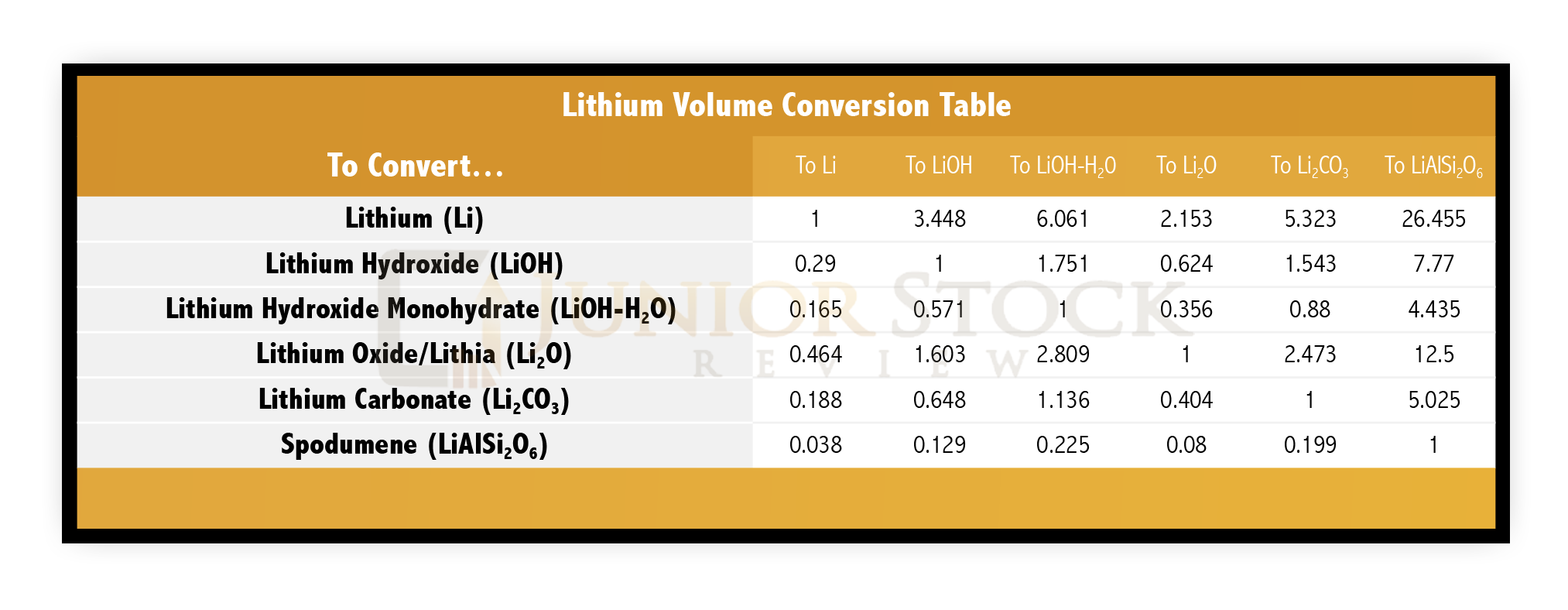
Lithium Volume Conversion Table

Source: London Stock Exchange   

FYI – A quick example: If you’re given a resource in terms of %Spodumene, 5%, and you want to convert it to %Lithium, simply multiply the 5% by the lithium conversion factor 0.038, which equals 0.19%.


I believe it’s undeniable that lithium will play a major role in powering our clean air future. The trend is your friend and in this case it is only the beginning of what appears to be a major turning point in the way we live our day to day lives.


Until next time,


Brian


Disclaimer: This is not an investment recommendation, it is an investment idea. I am not an investment professional and do not know your specific investment criteria. Please do your own due diligence. I have not been paid to write this article, nor do I own any of the companies listed in this report.
Posted on

North American Uranium Producers

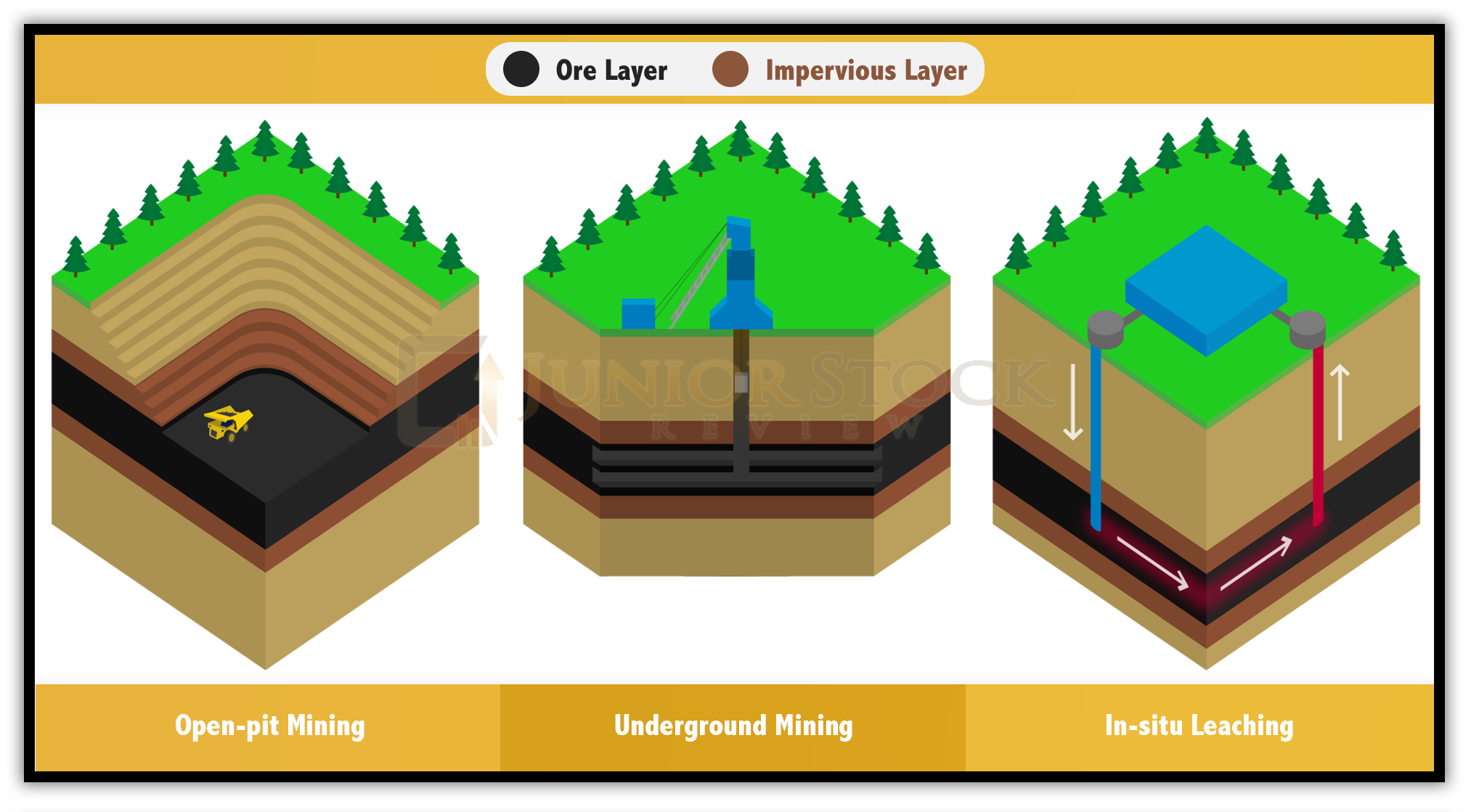
Uranium Mining Techniques

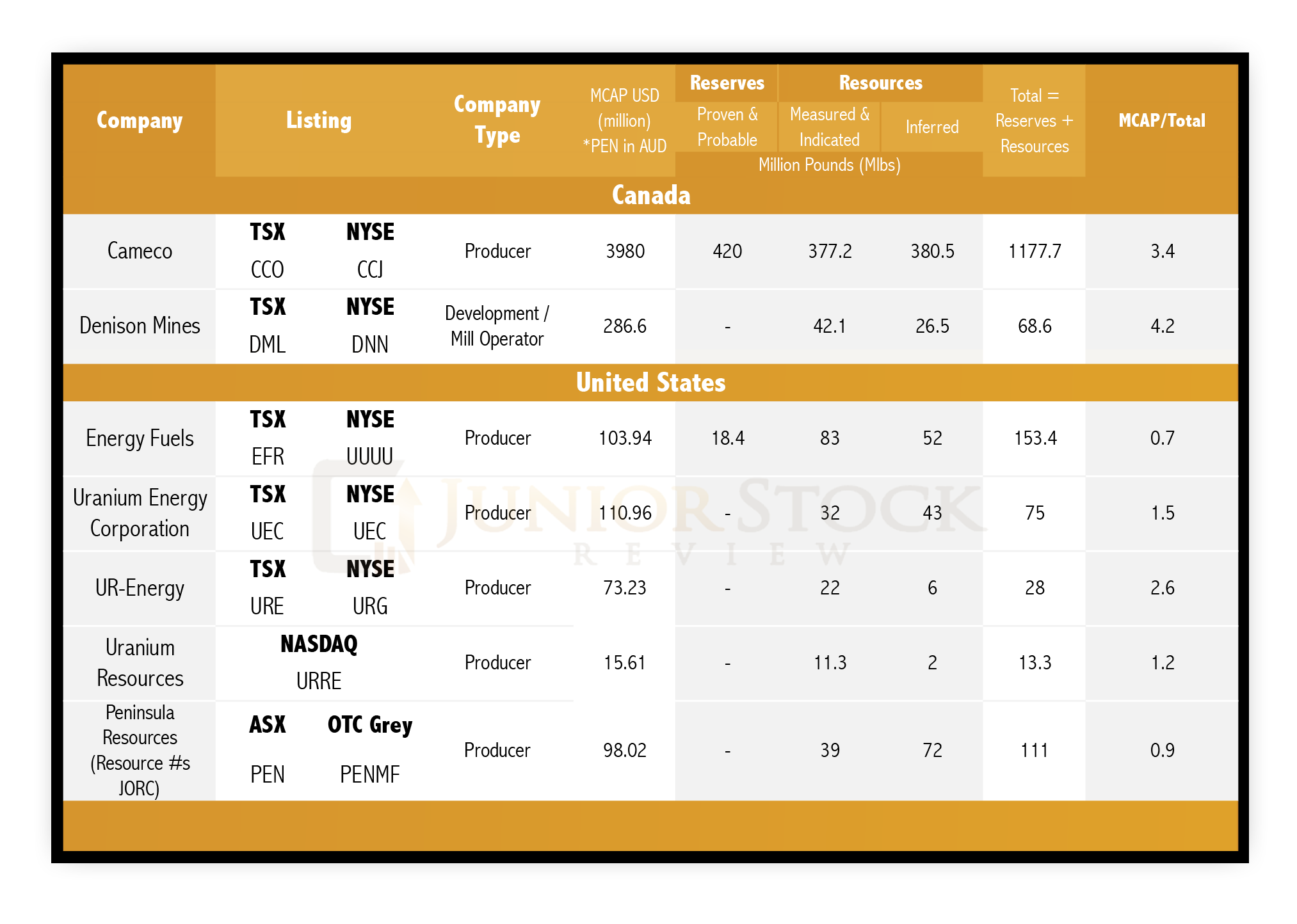
This is a ‘For Your Information (FYI)’ style report on North American uranium producers. I’ve given a very brief overview of each company, where their assets are, the size of their resource, and a few other tidbits.  If you haven’t already, check out the in-depth articles I’ve recently written on Cameco and Energy Fuels, as well.

North American Uranium Producers

NOTE: The table above reflects MCAP and resource numbers taken at the time of the writing of the report and doesn’t necessarily reflect the current MCAP or resource numbers of the companies mentioned. Please do your own due diligence to get updated values.


Cameco – Link to the Report

Energy Fuels – Link to the Report


Denison Mines

Denison Mines is led by CEO, David Cates, who is an accountant (CPA, CA) by trade. Cates has worked in the resource sector for a number of years, previously working with Kinross and PwC LLP before joining Denison in 2008.

While Denison Mines is better known for its uranium development project, Wheeler River, it does own 22.5% part of the McClean Lake Mill. The mill processes uranium ore produced by Cameco’s McArthur River, up to 18 Mlbs/yr U3O8. The remaining 6 Mlbs/year in excess capacity has been incorporated into Denison’s PEA for Wheeler River.

The mill cash generation isn’t spectacular, but does give Denison a revenue stream regardless of the uranium price.

  • Traded on the DML:TSX, DNN:NYSE
  • Executive Chairman – Lukas Lundin
  • All properties are in Canada
  • 25% ownership of GoviEx Uranium (GXU:TSXV)
    • Sold its African uranium assets to GoviEx in exchange for ownership stake
    • GoviEx Uranium is a uranium development stage company with two permitted projects, Madaouela (Niger) and Mutanga (Zambia) – this is a bigger deal than you may think – check out my article written earlier this year.
    • Total M&I resources – 124.29 Mlbs U3O8 and Inferred resources – 73.11 Mlbs U3O8


UR-Energy

UR-Energy is led by Executive Director and Acting CEO, Jeffery Klenda. Klenda’s background is in finance, having been an officer and/or director for numerous publicly traded companies throughout his 30-year career.

UR-Energy has a hedged sales book that stretches out to 2021 (See December 2016 Corporate Presentation), meaning a percentage of its current U3O8 sales are contracted at a higher than spot uranium price and, thus, is currently producing from its main asset, Lost Creek ISR Uranium Facility.

  • Traded on the NYSE: URG and the TSE: URE
  • All properties are located in the United States:
  • Lost Creek ISR Uranium Facility (6 individual contiguous projects)
    • Facility is located in Wyoming
    • M&I Resource of 13.251 million lbs U3O8 and Inferred Resource of 6.439 million lbs (Source)
    • Newly added pounds of uranium have the potential to be pipelined to the processing facility, giving the Lost Creek property a scalability factor
  • Shirley Basin Mine Site
    • Located in Wyoming
    • Purchased from AREVA in 2013
    • Preliminary Economic Assessment was completed in Q1 2015 and a mining permit application filed in 4Q 2015.
    • Estimated total of 6.3 million lbs of U3O8 may be produced from the project
  • Lost Soldier Project
    • Located in Wyoming
    • Exploration property located 14 miles north of the Lost Creek Facility
    • Requires more funding for further exploration and development. Not a priority given the current market
  • Lucky Mc Mine Site
    • Located in Wyoming
    • Part of the Pathfinder acquisition in 2013
    • Exploration property, with past production from the 1960s through to the 1990s. Historical conventional mine production of more than 46.7 million lbs.


Uranium Resources

Uranium Resources is led by CEO, Christopher Jones, who has been in the mining industry for 30 years. Currently, Jones leads a business which has recently branched out from its core business in uranium and entered the lithium exploration business. Uranium Resources refers to this as their “energy metals strategy,” which is meant to capitalize on the near and the longer term. (Source – slide 10)

Uranium Resources producing uranium assets are currently on standby until there is a sustained improvement in the uranium market.  Their Turkish Temrezli property is by far their largest uranium project and is currently in the permitting stage of development.

NOTE: With its listing on the ASX, Uranium Resources is listed according to JORC standards, which are different than NI 43-101.

  • Traded on the Nasdaq: URRE and ASX: URI
  • Uranium Properties are located in the United States and Turkey:
  • Temrezli Uranium Project
    • Located in Turkey
    • 44,700 acres of prospective property
    • M&I and Inferred Resource Total of 13.3 million lbs U3O8
    • Pre-Feasibility study completed in 2015 (see presentation for further detail)
    • Permitting is underway
  • Kingsville Dome Processing Facility
    • Located in Texas, United States
    • 17,000 acres of prospective ISR projects
    • In-Place Reserves – 50,000 lbs (not NI 43-101 compliant)
    • Production suspended until “there is a sustained improvement in the uranium market” ~Uranium Resources
  • Rosita
    • Located in Texas, United States
    • In-Place Reserves – 624,000 lbs (not NI 43-101 compliant)
    • Like Kingsville, production has been suspended
  • New Mexico Projects
    • Located in New Mexico, United States
    • 190,000 acres of prospective property


  • Lithium Properties
    • Columbus Basin (Nina) Lithium Project
      • Located in Nevada
      • 2017 Outlook: Geophysical sampling, geological analysis and follow-up drilling
    • Sal Rica Lithium Project
      • Located in Utah
      • 2017 Outlook: Sampling, geophysics and target prioritization for drilling


Uranium Energy Corporation (UEC)

UEC is led by Amir Andani, who is also the CEO of the precious metals company, Brazil Resources. Andani has used the bear market in uranium to purchase uranium properties throughout the western United States and Paraguay.

Currently, UEC has one producing asset, Palangana, and its Hobson Processing Facility. Its other two main assets are Bruke Hollow, which is in the process of being permitted, and Goliad, which is permitted and under construction.

Andani is a premier marketer and presents UEC fantastically with their website and investor material. This type of promotion is an X-factor in the junior market and definitely sets Andani apart from his competitors, regardless of how you view the rest of the company.

  • Traded on the NYSE: UEC
  • Properties in the United States and Paraguay:
  • Hobson Processing Facility
    • Fully licensed and permitted
    • Operational
    • 2 million lbs of processing capacity per year
  • Palangana
    • Fully permitted and producing
    • Located in Texas
    • M&I resource – 1,057,00 lbs U3O8 and Inferred resource – 1,154,000 lbs U3O8
  • Burke Hollow
    • In development – permitting underway
    • Inferred resource – 5,121,853.25 lbs U3O8
  • Goliad 
    • Fully permitted and under construction
    • M&I resource – 5,475,200 lbs U3O8 and Inferred resource – 1,547,500 lbs U3O8
  • Exploration Projects:
    • Nichols (Texas)
    • Longhorn (Texas)
    • Salvo (Texas)
    • Dalton Pass (New Mexico)
    • Long Park (Colorado)
    • Slick Rock (Colorado)
    • Anderson (Arizona)
    • Los Cuatros (Arizona)
    • Workman (Arizona)
  • Oviedo
    • Exploration project in Paraguay
  • Yuty
    • Exploration project In Paraguay


Peninsula Energy Limited

Peninsula Energy is led by CEO, John Simpson. Simpson has over 25 years of experience in the management of listed mineral companies. Simpson is at the helm of a company which operates a producing uranium mine, the Lance ISR Mine in the United States, a uranium exploration property in South Africa, and a gold exploration property in Fiji.

Peninsula is unique because it boasts a hedged contract sales book that stretches 10 years and 8.1 million pounds (Mlbs) which, at maximum capacity for their processing plant, is almost 4 years of full production. With an average contracted selling price of $55 USD/pound for the 8.1 Mlbs, investors are given  a lot of risk mitigation to a sliding uranium price. However, this could also mean a loss of upside potential, depending on where you think the uranium price may go in the future.

Peninsula is traded on the ASX and, therefore, expresses all of their resources according to JORC code.

  • Traded on the ASX: PEN
  • Properties located in the United States, South Africa and Fiji (Gold Project)
  • Resources are listed by JORC Code (not NI 43-101)
    • Lance ISR Uranium Project 
      • Located in Wyoming, United States
      • Three deposits totalling 53,674,224 lbs U3O8 (JORC code resources): Ross -Measured & Indicated (M&I) and Inferred total 11,184,612 lbs U3O8, Kendrick – M&I and I total 29,617,020lbs U3O8, and Barber – M&I and Inferred total of 12,872,592 lbs U3O8
      • Fully permitted and producing
      • Exploration potential on the property
      • Production levels to follow their hedged sales book, with 400,000 lbs to be delivered in 2017 at approximately $55 USD per pound.
      • Currently, Peninsula has 8.1 million pounds of U3O8 under contract to deliver to major utilities in the United States and Europe over the next 10 years. These 5 contracts total approximately $44o million USD and an average 3O8 selling price of $55 USD per pound
      • Project is expected to produce 2,300,000 lbs U3O8 per annum at full capacity


  • Karoo Project (Joint Venture with BEE Groups)
    • Located in South Africa
    • Exploration property
    • JORC Code-Compliant Mineral Estimate (Indicated and Inferred) total of 56.9 million lbs of eU3O8
    • In the next 3 to 5 years, the company plans to expand this resource further, focusing drilling on the eastern sector, RystKuil channel.
  • Raki Raki Gold Project (JV – 50% ownership)
    • Located in Fiji
    • Exploration property


Anfield Resources Inc.

Anfield is led by CEO, Corey Dias, whose 10 years of experience prior to Anfield was in capital markets on both the buy and sell sides. Dias is leading this uranium development company to “near term” production; I use quotations because they still need to refurbish their conventional mill and acquire the proper mining licensing and permitting – ‘near term’ is subjective.

Conventional uranium mills are hard to come by in North America, therefore, owning one can be an asset, as the conventional mining of uranium is not complete with milling.  Anfield has used the uranium bear to acquire a variety of properties across the western United States which have past production and historical uranium resources.

  • Traded on the TSX Venture: ARY, Frankfurt: OAD
  • Steps to production: Well field development, mill refurbishment, and mine licensing/permitting
  • Potential uranium production across all assets – 1,500,000 lbs U3O8 per year
  • Properties located in the United States
    • Shootaring Canyon Mill
      • 750 tpd conventional uranium mill
      • Located in Utah
    • Velvet-Wood Mine
      • Located in Utah
      • M&I resource of 4.6 Mlbs U3O8 (Slide 10 )
      • Surface stockpile of 370,000 lbs U3O8
      • PEA completed in 2016
    • Exploration Properties (some properties have historical resources and past production)
      • Arizona – Brecca Pipes and Date Creek Basin
      • Colorado – Slick Rock District, Western Gypsum Valley District, Paradox District and Gateway District
      • Utah – Lisbon Valley, Henry Mountains Area, Moab Uranium District, Dry Valley Area, Paradox Area, Monticello-Cottonwood, Monticello-Motezuma Canyon, Thompson District, Green River District, White Canyon and San Rafael District
      • Wyoming – Black Hills, Great Divide Basin, Laramie Basin, Powder River Basin, Shirley Basin and Wind River Basin


AREVA

  • Directly or indirectly is 85.6% controlled by the French State
  • Not just a miner, they are involved in each aspect of the nuclear fuel cycle


Uranium One – Owned by AMRZ – Mining Arm of ROSATOM State Atomic Energy Corp.

  • State owned and controlled
  • Operations in the United States and Kazakhstan
    • Willow Creek ISR located in Wyoming with Proven and Probable (P&P) Reserves of 6,754,000 lbs U3O8, M&I of 16,798,000 lbs U3O8 and Inferred of 141,000,000 lbs of U3O8
    • Kazakhstan Properties (5 properties) have a total resource (M&I + Inferred) of 148,460 tU


If you believe the future is bright for uranium, but aren’t sure when the market is going to turn for the better, a producer is a great way to ride the bear market out, while having exposure to a sector that, in my opinion, could change on a dime. Each of the companies listed have merits for investment. Be objectively critical and find the company or companies that fit your personal investment criteria.


Until next time,


Brian


DISCLAIMER: The following is not an investment recommendation, it is an investment idea. I have not been compensated to write this article, however, I do own shares of one or more of the companies mentioned in this article. Please perform your own due diligence to decide whether it is a company that’s best suited for your personal investment criteria. All analytics were taken from the company websites and press releases.


Posted on

Energy Fuels: Positioned to Lead the American Uranium Renaissance

Energy Fuels

The current uranium market has, in my opinion, all the makings of the perfect contrarian investment.

  • The uranium price hit a 12-year low of $17.75 USD per lbs in these past weeks, which is close to 90% off the 2007 high – the cure for low prices is low prices.
  • The world’s electricity output has grown steadily at an average rate of 3.4% CAGR, from 2009 to 2014, in the face of turmoil following the world economic crisis that struck in the fall of 2008. (Rate calculated using data from International Energy Agency (IEA))
  •  The clean air trend has greater momentum every year, with the Paris Climate Accord, or the 450 Scenario (International Energy Agency), leading the charge to reduce carbon emissions.
  • Nuclear power generation is cheap, safe and reliable.

The uranium market is not without it detractors, but to me, it’s not if but when will the uranium market turn. The further the uranium price falls, the  further uranium companies’ share prices drop and, thus, the less risk associated with buying them.

In the famous words of Howard Marks,

“Upshot is simple: to achieve superior investment results, you have to hold non-consensus views regarding value, and they have to be accurate. That’s not easy.”
~Marks, The Most Important Thing Illuminated, pg.7

For me, waiting for the uranium market to turn from bear to bull can be done successfully by choosing companies that are able to weather the storm. What do I mean by this? Well, some uranium producers have protected themselves by hedging all or part of their sales books for the next year or so to ensure they can still operate.

Those with great properties, scalability in their production, locations in the right jurisdictions, the sales contract books to at least partially protect downside uranium price risk, and that are run by experienced and proven management will be the companies that survive and are the first to lead the bull market.

The uranium market may not change tomorrow or next week, but I do believe there is a bright future for this clean energy producing commodity.


It’s Gonna Be HUGE!

Let us take a look at one country in particular, a country which I believe will turn to more domestic production of uranium in the future, and to nuclear power for its clean energy production.

An American Ressainance in Uranium

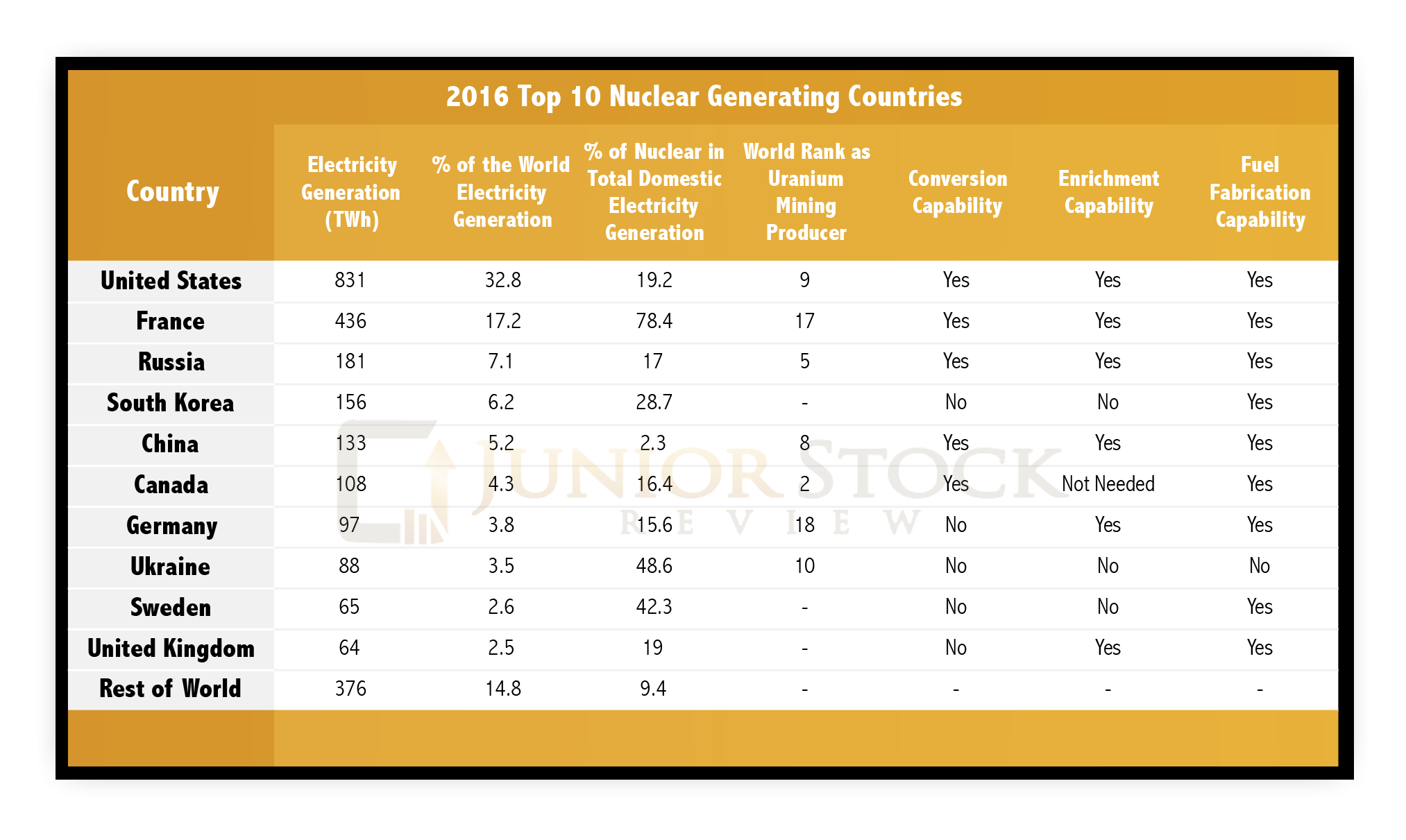
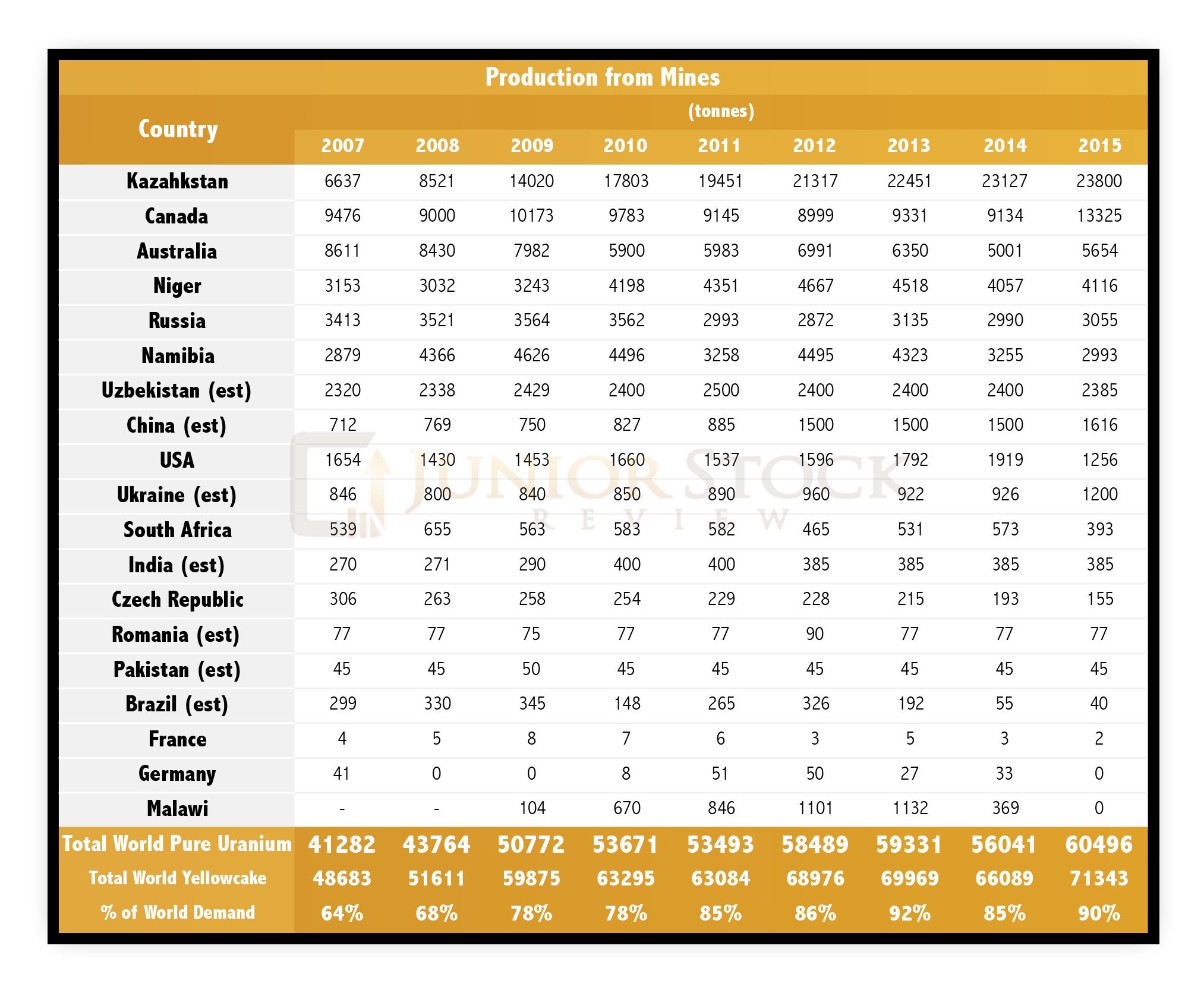
If you’ve haven’t already guessed, the country I’m referring to is the United States, and as you can see from the table below, they are the world’s largest generator of nuclear power. Interestingly enough, however, they are only the world’s 9th largest uranium producer.

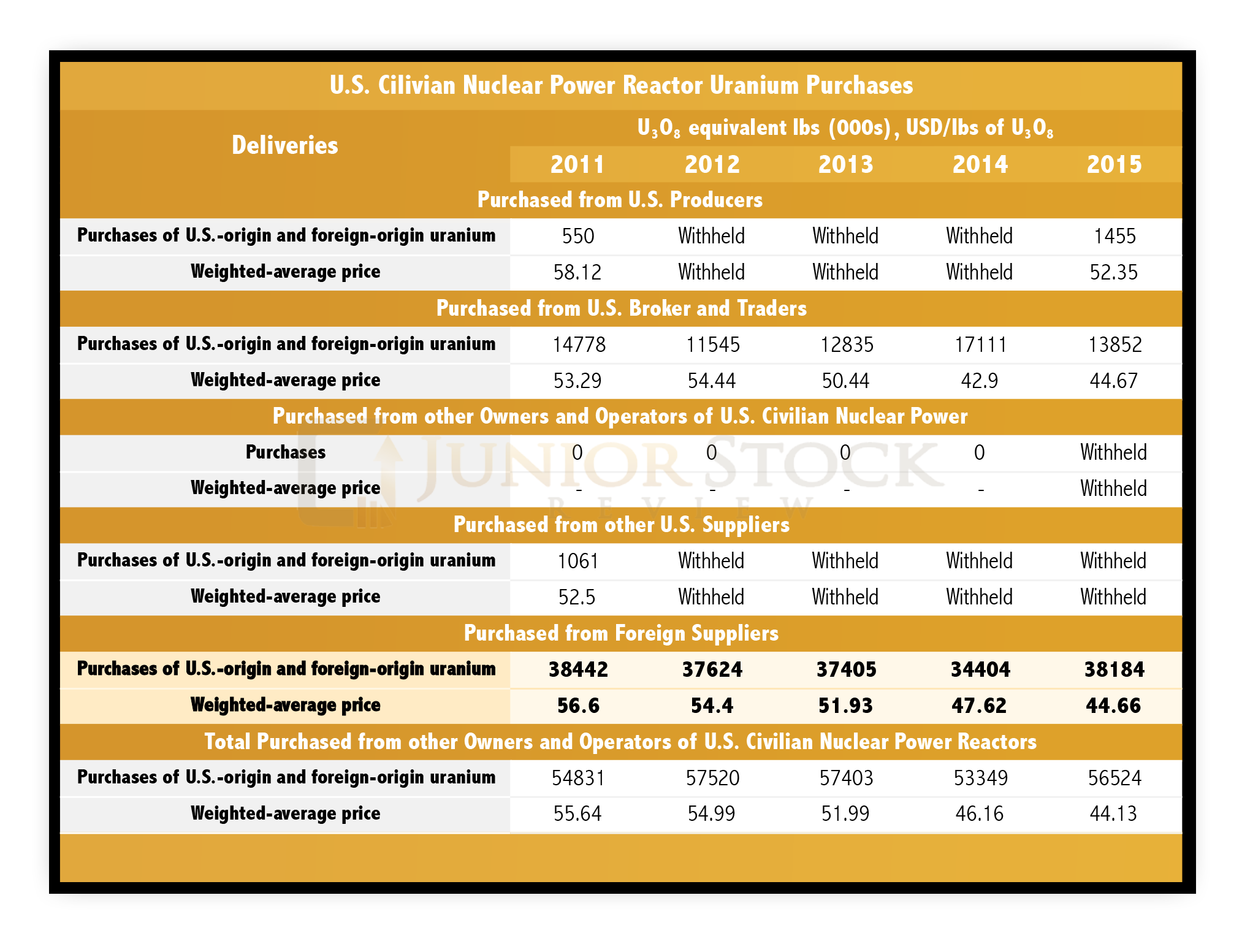
What does this mean? The United States is required to import the vast majority of their uranium needs, as can be seen in the table from the USA Energy Information Agency’s breakdown of the purchased uranium in years 2011 to 2015. Specifically, refer to the data in ‘purchased from foreign suppliers’ and you will see that the U.S. purchased the vast majority of their uranium from foreign entities in 2015.

Top 10 Nuclear Power Generating Countries
Source: International Energy Agency – 2016 Key World Energy Statistics – pg.17


Uranium Mine Production by Country
Source: World Nuclear Association
U.S. Uranium Purchases 2011 to 2015
Source: U.S. Energy Information Administration


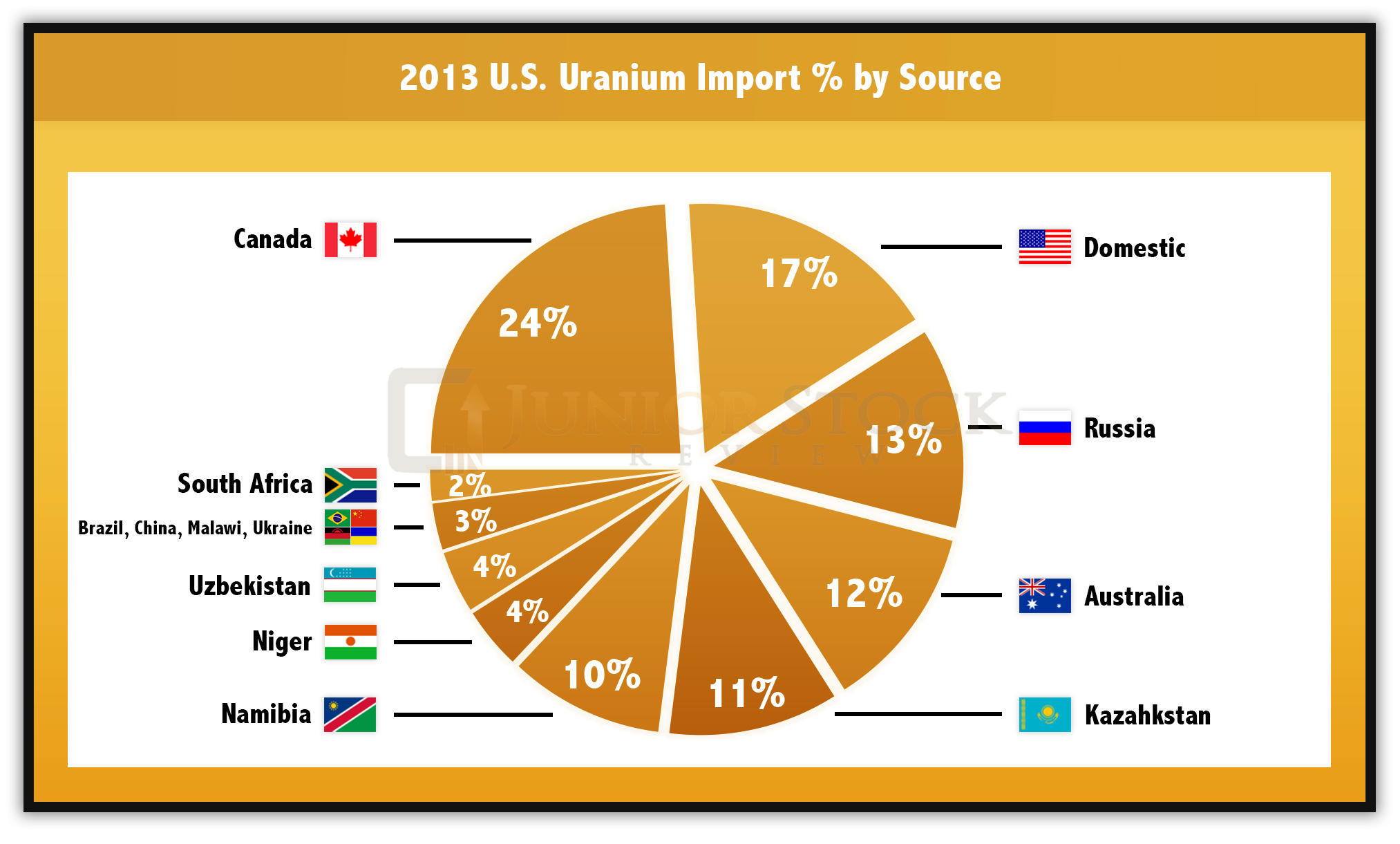
Who did the United States import their uranium from? Take a look at the pie chart below:

U.S. Uranium Import Sources
U.S. Energy Information Administration

Source: U.S. Energy Information Administration

The effect that president elect Donald Trump will have on the American economy has yet to reveal itself. From the statements he made during his campaign, however, we know of a few things that could happen:

  • Re-negotiate North American Free Trade Agreement (NAFTA)
    • Canada is the U.S.’ #1 trading partner and its #1 supplier of uranium. If the re-negotiation adds a tariff to imported Canadian uranium, U.S. utilities will be looking internally for a cheaper source.
  • Relations with Russia
    • It’s hard to say where this will go, but if tensions were to increase with Russia, it’s my contention that their supply of uranium to the U.S. may end.  The same could be said for the former Soviet States, Kazakhstan and Uzbekistan.
  • Made in America
    • Trump’s platform was “to make America great again,” and my guess is that this will include producing more of their goods within their borders. In particular, I believe there will be a push to produce more uranium within the country, creating more jobs and more security of supply.


Energy Fuels, America’s Next Leader in Domestic Uranium Production

The push for further domestic production will start with one of North America’s largest domestic uranium companies Energy Fuels. Energy Fuels is a uranium producer headquartered in Lakewood, Colorado, and with its producing assets in the western part of the United States. Its primary operations are as follows:

    • White Mesa Mill (Utah) – Only licensed and operating conventional mill in the USA.
    • Nichols Ranch Processing Facility (Wyoming) – In-Situ Recovery (ISR) of uranium
    • Alta Mesa Project (Texas) – In-Situ Recovery (ISR) of uranium

Let’s take a look at the reasons I believe Energy Fuels is set to weather the bear market storm.

The Energy Fuels Team

The Energy Fuels team is led by President and Chief Executive Officer (CEO), Stephen P. Antony. Antony has led Energy Fuels since his appointment in 2010. He’s a graduate of the Colorado School of Mines, originally trained as an engineer. He also holds a Masters of Business Administration from the University of Denver.

Antony has been in the mining industry for 39 years, and his start in the uranium business was with the mining arm of Mobil Oil, where he developed the reclamation plan for Mobil’s El Mesquite ISR operation in Texas. His next years were spent in managerial roles with Energy Fuels Nuclear, where he held the position of Director of Technical Services and with Power Resources Inc., where he was Vice-President of Business Development. Antony then consulted for Cameco as they completed their due diligence on Power Resources before their take over. Finally, in 2005, Antony was back with Energy Fuels as Chief Operating Office (COO), in charge of all the day-to-day operations of the corporation, production and exploration.

Antony has a great mixture of technical and managerial experience, and with 39 years in the business, he is certainly in the right position at the helm of America’s largest domestic uranium company.

My personal work experience is in operations, so I’m probably a little biased in my belief that operations, next to the CEO, are  the most important positions at a company. Energy Fuels has split their head operational position into 2 Executive Vice-President (VP) roles.

First, Harold R. Roberts is VP of Conventional Operations. Roberts is a trained engineer, having graduated from Montana State University in 1975. He has held many operational type roles throughout his career, from operations oversight to project development, as well as executive positions with Denison Mines, as Executive VP of U.S. Operations, and Energy Fuels Nuclear as President. Roberts’ work experience sets him up well for his operational role at Energy Fuels.

Secondly, W. Paul Goranson is VP of ISR Operations. Goranson is a trained engineer and possesses both an undergraduate and a Master’s degree from Texas A&M. Goranson has 28 years of experience in the uranium industry. Before joining Energy Fuels, he held executive roles with Uranez Energy Corporation, where he was COO and Director, Cameco Resources, where he was President, Mestena Uranium LLC, where he was VP, and finally, Rio Algom Mining and Uranium Resource Inc, where he held senior positions.

Energy Fuels is led by a seasoned group of uranium professionals, giving the company a solid footing during these hard days in the uranium business. Their business plans have thus far kept Energy Fuels profitable, and have set them up well for the upcoming bull.

Making America Great Again

It’s widely thought that North America is one of the best places for mining investment in the world. This is with good reason, as in our present moment in history, North America provides mining companies with a good legal system, relatively stable politics and a reliable workforce.

President Elect Trump is a wild card of sorts, and time will tell whether his proclamations will result in triumph or disaster, or maybe both, depending on your perspective. Only weeks after his win, it appears general consensus is that nuclear power will get a boost from Trump’s presidency.

Although the future is cloudy, I do believe that North America is your best bet from a jurisdictional perspective for uranium investment. The first part of this article describes the reasons I believe American uranium companies in particular will prosper in the years ahead.

Let us take a look at Energy Fuels’ presence in the United States and why they present the best bang for your investment buck for the American uranium companies.


Energy Fuels Properties

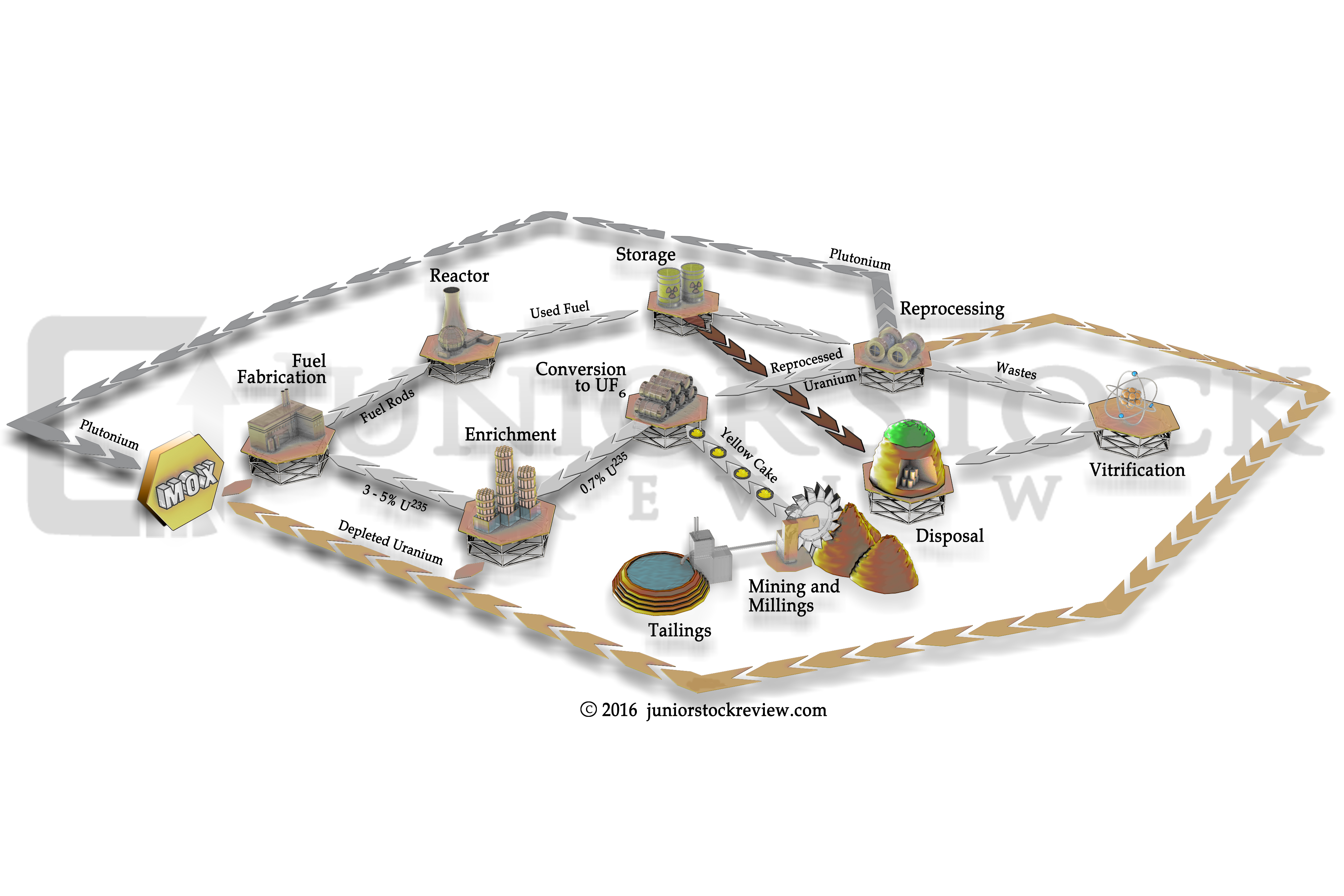
Located in Utah, White Mesa Mill is a conventional operation and the only licensed and operational mill in the United States. For those who aren’t familiar with the nuclear fuel cycle, let’s take a quick look.

Nuclear Fuel Cycle
Nuclear Fuel Cycle

A mill is integral to the cycle because yellowcake is produced through the milling process. Without it, uranium ore can‘t be converted into uranium hexafloride.

Conventional Uranium Mining

The White Mesa Mill has a licensed capacity of 8 million pounds (Mlbs) of uranium per annum and is centralized within the area where Energy Fuel’s high grade uranium mines are located.  Also, it possesses separate circuits to process high-purity vanadium and an alternate feed circuit, which produces uranium from other uranium-bearing  materials (don’t come from conventional ore). The alternate feed circuits are supplying Energy Fuels with profits during a dismal uranium market and represent a huge advantage to Energy Fuels when compared to its competitors.

Some food for thought, vanadium is extensively used within the steel industry as an alloying element, and is also a part of new battery technology, as it’s used with lithium to produce a powerful, safe and reliable battery solution.

PUSH:  Some push going into 2017 is the income generated from Energy Fuel’s new alternate feed contract, which was announced on October 31, 2016.


Mine Sites

Energy Fuels has a wide range of properties throughout the western United States. Let’s look at the conventional properties, first. Conventional uranium mining means that they mine uranium ore in an open pit or underground. The White Mesa Mill is the centrepiece for these mines, as all of the ore is trucked to the mill for processing.

Canyon Mine

  • Conventional development property located in Arizona
  • Inferred resource of 1.6 Mlbs
  • Extensive high grade copper mineralization (averaging 8.75%) was found (News Release). The plan is to expand the scope of the evaluation of the Canyon deposit, as this new discovery has the potential to make the economics of the project even better.  The further exploration of this target comes at a cost, as seen in the Q3 results, but it’s well worth it in my opinion, as a high grade copper by-product from this uranium mine could add a ton of value.
  • Production could start as early as 2017, with the ore being shipped to White Mesa for processing

Sheep Mountain

  • Conventional development property located in Wyoming – Currently, permitting for surface and underground mining
  • Probable reserves of 18.4 Mlbs U3O8, Indicated resource of 30.3 Mlbs U3O8
  • With a proposed maximum output of 1.5 Mlbs per annum

Henry Mountains Complex

  • Conventional property located in Utah, with close proximity to the White Mesa Mill. The Tony M mine is on standby, but fully permitted, while the Bullfrog portion of the project is still in permitting
  • Indicated resource of 12.8 Mlbs U3O8 and an Inferred resource of 8.1 Mlbs U3O8

La Sal Complex

  • The La Sal Complex is made up of a series of uranium/vanadium mines in Utah. These include: Beaver, Pandora, La Sal, Energy Queen and Red Clock projects
  • Beaver and Pandora are fully permitted and developed
  • Currently on standby
  • Measured and Indicated resource of 4.1 Mlbs U3O8 and 21.5 Mlbs of vanadium, and an Inferred resource of 0.4 Mlbs U3O8 and 1.9 Mlbs of vanadium

Whirlwind

  • Uranium/vanadium mine located on the Colorado/Utah border.
  • Fully permitted and developed
  • Currently on standby
  • Indicated resource of 1.0 Mlbs U3O8 and 3.3 Mlbs vanadium, and an Inferred resource of 2.0 Mlbs U3O8 and 6.8 Mlbs vanadium

Daneros

  • A uranium mine located in Utah, close to White Mesa Mill
  • Fully permitted and developed
  • Currently on standby
  • Inferred resource of 0.7 Mlbs U3O8

Roca Honda

  • Conventional property located in New Mexico, but within trucking distance to the White Mesa Mill. The project is still in permitting
  • Measured and Indicated resource of 14.8 Mlbs U3O8 and an Inferred resource of 11.2 Mlbs U3O8
  • PEA describes 2.6 Mlbs of production per year

Wate

  • Conventional property located in Arizona, but is within trucking distance to the White Mesa Mill. The project is in permitting
  • Inferred resource of 1.1 Mlbs U3O8

Energy Fuels also has a couple of other conventional development properties that are on a smaller scale: Sage Plain and EZ Complex. Check out their details here


In-Situ Recovery (ISR) Operations

Energy Fuels operates and owns ISR operations in the western United States, giving the company a portion of their U3O8 at a very low cost of production.

Nichols Ranch ISR Mine and Plant

  • Located in the Powder River Basin, Wyoming
  • Hank, Jane Dough properties are a part of Nichols Ranch
  • Fully licensed
  • 2 Mlbs of U3O8 per annum capacity
  • Measured and Indicated resource of 2.8 Mlbs U3O8
  • Resource expansion possibilities

Alta Mesa ISR Mine and Plant

  • Located in Texas
  • Purchased earlier this year (Mestena acquisition)
  • Fully licensed
  • 1.5 Mlbs of U3O8 per annum capacity
  • Currently on standby
  • Measured and Indicated resource of 3.6 Mlbs and an Inferred resource of 16.8 Mlbs

Energy Fuel’s owns a few ISR development properties, which are: Reno Creek, West North Butte, North Rolling Pin, and Arkose Mining Venture. For more information on these properties, check this out.

In total, Energy Fuels covers all of the bases with their ISR and conventional mining properties. The ISR projects provide the company with a low cost source of U3O8, which is particularly important in today’s price environment.

Not only is Energy Fuels one of America’s largest domestic uranium companies, but it has the potential to get even larger with there being a possibility for an expandable resource at a number of their properties. Available multiple million pounds in the ground and the ability to produce U3O8 up to 11.5 Mlbs per year, Energy Fuels has the horse power to respond to the growing domestic demand for uranium in the years ahead.


Author’s Note

As I mentioned earlier, my work experience was in the steel manufacturing business, and after the economic calamity of 2008, production at the plant where I worked was cut by 50% and stayed that way up until last year. With an increasing gap between the Canadian and U.S. dollars, more production tons were shifted to our plant in Canada.

To some, adding 25% more production should be easy, just flick the switch. But, what’s overlooked is the plant’s labour force, which was laid off during the downturn, leaving the plant with a senior workforce (unionized, senior members weren’t laid off). The issue with this scenario is that when it came time to add an additional crew, we had to train new workers in record time and fill in for the slew of retirements that removed experienced workers from a workforce that was largely baby boomers.

My point is this, it’s fantastic that there’s room to grow as the market turns, however, it isn’t always as easy as flicking a switch, because laid off employees don’t always return, and training new employees can be complex, depending on the process.


Financials

On November 3rd, Energy Fuels announced its 3rd quarter results.

Antony stated in the news release:

 “In light of today’s uncertain uranium market, Energy Fuels is intently focused on preserving, and in the case of Canyon, enhancing the value of the Company’s uranium assets.  We feel that the Company is well placed in the global uranium sector with multiple, 100%-owned production opportunities, which collectively have the potential to produce a large quantity of low-cost uranium in diverse ways in an improved market.  Moreover, the Company is working diligently to strike the correct balance between growing our production capabilities, maintaining visibility in global uranium markets, advancing high-priority development and permitting activities, and sustaining the financial health of the Company.  We believe our new Business Plan will upgrade and improve the quality of our portfolio of, producing, and permitted assets, while also maintaining and improving Energy Fuels’ sustainability, so our shareholders are in a position to benefit from the expected uranium market recovery.”

Here’s a summary of the news release highlights:

  • Gross profit of $3.0 million USD from mining and milling operations (34% gross profit margin)
    • Energy Fuels has a sales contract book that runs until 2020. Starting next year, in 2017, and working towards 2020, they have fewer tons contractually sold each year. This strategy leaves them open to upside in the uranium price, while protecting against downside.
    • To note, Energy Fuels’ sales contracts are completed at fixed prices, therefore, allowing the company to predict future cash flows against current operating costs.
  • Recovered 350,000 pounds of U3O8 during the quarter, 90,000 lbs from ISR and 260,000 lbs from conventional sources.
  • Implementation of cost cutting measures such as: sale or abandonment of certain non-core properties, sale of excess mining equipment and the Board of Directors have decided to reduce their total compensation by 20%.
  • Energy Fuels has re-jigged some of their contract deliveries, moving 300,000 lbs that were originally scheduled for 2017 to November 15, 2016.
  • A net loss of $8.2 million USD, $1.4 million USD impairment of inventory, and $6.3 million USD of development (permitting and land holding costs)
    • Development costs were for well-field construction at Nichols Ranch and continued shaft-sinking at the Canyon project (evaluation of high grade copper discovery)
    • In a letter released September 22, 2016, CEO Stephen Antony discusses the current uranium market and why the company completed a 2nd financing ($15 million USD) this year. This letter is well worth the read, as Antony draws on his experience to explain current market dynamics and outlines where Energy Fuels is headed.  Personally, I like the direction in which they’re headed; development and acquisition of properties is best done when the demand for your product isn’t there, just like being a contrarian investor and buying in a down market. When the market turns, Energy Fuels will be ready to rock, with their best properties ready to produce uranium ore.


Energy Fuels’ 3rd quarter financial results are reflective of a dismal market, one in which they produced profits from an operational perspective, but because the company has chosen to march ahead with the development of their other high potential properties, has incurred a net loss.

Even if the market doesn’t turn, Energy Fuels has efficient conventional and ISR projects that should give the company a healthy metal spread in the years ahead. Along with the additional income from their alternate feed circuits, Energy Fuels is poised to stick around for the boom.


Comparison to its Peers

North American Uranium Producers

NOTE: MCAP numbers may have changed since the writing of this article, please do your own due diligence and check. All other analytics are from the company websites.

To get an idea of how Energy Fuels stacks up against its peers, take a look at the table above. In a simple calculation of MCAP to total (reserves and resources) uranium, Energy Fuels is clearly undervalued.  Other than Cameco, Energy Fuels has the most production upside capability, along with the largest total uranium resources, giving it the ability to capitalize to a greater extent on a change in market sentiment.


Cash Generation Calculation

Energy Fuels is licensed to produce 11.5 Mlbs of uranium per year. Current market conditions have forced the company to cut back production to around 1 Mlbs per year. Outside of their developments cost, Energy Fuels has the ability to generate cash through its operations.

  • 1st quarter gross profit margin of 33%, 2nd quarter gross profit margin of 18% and a 3rd quarter profit margin of 34%. Average Profit margin for the year 28%.
  • The White Mesa Mill has an annual capacity of 8 Mlbs, but for the sake of this calculation, let’s be conservative and say that full capacity during an up market is 5 Mlbs, or roughly 62.5% of capacity
  • The ISR plants (Nichols and Alta Mesa) have a cumulative capacity of 3.5 Mlbs per year; let’s use the same conservative estimate and say that at full capacity the ISR plants will produce 2.2 Mlbs per year.
  • Therefore, in total, Energy Fuels will produce 7.2 Mlbs in this hypothetical bull market scenario
  • For the sake of this calculation, let’s use today’s approximate average sale price of $55 USD per pound

7.2 Mlbs x 55 $ USD /lbs = $396,000,000 USD

$396,000,000 x 0.28 = $110,880,000 USD in operational cash generation


Now, to put this in perspective, Energy Fuels’ current MCAP is roughly $111 million USD and this conservative example shows a cash generation of $110.8 million USD. If you consider that a portion of Energy Fuels’ sales will be at higher prices in the coming bull market, this number grows quite easily. Also, this example assumes a 62.5% capacity utilization, which may or may not be conservative, but there’s certainly room to grow to Energy Fuels’ licensed capacity of 11.5 Mlbs.

As with the 3rd quarter results, Energy Fuels will have development and permitting costs to pay over the next few years, but this money is well spent as it will bring on more capacity, fuelling American nuclear reactors for years to come.


Buying Value at a Discount

Looking to invest in the uranium space but are lukewarm about when the bear market will end? While Energy Fuels isn’t without risk because they are spending cash in the midst of a bear market to purchase great properties and to further explore, permit and develop high potential properties, Energy Fuels, in my mind, is well worth a look – they boast the following strengths:

  • Experienced management team
  • Undervalued, MCAP to Resources Ratio, compared to their North American peers
  • They have a hedged sales contract book with orders confirmed to 2020. That said, not all of their production is contractually sold, giving them plenty of upside to a rising uranium price in the future.
  • Largest American uranium company by resource size
  • Production scalability –  with a license to produce 11.5 Mlbs per year, there’s plenty of upside to fulfill demand. Many properties have the potential to expand their resource without the need for M&A.
  • All operations are in the western United States

Energy Fuels is ready to fuel America’s uranium renaissance. Invest ahead of the crowd and be a contrarian!


Until next time,


Brian Leni   P.Eng

Founder – Junior Stock Review


Disclaimer: This is not an investment recommendation, it is an investment idea. I am not an investment professional and do not know your specific investment needs. Please do your own due diligence. I have not been compensated to write this article and do not own shares of Energy Fuels.


Posted on

Waking the Giant: A Look at Cameco in Today’s Uranium Market & Going Forward

Cameco logo

Disclaimer: The following is not an investment recommendation, it is an investment idea. I have not been compensated to write this review, however, I do own shares in this company. Please perform your own due diligence to decide whether it is a company that’s best suited for your personal investment criteria. All Cameco Corporation analytics were taken from their website and press releases.


The uranium price continues to make new lows, and in the midst of this carnage, a slumbering giant is still making its shareholders money. Cameco’s 3rd quarter results, released last week, surprised many in the midst of such dismal prospects.

This report takes a look at the current Cameco story, specifically the people who manage this uranium company, the properties and the jurisdictions in which they’re located, and how Cameco is weathering a falling uranium price. This analysis also sheds light on the reasons I think Cameco will be the leader when this long uranium bear market comes to an end.


The People at the Helm of Cameco

Unlike junior companies which, for all intents and purposes, are only as strong as the people who manage them, the executive personnel in senior companies with producing assets aren’t always considered to be as vital to the company’s success. When a stalwart executive group is at the helm of a big company like Cameco, however, it can make all the difference in the world.  Let us take a look at what I believe is a great mix of business and real world uranium mining experience.

Cameco’s management is headed by Chief Executive Officer (CEO), Tim Gitzel, who took the reins back in July of 2011. Gitzel has a law degree from the University of Saskatchewan and possesses 25 years of combined experience in senior management and legal experience. Before joining Cameco, Gitzel was the Executive Vice-President (VP) of AREVA’s mining business unit based in Paris, France, later becoming President and CEO of AREVA’s Canadian subsidiary. Gitzel’s working experience has set him up well for his current position at the top of the world’s 2nd largest uranium company.

Gitzel’s operational team is led by Chief Operating Officer (COO), Robert Steane, who worked his way up the corporate ladder from Assistant Mill Superintendent to his appointment as Senior VP and COO in May of 2010. Speaking from my own experience, having worked in the steel manufacturing industry for several years, the best operational management comes from those who have worked their way up from the ‘floor’ to the c-suite. Hands on ‘floor’ experience can never be replicated in a class room, and in Cameco’s case, they have chosen well, promoting Steane from within to lead their operations.

Rounding out the most important positions in Gitzel’s team is Chief Financial Officer (CFO), Grant Issac. Issac holds a BA and MA in economics from the University of Saskatchewan and a PhD from the London School of Economics. Before joining Cameco, Issac was a professor and Dean of the Edward School of Business at the University of Saskatchewan. Issac was appointed Senior VP and CFO of Cameco in July of 2011, where he oversees finance, tax, treasury, investor relations, strategy and risk, and marketing for Cameco Inc. and Nukem.

The Cameco team is built around experience in the industry, and in my opinion, it will be what powers them through what is currently a very tough uranium market.


Cameco’s Producing Properties

Cameco’s properties have a combined Proven and Probable Reserve total of 410 million pounds (Mlbs). Further, they have 377 Mlbs in Measured and Indicated resources and an Inferred total resource of 381 Mlbs.  Cameco’s 3 largest producing mines are giants next to their peers. Let’s take a look:

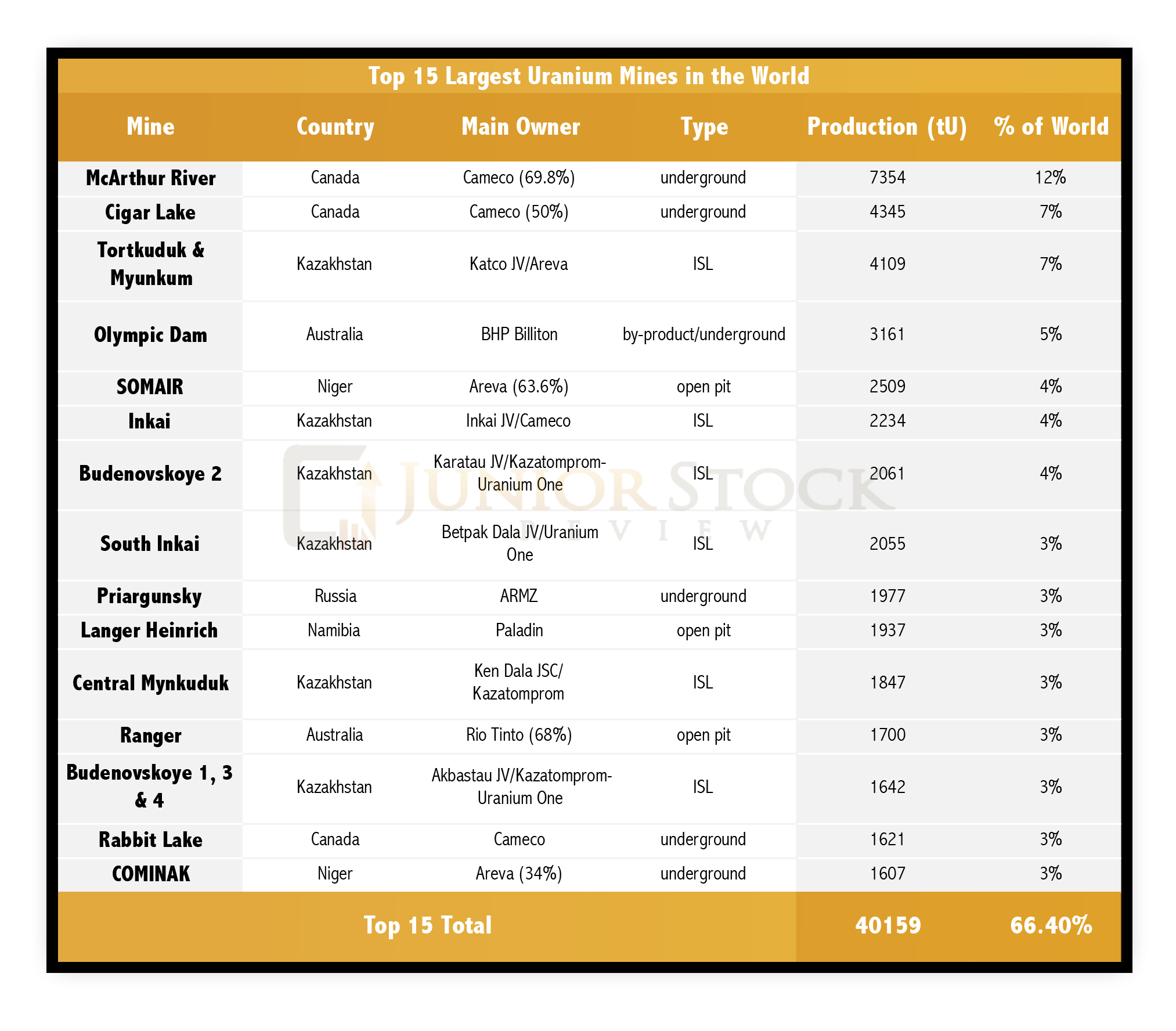
Top 15 Uranium Mines in the World
Source: Word Nuclear Association


McArthur River and Cigar Lake are not only Cameco’s largest producing assets, but the largest producing mines in the world. McArthur River and Cigar Lake are a part of Saskatchewan’s Athabasca Basin, which is home to some of the highest grade uranium mines in the world.

By the numbers:

McArthur River

  • Proven & Probable reserves of 234.9 Mlbs @ 10.94% (average grade U3O8) – more than 50% of Cameco’s reserves
  • Underground mine
  • 70% owned by Cameco

Cigar Lake

  • Proven and Probable reserves of 110.9 Mlbs @ 16.7% (average grade U3O8)
  • Underground mine
  • 50% owned by Cameco


Cameco’s third largest producing asset is a joint venture located in Kazakhstan, named Inkai. While not a high grade uranium source, the uranium in the Inkai deposit is extracted using In-Situ Recovery, a very low cost form of mining.

Inkai

  • Proven and Probable reserves – 43.1 Mlbs
  • In-Situ Recovery
  • 60% owned by Cameco


NOTE: On April 21, 2016, Cameco announced that it would be suspending production at its Rabbit Lake operation.


Prospective Properties

Milliennium

Cameco’s Millennium uranium project is a joint venture (Cameco owns 69.9%) with Areva and is located in the Athabasca Basin in northern Saskatchewan. It contains an Indicated resource of 53.0 Mlbs at an average grade of 2.39% U3O8 and an Inferred resource of 20.2 Mlbs, average grade of 3.19% U3O8.

As stated on the Cameco website, regarding work at Millennium,

“[N]o work is planned for 2016, as regulatory activity related to our final environmental impact statement continues to be on hold. Further progress towards a development decision is not expected until market conditions improve.” ~ Cameco

Given the current uranium market and the need to tie up regulatory requirements for the project, Millennium will wait for development until the market turns from bear to bull.


Kintyre

Cameco’s Kintyre uranium project is a joint venture (Cameco owns 70%) with Mitsubishi Development Pty Ltd. and is located in the Pibara region of Western Australia. It contains a Measured and Indicated (M&I) resource of 53.5 Mlbs U3O8.

The Kintyre project is advance-staged and has completed a prefeasibility study, community engagement and education program and signed an Indigenous Land Use Agreement with traditional owners, the Martu.

Although this project appears to be ready for construction, it may be a while before Cameco gives the green light, given the current uranium market.


Yeelirrie

Cameco’s Yeelirrie uranium project is 100% owned and located in Western Australia. It contains a M&I resource of 127.3 Mlbs, with an average grade of 0.16% U3O8.  This past summer, Cameco had Western Australia’s Environmental Protection Agency (EPA) do an assessment of the Yeelirrie project. The EPA evaluated the property against 9 criteria. Cameco reports on the results of the assessment on the Cameco Australia website,

“The EPA has determined that eight of the nine key environmental factors at Yeelirrie can be managed to meet the EPA’s objectives. For one factor, subterranean fauna, the EPA was not satisfied with what was proposed.” ~ Cameco Australia

Cameco will have to find a way to effectively deal with the subterranean fauna before they will have any hope of constructing a mine here. What’s the likelihood that they will be able to deal with this set back? I’m not really sure, more research is needed, but given the uranium price, I don’t believe bringing this asset to production is a very high priority.


Although Cameco’s business is highlighted by the strength of its mining operations, they’re involved in and excel at each aspect of the nuclear fuel cycle, from conversion to fuel rod assembly. Their nuclear fuel facilities are exclusive to Canada, or more specifically, Ontario. For those familiar with the geography of Southern Ontario, 3 of the 4 nuclear fuel facilities are actually situated in the Port Hope/Cobourg region, which is about a 1.5 hour drive east of Toronto.

Also to note, Cameco does have a 24% interest in the experimental Global Laser Enrichment facility in the United States. They are partnered with GE and Hitachi in this endeavour.

Cameco is truly an international company, but does have the bulk of its operations in North America, and specifically Canada. From a jurisdictional perspective, Cameco’s risky assets are in Kazakhstan. In relative terms, however, the Inkai mine makes up 10.5% of Cameco’s uranium reserves, and while this would certainly impact the company if it were compromised, it’s a small part of the company’s business as a whole.

Why do I consider Kazakhstan to be risky? There are a couple of reasons; Firstly, Kazakhstan uranium is primarily mined by a state-owned company called, KazAtomProm. Any time an industry is controlled by a government, I’m concerned about the possibility that the resource (asset) will be nationalized at some point. Second, with Kazakhstan being a former Soviet state, I wonder where allegiances will lie if tensions rose between Russia and the rest of the world – I wrote about this in part 3B of the Uranium series.


NUKEM

If you have explored Cameco quarterly news releases, you may be wondering about NUKEM. Prior to being purchased by Cameco in 2012 for USD $136 million, NUKEM Energy group had been involved in the nuclear energy industry for more than 50 years. NUKEM acted as an intermediary in the commercial nuclear fuel market, concentrating primarily on the purchase and sale of uranium concentrates U3O8, UF6 and enriched uranium product (EUP). Cameco has kept the NUKEM offices in Germany and the United States.

Further information on NUKEM can be found in the report, here


A Look at How Cameco is Surviving the Bear Market

How is Cameco fairing in this uranium bear market? I had the chance to correspond with Senior Communications Specialist, Carey Hyndman, last month:


  1. Cameco’s uranium selling prices are protected to a certain degree with a price hedge, as outlined in the price sensitivity section of the 6Q. That said, when does the decision to cut production at these lower trending spot prices become a reality?


Hyndman: “The uranium price sensitivity table is based on our portfolio of contracts, where we have an average of 27M lbs in sales commitments over the 5-year period shown. It isn’t evenly distributed, but heavily committed through 2018 and declining in 2019 and 2020 to arrive at that average. We are cautiously preparing for a scenario where the market remains lower for longer and on that basis, our strategy is to profitably produce from only our tier-one assets, at a pace aligned with market signals, to increase long-term shareholder value. This means maintaining flexibility to increase or decrease production, but it depends on the market conditions.”


My Comments:

Commodity price hedging is fairly common for the largest producers in the resource sector, and it certainly protects against downside risk, but it also limits their upside potential in a raging bull market. In this case, I think Cameco has done a fine job protecting themselves from a massive slide in the uranium price, by hedging their sales portfolio.

Let us take a look at Cameco’s performance by the numbers in 2015:

  • Produced – 28.4 Mlbs U3O8
  • Average realized sale price per pound – $57.58 CDN
  • Revenue – $2.8 billion
  • Gross Profit – $697 million
  • 2016 YTD – Quarter by Quarter – Taken from Cameco News Releases, please review reports for further details, this is only meant to be a high level look at the quarterly financials:
    • 1st Quarter – 3 months ending March 31, 2016 – Revenue $408 million / Gross Profit $118 millon / Net Earning (loss) in $ per share (diluted) 0.20
    • 2nd Quarter – 3 months ending June 30, 2016 – Revenue $466 million / Gross Profit $43 million / Net Earning (loss) in $ per share (diluted) (0.35)
    • 3rd Quarter – 3 months ending Sept 30, 2016 – Revenue $670 million / Gross Profit $146 million / Net Earning (loss) in $ per share (diluted) 0.36

I believe this performance – in what is widely thought to be the 2 worst years of the uranium business in decades – to be proof that Cameco can survive and profit in the face of adversity.


  1. With an exploration budget greater than 2015, yet a lower 2016 trending uranium price, how is Cameco’s exploration work affected?

Hyndman: “You’ve seen our exploration program decline significantly, from a spend of $97 million in 2012, to under $50 million this year, so exploration has been significantly impacted. The budget process for 2017 is currently underway.”


  1. In a lower trending uranium price market, why does Cameco choose to invest in exploration rather than purchasing an outlined resource?

Hyndman: “You’ve seen our exploration program decline significantly, from a spend of $97 million in 2012, to under $50 million this year, so exploration has been significantly impacted. We continue to believe that our pipeline of advanced exploration projects including Millennium, Kintyre and Yeelirrie, as well as the other deposits where we have an interest, are best in class. On the M&A side, junior companies, including exploration plays and those that consider themselves developers, must compete against our internal suite of projects and mine expansion opportunities, and we have not seen anything that we think will add more value than what we already have.”


  1. Considering Russia’s decision to suspend their weapons grade plutonium down blending deal with the US (Oct.3/16 News Release), do you foresee this having a positive effect for Cameco’s primary uranium supply? If so, how?

Hyndman: “This was a headline in the context of political implications, not due to a potential impact on the uranium market. At the moment, only a very small quantity of MOX fuel (mixed oxide, where plutonium is recycled into reactor fuel) is produced globally, and the Russian proportion would only be a small piece of that. With a significant amount of oversupply in the market today, we would not anticipate much of an impact on the primary supply market.”


  1. In the 6Q uranium market update, you reference a few positives for uranium demand; Japanese reactor stress testing and new reactor construction. In the short term (1 to 2 years), does Cameco foresee any other catalysts for an increase in uranium demand? If so, please explain.

Hyndman: “Demand is fairly predictable: national energy policies are widely known, plans for reactors are published, and it’s generally reported when a reactor construction project begins and when reactors come online. The catalysts you listed are the ones we’re watching – Japanese reactors need to get on a sustained path for restarting (which would impact market sentiment), and we need to see continued construction of new reactors around the world, particularly in China, India and South Korea. As overall demand grows, and the excess inventory and oversupply that has built up over the past 5 years clears the market, we are then watching for a return to long-term contracting and more concern around security of supply. However, in the meantime, we’re keeping an eye on primary supply performance, as there has yet to be a significant supply reaction to the current oversupply situation.”


Issues with the CRA

Cameco has been in the news as of late, with their public battle with the Canadian Revenue Agency (CRA) over a potential $2.2 billion tax bill. The Financial Post reports in their October 3, 2016 article,

“At question is whether Saskatoon-based Cameco Corp. set up a subsidiary in low-tax Switzerland and sold it uranium at a low price simply to avoid tax, as the CRA contends. Cameco maintains it was a legal and sound business practice.” ~The Financial Post

In 1999, Cameco Europe Ltd. was established in Zug, Switzerland (Low Corporate Taxes).  As reported by the Globe and Mail,

“Cameco then signed a 17-year deal to take the uranium it produces in Canada and sell it to Cameco Europe before it made its way to the end customer.” ~Globe and Mail

The CRA’s reassessment of Cameco taxes for 2003, 2005 and 2006 tax years are being appealed in tax court now, with the court’s decision to come early next year. On their websites, Cameco outlines that the worst case scenario for them is,

“[O]ver time we would be required to pay cash taxes and transfer pricing penalties of between $1.5 billion and $1.7 billion, plus interest and instalment penalties. These payments cover the period 2003 to 2015.” ~ Cameco

My take on this situation; In the end, I think Cameco will have to pay some percentage of the monies in question to the CRA. Interestingly, Cameco isn’t the only resource company that’s in the midst of a major tax dispute with the CRA; Silver Wheaton is also in a public battle.

I believe this tax dispute trend isn’t going away any time soon, as governments around the world continue to spend money that they don’t have. Their only option, besides raising taxes, is to hire more people to question the tax returns of their citizens and corporations.

No matter the outcome, Cameco is still the major player in the uranium sector, and in my opinion, has the balance sheet to deal with whatever the courts decide. With the down trodden uranium price and this negative press, Cameco’s share price seems like a tremendous buy.

PUSH: Next spring, when this tax dispute is finalized by the courts, I’m of the opinion that Cameco’s stock will be re-evaluated to the upside.


Cameco Comparables

CCO – TSX Listing

MCAP – CDN $4, 975, 112, 002 (at the time of writing)

Price to Book – 0.914

Yield – 3.26%

52-Week High – CDN $17.67

52-Week Low – CDN $9.88


It’s incredibly hard to try to compare Cameco to its peers; If you consider the top 10 uranium producers in the world, most are state-owned and controlled, and the others, specifically BHP Billiton and Rio Tinto, don’t have businesses that revolve solely around uranium.

AREVA is probably the closest comparison because it’s involved in each part of the nuclear fuel cycle, but the French state controls, directly or indirectly, 86.52% of AREVA, making it, as far as I’m concerned, an unfair comparison.

In reality, Cameco is the largest publicly traded uranium company in the world and really has no direct comparisons. Instead, I believe Cameco’s value is better evaluated on the assets that it possesses and the people in management.

  • The top 2 producing uranium mines in the world (a 3rd in the top 10)
  • Proven and well established executive leadership – Gitzel, Steane and Issac
  • Cash generation in a down market – Hedged sales book protects against a falling uranium price
  • Not just a miner, but involved in all aspects of the nuclear fuel cycle
  • Good portfolio of undeveloped properties in great jurisdictions
  • Dividend paid quarterly

PUSH: In my opinion, even at these low uranium prices, Cameco is under-valued at its current MCAP. The market, however, can remain irrational longer than most of us can remain solvent, meaning this push may take a little while. That said, when uranium is looked upon with a little more positivity, I believe Cameco will lead the way in gains.


To me, choosing to invest in Cameco now does come with the risk of further negative sentiment toward the uranium sector, via a falling uranium price. As stated earlier in the report, however, Cameco’s executives have done a great job of protecting against this downside risk.

If money is made on the delta between price and value, Cameco is a company which possesses great value at its current price. Invest opposite to the crowd and take a look at Cameco – the uranium industry’s GIANT!


Until next time,


Brian Leni   P.Eng


Posted on

Speculator, a Compelling Piece of Fiction that’s as Much About Philosophy & Free-Market Principles as it is Speculation

Speculator

My introduction to the junior resource market and my outlook on the world were heavily influenced by Doug Casey. Without a doubt, I wouldn’t be where I am today were it not for the impression he made. I’ve read virtually every book Casey has written, so I was intrigued, to say the least, when I heard he would be releasing a fictional story about speculation.

It’s funny how things seem to pop into your life at just the right moment, because in the case of Speculator, the philosophical narrative really resonated with me. In part, I’m sure it has something to do with the types of projects I’m currently working on, but also because it’s written in true Casey style.


Speculator Review

Doug Casey and John Hunt’s collaboratively written, Speculator, is the answer to those looking for an education in junior mining stock speculation – with a twist. What makes this book especially interesting is that it offers a reprieve from the sometimes boring confines of non-fiction writing with some fantastic story telling.

Speculator tells the story of Charles Knight, a young speculator, and his adventures in the fictional West African nation of Gondwana. Knight is drawn to Gondwana to investigate a junior gold company, B-F  Explorations, in which he holds a large speculative position.

What Knight finds during his time in Gondwana, however, will change his life forever; by following his instincts, he uncovers a fraud that will put his life and the people he cares about in jeopardy. His plan to expose this fraud navigates the ironic and idiotic nature of our governing bodies, and how doing the so to speak ‘right thing,’ really doesn’t do any good for anyone.


Questioning Social Norms

Knight’s adventure intertwines with a few different plot narratives, which discuss some very important social concepts that are so often overlooked or considered too ‘politically incorrect’ to broach. In my opinion, this is where Casey and Hunt are at their best, providing commentary that anyone not completely sold on social norms will find particularly thought-provoking.

This paragraph stood out for me as both a lesson in speculation and in life:

“Most people, navigating the waters of life, seemed sonar directed, setting their course based on what the rest of the school of fish was doing. These sonar-directed types spent their days pinging their surrounding, turning-often suddenly and without understanding why-when everyone else turned. Perhaps if they turned fast enough the ones on the edges would get eaten, instead of them. It was safer, but the crowd, necessarily, always got average results. And occasionally the entire mass got swallowed whole.” ~ Casey, Hunt. Speculator, 91 (PDF Version)

Knight encounters a number of challenges that test his moxie, as he must decide how far he’s willing to go to ensure B-F’s fraud is uncovered and his profits maximized. The adventure concludes fantastically, fraught with death, love and taxes (so to speak).


The People & Experiences that Shape Our Lives

The principles you choose to live by reflect who you are, and essentially, where your life will lead. I can hear Casey’s voice in almost every one of the characters in this book, and for me, they provide excellent thinking points, or words to live by.

There are two characters, in particular, that play a major role in shaping Knight’s character:


Uncle Maurice is really much more than an uncle, as Knight uses him as a barometer for his actions throughout the story. Maurice empowers his nephew to follow his dreams, to live life by a set of principles that help Knight overcome obstacles along the way.

There are a variety of lessons to be learned from this character, but a few that stood out for me were:


  • The importance of soundness, which Knight defines as,

“Soundness means having integrity…People who are sound don’t live in contradictions. They’re…internally consistent…It’s being honest with yourself, for sure. Caring enough to seek the truth is part of it” (80-81).


  • Listen to your instincts:

“Contrary to common opinion, intuition wasn’t mystical; it was scientific. Intuition was the ability to properly integrate many subtle pieces of information. To have good intuition, therefore, someone needs experience and data and a logical mind that can fuse them into coherence” (17).


  • Be truthful:

“Truth never contradicts itself” (81), and, “lying to others is bad enough, but lying to myself is actually worse. I don’t have to live with other people, but I have to live with myself” (92).


Xander Winn is an experienced Dutch speculator, who imparts a great deal of wisdom throughout this adventure. Winn’s experiences combined with the fact that he shares similar principles make him the perfect supporting character for Knight, as they struggle to solve the issues that arise and to deal with the consequences of their actions.

For me, the following three themes were most prominent in the wisdom that Winn shares:


  • Life lessons:

“Lesson One: to succeed, position yourself to take advantage of luck. Lesson Two: bad luck happens. So plan on bad luck, not good luck” (12).

Winn explains further:

“Luck materializes when preparation meets opportunity” (30).


  • Money is important:

“Money is important. It’s not just hunks of metal, pieces of paper, or computer entries. It represents all the time you spend earning it. It represents all the good things you want to have, and do and provide for others. It really represents life itself, in concentrated form”  (25).


  • Justification of your actions:

“In your life, make sure to watch how far down that slippery slope of justification you drop, okay? An emotionally laden human brain can justify a whole lot of evil” (257).


Speculator can be read on a number of different levels. It’s simultaneously a great adventure story – complete with death, love, and suspense, – a useful guide to speculation, and a philosophical commentary on some of the most important social topics of our world. Read Speculator, and no matter what you take from it, I guarantee you will be entertained.

Become a Junior Stock Review VIP and receive a FREE digital copy of Speculator. Sign up now!


Until next time,

Brian


Posted on

A Clean Energy Giant In the Making

GoviEx Uranium

Disclaimer: The following is not an investment recommendation, it is an investment idea. I have not been compensated to write this review, nor do I own shares in this company. Please perform your own due diligence to decide whether it is a company that’s best suited for your personal investment criteria. All GoviEx Uranium analytics were taken from their website and press releases.


There’s an abundance of naturally occurring uranium (the nuclear fuel) in the world, but producing mines of consequential size and profitability are scarce. This is especially clear looking at the top 10 nuclear power generating nations. Canada is the only country with surplus uranium production; most of the rest are importing close to 50% or more of the uranium they consume.

Top 10 Nuclear Power Generating Countries
Source: International Energy Agency – 2016 Key World Energy Statistics – pg.17

France, in particular, stands out like a sore thumb because it’s not only the 2nd largest nuclear power generator, at 436 TWh, but nuclear power accounts for 78% of France’s domestic electricity generation. This is further compounded by France’s dismal uranium producing capability, with a mere 2 tonnes being produced in 2015. Low production forces France to import the vast majority of its U3O8 needs. Using the WISE Uranium Project’s Nuclear Fuel Material Balance Calculator, 436 TWh requires roughly 12,1576.74 tonnes of U3O8. So where do the French get their supply?

Areva is the 3rd largest uranium producing company in the world, with 9,368 tonnes of uranium produced in 2015. Areva, however, isn’t just a miner, it’s involved in all aspects of the nuclear fuel cycle. In addition major shareholder in Areva NP, Electricite De France (EDF), operates the majority of the nuclear power generation plants in France. From a global perspective, France makes up 39% of total company revenues, and 68% of total company employment. More than 85% of Areva’s shares are in French state hands, making it absolutely sensitive to French power generation needs.

Areva’s uranium production comes primarily from Niger, with its world class COMINAK and SOMAIR mines. The COMINAK mine is smaller than SOMAIR, but is the 15th largest uranium producing mine in the world, of which Areva owns 34%.

The SOMAIR Project, on the other hand, is the 5th largest current producing mine in the world, and Areva owns 63.6%. Both mines are located in the northwest region of Niger, near the town of Arlit. The mine was established in 1968, and by the end of 2015, had produced around 63,240 tonnes of uranium. With the mine lives nearing 50 years, SOMAIR and COMINAK could are approaching the end of their production, based on the quoted reserves.

Along with France, China and South Korea are the other standouts for me, from the world’s top 10 nuclear power generating countries, as their uranium needs far outweigh their uranium production figures. With future nuclear plant construction being dominated by these Asian power houses, the current U3O8 surplus will quickly be shifted to these nations.

Reactors under Construction
Source: World Nuclear Association- World Nuclear Performance Report 2016 – pg.14


In my opinion, a portion of this future uranium demand could be satisfied by GoviEx Uranium.

The GoviEx Uranium Story

The GoviEx Uranium story is bigger than its flagship Madaouela Project, in Niger. In their June 13, 2016 news release, GoviEx Uranium and Lukas Lundin’s Denison Mines announced that they had completed the transaction to combine their respective African uranium interests. GoviEx Uranium’s deposit portfolio now consists of not only its flagship Madaouela Project, but also the Mutanga Project in Zambia, the Falea Project in Mali, and finally, the Dome Project in Namibia. For this, Denison received 56,050,450 shares and 22,420,180 common share purchase warrants in GoviEx (further details can be found in the press release). This deal makes Denison Mines GoviEx’s largest shareholder, with a 25% stake in the company, and results in GoviEx holding approximately 200Mlb U3O8 in total mineral reseources, and two permitted mines.

Investing with Some of the Best

The insider support for GoviEx extends beyond the Lundin Group. Nuclear industry giants, Cameco and Toshiba, own 7% and 11% respectively. Mining legend, Robert Friedland’s Ivanhoe Industries owns 7%. Friedland’s geologist son, Govind, is the founder of GoviEx and holds 12% of shares. In total, roughly 60% of GoviEx is owned by influential corporate and strategic shareholders.

Jurisdiction

It’s no secret that Africa has seen its fair share of political unrest and overall unpredictability. At first glance, this may seem like a negative for the company, but a portion of the African nations depend almost entirely on their resource exports for the cash their economies so desperately need. In particular, Niger stands out as a mining friendly jurisdiction, with a democratically elected government. In my conversation with GoviEx CEO, Daniel Major, he highlighted this fact when he referred to Niger, where uranium production makes up about 70% of the national exports. For Niger, uranium mining is a business that brings social stability through job creation.

Further summarizing my conversation with Major, most West and Central African nations use OHADA business law, making navigation for companies in multiple jurisdictions much easier. In particular, GoviEx benefits by spreading risk across 4 countries that share similar legal systems and histories of mining. As described earlier, the SOMAIR mine has been in operation since 1968, meaning that the Nigerien people have multi-generational experience with this business. As Major points out, the Madaouela Project’s onsite work force, at least currently, is totally Nigerien.

The need for uranium production exports, and meeting the high international standards on its studies, has allowed GoviEx to acquire mining permits in 6 months, which is unbelievably fast compared to its peers. Mines such as Cigar Lake in Canada’s Athabasca Basin, for instance, have taken several years to acquire the appropriate permitting.
Any concerns about terrorist activity in Africa can be at least partially alleviated by the fact that there’s military presence, most notably the French, US and German in neighbouring Niger and neighbouring Mali. Also, drawing on one of the points I made earlier, because GoviEx has a 100% local work force, its projects may be considered less of a terrorist target.

GoviEx Resources

Beginning with the flagship asset, the Madaouela Project is made up of 5 deposits: Marianne, Marilyn, Miriam, MSNE and Maryvonne. As outlined in the development plan (where you will find further details), the Madaouela Project has approximately 61 million lbs U3O8 of Probable Mineral Reserves. The after-tax NPV, with an 8% discount, is USD $339 million with an IRR of 23.5%, and a long-term uranium price of USD $70 /lbs U3O8. The life of the mine (LoM) is expected to be 21 years, with an annual average production of 2.69 Mlb U3O8. Now, I’m sure most are wondering, how much is this going to cost, and how do you finance a project with a falling uranium price, in Niger? These are the questions I asked Major during our conversation:

  • How much is this going to cost?

As described in the development plan, initial capital costs are estimated at USD $359 million, with LoM capital cost being USD $676 million.

Short-Term PUSH:

A reliable indicator for identifying the presence of uranium in the ground is a radon gas survey. Radon gas is produced via the radioactive decay of radium-226, which is found in uranium ores. RadonEX of Saint-Lazare, Quebec in Canada will be conducting a radon gas survey at the Madaouela Project for GoviEx in the near future.

To summarize Major, the RadonEx program is targeted to expand resources at the Miriam open pit deposit portion of Madaouela. He said he believes that if this program is successful, it could improve the economics of the open pit portion of the project, reducing the capital cost associated with its construction. This reduction in cost not only reduces upfront capital, but also simplifies the project in the eyes of the financiers, who should be paid back before the second leg of the project, which is underground.

  • How do you finance the mine construction, given the uranium price and the jurisdiction?

To summarize Major, the traditional financing measures used by a lot of companies throughout the world aren’t typically available to projects in countries such as Niger. GoviEx has appointed Medea Capital Partners Ltd. as a Project Debt Advisor. They will assist in the process of structuring the debt portion of the project financing that’s required for the development of the project in Niger.

Medea concluded that there should be market capacity for Export Credit Agency (ECA) covered debt project financing for the development of the mine. The ECA’s involvement is expected to play a key role in achieving full funding. ECAs can provide credit insurance, which significantly reduces the risk profile of project debt to the syndicate of mining finance banks, that ultimately finance the development of the project. ECAs are public agencies that provide sovereign-backed loans, guarantees and insurance to companies who seek to do business in developing countries.
This method takes a little longer than the traditional process, and as Major says, they hope for the financing structure to be in place by the end of next year.

GoviEx’s other 3 properties are highlighted by the other fully permitted mine, Mutanga, situated in Zambia and was part of the acquisition from Denison Mines. In total, the Mutanga Project (Resource Outline) has 2.0 Mlbs U3O8 Measured, 5.8 Mlbs Indicated and 41.4 Mlbs Inferred. Some short-term PUSH could come from a Preliminary Economic Assessment (PEA) on the Mutanga Project, which Major indicated they would be pursuing in the near future.

Each of GoviEx’s 4 projects present exploration upside, which may not be as important in the near-term, but present great options for the future expansion of the resource.

Most Valuable Commodity

In the junior resource sector, it’s widely accepted that people are the company’s most valuable commodity. In GoviEx’s case, Daniel Major was tasked with bringing this company to production, drawing upon his technical background in mining. During our conversation, he outlined his work history and it’s chock-full of mining industry experience, ranging from his humble beginnings with Rio Tinto, as a mining engineer and hands-on equipment operator, to his work as an analyst with HSBC and JP Morgan. This combination of skill set and experience leave me feeling confident that Major is the man to bring this deposit into production.

Money is Made on the Delta Between Price and Value

While there are unanswered questions and concerns about GoviEx Uranium, such as solidifying financing, the African jurisdictional risk, and a falling uranium price, in my opinion, the story is undervalued in comparison to its development peers. Also in the last uranium bull cycle two of the best performing shares were Paladin and Energy Fuels, because they built mines in the cycle. After all, in the junior sector, money is made on the delta between price and value.

You be the judge:

· Proximity to the world’s 5th and 15th largest uranium producing mines
· Two mining permits: One for the 61 Mlbs (Probable) U3O8 Madaouela Project in Niger, and one for the Mutanga Project in Zambia
· 60% insider ownership; Lukas Lundin’s Denison Mines, Govind Friedland, Robert Friedland’s Ivanhoe Industries, Cameco and Toshiba
· 4 Projects with a combined resource of 197 Mlbs (M&I + I) with exploration upside

Is its current CDN $30 million MCAP justified next to its presented value proposition and company peers?


Until next time,


Brian Leni P.Eng

Founder – Junior Stock Review

Posted on

Strategies for Successful Buying or Selling

Junior Stock Review

As I’m sure you have heard or experienced, the junior resource market is highly volatile. To protect yourself, there are a number of different ways to buy and sell positions for maximum gains. I have put together a few of the strategies that I have used to squeeze out as much profit as I can with the juniors.

Tranche Buying

Tranche – def: a portion of something.

Tranche buying is the dollar cost averaging of the stock of your choice. Typically, dollar cost averaging is used over a specific time period. The investor decides they are going to invest X amount of money in a company and buy its stock over a certain period of time. The buying price of the stock isn’t taken into account, and will vary across that given time period.

Tranche buying is similar, but all price dependent. The investor picks a total position size and buys a large percentage of that total position as a first tranche. Typically, a first tranche can range from 40% to 60% of the total position. The remaining tranches will make up the remaining position, the portion of each is up to the individual investor. For myself, if I’m using this tactic, I will buy in two or three tranches, with the first tranche making up 50% and the other two split 25%/25%.

Typical rules of thumb for deploying the second and third tranches: A second tranche is bought if the stock drops by 10 to 20% below the initial investment. A third tranche is bought if the stock drops below 30% of the initial investment. Also, it should be noted, you should always investigate why the stock is dropping; is it just the regular volatility of the market or is it bad news that can’t be beaten? Answering these questions will tell you if you should buy a tranche or possibly even sell your position.

In my experience, I didn’t do enough investigation into why the stock was falling, because I was so used to a bull market that averaging down my initial position was somewhat automatic. A great example of this is Exeter Resources (XRC); I bought the stock in early 2012, somewhere around $3.00. The stock rose to around $4.00 and then proceeded to fall back down below a dollar by early 2013. I bought twice along the way – it was like trying to catch a falling sword.

In retrospect, with Exeter, I was chasing a deposit that looked amazing above $1400 USD/oz Au, but fell apart once the despair and doubt of the bear market took over. For a number of reasons, I should have caught this earlier, but I didn’t. Lesson hopefully learned. As Howard Marks says in his book, The Most Important Thing Illuminated, we need to be second-level thinkers; what are the unanswered questions? Have they been answered? What do the answers mean?

A Simple Example of Tranche Buying:
Total position – $10,000 in Explore Corp
1st tranche – $5000 @$1.00/share
2nd tranche – $2500 @$0.90 to $0.80
3rd tranche – $2500 @$0.70 and below

NOTE: There are many speculators who will average up their position in a stock after answering questions that open up new avenues for the success of the company. Answering major questions that might persuade you to buy more at a higher price include:

    – Good drill results that suggest there are more good things to come
    – Better than expected feasibility study results…higher IRR%
    – Political change, the de-regulation (these days, this rarely happens) of the mining industry

Free Ride

My first exposure to this rather simple concept was through Casey Research. They coined it taking a “Casey Free Ride,” because the initial investment amount is sold once the stock doubles, thus allowing you to take a free ride on the remaining portion of the stock that you own. For the junior companies, this is a great way to de-risk yourself as there are so many ways for a project to fail. By having your initial investment removed, you’re only playing with potential profit.
The downside to this strategy is that it significantly reduces the amount of upside potential the stock presents to you and it also increases the broker fees.

Full Position Buying

Depending on your risk appetite, this may be the most straightforward way to invest in the junior market. Personally, it’s the system I use the most these days. I find the best value for my risk appetite and deploy my full amount into that stock. The twist, however, is that if the stock price does fall and I’m ready to buy my next position, I will compare the value presented by each of the stocks in my portfolio to any new positions that I may be interested in buying – whatever presents the best value or buying opportunity is what I buy.
My most recent example of this is buying Lydian International (LYD). I bought my initial position in Lydian in the fall of 2014, just above $1.00. The stock dropped like a brick over the next year and found a resting place fluctuating between $0.20 and $0.30. Evaluating my portfolio this past spring and comparing it to the value in the market, I believed – and still believe – that Lydian poses remarkable value in a quickly rising market.

Margin Buying

Certainly the riskiest of the buying styles, the investor uses margin (or credit) to purchase more stock than they have actual money in their trading account. This allows for massive gains when you get it right, and massive holes when you don’t; major market fluctuations in such a small market, margin calls or outright company failures leave you very open to risk. This is not a buying strategy that should be taken lightly. I highly suggest that you speculate with money that you can afford to lose, but it’s your choice and fortune does favour the bold!

Private Placement Shares Becoming Free Trading

The primary source of cash for junior companies comes from private placements (PP). These PPs become free trading four months after issue. Investors in need of cash flow, especially after a run up in the stock, will therefore use this first opportunity to cash in their investment. You can play this a number of ways; firstly, you can short the stock in anticipation of the free trading shares, or you can think of it as a possible entry point and buy on the weakness, or both (Use SEDAR or SEDI to find this information).

Expiration of Warrants

Typically, warrants are issued during private placements. Warrants will always have an expiry date, and investors who have not exercised their warrants may rush to cash them out. Giving you the potential to enter the stock at a reduced price or the ability to short the stock in anticipation.

Forced Conversion of Warrants

Forced conversion of warrants isn’t a part of all private placement deals, but it can be. Reading the details of the deal can reveal this information and give you a leg up on the rest of the market. Forced conversion may be worded something like this, “if the stock price trades above a certain price for 20 trading days, the company has the right to force convert the warrants laid out in the PP.” Like the other PP related buying strategies, you can use this knowledge in a number of different ways (Use SEDAR or SEDI to find out this information).

Options or Insider Buying/Selling of Management or Consultants

Knowing when insider options are exercised or open market buying or selling is occurring is integral for understanding how much skin the company insiders have in the game. There’s an article I wrote which outlines this in more detail and explains how to keep track of insider buying and selling for your favourite stocks. Check it out. Invest Like an Insider

Until next time,

Brian

Posted on

2016 Natural Resource Symposium: A-List Speakers, Sexy Commodities & Words of Wisdom You Can’t Afford to Ignore

Natural Resource Symposium 2016

“Money is made on the delta between value and price.” ~ Rick Rule – Natural Resource Symposium, July 2016

For those who have never been to an investment conference, it’s time you attended one. If you have the budget, time and desire, the annual Natural Resource Symposium is the best there is when it comes to resource investment conferences.

The Symposium was held at the Fairmount Hotel in the heart of Vancouver, British Columbia, from July 26th to 29th of this year. The full cost of the conference was $899 USD (not including accommodations), but if you’re interested in future conferences, there are plenty of opportunities to lock in at a cheaper price, if you book early in the year.

For those who weren’t able to attend, they also offer mp3 recordings of the entire conference minus Robert Freidland’s speech. The mp3 recordings cost $299 USD and are a great alternative if you couldn’t be there in person.

To get an idea of what you can expect from this annual event, check out their website.

The Theme

With gold breaking out over the last 8 months, it isn’t surprising that there was an overarching precious metals theme at the Symposium. Honestly, though, even in the bear market of the last 4 years, interest has been focused on gold. It’s the sexiest commodity out there.

Besides gold, uranium was represented by Goviex, UEC’s Amir Adnani, and Fission’s Dev Randhawa. Personally, this is what interested me the most because I believe uranium is the next market to change cycles; coming out of the bear market that has slaughtered the uranium spot price to a 10-year low of around $25 USD per pound.

Stayed tuned! Subscribe to my FREE newsletter to receive the upcoming 4-part series on the uranium market. I’ll be discussing the Nuclear Fuel Cycle, world supply and demand, and a few of the companies you may want to watch.

Symposium Speakers

The list of speakers at this year’s Symposium may have been the best yet, with an all-star line up of newsletter writers; Louis James (Casey Research), John Kaiser (Kaiser Research), Marin Katusa (Katusa Research), Matt Badiali (S&A Resource Report); company executives that included Ivan Bebek (Auryn Resources), Robert Quartermain (Pretium), Patrick Anderson (Dalradian), Randy Smallwood (Silver Wheaton); and finally, brokers and resource personalities like Jim Rickards (The New Case for Gold), Trey Reik (Sprott), Peter Grosskopf (Sprott), Doug Casey (Casey Research), and John Embry (Sprott). And the list goes on…

Just like investments, you want to ensure that you’re receiving the best bang for your hard earned buck when you purchase a financial product. I could review each speaker and give a blurb about what they said and why it’s important, but I’m not going to do that. Simply put, Rick Rules’ talks alone were worth the money you’d pay to go to the conference (or to buy the mp3s) – the dozens of other presentations were icing on the cake. Even though much of what he says is the same every time I hear him speak, I always learn something, or better yet, have a ‘EUREKA’ type moment. I can truly attribute a lot of my success in the junior sector to what Rule has said in his speeches.

Rick Rule – Wednesday July 27, 2016 @7am

In total, Rule gave 5 presentations during the conference, one of which was an introduction to the companies that were in attendance. The focus of this review will be the talk he gave on the morning before the main event.

Here’s a summary of what were, in my opinion, the top 3 points from Rule’s speech:

1. Rule believes that the most common mistake speculators make is (transcribed from his speech):

“Every day you don’t sell a stock…for cash, you’ve bought it…If you are not willing to buy a stock that is in your portfolio…with fresh money…sell it.”

Rule made this statement as context for a free portfolio review he did with a prospective client. He reviewed their portfolio and asked why they owned certain stocks, but they couldn’t give a good answer. Rule proceeded to suggest that they sell the stock. The prospective client basically refused and said ‘no, I’m way down!’

To dig into Rule’s comment, every day that you hold a stock it’s like buying it again. If you wouldn’t re-buy the company in its present form and share price, you should sell it. A drop in the share price is like a sale at the mall; if you liked what you bought last week at full price and it’s on sale this week, wouldn’t you want to buy more?
When to sell a company is just as important as when to buy, but even still, I’d be willing to bet that most people are fixated on the buy side instead of the sell.

2. Rule believes the key to junior investing is (transcribed from his speech):

“You add value by answering unanswered questions…the key to making money in this business.”

This point is very important when it comes to determining the potential valuation of a company, as there should be a definite plan for answering these unanswered questions. If you ask the company executive how they plan to accomplish their goal, and they can’t give you a straight answer, walk away, or as Rule puts it, hang up the phone.

Conveniently, I recently wrote a post that examines this topic in greater detail, along with reviewing some of the ideas found in Howard Marks’ book, The Most Important Thing Illuminated.

3. Something that I wish I’d learned from Rule earlier in my investing career (transcribed from his speech):

“When a company’s story changes or your reason to own the stock vanishes…you have to sell.”

My worst loss to date was Banks Island Gold. My mistake? I didn’t sell when the story changed. Banks held two main properties, Yellow Giant and Red Mountain (now owned by IDM Mining). To make a long story short, they had issues at Yellow Giant and missed a payment to Seabridge for the Red Mountain – and they lost it. Red Mountain was the key to the speculation, but I didn’t sell. I still felt they could turn it around. Instead of losing 30%, I hunkered down and lost 95%. Hopefully, I’ve learned my lesson.

Thinking for the Long-Term

Everyone is interested in hearing about junior stock picks, but take it from me, you will make more money in your speculations if you take what Rule says and put it to work. Like the saying goes, give a man fish and he eats for a day, teach him to fish and he will eat for a lifetime. Early next year, most likely after PDAC in March, you will see the first rumblings of ticket booking for the 2017 edition of the Natural Resource Symposium. I highly suggest you go, or at least purchase the mp3s.

Subscriber Investment Summit

I started the review with sage words from Rule; “Money is made on the delta between value and price.” Well, on October 11 of this year, a conference of tremendous value and the best price in the business – FREE – will take place in Vancouver, British Columbia. It’s the Subscriber Investment Summit (SIS), hosted by Tommy Humphreys of CEO.ca, Eric Coffin of Hard Rock Analyst, and Keith Schaefer of Oil & Gas Bulletin.

Book your FREE ticket to check out companies that include: IDM Mining, CanAlaska Uranium and Colorado Resources; just to name a few.

Really, there’s no better way to do your due diligence than by speaking to a company’s CEO and/or other executives. Whether it’s the Sprott Symposium, the SIS that I attended back in the Spring, or any other investment conference, there’s a lot of value to be gleaned from the presentations and one-on-one conversations with the industry’s top minds. Plus, it’s always fun to fraternize with like minded individuals!

Until next time,

Brian

Posted on

The Most Important Thing Illuminated

The Most Important Thing Illuminated

What Type of Thinker are You?

The depth to which you research and think about an investment will most often dictate how successful you are. Howard Marks uses a great comparison of first versus second-level thinkers. He says,

“First-level thinking is simplistic and superficial, and just about everyone can do it (a bad sign for anything involving an attempt at superiority).”
~Marks, The Most Important Thing Illuminated. pg.4

“Second-level thinking is deep, complex and convoluted. The second-level thinker takes a great many things into account…Second-level thinkers know that success in investing is the antithesis of simple.” ~ Marks, The Most Important Thing Illuminated, pg.4

Here is a real world investing situation with a first and second-level solution: A gold mining company publishes a news release about lower production numbers for the next quarter, unfortunately, matching the previous quarter’s low results.

• A first-level thinker reads the news release and says let’s dump the stock

• A second-level thinker reads the news release and asks, “can they fix this production issue? What is the value of the stock if they can only produce at this current rate of production?” Most people will sell the stock because of this news; I think you should buy if there’s value there!
It’s easy to see the difference between the two lines of thinking and why the second-level thinker will always beat the first-level thinker. BE A SECOND-LEVEL THINKER! In the end, the choice may be the same, the best choice may be to sell, but by getting more complex with the questions you ask, a more reliable conclusion can be made.

“Upshot is simple: to achieve superior investment results, you have to hold non-consensus views regarding value, and they have to be accurate. That’s not easy.”
~Marks, The Most Important Thing Illuminated, pg.7

A Lesson from One of the Best

On numerous occasions, Rick Rule of Sprott Global, has spoken about the concept of answering ‘unanswered’ questions when you’re evaluating a company’s upside potential. After researching the basics of the company and what their end goal is, you should be able to assemble a list of questions that must be answered to reach that goal. It’s a good idea to try to roughly estimate a company’s value if that goal is achieved, which will give you a sense of their upside potential.

Recently, I wrote an article about an investment idea that I’ve been contemplating, Sandspring Resources. For those of you who aren’t familiar with Sandspring, it’s a 4.1 Moz gold project in Guyana. The following is an example of a few questions the company must answer to reach their goal of constructing a producing gold mine:

• How high will the gold price go and for how long? Sandspring’s economics are highly leveraged to the gold price. A strong gold price above $1300 USD for a prolonged period of time makes it a very good value proposition. In my mind, this is the most important question of all, as I believe that, barring a major political shift in Guyana, even if management decides not to drag their feet while attempting to build the mine, tremendous share price appreciation is in the future if the gold price continues to rise.

• Will they finance the project and, if so, how? There are a few different ways that they can finance the project, each with positives and negatives for the shareholders. They will only try to finance this project with a strong gold price and, therefore, this shouldn’t be an issue.

• How large of an impact will the drill results at Sona Hill have on the company’s economics? They are drilling 8000 metres over the course of the next year, good results could mean that the gold price may not need to be above $1300 USD for it to be of good value.

• Will the mine be permitted for construction? This is always a huge question when it comes to mines. It is one thing to drill and find mineralization, it’s another thing all together to permit a mine. Fortunately for Sandspring, a neighbouring mine, Guyana Goldfield’s Aurora Project, has been permitted and is producing.

• Are the people involved able to take this project successfully to production? They have done it in the energy sector in North America, can they parlay that to Guyana?

By answering these questions, you create more questions. The process is never over, you need to determine where your exit is and follow through when you do or don’t reach that goal.

As Rick Rule puts it, “it is easy to confuse a bull market with brains.” I can totally attest to this, because coming out of the crash in 2008, everything I bought went up. As the bear market bore its ugly head in 2012, I wasn’t ready for it and neither was my portfolio.

I can’t stress how important it is to buy at the bottom of the market’s cycle. True value lays where the majority of the investing population believe it’s not. A great example is the first six months of this year, when the precious metals market came back with a boom. For the last four years, the junior miners have been beaten down, dropping over 90% in nominal terms, and yet, the talking heads of the mainstream media and a good portion of your average investors believed there was no return from this hole.

With the money flowing into the resource sector the last few months, you almost can’t make a mistake – all boats are rising. This is very characteristic of a bull market in the junior resource sector. However, the more confident the general population becomes, the less comfortable you should be.

Until next time,

Brian

Posted on

Risky Business

money

Risk, we manage it in every part of our lives, but it’s most prevalent in our investments. The best in the business make it their goal to minimize it, while still maximizing profits.
In the junior resource sector, risk is managed by understanding a number of different aspects about a company, including: Who are the people, Where is the property, What does the balance sheet look like, and How much of the stock is owned by the company insiders?
Answering these questions will allow you to mitigate risk and maximize profits. The better the questions you ask, the better the results, I have no doubt!

“The art of investment has one characteristic that is not generally appreciated. A creditable, if unspectacular, result can be achieved by the lay investor with a minimum of effort and capability; but to improve this easily attainable standard requires much application and more than a trace of wisdom.”
~Ben Graham – The Intelligent Investor

Mr. Graham sums it up in this timeless quotation that applies to pretty much everything in life; mediocre results can be achieved by anyone, it’s only those who strive to outperform and act differently than the crowd that can achieve spectacular results. Managing risk is a big part of success in the financial world and, therefore, it’s very important to not only understand your risk tolerance, but also how to judge the amount of risk that exists in the investment you intend to buy.

Disclaimer: The following is not an investment recommendation, it is an investment idea. I do own shares in some of the companies mentioned in this article. Please perform your own due diligence to decide whether any of the companies mentioned fit your personal investment criteria.

Portfolio Distribution

During that first period in my investing career, I didn’t pay much attention to the risk associated with the portfolio I had assembled. I knew speculating in junior resource companies was risky, but I didn’t consider the level of risk that was involved with the types of companies I owned.

What do I mean? Well, in my view, there are a few different types of companies within the sector. Here are a few examples, plus some of the risks associated with each type of company:

Explorers (highest risk)

These companies are drilling for discoveries on properties that hopefully have the goods. In most cases, some mineralization has been found, but it currently doesn’t amount to much more than a hope or a dream.

Risks Associated with Explorers: They are cash burners with nothing but the cash in the coffers and the potential of their property to prop their stock price up.

Examples:
Colorado Resources
West Red Lake Gold Mines

Early Discovery (medium to high risk)

These companies have hit mineralization, but are looking to expand their discovery. These companies have not performed a Pre-Feasibility Study, Feasibility Study or Preliminary Economic Assessment.

Risks Associated with Early Discoveries: Consider if there’s further mineralization, whether that mineralization is economical, politics (unfortunately, always a risk), and how much money they need to further outline the resource.

Examples:
Auryn Resources
Gold Standard Ventures
Balmoral Resources

Outlined Resource (medium risk)

These companies have found a resource. The value of the resource is directly linked to the Feasibility Study (or Pre-Feasibility) or Preliminary Economic Assessment.

Risks associated with outlined resources typically relate to the commodity price, politics (permitting and taxes), and financing.

Examples:
Dalradian Resources
Orezone Gold Corp.
Lydian International
Goldquest

Prospect Generators (medium risk)

These companies are explorers (high risk), however, they use other people’s money to drill their properties, making it less risky than a typical explorer, but there’s still the risk of not finding any mineralization.

Risks associated with prospect generators are typically similar to explorers, however, they are less of a risk because they have access to other people’s money. ‘Other people’s money’ typically refers to senior producers, who will pay certain companies to perform exploration work for them.

Examples:
Lara Exploration
Mirasol Resources

Producing (medium to low risk)

These companies have a resource that they are harvesting. They can be further broken down into segments based on the amount of ounces they produce, with the low multi 100Ks ounces being mid-tier producers and those in the millions of ounces being considered senior producers.

Risks associated with producers are political and production related failures.

Examples:
Endeavour Mining (mid-tier)
Guyana Goldfields (mid-tier)
Gold Corp (Senior)
Barrick Gold (Senior)

Streamers (low risk)

These companies generally fund juniors with an outlined resource. The deal works for both parties, as the funding company is able to buy a certain portion of the produced commodity at a fraction of the spot price, typically for the life of the mine and any future discoveries on the property. The junior benefits by acquiring funding without diluting shareholders and depending on perspective, receives a better deal on the financing cost of the project.

Risks associated with streamers are political and production related failures, however, streamers typically have multiple streams and therefore dilute the risk associated with any one given jurisdiction or mine facility.

Examples:
Silver Wheaton
Franco Nevada
Royal Gold
Sandstorm Gold

When designing your portfolio, it’s wise to choose the types of companies that fit your risk profile, whatever that may be. Keeping in mind that the value of the companies in any of the given categories may make investing in them less risky than if all of the companies are trading at what you could call “fair market value.” Also, company type is only one part of the risk analysis.

“The bigger the discount, the bigger the margin of safety. Too small of a discount and the limited margin of safety provides no real protection at all.”
~Marks, The Most Important Thing Illuminated, pg.25

Assembling a Portfolio

Breaking the types of companies down into groups, you’re now better equipped to decide what’s going to make up your portfolio. I would highly suggest picking at least ten companies and splitting your money between them. Which percentages in each? Now, that’s another detail you will have to decide. During this last bear cycle, I believed the best value for my risk profile laid with the Early Discoveries and Outlined Resources. Therefore, these two groups made up 85% of my portfolio positions. In today’s market, August 2016, I would say that most of the value is in the explorers, which are, in most cases, sub-40 million dollar MCAP companies. But, the risk associated with that value may be too high for most people’s blood, because it truly is boom or bust with this group of juniors.

Putting it Together

My examples have been entirely precious metals based, because it’s been my focus for the last four years. To be a true value investor in the resource sector, however, you must branch out into whatever resource presents itself as the best value, which is typically whatever everyone else thinks you shouldn’t be in. Right now, in August 2016, that could be oil or uranium..?
I have only made one gold stock purchase in the last nine months and, right now, I sit contemplating where to put the profits from the stock that I sold. Does it go back into the precious metal sector for the next leg up in the bull market? Does it go into uranium (I’m very intrigued)? Or, does it go into oil (I actually bought my first oil stock in over four years, two weeks ago)? Not sure yet, but I want to manage my risk effectively and that, to me, means buying value, not what’s hot.

If you want to hit your first 10 bagger, it won’t be from buying the hottest stock going, it will be by doing the opposite of what most think to be true. For example, accumulating gold junior stocks in 2014 and 2015!

Unitl next time,

Brian