A Clean Energy Giant In the Making
Disclaimer: The following is not an investment recommendation, it is an investment idea. I have not been compensated to write this review, nor do I own shares in this company. Please perform your own due diligence to decide whether it is a company that’s best suited for your personal investment criteria. All GoviEx Uranium analytics were taken from their website and press releases.
There's an abundance of naturally occurring uranium (the nuclear fuel) in the world, but producing mines of consequential size and profitability are scarce. This is especially clear looking at the top 10 nuclear power generating nations. Canada is the only country with surplus uranium production; most of the rest are importing close to 50% or more of the uranium they consume.
[caption id="attachment_671" align="aligncenter" width="2026"]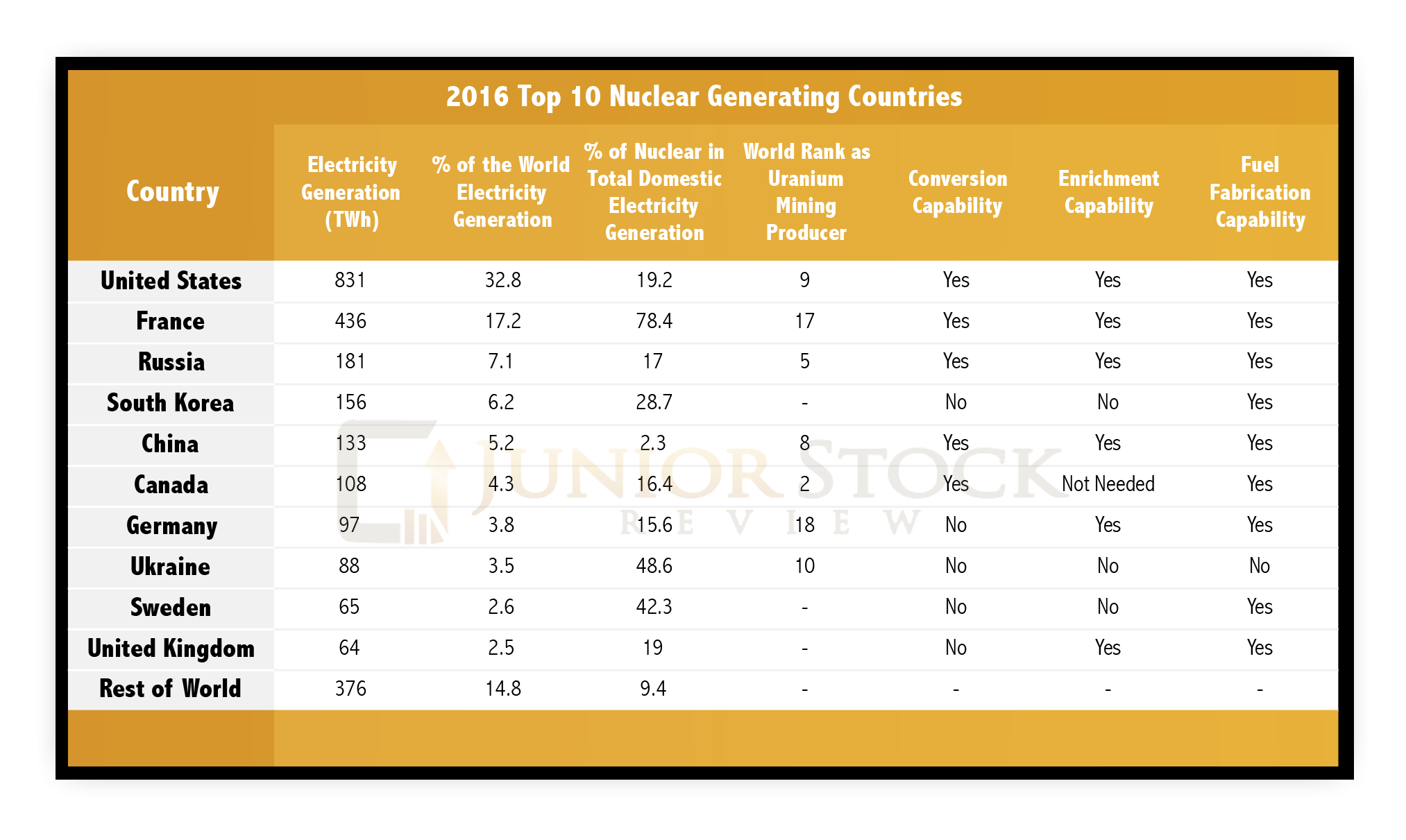 Source: International Energy Agency – 2016 Key World Energy Statistics – pg.17[/caption]
France, in particular, stands out like a sore thumb because it's not only the 2nd largest nuclear power generator, at 436 TWh, but nuclear power accounts for 78% of France’s domestic electricity generation. This is further compounded by France’s dismal uranium producing capability, with a mere 2 tonnes being produced in 2015. Low production forces France to import the vast majority of its U3O8 needs. Using the WISE Uranium Project's Nuclear Fuel Material Balance Calculator, 436 TWh requires roughly 12,1576.74 tonnes of U3O8. So where do the French get their supply?
Areva is the 3rd largest uranium producing company in the world, with 9,368 tonnes of uranium produced in 2015. Areva, however, isn't just a miner, it's involved in all aspects of the nuclear fuel cycle. In addition major shareholder in Areva NP, Electricite De France (EDF), operates the majority of the nuclear power generation plants in France. From a global perspective, France makes up 39% of total company revenues, and 68% of total company employment. More than 85% of Areva’s shares are in French state hands, making it absolutely sensitive to French power generation needs.
Areva’s uranium production comes primarily from Niger, with its world class COMINAK and SOMAIR mines. The COMINAK mine is smaller than SOMAIR, but is the 15th largest uranium producing mine in the world, of which Areva owns 34%.
The SOMAIR Project, on the other hand, is the 5th largest current producing mine in the world, and Areva owns 63.6%. Both mines are located in the northwest region of Niger, near the town of Arlit. The mine was established in 1968, and by the end of 2015, had produced around 63,240 tonnes of uranium. With the mine lives nearing 50 years, SOMAIR and COMINAK could are approaching the end of their production, based on the quoted reserves.
Along with France, China and South Korea are the other standouts for me, from the world’s top 10 nuclear power generating countries, as their uranium needs far outweigh their uranium production figures. With future nuclear plant construction being dominated by these Asian power houses, the current U3O8 surplus will quickly be shifted to these nations.
[caption id="attachment_674" align="aligncenter" width="2026"]
Source: International Energy Agency – 2016 Key World Energy Statistics – pg.17[/caption]
France, in particular, stands out like a sore thumb because it's not only the 2nd largest nuclear power generator, at 436 TWh, but nuclear power accounts for 78% of France’s domestic electricity generation. This is further compounded by France’s dismal uranium producing capability, with a mere 2 tonnes being produced in 2015. Low production forces France to import the vast majority of its U3O8 needs. Using the WISE Uranium Project's Nuclear Fuel Material Balance Calculator, 436 TWh requires roughly 12,1576.74 tonnes of U3O8. So where do the French get their supply?
Areva is the 3rd largest uranium producing company in the world, with 9,368 tonnes of uranium produced in 2015. Areva, however, isn't just a miner, it's involved in all aspects of the nuclear fuel cycle. In addition major shareholder in Areva NP, Electricite De France (EDF), operates the majority of the nuclear power generation plants in France. From a global perspective, France makes up 39% of total company revenues, and 68% of total company employment. More than 85% of Areva’s shares are in French state hands, making it absolutely sensitive to French power generation needs.
Areva’s uranium production comes primarily from Niger, with its world class COMINAK and SOMAIR mines. The COMINAK mine is smaller than SOMAIR, but is the 15th largest uranium producing mine in the world, of which Areva owns 34%.
The SOMAIR Project, on the other hand, is the 5th largest current producing mine in the world, and Areva owns 63.6%. Both mines are located in the northwest region of Niger, near the town of Arlit. The mine was established in 1968, and by the end of 2015, had produced around 63,240 tonnes of uranium. With the mine lives nearing 50 years, SOMAIR and COMINAK could are approaching the end of their production, based on the quoted reserves.
Along with France, China and South Korea are the other standouts for me, from the world’s top 10 nuclear power generating countries, as their uranium needs far outweigh their uranium production figures. With future nuclear plant construction being dominated by these Asian power houses, the current U3O8 surplus will quickly be shifted to these nations.
[caption id="attachment_674" align="aligncenter" width="2026"]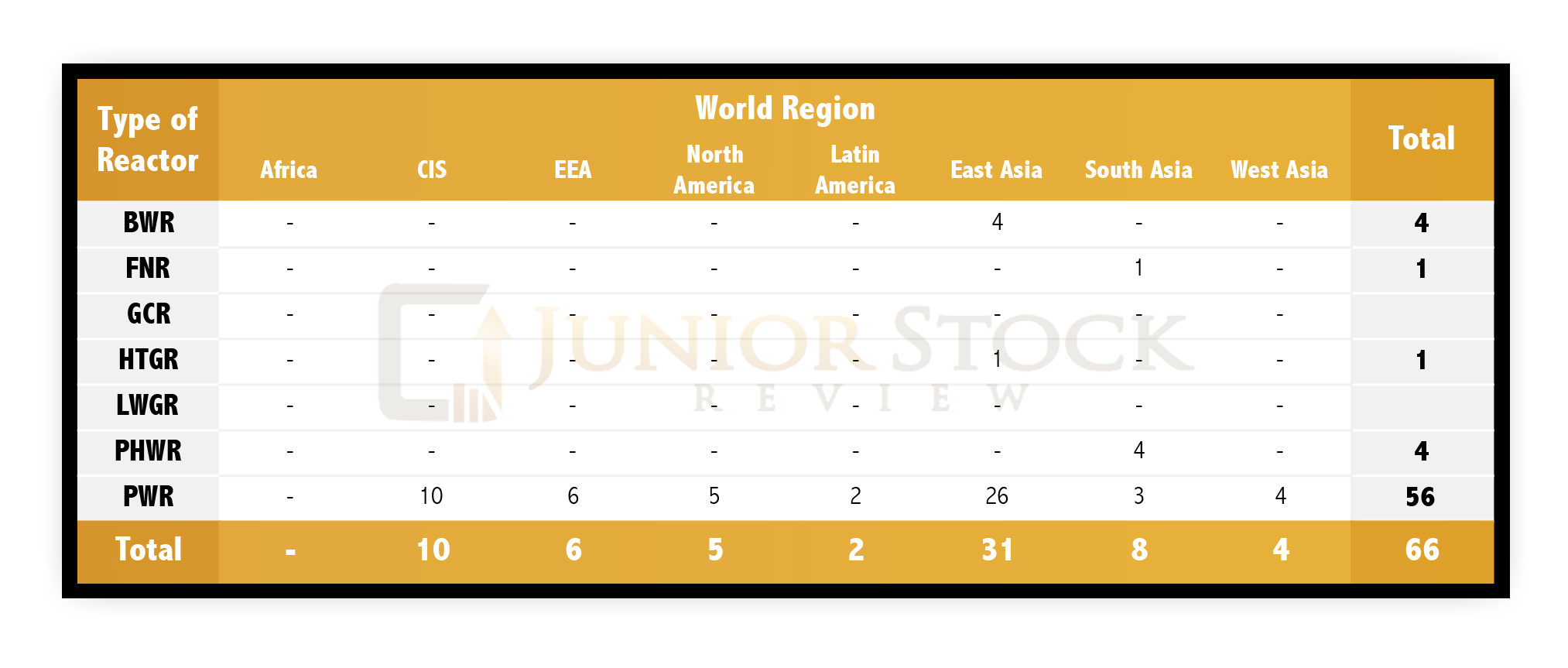 Source: World Nuclear Association- World Nuclear Performance Report 2016 – pg.14[/caption]
In my opinion, a portion of this future uranium demand could be satisfied by GoviEx Uranium.
Source: World Nuclear Association- World Nuclear Performance Report 2016 – pg.14[/caption]
In my opinion, a portion of this future uranium demand could be satisfied by GoviEx Uranium.
Source: International Energy Agency – 2016 Key World Energy Statistics – pg.17[/caption]
France, in particular, stands out like a sore thumb because it's not only the 2nd largest nuclear power generator, at 436 TWh, but nuclear power accounts for 78% of France’s domestic electricity generation. This is further compounded by France’s dismal uranium producing capability, with a mere 2 tonnes being produced in 2015. Low production forces France to import the vast majority of its U3O8 needs. Using the WISE Uranium Project's Nuclear Fuel Material Balance Calculator, 436 TWh requires roughly 12,1576.74 tonnes of U3O8. So where do the French get their supply?
Areva is the 3rd largest uranium producing company in the world, with 9,368 tonnes of uranium produced in 2015. Areva, however, isn't just a miner, it's involved in all aspects of the nuclear fuel cycle. In addition major shareholder in Areva NP, Electricite De France (EDF), operates the majority of the nuclear power generation plants in France. From a global perspective, France makes up 39% of total company revenues, and 68% of total company employment. More than 85% of Areva’s shares are in French state hands, making it absolutely sensitive to French power generation needs.
Areva’s uranium production comes primarily from Niger, with its world class COMINAK and SOMAIR mines. The COMINAK mine is smaller than SOMAIR, but is the 15th largest uranium producing mine in the world, of which Areva owns 34%.
The SOMAIR Project, on the other hand, is the 5th largest current producing mine in the world, and Areva owns 63.6%. Both mines are located in the northwest region of Niger, near the town of Arlit. The mine was established in 1968, and by the end of 2015, had produced around 63,240 tonnes of uranium. With the mine lives nearing 50 years, SOMAIR and COMINAK could are approaching the end of their production, based on the quoted reserves.
Along with France, China and South Korea are the other standouts for me, from the world’s top 10 nuclear power generating countries, as their uranium needs far outweigh their uranium production figures. With future nuclear plant construction being dominated by these Asian power houses, the current U3O8 surplus will quickly be shifted to these nations.
[caption id="attachment_674" align="aligncenter" width="2026"] Source: World Nuclear Association- World Nuclear Performance Report 2016 – pg.14[/caption]
In my opinion, a portion of this future uranium demand could be satisfied by GoviEx Uranium.
The GoviEx Uranium Story
The GoviEx Uranium story is bigger than its flagship Madaouela Project, in Niger. In their June 13, 2016 news release, GoviEx Uranium and Lukas Lundin’s Denison Mines announced that they had completed the transaction to combine their respective African uranium interests. GoviEx Uranium’s deposit portfolio now consists of not only its flagship Madaouela Project, but also the Mutanga Project in Zambia, the Falea Project in Mali, and finally, the Dome Project in Namibia. For this, Denison received 56,050,450 shares and 22,420,180 common share purchase warrants in GoviEx (further details can be found in the press release). This deal makes Denison Mines GoviEx’s largest shareholder, with a 25% stake in the company, and results in GoviEx holding approximately 200Mlb U3O8 in total mineral reseources, and two permitted mines.Investing with Some of the Best
The insider support for GoviEx extends beyond the Lundin Group. Nuclear industry giants, Cameco and Toshiba, own 7% and 11% respectively. Mining legend, Robert Friedland’s Ivanhoe Industries owns 7%. Friedland’s geologist son, Govind, is the founder of GoviEx and holds 12% of shares. In total, roughly 60% of GoviEx is owned by influential corporate and strategic shareholders.Jurisdiction
It's no secret that Africa has seen its fair share of political unrest and overall unpredictability. At first glance, this may seem like a negative for the company, but a portion of the African nations depend almost entirely on their resource exports for the cash their economies so desperately need. In particular, Niger stands out as a mining friendly jurisdiction, with a democratically elected government. In my conversation with GoviEx CEO, Daniel Major, he highlighted this fact when he referred to Niger, where uranium production makes up about 70% of the national exports. For Niger, uranium mining is a business that brings social stability through job creation. Further summarizing my conversation with Major, most West and Central African nations use OHADA business law, making navigation for companies in multiple jurisdictions much easier. In particular, GoviEx benefits by spreading risk across 4 countries that share similar legal systems and histories of mining. As described earlier, the SOMAIR mine has been in operation since 1968, meaning that the Nigerien people have multi-generational experience with this business. As Major points out, the Madaouela Project's onsite work force, at least currently, is totally Nigerien. The need for uranium production exports, and meeting the high international standards on its studies, has allowed GoviEx to acquire mining permits in 6 months, which is unbelievably fast compared to its peers. Mines such as Cigar Lake in Canada’s Athabasca Basin, for instance, have taken several years to acquire the appropriate permitting. Any concerns about terrorist activity in Africa can be at least partially alleviated by the fact that there's military presence, most notably the French, US and German in neighbouring Niger and neighbouring Mali. Also, drawing on one of the points I made earlier, because GoviEx has a 100% local work force, its projects may be considered less of a terrorist target.GoviEx Resources
Beginning with the flagship asset, the Madaouela Project is made up of 5 deposits: Marianne, Marilyn, Miriam, MSNE and Maryvonne. As outlined in the development plan (where you will find further details), the Madaouela Project has approximately 61 million lbs U3O8 of Probable Mineral Reserves. The after-tax NPV, with an 8% discount, is USD $339 million with an IRR of 23.5%, and a long-term uranium price of USD $70 /lbs U3O8. The life of the mine (LoM) is expected to be 21 years, with an annual average production of 2.69 Mlb U3O8. Now, I'm sure most are wondering, how much is this going to cost, and how do you finance a project with a falling uranium price, in Niger? These are the questions I asked Major during our conversation:- How much is this going to cost?
- How do you finance the mine construction, given the uranium price and the jurisdiction?